
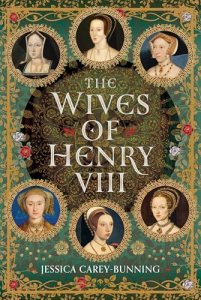
 The wives of Henry VIII have been an area of fascination for history nerds and novices alike for centuries. We all know the stories of Catherine of Aragon, Anne Boleyn, Jane Seymour, Anna of Cleves, Katherine Howard, and Kateryn Parr. However, these stories only offer a glimpse at the lives of these women. They follow the more traditional studies of the Tudor queens, but what happens if we take a more revisionist approach to their lives? What can we learn about these women besides their crowns and who they all married? There is more to their stories, like the minute details that Jessica Carey-Bunning explores in her book, “The Wives of Henry VIII: Rethinking the Stories Behind the Symbols.”
I would like to thank Pen and Sword Books and Net Galley for sending me a copy of this book. I am always looking for a new approach to the Tudor queens. So when I saw that it was a book featuring all six wives with a promised fresh perspective, I decided to give it a chance.
Carey-Bunning has taken a different approach to these six remarkable women. Instead of a biography about their lives, she has chosen to highlight aspects of their lives. We, of course, go in chronological order, starting with Catherine of Aragon. With Catherine, we examine why she was named Catherine and its significance in her family, as well as her finances as the widow of Arthur, and extended through her annulment. We then moved to Anne Boleyn and explored her role in the Chateau Vert pagent as well as her looks, either with the English gable hood or the French hood, and she includes the latest research into what Anne might have looked like. After Anne, we transition to Jane Seymour, to her stance on matters of faith and whether or not she was a popular queen.
Anna of Cleves may have had the shortest reign of all the queens, but it is her education and her faith that Carey-Bunning explores in her section. Katherine Howard also had one of the shortest reigns of any of Henry’s wives, but for different reasons than Anna of Cleves. With Katherine, we explore exactly what kind of influence the young queen had and her connection to her infamous cousin Anne Boleyn. Finally, we examine Kateryn Parr, the 17th century’s fascination with the queen, and the tale of her almost arrest over religious matters.
I found this book refreshing with the new approach to the wives of Henry VIII. I learned new aspects of the queens, which was very nice. Carey-Bunning combined an easy-to-follow writing style with innovative research to give her readers a different way to look at the Tudor wives. If you want to learn something new about the Tudor queens, I think you will enjoy “The Wives of Henry VIII: Rethinking the Stories Behind the Symbols,” by Jessica Carey-Bunning.
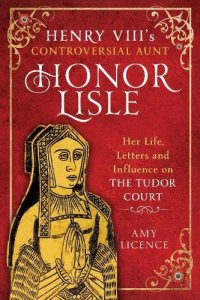 Marrying into the royal family is not all sunshine and rainbows. Of course, we tend to think about those who marry the king, the queen, the prince, or the princess. But we also need to consider the aunts and the uncles of the royals as part of the family. Take, for example, Arthur Plantagenet, the illegitimate son of Edward IV and the uncle of Henry VIII. His second wife, Honor Lisle, would help him rule Calais; however, she is best known for her letters and her devout Catholic faith during the Reformation in England. So why is Honor Lisle considered a controversial figure, and what was the cause of the fall of Honor and Arthur from the royal good graces? Amy Licence explores the life of Henry VIII’s step-aunt in the first full biography dedicated to Honor Lisle, which is entitled “Henry VIII’s Controversial Aunt, Honor Lisle: Her Life, Letters, and Influence on the Tudor Court.”
 The Great Matter was a defining event in the lives of King Henry VIII, Catherine of Aragon, and Anne Boleyn. One of the world’s messiest divorces, it saw Henry VIII trying everything in his bag of tricks to annul his marriage to Catherine of Aragon to marry his new infatuation, Anne Boleyn. While we know that the basis for his argument that he should be able to divorce Catherine comes from the book of Leviticus in the Bible, we often see Henry’s debate through the Catholic and Protestant lenses. However, Henry relied on another group of people who had not been on English soil for centuries, the Jews. What does Jewish law bring to the discussion of the Great Matter and did it help Henry? Jerry Rabow examines this often overlooked aspect of Henry’s road to divorce in his book, “Henry VIII and His Rabbis: How the King Relied on Jewish Law to End His First Marriage- and Why He Failed.”
 In an age when most women of power did not have much power outside their own countries, one stood higher than most. She was not even supposed to become queen, but fate had a bigger mission for the young woman: rescue Christianity from dying out. As a ruler, this seems like a monumental task to complete especially when their enemies were the Ottoman Empire and the Turks at the height of the power. There was one woman who was up to the challenge while fighting to reclaim Spain for the Christians, exploring the new world, and dealing with her family drama. Isabella of Castile is either viewed as a saintly queen or a horrible woman ruler, but what do the archives tell us about her reign? Kirstin Downey tells the story of this revolutionary queen in her biography, “Isabella: The Warrior Queen.”
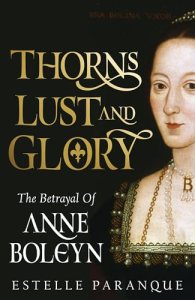 A young woman catches the attention of a king already married to a princess from a faraway kingdom. The king desires the young lady and divorces his wife to marry her. However, there is a catch. The young lady spent some time in the French court of Francis I and Claude of France, whereas the king’s wife was the daughter of the Spanish King and Queen as well as the aunt of the Holy Roman Emperor. The Great Matter of Henry VIII, Anne Boleyn, and Catherine of Aragon is considered one of the messiest divorces in English history and rightfully so when you consider the diplomatic consequences that this divorce would have across Europe. Estelle Paranque highlights the connection between Anne Boleyn and the French court in her latest book, “Thorns, Lust, and Glory: The Betrayal of Anne Boleyn.”
 Marriage has been an integral part of life for centuries. It has been used to create strong alliances and cement love matches. However, once the wedding ceremony is finalized, the facade often fades and the truth about the families is revealed. Jane Parker finally marries the love of her life, George Boleyn, but she soon realizes that her new family is full of ambition, especially her new sister-in-law Anne Boleyn. As one of the greatest marriages of the 16th century is beginning to fall apart, can a new romance be waiting in the wing to rock England and all of Europe to its core and whose side will Jane join in the end? Danielle Marchant continues her exploration of Jane Parker Boleyn, Lady Rochford’s life in her novel, “The Lady Rochford Saga Part 2: Tourmens de Mariage.”
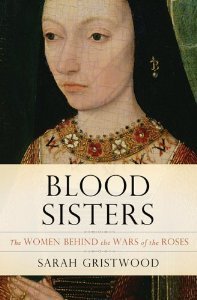 When it comes to studying wars from the past, we often focus on the men who fought during the battles the strategies that were implemented to win and the plans that backfired spectacularly. So frequently in the study of wars, we forget about the women left behind, but in fact, they had bigger roles to play than sitting on the sidelines. For example, the royal women who lived in England during the conflict known as the Wars of the Roses played an essential role in how the wars concluded. These women are slowly coming into the spotlight in biographies and historical fiction novels, but it is rare to read a book about the Wars of the Roses where the central figures are the women, until now. Sarah Gristwood has taken seven women from this age and weaved their stories into her book, “Blood Sisters: The Women Behind the Wars of the Roses.”
 The tragedies of the Boleyns and the Howards left many with scars and heartache, none more so than Jane Parker. The daughter of Henry Parker, Lord Morley, Jane is seen to be destined for a great marriage and a successful career at court. As one of the ladies to serve Queen Catherine of Aragon, Jane witnesses the splendor, glam, and intrigue needed to survive in the court of Henry VIII. Danielle Marchant has taken inspiration from what she has studied about Jane Parker to create “The Lady Rochford Saga- Part 1: Into the Ranks of the Deceived.”
 Two women destined to be rivals for one man’s affection. One is the daughter of royalty, destined to become Queen of England since she was a baby. Her first husband died suddenly, and she married her brother-in-law, the young King Henry VIII. The other woman is the daughter of a family on the rise at court. She has been educated in courts abroad but has returned to her native England to serve the Queen of England, but King Henry VIII falls in love with this young woman. Catherine of Aragon and Anne Boleyn; are two women destined to be rivals, but a new museum exhibit uncovers these women’s similarities. In this corresponding book, “Catherine and Anne: Queens, Rivals, Mothers,” Owen Emmerson, Kate McCaffrey, and Alison Palmer share the latest academic research to understand better these two queens who dominated the 16th century.
 Adventures of a Tudor Nerd