
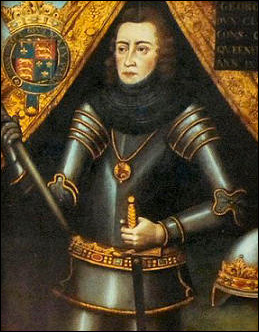
Biography: George Plantagenet 1st Duke of Clarence

georgeclarence(Born October 21, 1449- Died February 18, 1478). Son of Richard Plantagenet, 3rd Duke of York and Cecily Neville, Duchess of York. Married to Isabel Neville, Duchess of Clarence.
Father of Anne of York, Lady Margaret Pole, Countess of Salisbury, Edward Plantagenet, 17th Earl of Warwick, Richard of York. George was a young man who believed that he would be a better king than his brother Edward IV. He revolted a few times and it led to his death by an unusual means.

George Plantagenet was born on October 21, 1449 to Richard Plantagenet, 3rd Duke of York and Cecily Neville, Duchess of York. His father died at the battle of Wakefield on December 30, 1460 and in March 1461, his brother became King Edward IV. George was created the 1st Duke of Clarence and a Knight of the Garter by his brother and the following year, he received the Honour of Richmond and was created lord-lieutenant of Ireland.

When George was named as a possible suitor for Mary, the daughter of Charles the Bold, later the Duke of Burgundy, he would enter into the influence of Richard Neville, 16th Earl of Warwick. Warwick, also known as “the kingmaker”, helped Edward IV become king but when Edward married Elizabeth Woodville instead of Bona of Savoy, which would have established an alliance with France, Warwick and Edward were not as close as they once were. Warwick decided to get back at Edward and in July 1469, George married Warwick’s daughter Isabel (or Isabella), which was a marriage that Edward did not support at all.

Warwick then started a series of uprisings in northern England; Edward was a popular king but his marriage with Elizabeth Woodville sullied his image a little while Warwick was seen as a national hero. Edward did employ an army, but when he saw that he was outnumbered, he dispersed his army and allowed himself to be captured by Warwick. Warwick had Edward imprisoned in the Tower, but when his reputation began to suffer, he released Edward in October 1469. Warwick and George both decided to reconciled with Edward but Edward never truly trusted either of them ever again.

George was loyal to his brother, but when Warwick deserted Edward and fled to France, George went with his father in law. On the way to France, Isabel gave birth to their first child, a girl, on 16 April 1470, in a ship off Calais. The child would not survive. Warwick joined forces with Margaret of Anjou and Louis XI of France to restore Henry VI to the throne. In September 1470, Warwick and his rebellion made its way to England. Warwick removed Henry VI from the Tower and restored him to the throne.

Henry VI rewarded George by making him next in line to the throne after his own son, removing Edward IV from the line of succession completely. Warwick had his younger daughter, Anne Neville, George’s sister-in-law, marry Henry VI’s son in December 1470. This obviously infuriated George since this meant that Warwick had no desire of making George the next king and so George secretly reconciled with his brother.

Warwick made a mistake and decided to take Louis XI’s advice and declare war on Burgundy. This forced the duke of Burgundy, who had stayed on the sidelines this entire time, to help Edward IV raise an army. Edward returned to England on March 11, 1471. His army defeated Warwick’s army at the Battle of Barnet in April 1471, where Warwick was killed. After Warwick’s death in April 1471 Clarence appears to have seized a vast sum of the estates Warwick owned. George did not gain all of Warwick’s properties as his younger brother Richard Duke of Gloucester married the widow Anne Neville. In March 1472 was created by right of his wife Earl of Warwick and Salisbury. A quarrel between George and Richard ensued, and in 1474 the king interfered to settle the dispute, dividing the Warwick estates between his brothers.

In 1475 George ‘s wife Isabel gave birth to a son, Edward, later Earl of Warwick. Isabel died on December 22, 1476, two months after giving birth to a short-lived son named Richard. Though it is believed that Isabel died of either consumption or childbed fever , George was convinced she had been poisoned by one of her ladies-in-waiting, Ankarette Twynyho, whom, as a consequence, he had judicially murdered in April 1477 right after her trial. The same year, George was eligible for Mary Duchess of Burgundy’s hand, but when Edward refused the marriage suit, George left court.

Edward was convinced that George was aiming at his throne after three of George’s men were tried for treason and were executed. George was thrown into prison, and in January 1478 the king unfolded the charges against his brother to the parliament. He had slandered the king; had received oaths of allegiance to himself and his heirs and had prepared for a new rebellion. Both Houses of Parliament passed the bill of attainder, and the sentence of death was announced. It is said that Edward gave his brother a choice on how he would die and George said that he would like to be drowned in a butt of Malmsey wine. What we do know is that George Duke of Clarence was executed in private either on February 17th or 18th 1478. Two of his children would outlive him: Edward earl of Warwick, who was executed in 1499, and Margaret Pole Countess of Salisbury.
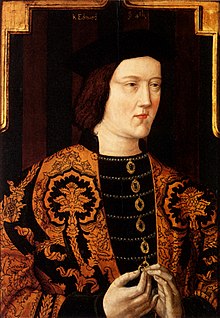
Biography: King Edward IV

220px-Edward_IV_Plantagenet(Born April 28, 1442- Died April 9, 1483). Son of Richard, 3rd  Duke of York and Cecily Neville. Married to Elizabeth Woodville. Father of Elizabeth of York, Mary of York, Cecily of York, Edward V of England, Margaret of York, Richard of Shrewsbury, 1st Duke of York, Anne of York, George Plantagenet, 1st Duke of Bedford, Catherine of York, and Bridget of York. Edward IV was the first king from the house of York, but he was still a Plantagenet. He helped bring the country together, especially financially, but his one flaw was his private life, where he was unwise and naive. 

Edward IV was born on April 28, 1442 to Richard, 3rd Duke of York and Cecily Neville, and was given the title of the Earl of March. Richard Duke of York, Edward’s father, was the Lord Protector when Henry VI had his bouts of mental illness, but once the king got well, York was removed from the position and his reforms were reversed. One of his biggest rivals was  Edmund Beaufort, Duke of Somerset. In 1455, York had enough of Somerset and marched against him at the First Battle of St. Albans, where Somerset was killed. It was then that Margaret of Anjou took up her husband’s cause. She encouraged the new duke of Somerset Henry Beaufort to fight against York. The battlelines were being drawn. The Yorkists were led by Richard duke of York, Richard Neville earl of Salisbury and his son Richard Neville earl of Warwick. The Lancastrians were under Henry VI, but led by Margaret of Anjou, Somerset, and Henry Percy, third earl of Northumberland. In 1459, at the battle of Ludlow, the Lancastrians won and sent the Yorkists into hiding; however the Yorkists came back with a vengeance at the battle of Northampton.

In 1460 York officially declared his claim to the throne. After much discussion, it was agreed that after the king died, York and his sons would be the heirs to the throne, removing Edward of Westminster from the line of succession. Henry VI seemed to have been okay with this arrangement, but Margaret was beyond upset. She led the Lancastrian forces to face off against York at the battle of Wakefield on December 30, 1460. York and his son Edmund, Earl of Rutland, were killed in the battle. Edward was 18 at the time of his father’s death.

Edward was now in charge of the Yorkist faction and with the help of Richard Neville, the earl of Warwick, he was able to defeat the Lancastrian army at both the battle of Mortimer’s Cross and the Second Battle of St. Albans in February 1461. On March 4, 1461, Edward declared himself king of England, a move that his father never attempted to make. Three weeks later at the Battle of Towton on March 29, 1461, the bloodiest battle on English soil, Edward was able to decisively beat Henry VI’s forces and secure his claim to the throne. Henry VI and Margaret of Anjou fled to Scotland to seek the aid of James III.

Edward was declared Edward IV. He was welcomed to the throne. His focus was to rule wisely and gain the support of the nobles by limiting the policy of court favorites and placed the control of Crown lands under court officials. He wanted to make sure that his court was politically and financially sound. Edward owed a lot to his cousin Richard Neville, Duke of Warwick, also known as “the Kingmaker”, and he rewarded him greatly. He was made the Chamberlain of England and he was considered the second most powerful man in England. Warwick’s son John Neville was made earl of Northumberland after the battle of Hexham in May 1464, a hereditary title that belonged to the Percy family.  

Warwick and Edward were considered close. However that would change very quickly. Warwick knew that Edward would have to marry well and so under his own initiative, he set to secure an alliance with the French King Louis XI by marrying Edward IV to the French king’s daughter Bona of Savoy. Edward wasn’t really thrilled about an alliance with France; he had actually prefered an alliance with Burgundy. Edward decided to take the issue of  his marriage into his own hands. In May 1464, he secretly married Elizabeth Woodville, the daughter of the 1st Lord of Rivers and Jacquetta Rivers, and the widow of Sir John Grey. They were able to keep the marriage a secret for over four months and when it was announced, there was an uproar. Her family was always supporters of the Lancastrian cause and there was a rumor, that we cannot confirm or deny as of right now, that Edward entered into a similar marriage contract with Lady Eleanor Butler a year or two before he married Elizabeth.

Warwick was obviously the most upset about this marriage because he had spent so much time setting up an alliance  with France to be thwarted. With the rise of the Woodvilles, Warwick feared that they would overthrow his title of the second most powerful man in England. Edward thwarted Warwick’s plans to marry his family with the king’s and the final straw for Warwick was when Edward married his sister Margaret to Charles duke of Burgundy, cementing an alliance between England and Burgundy, which was not what Warwick wanted. Warwick realized that the gap between him and Edward was too large.

Warwick decided to side with Edward’s power hungry younger brother George Duke of Clarence, and Louis XI of France, who promised Warwick land in France if he overthrew Edward. Warwick’s plan was to depose Edward and  place George on the throne. In July 1469, Warwick successfully married George to his daughter Isabel, which was something that Edward did not approve of. Warwick then started a series of uprisings in northern England; Edward was a popular king but his marriage with Elizabeth Woodville sullied his image a little while Warwick was seen as a national hero. Edward did employ an army, but when he saw that he was outnumbered, he dispersed his army and allowed himself to be captured by Warwick. Warwick had Edward imprisoned in the Tower, but when his reputation began to suffer, he released Edward in October 1469. Warwick and George both  decided to reconciled with Edward but Edward never truly trusted either of them ever again.

Warwick knew that if he was going to restore his power, he had to discuss matters with Louis XI and Margaret of Anjou, which meant that he had to defect to the Lancastrian cause, which he did. In September 1470, Warwick and his rebellion made its way to England. John Neville switched sides, which left Edward unprepared and it forced him to leave England on October 2 and seek aid from his brother in law the duke of Burgundy. Warwick removed Henry VI from the Tower and restored him to the throne. Warwick made a mistake and decided to take Louis XI’s advice and declare war on Burgundy. This forced the duke of Burgundy, who had stayed on the sidelines this entire time, to help Edward IV raise an army. Edward returned to England on March 11, 1471. His army defeated Warwick’s army at the Battle of Barnet, where Warwick and John Neville were killed. On May 4, 1471, Edward faced off against the Lancastrian army at the Battle of Tewkesbury, where the Lancastrians were finally defeated and Edward of Westminster was killed. Margaret of Anjou was arrested and shortly afterward, King Henry VI died, possibly murdered under the orders of Edward IV.

Edward IV’s purpose on the second part of his reign was to work on establishing strong alliances, which he did with the dukes of Brittany and Burgundy, and the king of Aragon. In July 1475, Edward decided that he was going to try to recapture the English lands in France. His brothers George and Richard supported this idea, however this ended in disaster and Edward was forced to sign a peace treaty with Louis. George viewed this as a horrible defeat and so he plotted to remove his brother from the throne yet again. This was the last straw for Edward and he had George arrested and tried for treason. George was found guilty and was executed in February 1478; if the story about his execution is correct, he drowned in a butt of Malmsey wine.

Edward was a great supporter of the arts and was the primary patron of printing. He encouraged William Caxton to pursue his goal of printing the first book in England in November 1477. Edward also financed  major building jobs at Windsor Castle and Eltham Palace in Kent. Towards the end of his life, Edward fell ill, and on April 9, 1483, he died from either pneumonia or typhoid. He was just 40 years old and he left the throne to his son Edward V.

Biography: Richard Duke of York

richarddukeofyork-243x300Also known as Richard Plantagenet. (Born September 21, 1411- Died December 30, 1460). Son of Richard Earl of Cambridge and Anne Mortimer. Married to Cecily Neville. Father of Anne, Duchess of Exeter, Edward IV, King of England, Edmund, Earl of Rutland, Elizabeth, Duchess of Suffolk, Margaret, Duchess of Burgundy, George, Duke of Clarence, and Richard III, King of England. Richard Duke of York was the one who became Lord Protector to Henry VI, but when he didn’t get the respect he thought he deserved, challenged the king and claimed that he should be king, and started the Wars of the Roses.

Richard of York was born on 21 September 1411. He was the son of Richard, 3rd Earl of Cambridge, by his wife Anne de Mortimer, the daughter of Roger Mortimer, 4th Earl of March. Anne Mortimer was the great-granddaughter of Lionel, Duke of Clarence, the second surviving son of King Edward III. After the death in 1425 of Anne’s brother Edmund, the 5th Earl of March, this supplied Richard, of the House of York, with a claim to the English throne that was, under English law, arguably superior to that of the reigning House of Lancaster, descended from John of Gaunt, the third son of King Edward III. On his father’s side, Richard had a claim to the throne in a direct male line of descent from his grandfather Edmund, 1st Duke of York, fourth surviving son of King Edward III and founder of the House of York. Richard’s claim through his mother made him more eligible to be king than Henry VI, thus he adopted the last name “Plantagenet” in 1448 to mark his claim to the throne.

Richard’s mother is said to have died giving birth to him and his father was executed  in 1415 for his part in the Southampton plot that tried to remove Henry V from the throne and replace him with Edmund Mortimer. His father’s titles were forfeited, but not attainted, which meant that Richard at 4 years old, became his father’s heir. A few months later, Richard’s uncle Edward of Norwich, 2nd Duke of York, was slain at the Battle of Agincourt on October 25, 1415. Henry V decided to give the lands of the Duchy of York to Richard.

Richard was an orphan and he was considered property of the crown. His wardship was a very valued gift of the crown and it was granted to Ralph Neville, 1st Earl of Westmorland. Ralph Neville had a large family, 20 children who survived infancy,  with many daughters who needed husbands, so in 1424, Neville betrothed Richard to his daughter Cecily Neville. On February 2, 1425, Richard was created Duke of York, after his uncle Edmund Mortimer died. In October 1425, Ralph Neville died and his widow Joan Beaufort was given the wardship of Richard, which was even more valuable since Richard was now the Duke of York. On May 19, 1426 he was knighted at St Mary de Castro in Leicester by John, Duke of Bedford, the younger brother of King Henry V. In October 1429 or earlier, Richard and Cecily were married. York was there for Henry VI’s coronation on November 6, 1430 and he was also at Henry VI’s coronation in France when he became king of France on December 16, 1431. Finally, on May 12, 1432, York was finally given full control over his estates.

York was loyal to Henry VI and the Lancasters in the beginning. He worked with John Duke of Bedford, who was the English regent in France. Bedford died in 1435 and York took on the responsibility of being governor of France and Normandy from 1436 to 1437 and 1440 to 1445. At this time, York  was neutral in politics, but he seemed to have sided with Humphrey Duke of Gloucester in the idea of continuing the war with France. York wanted to apart of Henry VI’s council, but he was not allowed. On his return to England in 1450 York was seen as the opponent of the Duke of Somerset. He was as popular as Somerset was not and York had powerful allies in the Nevilles. In 1451, there was a claim in Parliament that York should be the next heir to the throne because the king did not have a son. This claim was not taken seriously and the one who proposed this was imprisoned.  

In 1452, York declared that he wanted to be the next heir to the throne so he summoned an army to march on London. It didn’t go well and York was placed on house arrest for two weeks and then he was forced to give an oath of allegiance to the king and promised that if he did want to pursue his claim, he would do it in a legal manner.

In the summer of 1453, York had lost all hope of becoming king and changing the government for the better as Margaret of Anjou became pregnant and the king’s half brother Edmund Tudor married Margaret Beaufort. Then in August of 1453, Henry VI had his first bout with mental illness reared its ugly head. He heard about the Battle of Castillon in Gascony, which ended the English hopes of winning the Hundred Years’ War, sending him into an unresponsive state. The Council decided to elect York as Lord Protector and one of the first things he did was to have Somerset arrested and placed in the Tower. In October of the same year, the son of Henry VI and Margaret of Anjou, Edward of Westminster Prince of Wales, was born dashing York’s chances of becoming the heir by peaceful means. York remained Lord Protector until 1455 when Henry VI recovered. Henry VI released Somerset and basically reversed every decision that York had made while he was Protector. This was the last straw for York.

York and his Neville allies, including Richard Neville, Duke of Warwick, marched to St. Albans where they faced off against Somerset and the Lancastrian forces that supported the king. Somerset was killed during the  First Battle of St Albans on May 22, 1455, and shortly after, the king had another bout of mental illness. York was declared Lord Protector yet again, but was removed from his post when the king recovered in 1456, but the king had accepted York and the Nevilles as an important part of the government. This reconciliation would not last long.

It was then that Margaret of Anjou took up her husband’s cause. She encouraged the new duke of Somerset Henry Beaufort to fight against York. The battlelines were being drawn. The Yorkists were led by Richard duke of York, Richard Neville earl of Salisbury and his son Richard Neville earl of Warwick. The Lancastrians were under Henry VI, but led by Margaret of Anjou, Somerset, and Henry Percy, third earl of Northumberland. In 1459, at the battle of Ludlow, the Lancastrians won and sent the Yorkists into hiding; however the Yorkists came back with a vengeance at the battle of Northampton.

In 1460 York officially declared his claim to the throne. After much discussion, it was agreed that after the king died, York and his sons would be the heirs to the throne, removing Edward of Westminster from the line of succession. Henry VI seemed to have been okay with this arrangement, but Margaret was beyond upset. She led the Lancastrian forces to face off against York at the battle of Wakefield on December 30, 1460. York and his son Edmund, Earl of Rutland, were killed in the battle. York was beheaded, his head was put on a spike wearing a paper crown and was displayed over Micklegate Bar at York.