
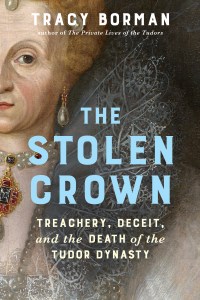
 It is March 1603, and the Virgin Queen is dying. She has no children to inherit her throne directly, so she must choose a successor. She chooses the son of Mary Queen of Scots, the queen who had been executed a few years before. James VI of Scotland will become James I of England, but was it as easy as William Camden makes it in his account? What does a recent discovery about Camden’s original manuscript of Annales tell us about James’ succession to the throne of England? Tracy explores the messy conflict to find an heir to the English throne in her latest book, “The Stolen Crown: Treachery, Deceit and the Death of the Tudor Dynasty.”
I would like to thank Grove Atlantic and Net Galley for sending me a copy of this book. I have been a fan of Tracy Borman’s books for a few years now because of how she is able to present new information about stories from the past that I already know and give them a fresh look. When I heard that James might have stolen the crown from Elizabeth I, that thought intrigued me so much that I knew I wanted to read this book.
So how did the Stuarts come into power, and why did Elizabeth have James as her successor? To understand that question, we have to explore briefly the origins of the Tudor dynasty and how Elizabeth I came to the throne. After we are firmly established in the reign of Elizabeth I, Borman goes through why Elizabeth needed to elect a successor and the nominees. Those up for Elizabeth’s throne were: James VI, Arbella Stuart, Lady Katherine Grey, Mary Grey, and Henry Hastings, Earl of Huntingdon. We get to see how Elizabeth handled each of her potential choices as the next ruler of England, but the two that are highlighted significantly in this book are Arbella Stuart, the daughter of Charles Stuart, 5th Earl of Lennox, and Elizabeth Cavendish, and the man who would become King James VI of Scotland.
Borman shows her readers the complex relationship between Elizabeth and James, a tumultuous relationship, especially after the death of James’ mother, Mary Queen of Scots. It was not the most cordial relationship that has been shown in history, including the Annales written by William Camden. However, due to extraordinary research that was revealed in 2023, it was shown that Camden’s writing had serious revisions to paint James in a better light during the fight for succession. In fact, there were attempts on Elizabeth’s life that James knew about, including one incident where he might have been directly involved. Just because James became King of England after Elizabeth’s death does not mean that he had an easier time in England. In fact, the Stuarts lasted less than a hundred years before the monarchy was dissolved with the execution of James’s son Charles I in 1649.
This is another spectacular book by Borman, one that changed how I viewed the relationship between Elizabeth and James in the final years. It reads like a political thriller and offers a deeper appreciation for Elizabeth’s fight for the English throne, while also highlighting how the Stuarts employed similar tactics to the Tudors in securing their right to rule England. Suppose you want an extremely well-researched book that provides great insight into the end of Elizabeth’s reign and provides new information about this period. In that case, I highly recommend you read “The Stolen Crown: Treachery, Deceit and the Death of the Tudor Dynasty” by Tracy Borman.
 We all know the story of the last Tudor monarch, Queen Elizabeth I, who often viewed herself as a female king and who remained a virgin for her entire life. With her death, the Tudor dynasty ended, and a brand new dynasty made its mark on English history. It was a dynasty in England that the son of Elizabeth started I’s rival, Mary Queen of Scots, King James VI of Scotland. King James was not just a king, but a man in love with numerous lovers, and when he fell in love, he fell hard. Gareth Russell explores the life of King James VI/I, who ruled two nations while searching for true love in his latest book, “Queen James: A New History About the Life and Loves of Britain’s First King, James Stuart.”
 Throughout history, many civil wars have altered the course of the history of the countries where they occurred. While we think about the American Civil War, the French Revolution, and the Wars of the Roses, another civil war often overlooked outside of England is the English Civil Wars. A series of conflicts between the Parliamentarians and the Royalists led to the execution of King Charles I and the rise of the English Republic under Oliver Cromwell. We often view the conflict from either Charles’ or Oliver’s perspective, but we have to consider the family that Charles left behind. How did the English Civil Wars mold the children of Charles I and his Catholic Queen Henrietta Maria? Linda Porter explores the lives of the royal children in her book, “Royal Renegades: The Children of Charles I and the English Civil Wars.”
 English royal history is filled with fantastic stories of triumphs and tribulations, grand romances, and divorces that shook the foundations of the monarchy. It is also filled with struggles over religion, wars both inside England and with foreign nations, and heartbreaking child losses. We often think about the spouses of the Plantagenets and the Tudors when we think about royal romances, but we shouldn’t forget about the dynasties that came after, like the Stuarts. So how did the Stuart dynasty come to be and how did the unions between monarchs and their significant others affect the dynasty and England? Heather R. Darsie explores this often-overlooked dynasty and the stories of their marriages and romances in her latest book, “Stuart Spouses: A Compendium of Consorts from James I of Scotland to Queen Anne of Great Britain.”
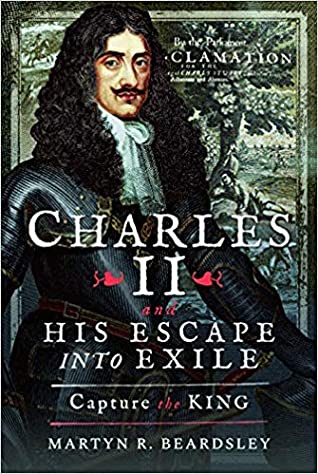 On January 30, 1649, the Stuart monarchy took a major hit when Charles I was tried and executed by the Rump Parliament, making way for the Commonwealth of England to take control. His eldest son, Charles II, fled England leaving the control of the country in the hands of Oliver Cromwell. Two years later, in 1651, Charles tried to make his triumphant return to restore the monarchy. However, it failed miserably at the Battle of Worcester on September 3, 1651; Charles II was able to escape with the help of those loyal to the crown. The story of his escape from Cromwell’s men and his exile in Europe are told in Martyn R. Beardsley’s book, “Charles II and His Escape into Exile: Capture the King.”
 Adventures of a Tudor Nerd