
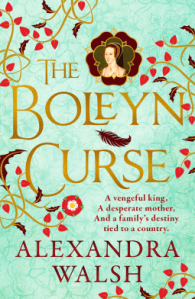
 The court of Henry VIII was a treacherous place for anyone, but especially for the Boleyn family. We all know the stories of Anne, Mary, George, and Thomas, but one figure from this illustrious family does not get enough attention: Elizabeth Boleyn, the mother of Anne, Mary, and George. What was her relationship like with her family, her husband, and most importantly, King Henry VIII? And what does a Chaucer manuscript recently discovered at Cerensthorpe Abbey have to do with Elizabeth and the Boleyns? Alxandra Walsh explores the life of Elizabeth Boleyn and the mystery of the missing Chaucer in her latest dual-timeline novel, “The Boleyn Curse.”
I would like to thank Boldwood Books and Net Galley for sending me a copy of this novel. I enjoy a good dual-timeline novel, and when I saw that this one also featured Elizabeth Boleyn as the main character, I was intrigued. Elizabeth Boleyn has not been the focus of novels of the Boleyn family that I have read, so I was interested to see how her story would translate into historical fiction.
Since this is a dual timeline novel, there are two main timelines. We get to explore the Tudor period with Elizabeth Boleyn and the modern day with Tabitha Mundy, the archivist of Cerensthorpe Abbey. We begin with the modern storyline and Tabitha, who is employed by the owner of Cerensthorpe Abbey, Edith Swanne, to archive the entire estate. Tabitha is dealing with the death of her husband, Blake, when she meets Edith’s nephew and heir to the estate, Gulliver. Edith gives Tabitha the task of finding a missing Chaucer manuscript by decoding clues left behind in a journal from the 1900s. The journey to the missing manuscript holds a connection to Elizabeth Boleyn and the curse upon the family.
We also jump back to the life of Elizabeth Boleyn, who was Elizabeth Howard when the audience is introduced to her in 1485. Her father was arrested by the new King Henry VII for supporting King Richard III, but eventually the family rebuilt their reputation. Elizabeth falls in love with Thomas Boleyn and joins the glittery court of King Henry VIII, where she catches the eye of Henry VIII himself. Elizabeth fights for her family and the love of her husband, even if it means making an enemy of the crown itself.
I think this was a decent novel, even though it explored my least favorite rumor about the Boleyn family. I also thought the diary entries were a bit distracting from the rest of the narratives, a case of too many stories going on at once. Overall, I did enjoy this book. If you want a novel that is a dual timeline or a novel that features Elizabeth Boleyn, you should check out “The Boleyn Curse” by Alexandra Walsh.
 When we think about love, we have ideas about how people fall in love through dating and wooing one another. Sweet words and gestures. Flowers and chocolate. Dates at fun venues and romantic dinners. This is a more modern interpretation of romance and love, which was vastly different than the concept of courtly love that was common in royal circles in medieval Europe. What exactly was courtly love, and how did it play a role in the Tudor dynasty? Sarah Gristwood explores this topic in her latest nonfiction book, “The Tudors in Love: The Courtly Code Behind the Last Medieval Dynasty.”
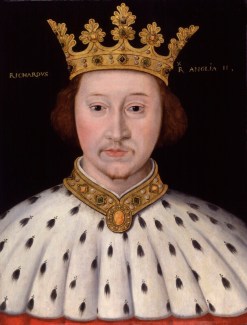 (Born January 6, 1367- Died on or about February 14, 1400).
  When we think of knights, we often think of shining armor, King Arthur and his fabulous court, fair maidens, and of course chivalry. These are considered to be literary ideals, almost too fantastic to be real. However, knights did live in the Middle Ages into the 14th century where some of the greatest knights lived. One is known as The Black Prince; the other was John of Gaunt. Both were brothers, sons of Edward III, the one who helped launch the Hundred Years’ War with France. The Black Prince might have a pretty cool nickname, but the one who really stole the show was John of Gaunt. The subject of Norman F. Cantor’s book “The Last Knight: The Twilight of the Middle Ages and the Birth of the Modern Era” is none other than the third son of Edward III, John of Gaunt.
 Adventures of a Tudor Nerd