
 When we think about the Tudor dynasty, we often think about the famous men and women who defined the era. An era full of change in all aspects of life, from religious and political, to the arts and literature. Throughout these changes, we tend to focus on how they affected the lives of Tudor men, but there is a growing field of interest in the lives of the average Tudor women and how their lives were affected. In her latest book, “Women’s Lives in the Tudor Era,” Amy McElroy explores women’s life stages in 16th-century England and how their roles changed.
I want to thank Pen and Sword Books and Net Galley for sending me a copy of this book. I enjoyed McElroy’s debut book, “Educating the Tudors,” and when I heard that she had another book about Tudor women, I knew I wanted to read it.
McElroy explains that like the centuries before and since the 16th century, it was riddled with negative views of women in all aspects of life. Women were seen as beneath men, which corresponded with the teachings of Aristotle. Wives, mothers, and daughters were supposed to be obedient and seen rather than heard. However, when we look at the different stages of life, we cannot separate the roles of women from everyday life.
To understand what it meant to be a Tudor woman, McElroy breaks down life into different stages, starting in childhood, going through adolescence, becoming a wife and mother, working life for women, how women relaxed, embracing widowhood, and finally, wills and death. Each stage of life is represented in a chapter in this book. McElroy takes the time to explore what it meant to be a woman at each stage of life and how their social standings changed. We see women receiving an education, going through courtships, getting married and becoming wives, starting their own families and the dangers of childbirth, how women earned a living, what they would do as recreational activities, and how they would survive if their husbands died. In each chapter, McElroy highlights women of different social statuses to show how they survived during the Tudor time.
This was an engrossing and utterly fascinating book. Some elements were completely new information for me, which was quite thrilling. The amount of details that McElroy included in such a short amount of pages was incredible. Another brilliant book by McElroy. If you want a fascinating glimpse into the lives of Tudor women, I highly recommend you read, “Women’s Lives in the Tudor Era” by Amy McElroy.
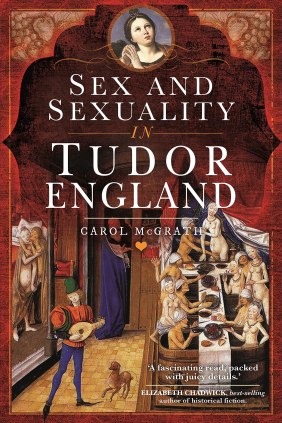 The study of the Tudor dynasty has led us on many different adventures throughout the centuries. We have analyzed this period from numerous angles, from the royals and nobles to the essential lives of those who lived in England during this time. We tend to leave the more intimate moments for historical fiction novels and dramas, but one must wonder what those moments might have been like for those who lived in Tudor England. What were the romantic and the more intimate moments like for the Tudors? In her book, “Sex and Sexuality in Tudor England,” Carol McGrath gives her readers an in-depth look at these private moments.
 Adventures of a Tudor Nerd