
 When we think about significant law documents from medieval England, we think about the Doomsday Book, the Assize of Clarendon, and the Statutes of Westminster. These documents would remain significant to England, but there is only one that would transcend its original purpose: the Magna Carta. To many nations, it is the foundation of liberty and justice for all. But, if we take away all the sparkling praise of the present day for the document, what can we discover about the Magna Carta? What was the Magna Carta truly at its heart, and why was it written? Dan Jones examines this document and the circumstances behind its creation in his book, “Magna Carta: The Birth of Liberty.”
I have been wanting to read and review all of the books Dan Jones has published currently, so when I saw this book, I knew I wanted to read it. The Magna Carta and its creation have been an area of interest for me for a while, so I wanted to see what new information Jones could provide to this field.
So how did the Magna Carta gain such a lofty reputation for a document written and sealed over 800 years ago? To understand this question, we need to go back to the reigns of Henry II, Richard the Lionheart, and the infamous King John, the king who was behind the reason why the Magna Carta was necessary. It is by understanding the reigns of his father and brother that we can tell, as an audience, how different John was compared to his Plantagenet ancestors.
John wanted to have a stronger hold on his English subjects, but the barons would not have it. They decided to rebel against John with his high taxes, his stringent laws, and his endless wars. The Magna Carta was a result of discussions and a few drafts, but it was this document that set the guidelines for peace, which lasted for a while. The Magna Carta was reissued a few times after John’s death, but it became an antique lost to time thanks to the Tudors. It was revived during the reign of the Stuarts, and its champion was Sir Edward Coke, who helped draft the Petition of Rights. From this moment on, the Magna Carta grew to become a document of liberty that would be a foundation for nations like the United States of America.
It is quite extraordinary how a document sealed at Runnymede over 800 years ago as a peace agreement between King John and his barons would turn into a symbol of liberty for the Western world. While this is not my favorite book by Dan Jones, as I found it a tad dry, I did find it informative and easy to follow. If you want a book about this remarkable document and its legacy, I recommend you read “Magna Carta: The Birth of Liberty” by Dan Jones.
 English history is filled with kings who had to fight for their crown, both at home and away in foreign lands. Men like William the Conqueror, Henry II, Henry IV, Edward IV, and Henry VII can be considered warrior kings, but one stands above them all. He only ruled for a little over nine years, but he proved his worth time and time again, especially against his French adversaries, and secured the crown of France for his young son. He was the son of Henry Bolingbroke, King Henry IV, and the grandson of John of Gaunt. He was Henry V and his story is one of the most remarkable tales in English medieval history, told masterfully in Dan Jones’ latest book, “Henry V: The Astonishing Triumph of England’s Greatest Warrior King.”
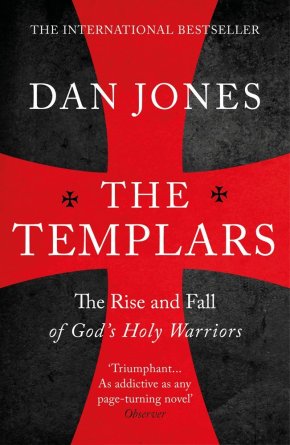 The Crusades were a series of wars between Christian and Muslim warriors for the right to control the Holy Lands of the Middle East. Many men on both sides earned legacies that would surpass their earthly bodies during bloody battles. It created many bands of knights that would last for generations, such as the Hospitallers and the Teutonic Knights. The Templars were the most famous of these knight groups, who may have lasted only for less than two hundred years, but whose legacy would turn into myth. Dan Jones has taken on the arduous task of discerning fact from fiction about the Templars in his book, “The Templars: The Rise and Fall of God’s Holy Warriors.”
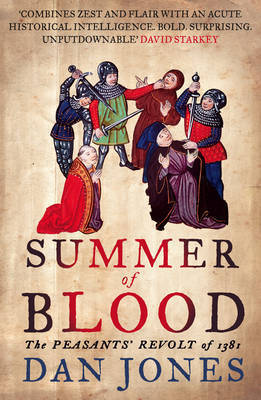 The year was 1381, and England was engulfed in chaos. A band of ruffians and revolters descended on London to achieve political change and a fair chance for the lower classes who suffered greatly from war and plague. The young King Richard II watched as men like Wat Tyler and the preacher John Ball led this ragtag army to his doorstep, fighting against his advisors, like John of Gaunt, to end a poll tax that was their last straw. Why did this ragtag army march on London? How did men like Ball and Tyler convince the masses to march against their sovereign and his government? How did this revolt end, and did the people get what they wanted due to their revolution? Dan Jones brings the bloody story of the first significant revolution by the English people to life in his book, “Summer of Blood: The Peasants’ Revolt of 1381.”
 The year is 1346, and numerous English ships have landed on the shores of France. King Edward III, his son Edward of Woodstock, and his lords launched the first stage of what would be known as the Hundred Years’ War. Amongst the English royalty, nobility, and regular soldiers, are companies of men who came of their own accord for money and glory. One company of men consists of ten men known as the Essex Dogs, led by Loveday FitzTalbot. They are not like the other groups. They do not fight for money or glory; they fight for each other. In the horrors of war in a foreign land, can the Essex Dogs keep their promise and stay alive? Dan Jones introduces the world to these ten men and the early stage of the Hundred Years’ War in his first historical fiction novel, “Essex Dogs.”
 When we study human history, in general, we tend to pick a country and a period to focus on and research. Books on the subject material tend to focus on one land with interactions between other nations. It is infrequent for authors to take on multiple countries unless concentrated on one event that affected numerous locations. Those books often read like textbooks and can be a bit dry. Finding the perfect balance between these elements and engaging with the reader is a monumental task for any author, but Dan Jones has taken on the challenge. His latest behemoth tome, “Powers and Thrones: A New History of the Middle Ages,” takes on the gigantic task of telling the story of the Middle Ages from diverse perspectives.
 As the weather gets colder, the leaves turn brilliant colors and fall from their trees, marking the perfect time of the year to snuggle with a blanket, a cup of tea, and a good spooky tale. Many would reach for a modern supernatural story, but ghost tales have been hiding in archives for centuries. One such story comes from the time of King Richard II. It was first found and transcribed from Latin in 1922 by medievalist M.R. James. Dan Jones has taken on the challenge to retell this story for a modern audience. Initially written by an unknown monk of Byland Abbey, this medieval ghost story is called “The Tale of the Tailor and the Three Dead Kings.”
 England throughout the centuries has known internal strife with civil wars to determine who had the right to rule the island nation. None more so than in the fifteenth century when a tug of war for the English crown broke out. Today, we call this time period “The Wars of the Roses”, but what was it all about? Who were the main figures during this time? What were the crucial battles that defined these wars? How did the Plantagenet Dynasty fall and how did the Tudors become the new dynasty to rule England? These questions and more are explored in Dan Jones’ book, “The Wars of the Roses: The Fall of the Plantagenets and the Rise of the Tudors”.
 The story of the Crusades has been told in many different ways from numerous directions. The epic conflict between Christianity and Islam for the Holy Lands that went on for centuries that has lived in infamy. Many questions have arisen as historians try to separate facts from the myths surrounding this topic. How and why did it start? Why did it continue to go on for so long? Was there really a winner in this conflict? Who were the people who defined this conflict? Dan Jones has taken on the challenge of writing a comprehensive history of this conflict and the people who fought during this time in his latest book, “Crusaders: The Epic History of the Wars for the Holy Lands”.
 Adventures of a Tudor Nerd