
 The medieval world could be a treacherous place to live in, especially when it comes to life in the medieval court. There was so much backstabbing and men reaching for titles and crowns that were not given to them. Take, for example, the House of York. Now, we will assume that their desire for the throne truly came to fruition during the period known as the Wars of the Roses in the 15th century. However, the sons and the daughter of Edmund of Langley and Isabella of Castile were fiercely loyal to those they served and were ruthless to those who they deemed as their enemies. This is the world that Constance of York, Lady Despenser, is raised in, but when her world is turned upside down, will she choose to stay on the sideline, or will she scheme with her family and fight for what they believe is right? Constance’s story is woven together in Anne O’Brien’s novel, “A Tapestry of Treason.”
I did have Anne on my blog with a guest post for her novel, “The Queen’s Rival,” and read it, which was a lot of fun, so I decided that I wanted to read more of her novels. I didn’t know a lot about Constance of York before this book, so I was excited to see she would tell Constance’s story.
We begin our tale in 1399 when Richard II sits on the throne, and the House of York is riding high. Constance of York is married to Thomas Lord Despenser, and her family, led by her father Edmund Langley, are sitting in good favor of their cousin, the king. However, things do not stay the same for long as Henry Bolingbroke comes back from exile to take back his Lancastrian titles and lands, but he ends up taking the throne as Henry IV and imprisoning Richard II. Well, Constance and her family simply cannot have an usurper take the throne from their cousin. So, a plan is hatched with Constance’s husband, Thomas, at the center to try and free Richard II from his captivity. To say this failed massively would be an understatement, as it led to the execution of Thomas Lord Despenser.
As a widow, Constance hopes to live a normal life, especially after she falls in love with Edmund Holland, Earl of Kent. He wishes to marry Constance, but her family gets in the way of this love match. Constance is asked to help with a scheme to put one of the Mortimer boys on the throne and overthrow King Henry IV, but to do so, Constance must free the boys from their captivity. Constance agreed, and I wanted to scream at her. She throws away her chance at happiness for a plot that was easily foiled, and Constance ends up imprisoned herself. She loses the one real chance at marrying the man she truly loves as he marries another, and to top it all off, she ends up pregnant with his child.
While Constance of York was not a main character that I particularly enjoyed, O’Brien’s writing style is engaging, and it shows how tumultuous this period was for those closest to the throne. Overall, I enjoyed this novel and I am looking forward to reading more novels by Anne O’Brien. If you are like me and want to read a novel about a time in medieval England that’s not discussed much, I would suggest you read, “A Tapestry of Treason,” by Anne O’Brien.
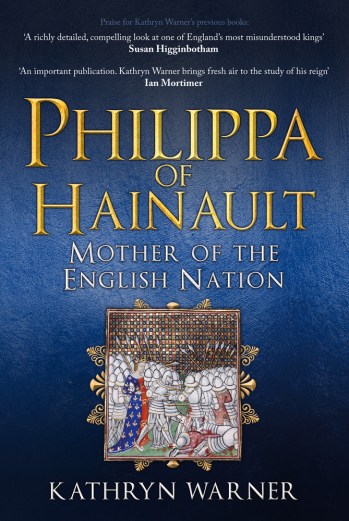 In medieval England, the queens were almost as famous, or infamous, as their husbands. In most cases, they came from royal backgrounds and their sons would become kings. That, however, was the case for Philippa of Hainault, the wife of King Edward III. She tends to be forgotten when it comes to discussing her famous husband, her infamous mother-in-law Isabella of France, and her sons whose children would go on to shape English history forever. That is until now. Kathryn Warner has decided to discover the truth about this rather remarkable woman in her latest biography, “Philippa of Hainault: Mother of the English Nation”.
 Adventures of a Tudor Nerd