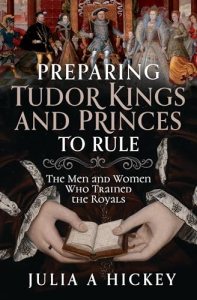
Book Review: “Preparing Tudor Kings and Princes to Rule: The Men and Women Who Trained the Royals” by Julia A. Hickey

In life, when it comes to a new skill or job, you must be trained to become good at it. The same can be said for the monarchy, which in a sense is a job that encompasses one’s entire life. You have to understand different languages, rhetoric, the arts of dancing, and music, as well as diplomacy and physical activities if you want to rule a nation. It may seem like a lot for one person to handle, but from the moment of their birth, a prince or princess has a team of people behind them to make sure that they are ready to either rule their home country or create an alliance with other nations. The Tudors knew how important educating their future monarchs was for the survival of the dynasty. Julia A. Hickey examines the people behind the teams raising the future Tudor monarchs in her book, “Preparing Tudor Kings and Princes to Rule: The Men and Women Who Trained the Royals.”

I want to thank Pen and Sword Books and Net Galley for sending me a copy of this book. The premise of this book was fascinating to me and I wanted to see if Hickey would introduce any new people from the Tudor dynasty in this book.

Hickey begins her book by exploring the origins of the Tudor family, starting with the matriarch herself Margaret Beaufort, followed by Owen, Edmund, and Jasper Tudor, and concluding with how Henry Tudor’s education and his lifestyle shaped him to become the first Tudor king. While I do enjoy a review section about the Wars of the Roses, I felt like this section went a bit too long.

Once we see Henry Tudor on the throne, we get to see how the Tudor dynasty grew with the children of Henry Tudor and Elizabeth of York. We get to see how Arthur Tudor as the heir had a much different education than his brother Henry, who was deemed a spare. The education of the princes was vastly different than the education allocated to the princesses even though it was based on humanism. With the death of Prince Arthur, Henry had to go through a crash course on how to rule a country before his father died in 1509. Hickey also shows her audience how the children of Henry VIII, Mary I, Henry Fitzroy, Elizabeth I, and Edward VI, were raised and educated. She also takes the time to show what happens to his children after Henry VIII’s death. Finally, we do get appendixes that feature mini-biographies for all the men and women who are featured in this book to show a different aspect of the Tudor court.

Overall, I found this a rather nifty little book about the Tudor court. Hickey does a decent job of telling the stories of these men and women who trained the Tudor rulers, both male and female. If you want a book that explores what it takes to rule England during the Tudor dynasty, you should check out “Preparing Tudor Kings and Princes to Rule: The Men and Women Who Trained the Royals” by Julia A. Hickey.

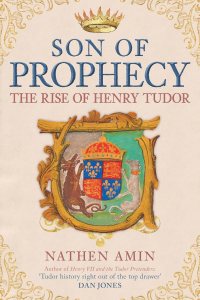
Book Review: “Son of Prophecy: The Rise of Henry Tudor” by Nathen Amin

The date is August 22, 1485, and a young man stands in the middle of a battlefield. He has done what seemed nigh impossible, he defeated the last Plantagenet king Richard III to become the new King of England. His heritage makes this man unique and qualified to start a new dynasty. His mother’s family the Beauforts have been explored quite heavily by historians and authors alike. They see this victory as a change in English history whereas his father’s family sees it as a sign of something deeper. To the Tudors and Henry’s fellow Welshmen, it is the fulfillment of a centuries-old prophecy. So who were Henry Tudor’s ancestors and what did it mean for Henry to be the titular Son of Prophecy? Nathen Amin tells the remarkable story of the Tudors and how their struggles and triumphs led to Henry Tudor taking the throne in his latest book, “ Son of Prophecy: The Rise of Henry Tudor.”

I want to thank Amberley Publishing for sending me a copy of this book. I have enjoyed Amin’s previous books, “The House of Beaufort: The Bastard Line that Captured the Crown” and “Henry VII and the Tudor Pretenders: Simnel, Warbeck, and Warwick,” When I heard that he was writing a book about the origins of the Tudors from the Welsh perspective, I knew I had to read it. I don’t know much about Welsh history, so I was looking forward to learning more. 

Amin begins by explaining that while those who study the life of Henry Tudor know that he was Welsh, they don’t highlight his Welshness as a unique aspect of his life. However, as Amin argues, it is the king’s Welsh heritage that makes his story so fascinating as the Tudor story in Wales spans eight generations and it is the story of warriors and diplomats. We begin with the warrior Ednyfed Fychan, who served Llwelyn ab Iorwerth Prince of Ewynedd during the Welsh War of Independence. Now, for those who are paying attention, you will notice that his surname is not Tudor, but Amin takes the time to explain the origins of the Tudor name as well as how English and Welsh relationships changed over time, starting at the time of the Saxons to the start of the Tudor dynasty. 

What I found fascinating is how the family that would later be known as the Tudors in English history were not afraid to get their hands dirty and be at the forefront of change for Wales. They fought tooth and nail for their Welsh rights and those who considered themselves the Prince of Wales, even if it meant putting their lives at risk. It was the stories of these men who created the foundation for Owen ap Maredudd ap Tudur (Owen Tudor) to leave his native Wales for England, work under Walter Hungerford, fall in love and marry the Dowager Queen Katherine of Valois, and have his sons Edmund and Jasper Tudor. This is the point that most people know as the “origins of the Tudors,” but by going back, Amin is showing his audience the depth of Henry’s Welsh roots and it would be on that battlefield on that August day where that Welsh loyalty would become a defining factor between victory or defeat. 

I was enthralled by this book and the copious amounts of notes that I took while reading. It was so much fun learning about historical events and figures that were unfamiliar to me in the context of the Tudor story. This book will revolutionize how you view the Tudors and how Henry Tudor gained the throne. If you are a Tudor nerd who wants to learn more about the Welsh connections to this dynasty, “Son of Prophecy: The Rise of Henry Tudor” by Nathen Amin is an absolute must-read.

Book Review: “The Beaufort Bride: Book One of The Beaufort Chronicle” by Judith Arnopp

49151069._SY475_A weak king caught in the middle of court drama, each side fighting for the control of the crown and the right to have their opinions heard. England is on the brink of civil war with a young heiress struggling to find where she belongs and to survive. The young heiress is Margaret Beaufort, the mother of Henry Tudor (the future of Henry VII) and a survivor of the Wars of the Roses. Her story has been told in many different ways, but the story of her early years has rarely been told, until now. Judith Arnopp has decided to tell Margaret’s story from her perspective in her novel, “The Beaufort Bride: Book One of The Beaufort Chronicle”.

Margaret is one of my favorite people from the Wars of the Roses to study. I have read a few biographies about Margaret Beaufort and a few historical fiction novels that feature her as a minor character. However, I have never read a historical fiction series about her before, so this one caught my eye. This was the first book that I have read written by Judith Arnopp and I thoroughly enjoyed it.

Arnopp begins her novel with Margaret finding out that her father committed suicide and that she is a wealthy heiress at a young age. She is living with her mother and her step-siblings. It is interesting to see the family interactions because Margaret’s step-siblings are rarely mentioned. To make sure Margaret is taken care of, her mother puts her on the marriage market at a very young age, which was not that unusual during this time. Margaret’s first husband was John de la Pole, a debatable issue that many historians view as merely an engagement and not a marriage, but it was quickly annulled when John’s father was declared a traitor and was massacred on a ship trying to escape England. I enjoyed seeing Margaret and John interacting with one another. They act more like friends than husband and wife, which makes you wonder what it might if they stayed married.

The bulk of this novel revolves around Margaret’s relationship with her second husband, Edmund Tudor, the step-brother of King Henry VI and a man who was twice her age. It is a relationship that we don’t know much about, but Arnopp shows how gradual and loving it might have been. Although Margaret was not thrilled with the arrangement at first, she did being to develop feelings for her new husband. It was during this time that Margaret finds her inner strength and she becomes pregnant with her only child, a son. Life, unfortunately, takes a turn for the worse for Margaret when Edmund tragically dies and she must face an excruciating labor experience to bring Henry into the world two months later. Margaret’s trauma during Henry’s birth means that she could never have any more children, making Henry the most precious person in her life.

I loved this novel. I honestly could not stop reading it. Arnopp makes Margaret’s early life so believable and heartbreaking. I love Margaret even more after reading this novel and I cannot wait to read the rest of this series. If you want a marvelous novel about Margaret Beaufort’s early life, I highly recommend you read, “The Beaufort Bride: Book One of The Beaufort Chronicle” by Judith Arnopp.

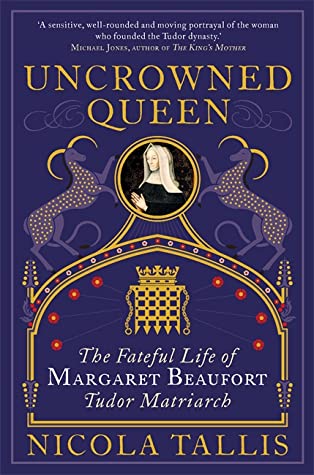
Book Review: “Uncrowned Queen: The Fateful Life of Margaret Beaufort Tudor Matriarch” by Nicola Tallis

45992763._SY475_The stories of the women of the Wars of the Roses have become very popular in recent years. Tales of Jacquetta Woodville, Elizabeth Woodville, Margaret of Anjou, and Elizabeth of York tend to be favorites of those who read historical fiction. However, there was one woman whose life story is so much better than fiction. She was married 3 or 4 times (depending on if you count her first marriage), had only one beloved son who she helped rise to become King of England, and was considered one of the most powerful women of her time. In the modern era of historical dramas, Margaret Beaufort has been portrayed as malicious and cunning, someone who plotted against the Yorkist cause. With all of these conflicting reports about this one woman, can we ever find out the truth about her life? What kind of person was Margaret Beaufort? Nicola Tallis has taken up the challenge to answer these questions to find the truth about this remarkable woman in her latest biography, “Uncrowned Queen: The Fateful Life of Margaret Beaufort Tudor Matriarch”.

I have been a huge fan of Margaret Beaufort, ever since I first heard about her rather extraordinary life. When I heard that Nicola Tallis was writing a new biography about her, I knew for a fact that I wanted to read it. Like Tallis’ previous biography that I read, this was an absolute joy to read.

From the moment she was born, Margaret was a useful pawn for the marriage market. Her father, John Beaufort, Duke of Somerset, was the grandson of John of Gaunt and Katherine Swynford and was an extremely powerful man. When he died, perhaps by suicide after a failed military campaign, Margaret was his only heiress. She was put on the marriage market at a young age and was perhaps married when she was quite young, but the first marriage she ever acknowledged was to Edmund Tudor, the father of Henry Tudor when she was 12; she would give birth to Henry when she was only 13 and never had any more children due to the trauma that she endured at such a young age.

It was this bond between mother and son that would define Margaret’s life and her motivation to keep on going, even when her life hung in the balance. After Edmund died, she was separated from Henry for years, meaning that if she wanted to protect her son, she would have to marry men of power, like her third husband, Henry Stafford, and her fourth husband, Thomas Stanley. These men would prove to be husbands that Margaret could rely on to make sure that Henry was able to survive during the Wars of the Roses. Margaret got along relatively well with kings like Henry VI and Edward IV, but to say that her relationship with Richard III was disastrous would be an understatement. Tallis takes the time to explore this relationship and to debunk the myth that she had something to do with the Princes in the Tower and their disappearances.
When Henry Tudor defeated Richard III at the Battle of Bosworth Field on August 22, 1485, the Tudor dynasty began and Margaret took up the new role as the King’s Mother. There were still triumphs and heartaches that Margaret had to endure, but we finally were able to see her piety and her desire to help out educational institutions during this last part of her life. By diving into the records, Tallis can reveal the truth about Margaret Beaufort’s life and her relationships with her ever-expanding family.

Tallis makes a triumphant return with this meticulously researched biography about the remarkable Margaret Beaufort. It is engaging and truly one of the best biographies about the matriarch of the Tudor dynasty. This is a must-read for anyone curious about the Wars of the Roses, the beginning of the Tudor dynasty, and this strong mother caught in the middle. I highly recommend “Uncrowned Queen: The Fateful Life of Margaret Beaufort Tudor Matriarch” by Nicola Tallis.

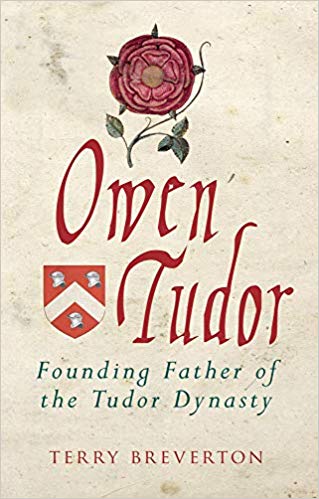
Book Review: “Owen Tudor: Founding Father of the Tudor Dynasty” by Terry Breverton

51qnw6zqydL._SX317_BO1,204,203,200_Henry VII  winning at the Battle of Bosworth Field on August 22, 1485, is viewed as the beginning of the Tudor Dynasty. However, the story of the Tudor family goes back centuries in Wales. What we consider the story of the Tudors tends to start with a man named Owen Tudor, a servant, who fell in love and married the dowager Queen of England, Catherine of Valois. Quite a romantic tale, but how much of it is true? Were the Tudors simple folk or did they have a bigger role to play in their native Wales? What roles did Owen and his sons play in the Wars of the Roses? These questions and more are explored in Terry Breverton’s latest biography, “Owen Tudor: Founding Father of the Tudor Dynasty”.

I would like to thank Amberley Publishing for sending me a copy of this fascinating biography. Owen Tudor is someone that has always interested me, so I was quite delighted to find out that Breverton had written the first biography about this extraordinary man and his life. 

Breverton begins by exploring the origins of the Tudors and how the Welsh bards were the ones who helped preserve the history and prophecies of Wales for future generations. One such prophecy was the prophecy of Cadwaladr, which speaks of the red dragon of Cadwaladr defeating the white dragons of those who the Welsh considered barbarians. It was also the Welsh who believed that a mab darogan (“the son of prophecy”) would conquer England. Breverton must discuss these ideas because they would help the Tudors gather support that was necessary for future victories. Breverton also discusses the history of Wales and England and the Glyndwr War. He explores the Tudor family tree and how Owen Tudor’s ancestors were very influential in the decisions that Wales made in these critical years. I found this part extremely fascinating to read because casual readers of the Wars of the Roses do not read about Welsh history and the Tudor ancestors, which is vital to understand how they were able to come out victorious in the end.

Breverton also explores the family history of Catherine of Valois and how she came to marry  King Henry V and her relationship with her first son, King Henry VI. However, the center of Breverton’s book is centered around the relationship between Owen Tudor and Catherine of Valois. He describes it as the “strangest marriage in English history”, but unlike other scholars, Breverton believes that an actual marriage did happen between Owen and Catherine. Their sons, Edmund and Jasper Tudor, would prove extremely important men during the Wars of the Roses, and tried to bridge the gap between the Yorks and the Lancasters. Breverton was able to track down where Owen was during his service during the Hundred Years’ War and the Wars of the Roses through his sons and through government records of the time, until his death shortly after the Battle of Mortimer’s Cross, on February 4, 1461. The one thing I wish Breverton would have included were maps of Wales, England, and France so it would be easier to understand which towns fell and where battles were fought.

Breverton does a superb job shedding light on Owen Tudor’s fascinating life and legacy. It was an absolute joy to read, I didn’t want it to end. This was my first time reading a book by Terry Breverton and now I want to read more of his books. Breverton blends an easy to understand writing style while maintaining scrupulous attention to details. You can tell that Breverton meticulously researched Owen Tudor and the events that shaped him. This may be the first biography about Owen Tudor, but I don’t think it will be the last. If you want to read a fabulous biography about Owen Tudor and the origins of the Tudor Dynasty, I highly encourage you to read “Owen Tudor: Founding Father of the Tudor Dynasty” by Terry Breverton. 

“Owen Tudor: Founding Father of the Tudor Dynasty” by Terry Breverton will be published in the US on November 1, 2019. If you would like to pre-order a copy of this book, please follow the link: https://www.amazon.com/Owen-Tudor-Founding-Father-Dynasty/dp/1445694379/ref=sr_1_1?keywords=Owen+Tudor+Founding+Father+of+the+Tudor+Dynasty&qid=1566589023&s=books&sr=1-1

Book Review: “Margaret Beaufort: Mother of the Tudor Dynasty” by Elizabeth Norton

9781445605784_p0_v1_s550x406The Wars of the Roses was a time of great hardships and strong men and women who did everything they could in order to survive. One of these remarkable people was a woman who did everything she could to make sure her only son lived and prospered. She was the daughter of a man who, allegedly committed suicide, she had four different husbands and gave birth to her son at the age of thirteen. She helped organize rebellions and a marriage that helped her son win the throne of England. Her name was Margaret Beaufort, the mother of King Henry VII. Her remarkable story is told in Elizabeth Norton’s insightful book, “Margaret Beaufort: Mother of the Tudor Dynasty.”

This was a time of extraordinary men and women who knew both triumphs and tragedies. Margaret Beaufort was no exception as Fortune’s wheel gave her quite a ride, as Elizabeth Norton explains:

The idea of Fortune’s wheel, with its random changes from prosperity to disaster, was a popular one in medieval England, and Margaret Beaufort, with her long and turbulent life, saw herself, and was seen by others, as the living embodiment of the concept. Margaret was the mother of the Tudor dynasty in England, and it was through her that Henry VII was able to bid for the throne and gather enough strength to claim it. She knew times of great prosperity and power, but also times of deep despair. These were, to a large extent, products of the period in which Margaret lived, and her family, the Beauforts, had also suffered and prospered from Fortune’s random spin in the years before her birth. (Norton, 9).

Norton begins her book by explaining the origins of the Beaufort family, with the relationship between John of Gaunt and Katherine Swynford. It is through John of Gaunt that the Beauforts were able to go from illegitimate children to royal relations. This connection brought them a lot of favors, but it also brought a lot of heartaches. When the Beauforts fell, they fell hard, like Margaret’s father John Beaufort who allegedly committed suicide after a failed mission in France. His death meant that Margaret, his only child, was made a very wealthy heiress and a very eligible young lady on the marriage market. She was married to her first husband at the tender age of 10, but it did not last long. Her second marriage was to King Henry VI’s half-brother Edmund Tudor. He died before he could meet his son, leaving Margaret a mother and a widow before she turned 14. This might have been a dark moment in any young woman’s life, but Margaret grows from this experience, for herself and her only son Henry Tudor.

Margaret used her next two marriages, to Sir Henry Stafford and Lord Thomas Stanley, to her advantage to help her son’s cause. Henry was on the run with his uncle Jasper during this time since the Yorkist cause saw him as a potential heir to the throne. It was Margaret’s influence with the court and her financial support that helped her son and her brother-in-law survive during this time. It all paid off and after years apart, she was reunited with her son after the Battle of Bosworth Field. Henry was victorious and declared King Henry VII. The Tudor Dynasty was created, and Margaret Beaufort began her new role as the King’s Mother. She was a mother-in-law to Elizabeth of York, a grandmother to Henry and Elizabeth’s children, and a patroness for colleges and universities. Margaret was a devout woman who also had control of her own finances, even though she was married. Fortune’s wheel gave Margaret Beaufort quite a ride, but she endured it and helped create one of the greatest dynasties in English history, the Tudor dynasty.

Elizabeth Norton sheds light on Margaret Beaufort’s story. In recent years, Margaret Beaufort has been vilified but reading the letters written by Margaret and from people who knew her shows who she really was, a strong and devout woman who would do anything for her son. Norton is able to balance the facts that we know about Margaret’s life and times with letters and poems about her and Norton’s engaging writing style to give Margaret a biography she deserves. This biography is meticulously researched and a delight to read. If you want a fascinating biography about this remarkable woman, I highly recommend you read Elizabeth Norton’s “Margaret Beaufort: Mother of the Tudor Dynasty”.

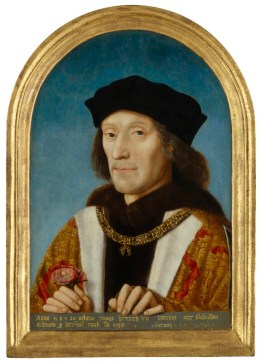
Biography: King Henry VII

mw03078(Born January 28, 1457- Died April 21, 1509). Son of Margaret Beaufort and Edmund Tudor, 1st Earl of Richmond. Married to Elizabeth of York. Father of Arthur, Prince of Wales, Margaret, Queen of Scots, Henry VIII, King of England and Mary, Queen of France. Henry VII went from an exile to the founder of one of the most powerful dynasties in all of English history, the Tudor Dynasty.

Henry Tudor, later Henry VII, was born at Pembroke Castle to Margaret Beaufort and Edmund Tudor, 1st Earl of Richmond on January 28, 1457. Henry never met his father Edmund because he died three months before Henry was born. His grandfather, Owen Tudor, was married to Katherine of Valois which made Henry’s father half brother of King Henry VI. Henry’s mother was the great granddaughter of John of Gaunt and his third wife Katherine Swynford. Henry’s mother Margaret Beaufort was only 13 when she gave birth to Henry and because his father died, his uncle Jasper Tudor took care of him.

Life was stable for Henry Tudor for a few years, until Edward IV won the crown in 1461, sending Henry’s uncle Jasper into exile and the title of Earl of Pembroke as well as Pembroke Castle and the wardship of Henry went to a Yorkist supporter William Herbert. Henry stayed with William Herbert until 1469, when the Earl of Warwick Richard Neville switched sides to the Lancastrians and had Herbert executed. Warwick restored Henry VI to the throne in 1470, Jasper came back from exile, and Henry was allowed to go to court.

This return of Henry VI would not last long as Edward IV was restored to the throne and Warwick was killed. Henry and Jasper tried to gather more support for the Lancastrian cause but they got caught in a bad storm in the English Channel while escaping from Tenby. They landed in Brittany where they sought the protection of Francis II, Duke of Brittany, which he did give to them. The Lancastrians along with Jasper and Henry, were housed at the Château de Suscinio in Sarzeau. Edward IV tried his best to apprehend Jasper and Henry but he failed to do so. Edward IV died on April 9, 1483, leaving his throne to his young son Edward V. After a few weeks, Edward V and his siblings were declared illegitimate and the throne was passed onto Edward V’s uncle Richard Duke of Gloucester, who became Richard III. Edward V and his brother Richard Duke of York were never seen again.

Henry’s mother Margaret Beaufort saw an opportunity for her son to become king. During this time Margaret was plotting with Elizabeth Woodville to arrange a marriage between Henry and Elizabeth Woodville eldest daughter, Elizabeth of York. Henry and Jasper tried to invade England in October 1483, but they were forced to go back to Brittany. It was in December 1483 that Henry made an oath in Rennes, France to marry Elizabeth of York when he became King of England. When the Duke of Brittany got very ill in 1484, his treasurer Pierre Landais made a deal with Richard III to give over Henry and Jasper Tudor in exchange for 3,000 English archers to defend a French attack. A bishop in Flanders John Morton heard about the deal and warned Henry and Jasper just before Landais could reach them. Henry and Jasper fled into France where King Charles VIII allowed them to stay until Duke Francis II felt better.
Henry and Jasper Tudor made their way back to England in August 1485, where they faced off against Richard III at the Battle of Bosworth Field on August 22, 1485. Richard III was defeated and Henry became Henry VII. Henry was crowned king on October 30, 1485 and he would marry Elizabeth of York the following year on January 18, 1486. The couple had their first child, Arthur, on September 20, 1486. Henry and Elizabeth would have 4 children who would survive into adulthood; Arthur Tudor, Margaret Tudor, Henry Tudor, and Mary Tudor. During 1487, a young man named Lambert Simnel, claimed that he was the earl of Warwick, Elizabeth’s cousin, so Henry VII had the real earl of Warwick taken from the Tower and paraded through London. It was at the last battle of the Wars of the Roses, the Battle of Stoke Field on June 16, 1487 that Lambert Simnel was defeated. Henry decided to let the boy live and gave him a job at the castle.

In 1490, a young man named Perkin Warbeck, appeared and claimed to be Richard Duke of York. Warbeck won the support of Edward IV’s sister Margaret of Burgundy and James IV of Scotland. In September 1497 Warbeck landed in Cornwall with a few thousand troops, but was soon captured. He was allowed to live in the court and his wife Lady Catherine Gordon was made one of the ladies in waiting for Elizabeth of York. Warbeck tried to escape and it landed him in the Tower of London, close to Edward Plantagenet, 17th Earl of Warwick, son of the late George, Duke of Clarence. Warbeck and Warwick plotted to escape the Tower, but the plan was uncovered and both men were charged with treason. Perkin Warbeck was hanged at Tyburn on November 23, 1499.

Henry VII was a cautious man and decided that it was better to make alliances through marriages than to launch into expensive wars, like his predecessors. Henry VII was one of the first European monarchs to recognise the importance of the newly united Spanish kingdom under Isabella of Castile and Ferdinand of Aragon and concluded the Treaty of Medina del Campo, by which his son, Arthur Tudor, was married to Catherine of Aragon. He also concluded the Treaty of Perpetual Peace with Scotland, which betrothed his daughter Margaret to King James IV of Scotland. Henry VII hoped to break the Auld Alliance between Scotland and France through the marriage of Margaret to the Scottish king, but it did not happen. Henry was also able to form alliances with Pope Innocent VIII and Holy Roman Emperor Maximilian I.

On November 14, 1501, Arthur Tudor married Katherine of Aragon. The following year, tragedy hit hard as Arthur died on April 2, 1502. His son’s death hit Henry hard and it was his wife Elizabeth of York who consoled him and convinced him that he still had Henry, his youngest son, as his heir and that they were still young enough to have children. Henry VII wanted to maintain the Spanish alliance. He therefore arranged a papal dispensation from Pope Julius II for Prince Henry to marry his brother’s widow Katherine. Elizabeth would have one more child, a girl named Katherine, on February 2, 1503, but the baby would not live long. Elizabeth of York would die on her 37th birthday, on February 11, 1503. Henry would grieve over the loss of his wife and son the rest of his life. He retreated to Richmond Palace, which was the former Sheen Palace but it was badly damaged in a fire in 1497 and rebuilt. Henry’s health failed him and he would die on April 21, 1509 at Richmond Palace. His only son Henry Tudor succeeded his father and became Henry VIII.

Biography: Margaret Beaufort

(Born May 31, 1443- Died June 29, 1509). Daughter of John Beaufort, 1st Duke of Somersetdownload (2) and Margaret Beauchamp of Bletsoe. Married to John de la Pole 2nd Duke of Suffolk, Edmund Tudor 1st Earl of Richmond, Sir Henry Stafford, and Thomas Stanley 1st Earl of Derby. Mother of Henry Tudor, later known as Henry VII. Margaret was the mother of the Tudor Dynasty. She never gave up on her son Henry Tudor.

Margaret Beaufort was born on May 31, 1443 to John Beaufort, 1st Duke of Somerset and Margaret Beauchamp of Bletsoe. She had seven half-siblings from her mother’s first marriage to Sir Oliver St John. Her father was the  second son of John Beaufort, 1st Earl of Somerset, the first son of John of Gaunt and Katherine Swynford. Margaret’s father went to France to fight for King Henry VI, but it went badly, and he either died from illness or committed suicide on May 27, 1444, leaving Margaret his sole heiress.

Under a deal that her father made with Henry VI, the king took wardship of Margaret, but the king broke that deal and passed on the wardship to William de la Pole 1st Duke of Suffolk. At this time, Margaret remained in her mother’s house to receive her education. On January 28, 1450, William de la Pole, who was not popular at all with Parliament, was ordered to be arrested. Between January 28 and February 7, 1450, Margaret and John de la Pole, the eldest son of William de la Pole, were married, yet they never lived together. With this marriage, William de la Pole was seen as reaching too far since Margaret was a potential heir for the throne and was charged with treason. William de la Pole was murdered on May 2, 1450. Margaret never recognized this marriage as she was under twelve when she was married.

In 1453, Margaret and her mother were called to court when Henry VI granted the wardship of Margaret to his half brothers Edmund and Jasper Tudor. With her first marriage annulled, it paved the way for the marriage between Margaret and Edmund. Margaret was 12 and Edmund was 24 at the time of the wedding on November 1, 1455. The marriage was consummated and soon Margaret was pregnant. Unfortunately, Edmund would never meet his son as he died on November 1, 1456 of the plague. Margaret gave birth to her only son Henry Tudor on January 28, 1457 at the age of 13. It was a difficult birth and Margaret was never to have another child after Henry.

Being a single mother and a young widow, Margaret knew that she had to marry again to make sure that she could financially survive. She arranged her own marriage and after the required one year of mourning was over, Margaret married Sir Henry Stafford on January 3, 1458. From what we can tell, it sounds like a happy marriage between Margaret and Sir Henry Stafford. When Henry was two years old, his uncle Jasper was granted wardship over him and so Margaret and Henry were seperated. After the Battle of Towton, Jasper fled to Scotland to help Margaret of Anjou, Edward Duke of York became Edward IV, and Henry Tudor was stripped of his lands and put in the custody of William Herbert. At this time, Margaret was able to keep in contact with her son.

In 1469, the House of Lancaster came back into power, but only for a short amount of time as the House of York came back into power. At the Battle of Barnet on April 14, 1471, Sir Henry Stafford was injured  fighting for the Yorkists and he would die from his wounds on October 4, 1471. Margaret was a widow again at the age of 28. Henry and Jasper fled the country for their own protection, leaving Margaret alone and in need of another husband and protector.

In June 1472, Margaret married her fourth and final husband Thomas, Lord Stanley. This was a marriage of convenience as Margaret was able to enter the court of Edward IV and Elizabeth Woodville in order to gain favor and secure her son’s return to England. Before this could happen, Edward IV died on April 9, 1483. The crown passed on to the king’s eldest son Edward V, but Edward and his brother Richard went to the tower for their own protection, never to be seen again. Their uncle Richard III became king, and even though Margaret carried the train at Queen Anne’s coronation, Richard stripped Margaret of all of her titles and land. During this time Margaret was plotting with Elizabeth Woodville to arrange a marriage between Henry Tudor and Elizabeth of York.

In 1483, Henry and Jasper failed to invade England. Richard found out that Margaret was part of this plot and she was charged with high treason, but instead of being executed, she was placed under house arrest. Margaret’s life changed for the better when her son was able to defeat Richard at the Battle of Bosworth Field on August 22, 1485, with the help of Margaret’s husband Thomas, Lord Stanley, and became King Henry VII.  Thomas, Lord Stanley was made Earl of Derby and Margaret was made Countess of Richmond and Derby. Margaret was able to see her son once again after 14 years apart. Margaret became the King Mother and was the second most important woman at court, next to Queen Elizabeth of York, who married Henry VII on January 18, 1486. Margaret was there to help with the births of her grandchildren, and the deaths of a few including Arthur Prince of Wales, who died on April 2, 1502.

Elizabeth of York would die on February 11, 1503, leaving Margaret’s son a widower. Thomas, Lord Stanley would die in 1504, and although she spent most of her son’s reign styling herself as a widow in order to have control over her own properties and finances, it still must have been a hard loss for Margaret. Margaret’s beloved son Henry VII died on April 21, 1509, and she took his death the hardest. Margaret Beaufort was able to see her grandson Henry VIII’s coronation on June 23, 1509, but then she died only six days later on June 29, 1509.

Biography: Jasper Tudor

410px-Arms_of_Jasper_Tudor,_Duke_of_Bedford.svg(Born November 1431- Died December 21, 1495). Son of Owen Tudor and Catherine of Valois. Married to Catherine Woodville. Jasper was really one of the unsung heroes of the Wars of the Roses. He never gave up on fighting for the cause he believed in and he did his best to keep his nephew Henry Tudor safe.

Jasper Tudor was the second son born to Owen Tudor and Catherine of Valois born in 1431. He was the brother of Edmund Tudor and half- brother of King Henry VI. After his mother’s death on January 3, 1437, Jasper and Edmund were sent to Barking Abbey where they were raised and educated by Katherine de la Pole from July 1437 until March 1442. Around that time, their half-brother Henry VI allowed for Edmund and Jasper to live at court, where they received the military training that would be essential for their survival later in life. In 1449, Jasper was knighted and in 1452, he was created the earl of Pembroke.

Jasper worked hard to stop the fighting between the Yorks and the Lancasters while he was still living in the courts. Jasper’s brother Edmund took in a young Margaret Beaufort as his ward and he later married her on November 1, 1455. The following year, on November 3, 1456, Edmund died of the plague, leaving his young and pregnant widow in Jasper’s custody. Henry Tudor, earl of Richmond was born on January 28, 1457.  Jasper was also responsible for maintaining the Lancastrian ties in Western Wales between 1456 and 1459. In 1460, Jasper was able to capture the Duke of York’s North Welsh stronghold of Denbigh Castle.

Jasper and his father Owen Tudor raised an army in Wales for Henry VI and met against the Yorkist forces at the battle of  Mortimer’s Cross on February 2, 1461. It was an utter defeat for the Lancastrians. Owen Tudor was taken into custody and executed while Jasper escaped first into Ireland and then into Scotland.  Jasper then went to France where he was welcomed by King Louis XI in 1462. He stayed in France for 6 years, until he returned to Wales in 1468, when he lost his title of earl of Pembroke and Pembroke Castle to William Herbert.

Jasper did regain the earldom of Pembroke when Henry VI was restored to the throne, but in 1471, he fled to the continent yet again once Edward IV was crowned king. Jasper  and Henry tried to gather more support for the Lancastrian cause but they got caught in a bad storm in the English Channel while escaping from Tenby. They landed in Brittany where they sought the protection of Francis II, Duke of Brittany, which he did give to them.The Lancastrians along with Jasper and Henry, were housed at  the Château de Suscinio in Sarzeau. Edward IV tried his best to apprehend Jasper and Henry but he failed to do so.

In October 1483, Jasper and Henry tried to go back to England, but it failed and they were forced to return to Brittany. When the Duke of Brittany got very ill in 1484, his treasurer Pierre Landais made a deal with Richard III to give over Jasper and Henry in exchange for 3,000 English archers to defend a French attack. A bishop in Flanders John Morton heard about the deal and warned Jasper and Henry just before Landais could reach them. Jasper and Henry fled into France where King Charles VIII allowed them to stay until Duke Francis II felt better.

Jasper and Henry made their way back to England in August 1485, where they faced off against Richard III at the Battle of Bosworth Field on August 22, 1485. Richard III was defeated and Henry became Henry VII. Jasper’s titles and properties were all returned to him and he was made a Knight of the Garter as well as Duke of Bedford. On November 7, 1485, Jasper married Catherine Woodville, the sister of Queen Elizabeth Woodville. They had no children. Jasper would die on December 21, 1495 at Thornbury Castle at the age of 64.

Biography: Owen Tudor

Full name: Owen ap Maredudd ap Tudur. (Born around 1400- Died February 2, 1461) Son of Maredudd ap Tudur and Margaret ferch Dafydd. Husband of Catherine of Valois.  Father of 4-6 children, including Edmund and Jasper Tudor.

Owen Tudor was the son of Maredudd ap Tudur and Margaret ferch Dafydd. We do not know much about his early life. Owen’s father and his uncles were involved in the rebellion of Owain Glyn Dwr, the last Welsh Prince of Wales, against the English. This rebellion was suppressed and Welshmen moved into England to find work. In 1421, he found work with Sir Walter Hungerford, the steward of King Henry V. In 1422, King Henry V would die from dysentery, leaving behind his 21 year old wife Catherine of Valois and their baby son, who was now King Henry VI. It was during this time that  it is said that Owen came to work in Catherine’s household.

Parliament passed a bill that stated that the dowager queen could not marry again unless she had the king’s permission. If she did marry without permission, her husband would lose everything, but their children would remain legitimate. It is said that the couple was married between 1428 and 1429. In May 1432, Owen Tudor was given the same rights as an English gentleman. The couple had at least 4 children; Edmund born in 1430, Jasper born in 1431, a son who is rumored to have become a monk, and a daughter who either died young or became a nun.

Catherine would enter Bermondsey Abbey to receive medical attention, where she died on January 3, 1437. Edmund and Jasper were sent to the Abbess of Barking to receive  their education while Owen dealt with the king’s Regency council. Owen was nervous about the council and so he sought sanctuary at Westminster Abbey; when he did arrive at the council, he was cleared of all charges and was allowed to return to Wales. However, he was captured by Lord Beaumont and sent to Newgate Prison.

In 1438, he managed to escape with the help of a priest and a servant; he was recaptured and held at Windsor Castle under the guardianship of Edmund Beaufort. In 1439, King Henry VI pardoned Owen Tudor, restored all of his lands, provided him a position at court, and made the Keeper of the King’s Parks in Denbigh. In 1442, Henry VI welcomed his half- brothers Edmund and Jasper to court with open arms. In November 1452, Edmund became the earl of Richmond and Jasper became the earl of Pembroke. On November 3, 1456, Edmund Tudor died from the plague, leaving his young son and wife in the capable hands of his brother Jasper Tudor.  Owen and Jasper would serve Henry VI by capturing Yorkist supporters for the king and in return gaining their estates, including John, Lord Clinton in 1459; that same year, Owen had a son with an unknown mistress named Sir David Owen, born at Pembroke Castle.

Owen joined his son Jasper’s army to raise an army in Wales in January 1461. On February 2, 1461, their army faced off against the Yorkist army at the battle of Mortimer’s Cross. It was a devastating loss for the Lancasterian cause. Jasper Tudor escaped, but Owen was captured and beheaded under the orders of Edward Earl of March, later Edward IV, at Hereford.