
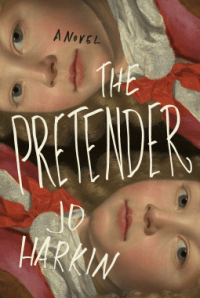
 The Wars of the Roses are ending, and with it comes uncertainty about who will lead the country. On one side is King Richard III, who many believe killed his nephews to become King of England; on the other is Breton Henry, Henry Tudor, who believes he is the rightful king due to his bloodline. However, there is a third player in this entire debacle. A young farm boy named John Collan may spend his days daydreaming and studying to his heart’s content, but he is destined for more. A path that will lead him to hobnob with nobility and become the enemy of a king who just sat on his throne. Just who is John Collan, and how did this boy go from the farm to a life of infamy? Jo Harkin tells the story of how John Collan became Lambert Simnel in her novel, “The Pretender.”
I would like to thank Knopf and Net Galley for sending me a copy of this novel. As someone who reads a lot about the Wars of the Roses, I tend to gravitate towards the main players and the nobility. However, there was something about a novel all about one of the pretenders, Lambert Simnel, that piqued my curiosity. Plus, the fact that this was the author’s first foray into historical fiction was a nice touch. I wanted to see how well Harkin would do with an obscure figure and her first historical fiction novel.
We begin with John Collan, a son of a farmer who dreams of being a scholar and running away from a rather vicious goat. John’s father, Will Collan, is a pretty wealthy man, but he is also connected to a man named Maister Richard Simons, who agrees to tutor John at Oxford. Such a remarkable turn of luck for a farm boy, but why choose him over others? Maister Simons explains that Will Collan is not John’s father. His name is not even John. He is to be known as Lambert Simnel, and his true father is none other than George, Duke of Clarence, which makes him Edward, Earl of Warwick. It’s a lot to take in, but then John/Lambert is taken to both Burgundy and Ireland so that he can gain powerful allies such as Margaret, Dowager Duchess of Burgundy, John de la Pole, 1st Earl of Lincoln, and the Earl of Kildare.
John/Lambert continues to study, falls in love with a girl named Joan, is crowned king, and even goes to war against the Tudor king. But the boy will soon learn the bitter taste of betrayal and the heartache of losing those he loves the most to try and wrest the crown from Henry VII. While the dialogue was at times borderline vulgar, I did enjoy most of the story until the aftermath of the Battle of Stoke Field. It was when John/Lambert was held captive that it fell flat, and it was a bit difficult to follow along for me. I also wish Harkin had included some sort of author’s note or explanation of her research to help those who are new to Lambert Simnel’s story understand why she wrote the novel in the way she did.
Overall, I think this was a decent novel. It is ambitious to tackle an obscure figure like a pretender as a protagonist of a historical novel, but I think Harkin does a good job. It makes you wonder what must have been going on when this young man decided that he was going to take on a crowned king. Such a small footnote in history makes one compelling tale. If you want a novel about someone who does not get enough attention, I recommend you read “The Pretender” by Jo Harkin.
 August 22, 1485, marked the end of the Plantagenet Dynasty with the death of King Richard III at the Battle of Bosworth Field. The man who succeeded him as King of England after his death was young Henry Tudor, whose dynasty would live in infamy in English history, thought that he was done fighting on the battlefield for his right to rule. This was only the beginning of a decades-long war against those who claimed to be lingering shadows of the past. They claimed to be the Princes in the Tower, whose disappearances in 1483 left to doubt and confusion on what happened to them and gave those who despised this new dynasty opportunity to exploit a young king’s fear of being overthrown. The young men who made this king who won his way to the throne on a battlefield quake in his boots are known today as “the Pretenders”, but who were they? In Nathen Amin’s much-anticipated book, “Henry VII and the Tudor Pretenders: Simnel, Warbeck, and Warwick”, he traces the origins of each pretender to show what type of threat that they posed to the first Tudor king.
 (Born June 11, 1456- Died March 16, 1485). Daughter of Richard Neville, 16th Earl of Warwick and Anne Beauchamp, 16th Countess of Warwick. Married to Edward of Westminster, Prince of Wales and King Richard III. Mother of Edward of Middleham, Prince of Wales. Anne Neville was the daughter of “the Kingmaker”. She was part of the powerful Neville family and she was married to two very important people in the houses of Lancaster and York respectfully. She played a critical role in the Wars of the Roses.
 Adventures of a Tudor Nerd