
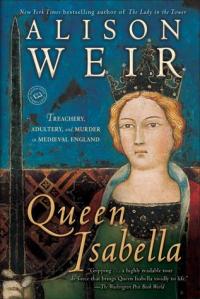
Book Review: “Queen Isabella: Treachery, Adultery, and Murder in Medieval England” by Alison Weir

Throughout medieval English history, there have been some famous queens who left their marks. Empress Matilda, Eleanor of Aquitaine, Eleanor of Castile, Philippa of Hainault, and Margaret of Anjou each left an impression on English history, either good or bad. However, there was one queen whose negative reputation came with the nickname “She-Wolf of France,” and her name was Queen Isabella of France. The wife of Edward II and mother of Edward III, she left her husband for Roger Mortimer and overthrew her husband in favor of her son. For centuries, she has been viewed as a horrible villainess, but is that a fair assessment of her life? Alison Weir dives into the archives to find the truth about Isabella of France, and she presents her findings in her biography, “Queen Isabella: Treachery, Adultery, and Murder in Medieval England.”

As a fan of Alison Weir, I am trying to read every book she has written so far, so when I saw this book in a used book store, I jumped at the chance to read it. I have read books that have featured Isabella of France, but I have never read a biography about her until now. I wanted to see if this book would change how I feel about her.

Isabella of France was the daughter of Philip IV, King of France, and Jeanne I, Queen of Navarre, born in 1295. As the only surviving daughter of Philip and Jeanne, she was expected to make a match that would create an alliance, which she did when she married Edward II of England. On paper, it should have been an ideal match, but Edward II had his favorites. The first was Piers Gaveston, whom Edward II knew before he married Isabella. Edward paid more attention to advancing Gaveston than governing, which led to the great men of England (known as the Ordainers) enacting the Ordinances of 1311 and Gaveston’s execution in 1312. Edward II swore revenge against those who killed Gaveston.

For a while, Edward and Isabella had a loving relationship. They had four surviving children: Edward III of England, John of Eltham, Earl of Cornwall, Eleanor Countess of Guelders, and Joan Queen of Scots. Unfortunately, Isabella’s happiness would not last long as Hugh Despenser the Younger would take the place as Edward’s new favorite. Things got so bad for Isabella that she decided to leave for France, stay there with her son Edward III, and start a relationship with Roger Mortimer. It would end with an invasion of England, the death of the Despensers, Edward II captured, and Edward III becoming King of England.

Isabella of France’s reputation may have been marred for centuries for her role in overthrowing her husband in favor of her son, and for what happened to Edward II afterward, but I think Weir does a decent job in rehabilitating her reputation. I don’t necessarily agree with her assessment of Edward II, but I felt like, when it came to Isabella herself, I appreciate her story and feel a bit sympathetic for what she had to deal with. If you want a biography about Isabella of France, I would recommend you read “Queen Isabella: Treachery, Adultery, and Murder in Medieval England” by Alison Weir.
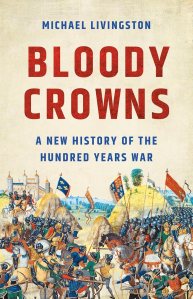
Book Review: “Bloody Crowns: A New History of the Hundred Years War” by Michael Livingston

Medieval Europe was a time of conflicts and change. While smaller disputes between countries or civil wars would define borders, the most prominent conflict during this period was the Hundred Years’ War. A conflict that has been traditionally taught to have lasted 116 years between England and France. It is often told from the English perspective, with battles such as Agincourt, Crecy, and Poitiers celebrated. But what if we look at the bigger picture and expand our lens to the whole of Europe while keeping a neutral approach to the France vs England conflict? What if the conflict did not last a mere hundred years, but in fact two hundred years? What type of story would this kind of approach tell when it comes to medieval European history? Michael Livingston takes on the mammoth challenge of telling the tale of how this war changed European history forever in his latest book, “Bloody Crowns: A New History of the Hundred Years War.”

I would like to thank Basic Books and Net Galley for sending me a copy of this book. I enjoyed the previous book that I read by Michael Livingston on the Battle of Crecy, so when I heard that he was writing a new book about the Hundred Years’ War, I was intrigued. I wanted to see what new information he could provide for a conflict that has been discussed heavily for centuries.

Livingston delivers with a plethora of information. He begins by explaining that the term Hundred Years’ War came from a French textbook in 1823. We often think that it began when King Philippe VI of France declared English lands forfeit on May 24, 1337, so King Edward III declared that he was the rightful king of France; and the end of the war was when the French seized the city of Bordeaux on October 19, 1453. However, Livingston argues that the war began in 1292 and ended in 1492, which means it was a two-hundred-year war. Livingston then goes into explaining the origins of France and England to explain how on earth they even got to a state of strife.

While the study of the conflict between France and England tends to focus on these countries, Livingston expands his view to include a pirate war between English and Norman merchants, wars in Portugal, the Burgundian Wars, fights between England, Scotland, and Wales, peasant revolts of all varieties, and wars with the Flemish. We also see a few civil wars in both France and England, including the Wars of the Roses. There are also colorful characters, including a couple of mad kings, the Black Prince, Henry V, Joan of Arc, William Wallace, earls and dukes of every variety, knights who were loyal to a fault, queens who fought for their families, heiresses fighting for their land rights, and a ton of family squabbles. And of course, Livingston focuses on the battles that defined the period, including Crecy, Poitiers, Agincourt, and Orleans, as well as lesser-known battles that helped shift the momentum for either side. Livingston can provide such vivid details that it feels like you are on the battlefield, even when it comes to the more obscure battles.

In my opinion, Livingston is one of the finest medieval military historians right now, and this is his magnum opus. I learned so much by reading this book that it kind of redefined what I think of the Hundred Years’ War. This is one of the best books I have read this year. If you want a book about medieval Europe that will challenge your way of thinking about one of the biggest conflicts of the age, I highly recommend you read “Bloody Crowns: A New History of the Hundred Years War” by Michael Livingston.

Book Review: “Sceptred Isle: A New History of the Fourteenth Century” by Helen Carr

The Plantagenets, a dynasty that ruled England for over three hundred years. At least that is if you include the Lancastrian and Yorkist kings. Otherwise, the reign of the Plantagenets ended with Richard II being overthrown. So, how did the Plantagenets fall? How did wars, favoritism, and the plague factor into the fall? Helen Carr examines these questions and the rule of three kings over the fourteenth century in her latest book, “Sceptred Isle: A New History of the Fourteenth Century.”
I have really enjoyed Helen Carr’s insight into medieval English history in her book, The Red Prince, so when I heard she was writing a book about the Plantagenets again, with a focus on the fourteenth century, I was excited to read it. The idea in this book that caught my attention was the idea that the Plantagenet dynasty ended when Henry of Bolingbroke overthrew Richard II. As someone who believes that the Plantagenet dynasty ended with the death of Richard III, the concept that it ended almost a century earlier is intriguing.

We begin our adventure with a double reburial of King Arthur and Queen Guinevere, the idea of King Edward I and his wife Eleanor of Castile. It was a kind gesture, but the prophecy that was left behind would be almost prophetic. With the death of King Edward I, the Hammer of the Scots, the throne passed to his son Edward II. While Edward I was a strong warrior, Edward II was a handsome prince who only cared about his favorites, Piers Gaveston and Hugh Despenser the Younger. It would cause those around him, including his wife, Isabella of France, and her lover, Roger Mortimer, to take action against him. Isabella and Mortimer placed Edward III on the throne, but they would soon learn that Edward III was not as passive as his father.

Edward III would return to the warrior state of mind like his grandfather Edward I. With his wife Philippa of Hainault, they would have a large family with many sons, including John of Gaunt and Edward the Black Prince. It would be Edward III who would try to take the French throne for England in a conflict known as the Hundred Years’ War (not the quickest war, and it didn’t go the way Edward III envisioned it). And to top it all off, Edward III had to deal with the emergence of the Black Death and how it affected not only his own family but England and Europe as a whole.

Before Edward III died, his heir, the Black Prince, died, which meant that the Black Prince’s son, Richard II, was destined to be the next king. However, youth and favoritism failed the king as chaos reigned ever since the start of his reign, with the Peasants’ Revolt, and ended with Henry of Bolingbroke becoming the first Lancastrian King, Henry IV.

This was another wonderful book by Helen Carr. It demonstrates Carr’s ability to balance extensive research with a narrative format to create an accessible history book that novices and experts will equally enjoy. My only qualm with this book, if you can call it an issue, is that I wanted it a bit longer so we get more analysis of how this one century affected English and European history as a whole. If you want a book that dives into the history of one of England’s most tumultuous centuries, I highly recommend you read “Sceptred Isle: A New History of the Fourteenth Century” by Helen Carr.

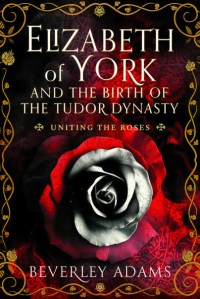
Book Review: “Elizabeth of York and the Birth of the Tudor Dynasty: Uniting the Roses” by Beverley Adams

Throughout English history, some of the most famous queens have been associated with the Tudor dynasty. We have the six wives of Henry VIII (Catherine of Aragon, Anne Boleyn, Jane Seymour, Anna of Cleves, Catherine Howard, and Catherine Parr), Queen Mary I, and Queen Elizabeth I. However, one Tudor queen is often overlooked for her daughters-in-law and granddaughters, the first Tudor queen, Elizabeth of York. So who was Elizabeth of York and what role did she play in the transition between the Plantagenet dynasty and the Tudor dynasty? Beverley Adams hopes to enlighten readers about this remarkable queen in her latest book, “Elizabeth of York and the Birth of the Tudor Dynasty: Uniting the Roses.”

I want to thank Pen and Sword Books and Net Galley for sending me a copy of this book. While I know quite a bit about Elizabeth of York, the Wars of the Roses, and the origins of the Tudor dynasty, I wanted to see how Adams would portray these topics for beginners. 

To begin with, Adams lays out the origins of the conflict that we know today as the Wars of the Roses with Edward III and his sons, John of Gaunt 1st Duke of Lancaster, and Edmund of Langley, 1st Duke of York. This led to a clash between King Henry VI and Richard Duke of York. Elizabeth of York’s father, the future King Edward IV, was the son of Richard Duke of York and he had to fight for his throne. Adams explores Elizabeth’s childhood as the eldest child of Edward IV and his wife Elizabeth Woodville during this tumultuous period of English history, which would form the foundation of what kind of queen she would be in the future.

Everything changed when Edward IV died suddenly, which meant that Elizabeth’s younger brother became Edward V and left Richard Duke of Gloucester as Lord Protector. For some reason, Richard Duke of Gloucester decided to take matters into his own hands, took control of the country, declared the children of Edward IV and Elizabeth Woodville illegitimate (including Elizabeth of York), and was crowned King Richard III in a matter of months. Some resisted the new king including the son of Margaret Beaufort and Edmund Tudor, Henry Tudor. Margaret Beaufort and Elizabeth Woodville arranged a marriage between Henry and Elizabeth that would occur if Henry was able to defeat Richard III and become King of England, which he did at the Battle of Bosworth Field. The rest of this book is dedicated to showing how Elizabeth of York was as a wife, queen, and mother as she dealt with death, treachery from Lambert Simnel and Perkin Warbeck, and triumphs as she was able to see the start of the Tudor dynasty.

I think Adams does a decent job with a book that is an introduction to Elizabeth of York, the Wars of the Roses, and the beginning of the Tudor dynasty. There are some myths that she repeats to debunk, but I feel like, in some places, Elizabeth of York was not the main focus, which was a bit disappointing. Overall, if you want a solid introductory book to the life and times of the first Tudor queen, I would recommend you read, “Elizabeth of York and the Birth of the Tudor Dynasty: Uniting the Roses” by Beverley Adams.

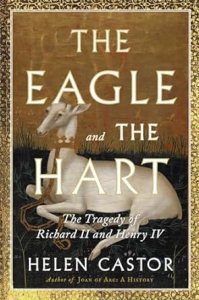
Book Review: “The Eagle and the Hart: The Tragedy of Richard II and Henry IV” by Helen Castor

The story of the Plantagenets is filled with high triumphs and devastating tragedies. It is a story of families torn apart for a crown and the desire to either rule with an iron fist for the glory of England or live a life of luxury at the expense of their citizens. The story explored in this particular book is the tale of two cousins born months apart, Richard of Bordeaux and Henry Bolingbroke. Richard and Henry were not born to become King of England, but Fortune’s Wheel had a different plan for the cousins. So how did these cousins become kings and how did their tale turn to tragedy not only for their relationship but for all of England? Helen Castor tells the tale of these two Plantagenet kings in her latest book, “The Eagle and the Hart: The Tragedy of Richard II and Henry IV.”

I want to thank Avid Reader Press and Net Galley for sending me a copy of this book. I have seen this book on social media and ever since it was announced, I knew I wanted to read it. I have enjoyed Castor’s posts online as well as her documentary on the She-Wolves, based on her book of the same name, so when I heard about this one, it was an intriguing premise and so I jumped at the chance to read it. 

The fact that Richard of Bordeaux and Henry Bolingbroke became King Richard II and King Henry IV respectively is quite the story. Richard was the son of Edward The Black Prince and Henry was the son of John of Gaunt; both of their fathers were sons of Edward III and so the idea was that one of his sons would inherit the throne. However, Edward III had different plans after the death of Edward The Black Prince. It was announced that the young Richard of Bordeaux would be crowned King of England. This should have been the first red flag for England because it means that a Regency council must be formed. There are fights for power and fights over finances that culminate in the Peasants’ Revolt. Richard II doesn’t have much desire to fight for his country on the battlefield against the French or the Scottish, but he does care about favoring his favorites, even if it means turning the government against him. One such group, the Appellant Lords, will prove an extremely dangerous challenge for Richard II, and it will include his cousin Henry Bolingbroke. While many of the Appellant Lords will end up dead, Henry Bolingbroke is merely exiled, which in the long run, was not the best decision for Richard II. 

In 1400, John of Gaunt died and the title as well as the lands of the Duke of Lancaster were turned over to Richard II while Henry Bolingbroke was in exile in France. This marks the turning point for Henry as he decides to invade England while Richard is away dealing with problems in Ireland. It will end with Richard’s abdication and the coronation of Henry Bolingbroke as King Henry IV. However, things are not all sunshine and rainbows for Henry IV, the 1st Lancastrian King of England, as he finds out that it is not easy being a king. 

I must applaud Castor for writing a dual biography that is both balanced and utterly brilliant. It did take me a while to read this book because I was taking so many notes while I was reading and it gave me a better understanding of this tumultuous time. I would suggest that if you do read this book, take your time so that you can understand the complex nature of the conflict between these two cousins. If you are a fan of the Plantagenet dynasty, I highly recommend you read, “The Eagle and the Hart: The Tragedy of Richard II and Henry IV” by Helen Castor.

Book Review: “The Archer’s Tale” by Bernard Cornwell

The year is 1342 in the sleepy coastal English town of Hookton when marauders attack and steal a precious relic. Thomas, a young archer, is the only survivor. With his father’s dying breath, he has given Thomas a mission to carry out, retrieve the relic, and avenge his family’s honor. The hunt for the man responsible takes Thomas to France during the beginning of the conflict that will be known as the Hundred Years’ War. Can Thomas of Hookton find the relic he was tasked to find or will another quest drag him into an even darker path? Thomas’s tale begins in the first book of the Grail Quest trilogy by Bernard Cornwell called, “The Archer’s Tale.”
I found this particular book in a used bookstore and it caught my eye. I have enjoyed the Saxon Stories series by Bernard Cornwell and so when I saw that he had written a trilogy set during the Hundred Years’ War, I was intrigued. I wanted to see how well he would tackle the medieval period and the conflict between England and France.

We begin with the massacre of Hookton, which happened in the early hour of Easter morning 1342. The prize that the raiders are after is the lance that St. George used to slay the dragon, or that’s the story that Father Ralph tells the town. His illegitimate son Thomas is given the task of recovering the lance for a man wearing black armor with a blue and yellow standard who happened to be Thomas’s cousin. As there is nothing left for Thomas in Hookton, he decides to join Will Skeat and his archers in France as they fight for King Edward III and his son Edward the Black Prince. It is in Brittany that Thomas is introduced to the Blackbird, a female archer whose true identity is Jeanette the widowed Countess of Armorica who is trying to protect her young son, the new Count of Armorica from the English.

After saving Jeanette from a complicated situation, Thomas is on the run for killing a man. It is while he is on the run that his life is saved by a Jewish doctor and in return, Thomas saves the life of a girl named Eleanor. This girl is the illegitimate daughter of Sir Guillaume d’Evecque, a French nobleman who was with the black armored man who attacked Hookton. They both have a grudge against the man, but Sir Guillaume offers Thomas a different quest, which is to find the Holy Grail, the same relic the man in black armor is searching for. Thomas decides that he must help his friends in the English army as they face off against the French army in the battle that will be known as the Battle of Crecy.

As someone who is a fan of the Saxon Stories series, I felt like Thomas of Hookton was very much like Uhtred of Bebbanburg in the way that he is on a long quest for revenge, but he discovers that he is destined for a bigger purpose and an even more deadly path. I found myself enjoying the way Cornwell portrays medieval England and France during this conflict and I am looking forward to seeing where Thomas of Hookton will go next and if he will get his revenge and recover the Holy Grail. If you love medieval tales full of adventure and action, you should check out the first book in The Grail Quest, “The Archer’s Tale” by Bernard Cornwell.

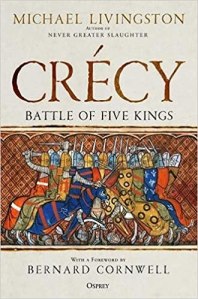
Book Review: “Crecy: Battle of Five Kings” by Michael Livingston

The year is 1346 and war has just begun between France and England. This conflict would be known as the Hundred Years War, which lasted over 116 years and ended in failure for the English. However, some glorious moments like Agincourt gave the English cause to celebrate, but none more so than the Battle of Crecy. It was a colossal battle between five European kings, leaving countless dead on the field without many long-term rewards. So how did the French and English armies meet on the field of Crecy and what truly happened? Michael Livingston dives deep into the archives and archaeological research to tell the truth of this famous battle in his book, “Crecy: Battle of Five Kings.”
I first heard about this title from a post by Dan Jones singing the praises of this book. I have heard about Crecy from books that I have read, albeit as a side note for the other storylines, so when I learned that there would be a new book about the battle, I jumped at a chance to read it.

Before we dive into the bulk of the conflict, we must understand the challenges of investigating a battle that happened centuries ago. Livingston explains that we must take the more traditional story of this battle with a grain of salt, especially regarding the death totals and the location of the fighting as they were more susceptible to alterations. We also must understand that the issue of biases comes into play and that every writer has a different motive for recording what they do and why some accounts were remembered and others lost to the past.

Livingston then dives into the origins of the conflict, the Hundred Years’ War, starting with the Norman Conquest and exploring how things like wine and wool led to England’s desire to capture the French crown. It is an extraordinary tale, but so were the marches by the English army, led by Edward III and his son the Black Prince, and the French army under the command of King Philippe VI, Charles II Count of Alencon, and King John (the Blind) of Bohemia. What I found fascinating is the different approaches that the French and English armies took on their road to Crecy and what they considered important during their campaigns. Finally, Livingston takes the time to focus on the battle itself, what we know about the battle, including the capture of the Black Prince and the death of King John of Bohemia, and the location where he believes the battle was fought.

This was my first time reading a book by Michael Livingston and I thoroughly enjoyed it. Livingston does a fantastic job of explaining his thought process when it comes to his theories on this important battle while also making it accessible to his audience. I learned so much about the battle, the campaigns of the French and English leading up to the battle, and how to re-examine a medieval battle. If you are a medievalist or just a medieval history nerd, “Crecy: Battle of Five Kings” by Michael Livingston is the book for you.

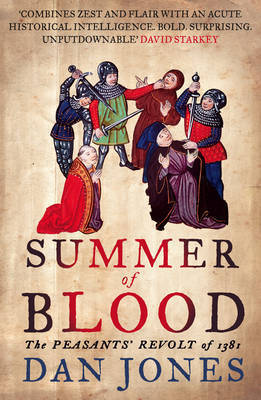
Book Review: “Summer of Blood: The Peasants’ Revolt of 1381” by Dan Jones

Summer of BloodThe year was 1381, and England was engulfed in chaos. A band of ruffians and revolters descended on London to achieve political change and a fair chance for the lower classes who suffered greatly from war and plague. The young King Richard II watched as men like Wat Tyler and the preacher John Ball led this ragtag army to his doorstep, fighting against his advisors, like John of Gaunt, to end a poll tax that was their last straw. Why did this ragtag army march on London? How did men like Ball and Tyler convince the masses to march against their sovereign and his government? How did this revolt end, and did the people get what they wanted due to their revolution? Dan Jones brings the bloody story of the first significant revolution by the English people to life in his book, “Summer of Blood: The Peasants’ Revolt of 1381.”
I have been reading books by Dan Jones for a few years now, but I have just read this particular title. The Peasants’ Revolt has always been a footnote or maybe a paragraph in books that I have read about the Plantagenets, John of Gaunt, and Richard II. I wanted a deeper dive into this momentous event in medieval English history, which is precisely what this book provides Jones’ audience.

The Peasants’ Revolt lasted from May to August 1381, sweeping across England, and was one of the most defining moments in English history. The Black Death had ravaged the English countryside, and the ones left had to pick up the pieces. Adding to the stress from the plague, England was at war with their bitter enemy France in the Hundred Years’ War, which the former King Edward III started, and the government was running out of funds. The English government under King Richard II had already created two poll taxes targeting the more affluent members of society. Still, they did not raise enough funds, so they came up with a brilliant idea in 1380 to create a third poll tax targeting the ordinary people of England.

To say the introduction of the third poll tax did not go over well with the people would be an understatement. The people were pissed off at their government, especially men like John of Gaunt, who they considered a tyrant and someone who did not care about the people. The revolt started in the town of Brentwood but soon spread like wildfire throughout Essex; men and women joined the cause to protest against the poll tax and corrupt politicians.

The angry mob would eventually adopt leaders like Wat Tyler, Jack Straw, and John Ball, adding fuel to the fire. They would march on London during the festival of Corpus Christi, looting, damaging homes, and killing those they deemed an enemy of the state. Richard II and his cousin Henry of Bolingbroke were in the Tower of London while the city was on fire and heads were rolling. Jones explains how matters came to a head when the ragtag army faced off against King Richard II’s army at Smithfield, where Wat Tyler fell, and the terror of Richard II rose to prominence.

Dan Jones does a superb job telling the story of the Peasants’ Revolt from the perspective of the ordinary people who marched for a better life and a bit of chaos. This little book contains fascinating facts, anger, blood, and gore that will entice anyone interested in medieval England. If you want a book about the early days of Richard II’s reign and the revolt that caused him to grow up quickly, I would highly recommend you read “Summer of Blood: The Peasants’ Revolt of 1381” by Dan Jones.

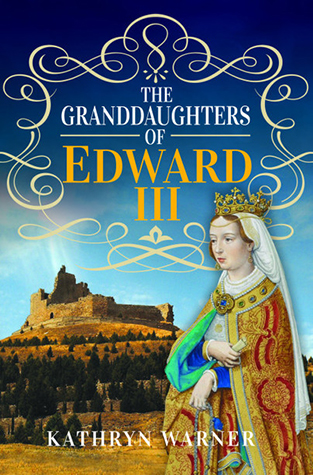
Book Review: “The Granddaughters of Edward III” by Kathryn Warner

Granddaughters of Edward IIIWhen we think about the legacy of Edward III, we often think about a warrior king who became king after his father, Edward II’s disastrous fall from grace. We know about his sons that he had with his beloved wife, Philippa of Hainault: Edward the Black Prince, Lionel of Antwerp, Duke of Clarence, John of Gaunt 1st Duke of Lancaster, Edmund of Langley, 1st Duke of York, and Thomas of Woodstock, Duke of Gloucester. Famously, we get the 15th-century conflict known as the Wars of the Roses through the descendants of Edward III. However, the male descendants only tell half the story of Edward III and Philippa of Hainault’s legacy in England and throughout Europe. In her latest book, “The Granddaughters of Edward III,” Kathryn Warner examines the lives of Edward III’s female descendants to better appreciate the strength of this group of branches of the Plantagenet family tree.
Thank you, Pen and Sword Books and Net Galley, for sending me a copy of this book. I am always looking for more books about the Plantagenets, and I know a bit about Edward III’s sons but not much about his granddaughters.

Warner has chosen to take a joint biography approach to this book by focusing on nine out of eleven of Edward III’s granddaughters. These eleven granddaughters were the daughters of Lionel Antwerp, John of Gaunt, Isabella Woodstock, Edmund of Langley, and Thomas of Woodstock. The eleven granddaughters of Edward III and Philippa of Hainault were: Philippa of Clarence, Philippa of Lancaster, Elizabeth of Lancaster, Marie de Coucy, Philippa de Coucy, Catalina of Lancaster, Constance of York, Joan Beaufort, Anne of Gloucester, Joan of Gloucester, and Isabel of Gloucester.

These women were not just great ladies in England, but in the case of Philippa of Lancaster and Catalina of Lancaster, they were Queens of Portugal and Castile, respectively. Philippa of Lancaster ushered in the Illustrious Generation in the history of the royal family of Portugal. Catalina married her mother’s mortal enemy to create a stronger connection between England and Castile. Back in England, the remaining granddaughters had to deal with rebellions against King Henry IV, resulting in husbands and sons being beheaded. One had married her former brother-in-law when her husband died, and another had an affair with the king’s half-brother, resulting in the birth of an illegitimate daughter. A granddaughter had her marriage annulled when her husband decided to marry a lady-in-waiting. One began her life as an illegitimate child and would end up being the grandmother to two Kings of England.

Warner has been able to take the stories of these eleven women who shared a grandfather and show how their tales transformed England, Castile, and Portugal forever. The amount of love and attention she dedicated to this book is admirable. I appreciate how Warner could give readers who only understood the English side of these tales a better understanding of the political situations in Castile and Portugal. If you want a book with brand new medieval heroines with a connection to the Plantagenet dynasty, I highly recommend you read “The Granddaughters of Edward III” by Kathryn Warner.

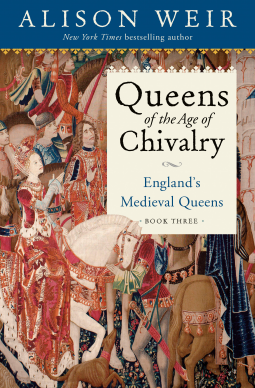
Book Review: “Queens of the Age of Chivalry: England’s Medieval Queens” by Alison Weir

cover263156-mediumWhen we think of the title “medieval queen,” a few things come to mind. They were seen as mere trophy wives who were only suitable for making alliances and giving birth to children. It may be a cruel assessment for a modern audience, but that was the reality of the medieval world. However, the late Plantagenet queens decided to step outside the socially acceptable path for their lives and forged a new one. In Alison Weir’s latest nonfiction book, “Queens of the Age of Chivalry: England’s Medieval Queens,” she explores the lives of five Plantagenet queens who had to adapt quickly to the ever-changing world of late medieval England.

Thank you, Ballantine Books and Net Galley, for sending me a copy of this book. I have read and enjoyed the previous books in England’s Medieval Queens series, and I wanted to see which queens would be included in this book.

The years covered in this book are 1299-1399, a time of turmoil, change, and the plague. During that time, five queens forever left their marks on England: Marguerite of France, Isabella of France, Philippa of Hainault, Anne of Bohemia, and Isabella of Valois. Their royal husbands were Edward I, Edward II, Edward III, and Richard II. Since these queens were foreign brides, it was a balancing act between what their home country expected of them and what England expected their new queen to do, which was, in most cases, to give birth to heirs and to stay out of politics.

We begin with Marguerite of France, who was the second wife of Edward I and the step-mother of Edward II; her most extraordinary claim to fame was to try and prevent her son from ever seeing Piers Gaveston, which sadly did not last long. Isabella of France had to deal with Edward II’s favoritism to not only Piers Gaveston but to Hugh Despenser the Younger. This led her to join Roger Mortimer and rebel against her husband. This decision would create a black cloud around her reputation for centuries.

As part of the rebellion, Edward III married Philippa of Hainault, who was the closest of these five queens to be the ideal medieval queen. She gave Edward III many heirs that would help define future generations. Richard II’s first wife, Anne of Bohemia, was the essence of sophistication, but her death sent him reeling, forcing him to take a child bride named Isabella of Valois.

Being a queen in the late medieval period was not easy, especially with the Black Death, the Hundred Years’ War, the Peasants’ Revolt, and internal struggles were constantly in play, but the five queens mentioned in this book were able to navigate this tumultuous time to create their legacies. Weir once again weaves fun facts and compelling tales of each queen to give her readers her perspective on their true legacies. If you have enjoyed the previous books in “England’s Medieval Queens” series, I would highly recommend you read “Queens of the Age of Chivalry: England’s Medieval Queens” by Alison Weir.