
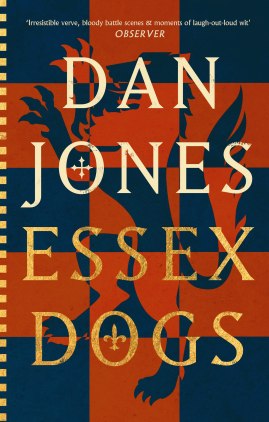
 The year is 1346, and numerous English ships have landed on the shores of France. King Edward III, his son Edward of Woodstock, and his lords launched the first stage of what would be known as the Hundred Years’ War. Amongst the English royalty, nobility, and regular soldiers, are companies of men who came of their own accord for money and glory. One company of men consists of ten men known as the Essex Dogs, led by Loveday FitzTalbot. They are not like the other groups. They do not fight for money or glory; they fight for each other. In the horrors of war in a foreign land, can the Essex Dogs keep their promise and stay alive? Dan Jones introduces the world to these ten men and the early stage of the Hundred Years’ War in his first historical fiction novel, “Essex Dogs.”
I have read nonfiction books by Dan Jones for years now, and I have thoroughly enjoyed the amount of detail he puts into each book. When Dan Jones announced that he would dive into the world of historical fiction, I was fascinated to see how well he could handle the transition from historical nonfiction to fiction. I was pleasantly surprised by how this amazingly gripping novel.
This story, from the landing in France to the Battle of Crecy, is told through the eyes of Essex Dogs, a rag-tag group of men from England, Scotland, and Wales. Each man has a past that they are trying to run away from, but their loyalty to each other unites them to finish their forty days of service to King Edward III. Some Essex Dogs include the pint-size fighter Pismire, the strong Scotsman, and the loyal Millstone. We also have crazy priest Father, the young and naive archer Romford, and their fearless leader, who will do anything to keep his group together, Loveday FitzTalbot.
I love the colorful interactions that the Essex Dogs had between one another and with the actual people who were involved in the campaign to Crecy. Each soldier’s struggles, from injuries and drug use to strategies and the punishments for not following royal commands, were written brilliantly. However, one area in which Jones excelled was portraying the brutality of war. The battles and skrimmages Jones included were so believable that I had to collect my breath after each battle before I went back to ensure the Essex Dogs were okay. Even the fights between companies were thrilling and will stay with me for a long time ( I am looking at you, chapter 12).
I honestly did not know what to expect when I ordered this book back in February, but it was a masterpiece. I can’t believe it took Dan Jones this long to write historical fiction, but I cannot wait for the next book in this trilogy. It is easily one of my favorite historical fiction novels of this year. If you want an electrifying novel with a compelling cast of characters set at the beginning of the Hundred Years’ War, “Essex Dogs” by Dan Jones is a must-read.
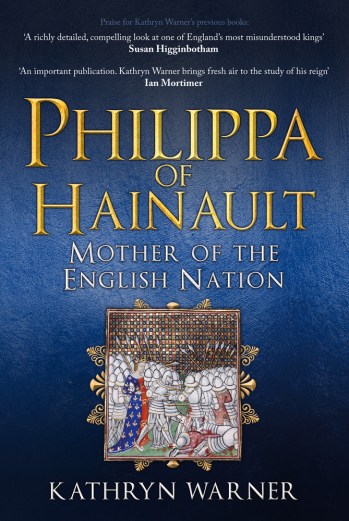 In medieval England, the queens were almost as famous, or infamous, as their husbands. In most cases, they came from royal backgrounds and their sons would become kings. That, however, was the case for Philippa of Hainault, the wife of King Edward III. She tends to be forgotten when it comes to discussing her famous husband, her infamous mother-in-law Isabella of France, and her sons whose children would go on to shape English history forever. That is until now. Kathryn Warner has decided to discover the truth about this rather remarkable woman in her latest biography, “Philippa of Hainault: Mother of the English Nation”.
 Adventures of a Tudor Nerd