
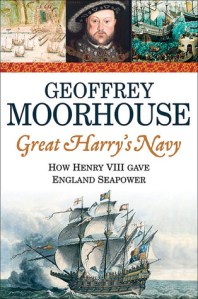
 One would assume that, since England is an island nation, its navy has been its strength since its foundation. That, however, was not always the case. While there were naval battles during the Middle Ages, it was not a navy like we know today. The concept of the Royal Navy was founded during the time of the Tudors, especially under the reign of Henry VIII. So, how did Henry VIII turn a navy from 7 ships to over fifty ships that could stand with other European navies? Geoffrey Moorhouse examines the creation of the English navy in his book, “Great Harry’s Navy: How Henry VIII Gave England Sea Power.”
This particular title was a used bookstore find for me. I saw that it was about the Tudors, and an aspect that I am not super familiar with. I don’t read a lot of nautically-based books, especially nonfiction, so I decided to go on a whim and try it out.
Moorhouse recognizes that this is a highly specialized book, so before delving into the history, he includes an extensive glossary at the beginning of the book to assist those unfamiliar with nautical terminology. He then dives into the origins of the English navy pre-Henry VII, and we can see that Henry VII did not leave his son, Henry VIII, many ships. However, Henry VIII had such a passion for ships that he got to work right away making shipbuilding centers and making sure that the right men were in the positions of power to make his navy superior to those in Europe. Moorhouse goes into minute detail to show how the Tudor navy rose, fell, and rose again to create a foundation that Henry’s children, Edward VI, Mary I, and Elizabeth I would build upon to create a sea superpower.
I am a fan of challenging books and discovering new topics in history. I wanted to learn more about naval history, presented in an easy-to-follow writing style. While Moorhouse does attempt to do this, his exuberant nerdy side for naval history comes out, and it felt like he was having a conversation with experts, not novices. It was one of those books that took me a long time to read because there was so much information that I was trying to digest as a novice.
I think this book is definitely written for a specific group of people, and they are those who love nautical history and learning about the Tudors. For novices, like myself, it may be quite a trial to read. If you are in the latter category and you want to read this, take your time and take notes if need be. I think this is a book that could be a great resource for historical fiction authors and just those who want a different approach to the Tudors. If that is you, “Great Harry’s Navy: How Henry VIII Gave England Sea Power” by Geoffrey Moorhouse might be a book to add to your collection.
 Do you have a favorite historical figure whom you have wondered what would have happened if they survived their dark fate? Have you wondered what would happen if they had fantastical abilities, such as transforming into animals? Maybe the last piece sounds a bit too far-fetched, but it makes for an interesting concept for a novel. What if we took the story of Lady Jane Grey, the Nine-Day Queen of England, and turned the tale into a fantastical comedy full of romance and adventure? Then, you would get the premise of “My Lady Jane” by Cynthia Hand, Brodi Ashton, and Jodi Meadows.
 A princess born to a king and his second wife lost her title and legitimacy when her father decided that her mother, Anne Boleyn, needed to die. Elizabeth Tudor knows the meaning of resilience as she survived her childhood during her father King Henry VIII’s reign. Now that her father is dead Elizabeth is at the mercy of her half-siblings Edward and Mary, plus any scheming man who wants to marry her and get closer to the crown. Can Elizabeth survive her siblings’ reigns or is she destined to be locked in the Tower to await her ultimate fate like her mother? Janet Wertman explores the life of Elizabeth Tudor in her latest series
 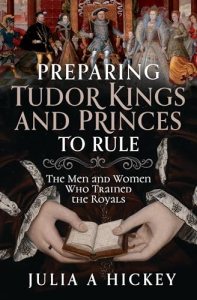 In life, when it comes to a new skill or job, you must be trained to become good at it. The same can be said for the monarchy, which in a sense is a job that encompasses one’s entire life. You have to understand different languages, rhetoric, the arts of dancing, and music, as well as diplomacy and physical activities if you want to rule a nation. It may seem like a lot for one person to handle, but from the moment of their birth, a prince or princess has a team of people behind them to make sure that they are ready to either rule their home country or create an alliance with other nations. The Tudors knew how important educating their future monarchs was for the survival of the dynasty. Julia A. Hickey examines the people behind the teams raising the future Tudor monarchs in her book, “Preparing Tudor Kings and Princes to Rule: The Men and Women Who Trained the Royals.”
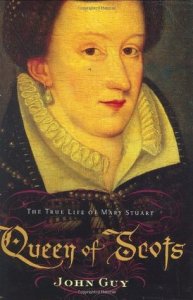 Women rulers in the past have either been praised or pushed down. They are either seen as ideal women or power-hungry villains. One such figure who suffered the worst from having her image raked through the mud for centuries was Mary Stuart, known throughout history as Mary, Queen of Scots. The Queen of Scotland who was married three times, was once the Queen of France, the mother of the future King of both England and Scotland, accused of having a hand in her second husband’s murder, plotted to overthrow Elizabeth I, and was executed for treason. Her story is well known, but what does the archival information tell us about Mary Stuart? John Guy scoured the archives to find the truth about this queen and presented his research in his biography, “Queen of Scots: The True Life of Mary Stuart.”
 Treason is the crime of betraying one’s country or monarch by trying to overthrow the government or kill a sovereign. While many English dynasties dealt with treason in their ways, the most infamous were the Tudors and how they dealt with the nobility. By the end of 1572, there were no more dukes in England, until 1623 when George Villiers became the Duke of Buckingham. What was classified as treason during the Tudor dynasty and why did the members of the nobility have to die? Helene Harrison hopes to answer these questions in her latest book, “Tudor Executions: From Nobility to the Block.”
 The royal dynasties of English history are some of the most popular in European history. We have the Normans, the Angevins, the Plantagenets, who occupied the throne for 300 years, the Scottish Stuarts who saw religious change and political upheaval, the haughty Hanovers, and the current Windsor dynasty. However, one dynasty that has captured the imagination of history nerds for centuries has been the tumultuous Tudors. In book two of Peter Ackroyd’s “The History of England: Tudors,” he explores the stories that made the Tudor dynasty so infamous.
 Time travel is a dream for history and science fiction nerds alike. To be able to go to a different period in history to witness major events sounds like it would be tons of fun, but it can also be treacherous if you do not know the era well. What should you wear? Where would you live? What would your occupation be and what should you eat? If you are invited to court, how do you navigate the crazy court intrigue and the ever-changing religious dilemma? Toni Mount has created the ideal book for those who wish to travel to the 16th century called, “How to Survive in Tudor England.”
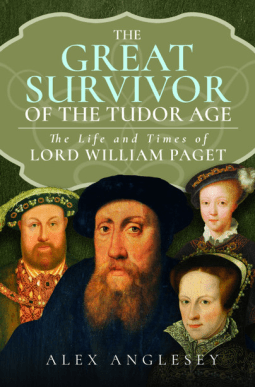 Rulers cannot govern alone. They require a team of men and women behind them to operate as a cohesive unit. The same can be said for rulers during the Tudor dynasty. We know the stories of men like Cardinal Wolsey and Thomas Cromwell, two men who rose through the ranks to prominent seats of power to ultimately have disastrous falls from grace. However, there was a third Tudor politician who should be in this discussion about rags-to-riches stories. He was the son of a common merchant who went to serve most of the Tudor monarchs as an advisor. Conspiracies and rebellions kept him on his toes, but he ultimately survived the Tudor dynasty, which was a difficult thing to achieve. His name was Lord William Paget and his story is told by his descendant Alex Anglesey in his debut book, “The Great Survivor of the Tudor Age: The Life and Times of Lord William Paget.”
 Adventures of a Tudor Nerd