
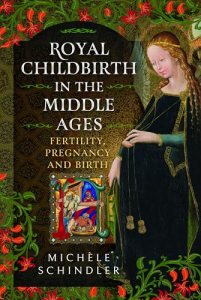
 Throughout history, many aspects of life have changed drastically, but one thing has remained the same: the different stages of life—birth, youth, adolescence, adulthood, old age, and death. It is the first stage of life, birth, that tends to get the least amount of attention when it comes to historical research. In recent years, it has been gaining more and more attention, especially when it comes to royal births, which have the most amount of written records. Michele Schindler has chosen to focus on the aspects of medieval childbirth in her latest book, “Royal Childbirth in the Middle Ages: Fertility, Pregnancy and Birth.”
I would like to thank Pen and Sword Books and Net Galley for sending me a copy of this book. I have enjoyed the previous book that I have read by Michele Schindler, and so when I saw that she had a new book about the medieval period out, I was excited to read it. I have read a few books that featured childbirth, primarily in the Tudor period, but never when it comes to the medieval period, so I wanted to learn more.
Schindler has decided to divide her book into sections, each part focusing on a different stage of childbirth: conception, pregnancy, birth, baptism, infant care, and how society as a whole understood childbirth as part of a woman’s life. Each section has sub-sections that explore aspects like miscarriages, twins, confinement, stillbirths, wet nurses, and deaths during infancy. These are very heavy topics, but they are discussed in a respectful manner.
To give context to the topics discussed, Schindler uses examples from multiple centuries to show how royal and noblewomen dealt with childbirth and its struggles. Some of the women featured in this book include Margaret Beaufort, Margaret of Anjou, Eleanor Cobham, Isabella of Castile, Alice Chaucer, Anne Neville, and Elizabeth of York. She also compared these lives and how they experienced childbirth to the common people to show the difference in status and the importance of ceremonies like confinement to the nobility.
Overall, I found this book to be really well researched, as well as being pretty easy to follow along with. I found a deeper appreciation for medieval women and what they had to go through to have a child. If you want to learn more about medieval childbirth practices pertaining to the higher echelons of society, I would recommend you read “Royal Childbirth in the Middle Ages: Fertility, Pregnancy and Birth” by Michele Schindler.
 In English history, the story of the royal families tends to capture the imagination of those who study it. Full of dynamic tales of kings and queens, and numerous nobles, these are tales that make it into history books and history classes. We tend to focus on the same kings and queens, who have become the popular royals. But what about those who are left in the dust of those popular royals? Who were the royal women who lived in the shadow of the throne that time has forgotten? What were the lives of these women like? It is these women who are the focus of Erin Lawless’s latest book, “Forgotten Royal Women: The King and I”.
 Adventures of a Tudor Nerd