
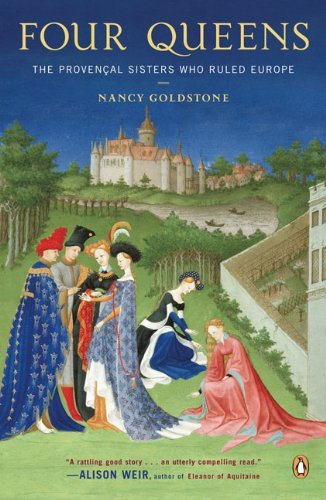
 In southeastern France, there is a region called Provence, known today for its lavender fields and its vineyards. In 13th-century France, Provence would be known as the birthplace of four queens who dominated European politics. The daughters, Marguerite, Eleanor, Sanchia, and Beatrice were the daughters of Raymond Berenger V Count of Provence, and his wife Beatrice of Savoy. They would become the queens of France, England, Germany, and Sicily. While the sisters were known for their beauty, how they acted as queen consorts for their husbands cemented their legacies in history. Nancy Goldstone tells the tale of these remarkable siblings and how they changed European history in her book, “Four Queens: The Provencal Sisters Who Ruled Europe.”
I am always looking for a new history story to familiarize myself with to read and grow as a history nerd. I was familiar with Eleanor of Provence as she is mentioned in biographies about Henry III, but her sisters were a complete mystery to me and so when I heard about this book and its exploration into the sister queens and 13th-century European history, it intrigued me.
Goldstone begins with a story of how the English King Henry III met with the French King Louis IX in Paris during Christmas 1254, and this extraordinary meeting was orchestrated by two sisters, Eleanor and Marguerite of Provence. We then jump back in time to the childhood of the four sisters in Provence, full of wine and songs of the troubadours. At the heart of this glamorous court was Raymond Berenger V and Beatrice of Savoy, Count and Countess of Provence, along with their four daughters; Marguerite, Eleanor, Sanchia, and Beatrice. All around Provence, wars raged, and without a male heir, Raymond Berenger V and his beloved Provence risked the wars coming into his home and taking everything he loved. What is a father to do, but make exceptional matches for his daughters?
Marguerite, the oldest daughter, was married to the young Louis IX of France, thanks to the deal made by her father and her new mother-in-law, the formidable Blanche of Castile, the White Queen. Guillaume of Savoy, the sisters’ uncle, decided to arrange the next marriage, which was between Eleanor of Provence and the King of England, Henry III, who had been ruling a turbulent nation for over 20 years. The two eldest sisters would help weather civil wars and crusades to allow the dynasties that they married to survive.
The younger sisters, Sanchia and Beatrice, married men who were also younger siblings and were fighting for their rights to rule in Europe. Sanchia married Richard, Earl of Cornwall, the younger brother of Henry III. They would become King and Queen of Germany for only a brief time, but they would pave the way for the Habsburgs. Finally, Beatrice married the younger brother of Louis IX, Charles Count of Anjou; they would soon become the King and Queen of Sicily.
In the world of 13th-century Europe which was dominated by kings and popes fighting crusades and civil wars, it was the women at home and their husbands’ sides that helped stabilize nations. Marguerite, Eleanor, Sanchia, and Beatrice were fierce women who were loyal to their own families even if that meant that they had to step in the way of their sister’s glory. Goldstone can weave together a narrative of all four siblings that is compelling, engaging, and academically fascinating. If you want a book that explores the familial bonds of four sisters and the lengths that they had to go to to protect what they loved the most, I highly suggest you read, “Four Queens: The Provencal Sisters Who Ruled Europe” by Nancy Goldstone.
 Two women who shared a name, related by marriage but divided by political and monetary motives. In Medieval Europe, this statement could refer to any number of women, but the two women who are the center of this particular story revolve around medieval England and the reign of King Henry III. One was Henry’s sister whose marriages and money problems were a thorn in her brother’s side. The other was Henry III’s wife who stood by his side and protected their children even when the nation despised her. Their names were Eleanor de Montfort and Eleanor of Provence respectfully; their stories are filled with disasters and triumphs that would shape how England was ruled in medieval times. Darren Baker explores their lives and the lives of their families in his latest biography, “The Two Eleanors of Henry III: The Lives of Eleanor of Provence and Eleanor De Montfort”.
 Adventures of a Tudor Nerd