
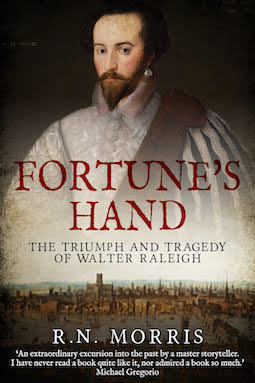
 I am not sure how I came to write a novel about Walter Raleigh. I think I can trace it back to visiting an exhibition on the myth of El Dorado at the British Museum in 2013. But thousands of people went to that exhibition and I dare say very few of them were foolish enough to start writing a 100,000 word novel under its influence.
The dream of the fabled city of gold was one that obsessed Raleigh for decades. He pinned his political hopes on finding it and bringing home its treasure, first for Queen Elizabeth I, so that he could provide her with the funds she needed to defend herself against her great enemy Spain; and later for her successor James I, no longer at war with Spain, but still, like every sovereign in history, desperately short of finances.
In both instances, however, the dream proved to be illusory.
Nonetheless, it was a dream that sustained him through periods of imprisonment and personal tragedy. A dream that he invested his reputation in, and one that he used to entice investors into his highly speculative voyages of discovery and predation. However, it surprised me to discover that Raleigh took part in surprisingly few of these voyages himself; he was an indifferent sailor who suffered badly from seasickness.
Raleigh first heard about El Dorado from a captured conquistador called Pedro Sarmiento de Gamboa. It was just a rumour. A rumour carried on a warm breeze from a distant land.
It seems ironic that a man who was so talented at creating his own mythology should fall victim to a myth. But perhaps that was why he was so drawn to the story, because he knew a great myth when he saw one, and understood more than most its power to inspire minds and influence behaviour. The myth of El Dorado was useful to Raleigh, not because he himself necessarily believed it to be true (there is evidence he didn’t) but because he knew that other men – and, most importantly, one woman – would.
I fell under its spell too.
When I started my research for the book, I knew very little about Walter Raleigh. The one thing I did know was the one thing that everyone knows: he spread his cloak across a puddle so that Elizabeth could walk across it without getting her feet wet. The more I progressed in my research, the less sure was I that this incident actually happened, at least not as it is depicted in countess children’s history books.
It is a compelling idea imbued with meaning. There’s another word for compelling ideas imbued with meaning: myths.
As a child, I thought the point of the story was simply to illustrate what a gentleman Raleigh was. Now I realize there was a bit more to it than that. Raleigh was positioning himself (to borrow a term from modern marketing) as the man who would safeguard his sovereign’s passage across a body of water. In other words, he would be the instigator of England’s colonial project on the other side of the Atlantic.
Raleigh’s life seems to be filled with stories that, even if they fall short of mythical, have at the very least a strong whiff of the apocryphal about them. I don’t believe it’s an accident. Whatever else he was, Raleigh was a poet. His life was his greatest poem, even if it didn’t quite have the ending he might have planned.
In my novel, I see him as a man of boundless imagination. There was nothing he could not envisage. And for him, imagining something was tantamount to accomplishing it. As he gets older, the lines between what he dreams and what he does blur.
Of course, reality did not always play along. But that never seemed to deter him from putting even greater faith in the power of his imagination.
This was the age of Dr John Dee, after all, the great conjuror of angels and demons. Raleigh consulted Dee on navigational matters as well astrological ones. You could say between them they conjured up the British Empire.
In Fortune’s Hand, I imagine Raleigh reciting the names of the places in Guiana that lead to Manoa – the city identified with El Dorado – as if he is uttering the words of an incantation. He even uses this litany of exotic names to soothe Elizabeth when she is distressed.
Raleigh wrote a long, unfinished epic poem in which Ocean addresses his love, Cynthia – AKA the moon. He was given the nickname ‘Water’ by Elizabeth, mocking his West Country pronunciation of his own name. He clearly identified himself with Ocean and Elizabeth with Cynthia, in other words he saw them both as mythic figures. I think it’s a very compelling image for their relationship. The moon is ever remote, changeable, presenting a cool, pale beauty. The ocean’s tides are subject to the lunar gravity, just as Raleigh was subject to Elizabeth’s commands, and whims.
The problem with such self-mythologizing is that it tends to be self-aggrandizing too. And if you see yourself as a hero or a demi-god, it probably means you don’t have much empathy for others. Especially those who have to be defeated, displaced and destroyed to make your myth a reality.
Empathy is not a quality much evident in the Raleigh of my novel. I said above that I saw him as a man of boundless imagination, but it is only boundless when it applies to himself and his interests. He has a curious imaginative blind spot when it comes to considering those whose interests are at odds with his, whether they are his rivals for Elizabeth’s favor, or the rebels he massacred in Ireland.
That makes him a problematic figure in today’s world. But then, to be fair to Raleigh, he wasn’t living in today’s world. The attitudes and beliefs that were woven into the intellectual fabric of the Elizabethan age strike us now as at best baffling and at worst appalling.
So why write a novel about this pre-eminent Elizabethan, at a time when others are petitioning to pull down his statue? The mythology that he created and others have added to has become entangled with England’s national story. I wanted to explore and try to understand the impulses that drove Raleigh through his remarkable life, in which he laid the groundwork for the British Empire. That is clearly a contested legacy now. To challenge and critique that legacy fully, I felt the need to confront one of its key originators – warts, myths and all.
R.N. Morris Bio:
Roger (R. N.) Morris is the author of thirteen novels. The latest is Fortune’s Hand, a historical novel about Walter Raleigh. He is also the author of the Silas Quinn series of historical crime novels and the St Petersburg Mysteries, featuring Porfiry Petrovich, the investigating magistrate from Crime and Punishment.
His website is rogernmorris.co.uk. Roger has a Facebook page for his novels, which is https://www.facebook.com/RNMorrisauthor
He is on twitter as @rnmorris and on Instagram as rogermorris7988. He would love to hear from you so drop him an email at contact@rogernmorris.co.uk
 The stories of the men behind the English crown can be as compelling as the men who wore the crown themselves. They were ruthless, cunning, power-hungry, and for many of them, did not last long. However, there were a select few who proved loyal to the crown and lived long and eventful lives. They are not as well known as their infamous counterparts, yet their stories are just as important to tell. One such man was the grandfather of two of Henry VIII’s wives and the great-grandfather of Elizabeth I. He lived through the reign of six kings and led his men to victory at the Battle of Flodden against King James IV of Scotland towards the end of his life. Thomas Howard, 2nd Duke of Norfolk had his fair shares of highs and lows, including imprisonment, but his story is rarely told. That is until now. Kirsten Claiden-Yardley has taken up the challenge to explore the life of this rather extraordinary man in her book, “The Man Behind the Tudors: Thomas Howards, 2nd Duke of Norfolk”.
 In history, we tend to focus on the stories of the men and women who shaped the era. This is obviously important, but the locations where the events of the past happened are equally as important. Sadly, many of the buildings that the men and women from the past knew no longer exist. However, there are a few, especially from the Tudor period, that we can still visit. Suzannah Lipscomb explored over 50 of these remarkable buildings and decided to tell their tales in her book, “A Journey Through Tudor England”.
 The Tudor dynasty and the enigmatic figures who made this time period so fascinating have been hotly discussed for centuries. Henry Tudor, who became King Henry VII after defeating King Richard III at the Battle of Bosworth Field in 1485. King Henry VIII, the second son whose numerous wives and his split from the Catholic Church made his name infamous in history. King Edward VI, Henry VIII’s beloved son who died before he really could accomplish the reformation that he had planned for England. Queen Mary I, who was the first Queen of England to rule in her own right and wanted to restore the Catholic Church. Finally, Queen Elizabeth I, who never married and led England to a “Golden Age”. Many historians have viewed the Tudor dynasty as a time of great change and England was in a good place. However, G.J. Meyer paints a darker picture of the era in his book, “The Tudors: The Complete Story of England’s Most Notorious Dynasty”.
 The story of Anne Boleyn is one of love, triumph, and tragedy. Her tale has been told in many different ways in the several centuries since her execution by many different people. Except by Anne Boleyn herself. We never truly understood what it might have felt like when she went to court for the first time, what it must have felt like to have fallen in love with King Henry VIII. How she might have felt when she had her daughter and experienced her numerous miscarriages. The devastation she must have felt when she found out about Henry’s abusive side, his mistresses, and her ultimate demise. That is until now. In Holly-Eloise Walters’ debut novel, “The Most Happy”, Anne Boleyn tells her personal story, giving the readers a better understanding of the legend.
 The 16th century was filled with extremely strong women who went on to shape European and world history forever. This was true for England and Scotland, two countries whose stories were intertwined by powerful women. The women who ruled these two countries during this time were women that those who study this time period know about; Lady Jane Grey, Mary I, Elizabeth I, and Mary Queen of Scots. There was one woman who knew all four of these women and lived for over 80 years: Bess of Hardwick, Countess of Shrewsbury. The story of these five women is told in Jill Armitage’s book, “Four Queens and a Countess: Mary Queen of Scots, Elizabeth I, Mary I, Lady Jane Grey and Bess of Hardwick: The Struggle for the Crown”.
 Attractive, wealthy and influential, Katherine Willoughby is one of the most unusual ladies of the Tudor court. A favourite of King Henry VIII, Katherine knows all his six wives, his daughters Mary and Elizabeth, and his son Edward.
 Author Bio
 The study of the Tudors tends to focus on England as a country of focus, however the Tudors did affect other countries like Spain, France, and Scotland. Many know the story of Mary, Queen of Scots and her relationship with Elizabeth I, but many do not know the tale of her mother, Marie de Guise. Her tale is one of love for her family and her adoptive country of Scotland. It is of loyalty and strength to do what she believed was right. She was a sister, a daughter, a mother, a queen, and a regent of Scotland. Marie’s story tends to be overshadowed by her daughter’s tragic tale, until now. Her story is the main focus of Melanie Clegg’s latest biography, “Scourge of Henry VIII: The Life of Marie de Guise”.
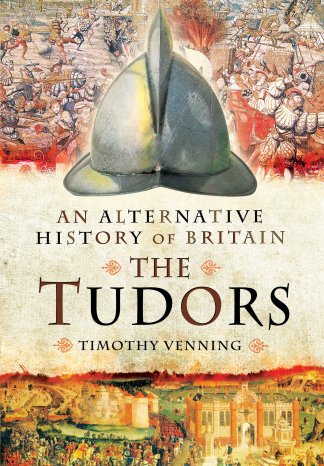 The study of history is all about asking questions about how and why events happened. We understand that history is very much a study of cause and effect; if a certain person causes something to happen, we study the effect of those actions. But what if the person changes what they do? What would happen to the course of history? These are considered the “what ifs” of history, which is something that history fans and students like to discuss with one another. These questions rarely are discussed in books, until now. Timothy Venning explores some of the “what ifs” of the Tudor Dynasty in his book, “An Alternative History of Britain: The Tudors”.
  Adventures of a Tudor Nerd