
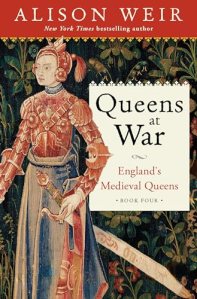
 The fifteenth century in England was a time of war. Between a usurper king, fighting with France, and fighting amongst themselves, an English king must be prepared to go into battle at any moment, and his queen must be ready to support him in any way. During this period, there were five kings and queens, and while the kings get a lot of attention, it is the queens who should get their flowers for what they did in times of distress. Alison Weir explores the lives of the final five Plantagenet queens in her final book in the England’s Medieval Queens series, entitled “Queens at War.”
I would like to thank Ballantine Books and NetGalley for providing me with a copy of this book. I am a big fan of Weir’s books, and I have thoroughly enjoyed her England’s Medieval Queens series. I wanted to see which queens Weir would focus on in this book and how she would approach their lives.
The years covered in this last book are 1399-1485, covering the reigns of Henry IV, Henry V, Henry VI, Edward IV, and Richard III. The queens featured in this book are Joan of Navarre, Katherine of Valois, Margaret of Anjou, Elizabeth Woodville (spelled Widville in this book), and Anne Neville. While I am familiar with the stories of Katherine, Margaret, Elizabeth, and Anne, Joan is a less well-known figure to me. Weir gives her readers a bit of background information about how Joan of Navarre was Henry IV’s second wife after his first wife, Mary de Bohun, died. Joan was married previously as well, to John IV de Montfort, Duke of Brittany. While she did have children with John, she never had royal children with Henry IV. Weir shows how Joan was treated as the stepmother to King Henry V after he married Katherine of Valois.
Weir explores Katherine of Valois’ relationships with both Henry V, the warrior king, and Owen Tudor, the man she fell in love with after the death of Henry V. We get to see how Katherine’s son, Henry VI, and his wife, Margaret of Anjou, dealt with the rising Yorkist faction. With her husband taking ill, it was Margaret of Anjou who was the figurehead for the Lancastrian cause in a conflict that would be known as the Wars of the Roses. Eventually, a young man named Edward IV would become King of England, and he shook the English court by marrying an English woman, Elizabeth Widville (Woodville). Finally, Weir explores the downfall of the Plantagenet dynasty and the end of the young Yorkist regime with Richard III and his wife Anne Neville.
Overall, I found this an informative and easy-to-follow book. It was a bit of a review for me as I am familiar with this period, but I found myself learning new information in this book, which was exciting. I think if you want to learn about 15th-century queens or if you are a fan of England’s Medieval Queens series, I recommend you read “Queens at War” by Alison Weir.
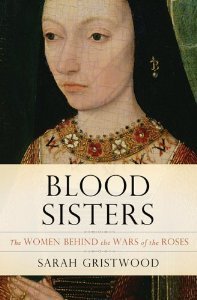 When it comes to studying wars from the past, we often focus on the men who fought during the battles the strategies that were implemented to win and the plans that backfired spectacularly. So frequently in the study of wars, we forget about the women left behind, but in fact, they had bigger roles to play than sitting on the sidelines. For example, the royal women who lived in England during the conflict known as the Wars of the Roses played an essential role in how the wars concluded. These women are slowly coming into the spotlight in biographies and historical fiction novels, but it is rare to read a book about the Wars of the Roses where the central figures are the women, until now. Sarah Gristwood has taken seven women from this age and weaved their stories into her book, “Blood Sisters: The Women Behind the Wars of the Roses.”
 The Woodvilles were a family synonymous with the Wars of the Roses and the rise of King Edward IV. Some of the more notable names from this family include Jacquetta Woodville, the family’s matriarch, and Elizabeth Woodville, the controversial choice for King Edward IV’s wife. However, it was not just the women of the Woodville family who made a name for themselves. Anthony Woodville, the son of Jacquetta and brother of Elizabeth Woodville, would become famous for his unexpected execution at Pontefract Castle. Still, there was so much more to his story than his death. Who was Anthony Woodville and what is his legacy? Danielle Burton hopes to answer these questions and more in her debut biography, “Anthony Woodville: Sophisticate or Schemer?”
 When we think about royal relationships from the past, we do not associate them with love; it is more about cementing power. Princes and kings knew how much was at stake, so they tended to have wives for politics and produce legitimate heirs that would inherit their kingdoms. For matters of love and lust, kings and princes would have mistresses, either of noble birth or lower, on the side. These women have been deemed whores and homewreckers but is that a fair assessment of their legacies? Julia A. Hickey takes a closer look at these misunderstood mistresses in her latest book, “Medieval Royal Mistresses: Mischievous Women who Slept with Kings and Princes.”
 When one says “the Princes in the Tower,” a few images pop into our mind. Two young boys were killed in the Tower by their evil uncle, who would become King Richard III. At least, that is the image that the Tudors wanted the world to see, and for centuries, that story has often been told. However, as research has expanded into who Richard III was, the tale of these two boys and their ultimate fate has become even murkier with new suspects and the question of whether the boys were murdered. Elizabeth St. John decided to take on the mystery of the Princes of the Tower with her twist to the tale in her latest novel, “The Godmother’s Secret.”
 During medieval wars, one’s fate is often determined by the spin of the Wheel of Fortune, even for those who did not fight a single battle. One could be living a life of luxury, stability reigning supreme, and is destined to marry a foreign king or prince, but when the wheel begins to spin, all seems lost, and the things that once were as good as guaranteed fall by the wayside. This description could fit any number of stories from the past. Still, the one highlighted in this particular novel is the story of the eldest daughter of King Edward IV and Elizabeth Woodville and the first Tudor queen. In the first book of her latest book series, “The Last White Rose: A Novel of Elizabeth of York,” Alison Weir shows how one woman was able to ride the highs and lows of life to secure her family’s legacy and transform English history forever.
 When one studies a specific dynasty, we tend to focus on the stories of those who rule their respective countries and explore the men who influenced the king’s decisions. A dynasty’s legacy tends to be viewed from the military and legal victories of the men, but just as important are the women who stood beside the king. Royal women tend to be considered side characters of the dynasty who were only crucial for their inheritance, who they married, and the children they could produce. But if we focused on the story of the royal women in a specific dynasty, what could we learn about the dynasty? Amy Licence took this concept to explore women’s voices and decided to tackle the Tudor dynasty in her latest book, “Tudor Roses: From Margaret Beaufort to Elizabeth I.”
 Adventures of a Tudor Nerd