
 When we consider the issue of succession, we often imagine the crown being passed to the next legitimate heir, regardless of gender, but that was not always the case. We think about the struggles that women like Mary I and Elizabeth I endured to secure and stay on the throne, but one woman came before them so close to becoming England’s first ruling queen. She was the daughter of King Henry I and the next in line to the throne after her brother tragically died, but after her father passed away, it was her cousin Stephen who usurped the throne. The war for the crown which would last decades would be known as The Anarchy is the primary focus for Sharon Kay Penman’s novel, “When Christ and His Saints Slept.”
I found this particular novel when I was going used book shopping and after so many people said that it was their favorite novel by Penman after “The Sunne in Splendour,” I knew that I wanted to buy and read it. I have been a fan of books about the struggle between Empress Matilda and King Stephen and the birth of the Plantagenet dynasty, so I wanted to see what kind of spin Penman would give to this story.
Penman begins her novel with a flashback to the last time Stephen saw his father before he went on Crusade in 1101, which was an influential moment in his young life. We then jump forward to Barfleur, Normandy in November 1120, which is where the legitimate male heir of Henry I, William, boarded the White Ship on a voyage he would not survive. The only legitimate child of Henry I, because the man had quite a few illegitimate children, was Empress Matilda (Maude). Her 1st husband, the Holy Roman Emperor died and since they did not have any children, Henry decides that she needs to remarry and his choice for her next husband is Geoffrey of Anjou. To say their relationship was tempestuous would be an understatement, but they were able to have a large family including Henry Plantagenet, the future King Henry II.
It seemed like all Matilda (known as Maude in this novel) had to do in order to secure the crown was sail to England for her coronation. But that’s not what happened. Instead, her dear cousin Stephen and his wife Matilda, stole her crown. If you think Maude is going to let Stephen do what he wants with her inheritance left to her by her father, you thought wrong because instead Maude decides to fight for her rights in the conflict known as the Anarchy. It was a bloody couple of decades for England full of betrayals and sieges. It will soon turn to not only a fight between Maude and Stephen but between their sons Henry and Eustace. This was not just a battle between nobility but, as we see with one of my favorite characters Ranulf Fitz Roy (a fictional character), it was a battle between barons and the illegitimate children of the old king for the future of England.
This was another absolutely brilliant book by Penman. The way she was able to craft such believable characters based on the historical records is nothing but awe-inspiring. It was a mammoth tome but it needed every single page to develop this rich story that I did not want to end. If you are like me and you crave a thrillingly vivid historical fiction novel, you must check out “When Christ and His Saints Slept” by Sharon Kay Penman.
 A legendary Queen of both France and England. A wife who went on the Crusades with her first husband and chose her second husband. A fierce mother who defended her Plantagenet children no matter the cost. Eleanor of Aquitaine has been revered and reviled for centuries, some saying she was a powerful woman ahead of her time while others considered her someone who could manipulate those around her by having affairs, including supposedly with her uncle in Antioch. Her story has been told in numerous ways through different mediums throughout the centuries, but now Elizabeth Chadwick has decided to write her interpretation of Eleanor of Aquitaine’s life in a trilogy of historical fiction novels. The first in the series, “The Summer Queen,” explores Eleanor’s early years, her marriage to a young French king, and the man destined to become King of England.
 Civil wars, clashes between cousins, are known to be full of battles between men on foot and horseback, with their eyes set on the throne of their desired country. Many stories of civil wars tend to leave out the women who often were left on the sidelines, ready to pick up the pieces. The story of the Anarchy is a bit different than other civil wars as one of the main figures was not a man, but Empress Matilda, the daughter of King Henry I and the rightful heiress of England facing off against the man who stole the throne from her, her cousin, King Stephen. However, it was not just Empress Matilda who defined what it meant to be a woman during the Anarchy. In her latest book, “Women of the Anarchy,” Sharon Bennett Connolly tells the stories of the mothers, sisters, and wives who defined this turbulent period that saw the end of one dynasty and the beginning of another.
 A life of luxury from birth, destined to be crowned King or Queen of England. This is what we often think life must have been like for royal heirs who reached the ultimate destination of a crown and a throne. However, the stories of those who failed to reach the throne are mired in tragedy and heartache. The question of royal succession in England is a complex issue, especially when the heir to the throne dies unexpectedly, leaving doubts on whether a dynasty will survive through blood or dissolve in conflict. How did the deaths of these potential rulers radically transform the fabric of English history as a whole and what can their lives tell us about what kind of rulers they might have been? Ashley Mantle hopes to answer all of these questions and more in his latest book, “Uncrowned: Royal Heirs Who Didn’t Take the Throne.”
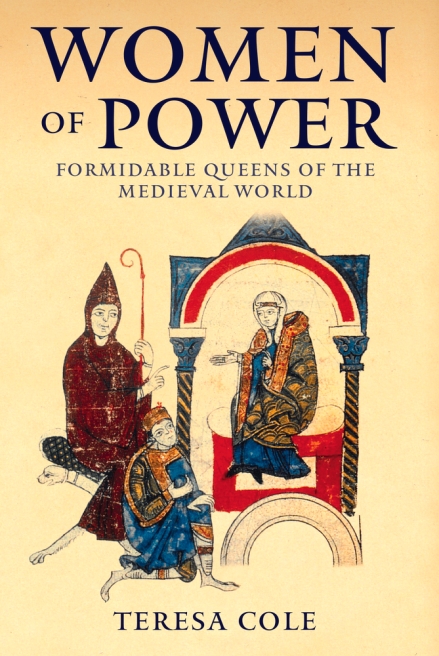 When we think about medieval women, we often think about very pious figures who relied on men, had numerous children, and would often fade into obscurity when they died. While this would be the ultimate fate for many women, it was not so for those close to thrones worldwide. In times of war and political upheaval, the daughters, the wives, and the queens picked up the pieces and patched their respective kingdoms back together. In her latest book, “Women of Power: Formidable Queens of the Medieval World,” Teresa Cole has chosen a select group of women to highlight her point about the strength of women who held power in the Middle Ages.
 A nautical disaster has left Henry I of England in a bind. His only legitimate child is his daughter Matilda, the former Holy Roman Empress. Matilda’s path to the throne may seem straightforward as she has the oaths of all the leading men in the kingdom and a new younger husband named Geoffrey of Anjou, but things take a drastic turn when Henry I dies. Chaos reigns supreme as her cousin, Stephen of Blois, is declared King of England. Matilda knows that the throne is rightfully hers, and she will fight tooth and nail to recover what has been lost. Her story is told in Carol McGrath’s latest novel, “The Stolen Crown.”
 The year 1120 was a horrible year for King Henry I. His only legitimate son William died when his ship, The White Ship, sank in the middle of the night. This tragedy left Henry with one option, his legitimate daughter Matilda, the former Holy Roman Empress, would become Queen of England, and her sons would continue the royal line. Unfortunately, Matilda’s throne was taken by Stephen of Blois, and now Matilda must join forces with her stepmother Her stepmother Adeliza has always stood by Matilda’s side. Still, when she remarries after Henry’s death, Adeliza struggles to support the rightful queen but stays loyal to her new husband, who supports Stephen. Matilda and Adeliza are caught in the middle of the Anarchy in Elizabeth Chadwick’s novel, “Lady of the English.”
 In human history, when citizens have disagreed with a new law or those in charge, they often stage a protest to show their frustration. When their voices are not heard, people often turn to rebellions and revolts to make sure their opinions matter. We might think that revolution and rebellion as a form of protest are modern ideas, but they go back for centuries. Revolutions and rebellions shaped history, no more so than in the middle ages. In his latest book, “Rebellion in the Middle Ages: Fight Against the Crown,” Matthew Lewis examines the origins of the most famous rebellions in medieval England and how they transformed the course of history.
 If you go to Fontevrault Abbey in France, you will find two rather extraordinary tombs. These tombs belong to King Henry II and Queen Eleanor of Aquitaine, the first King, Queen of the Plantagenet Dynasty, and the Angevin Empire. Their effigies tell us a lot about the couple that was buried side by side. The husband was restless; his model shows him ready to take action at any moment, with his crown upon his head and a scepter in his hand. His queen lays beside him, reading an unknown book. They seem to be prepared to watch over their kingdom and their family even beyond the grave. Those who know English history recognize their names and understand the family drama behind the scenes. We think we know the truth about Henry and Eleanor, but is there more to their story and their feuding family? In Matthew Lewis’s latest dual biography, “Henry II and Eleanor of Aquitaine: Founding an Empire,” he explores the relationship between this dynamic king and queen and how it shaped European and English history forever.
 In the middle of the night on November 25, 1120, screams could be heard from the English Channel. A ship known as The White Ship hit a rock and began to sink. Those on board were the glamorous English elite, including the legitimate son of King Henry I, William Aetheling. In an era where people feared the sea and could not swim, those on board sank to their watery death on that cold winter night that began with such frivolity. No one knew that night that this one disaster at sea would cause a dynastic struggle that would lead to the founding of the infamous Plantagenet dynasty. In his latest book, “The White Ship: Conquest, Anarchy and the Wrecking of Henry I’s Dream”, Charles Spencer takes his readers on a journey to fully understand the impact that this tragedy had on the English royal family.
 Adventures of a Tudor Nerd