
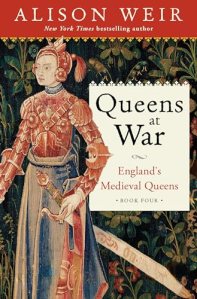
 The fifteenth century in England was a time of war. Between a usurper king, fighting with France, and fighting amongst themselves, an English king must be prepared to go into battle at any moment, and his queen must be ready to support him in any way. During this period, there were five kings and queens, and while the kings get a lot of attention, it is the queens who should get their flowers for what they did in times of distress. Alison Weir explores the lives of the final five Plantagenet queens in her final book in the England’s Medieval Queens series, entitled “Queens at War.”
I would like to thank Ballantine Books and NetGalley for providing me with a copy of this book. I am a big fan of Weir’s books, and I have thoroughly enjoyed her England’s Medieval Queens series. I wanted to see which queens Weir would focus on in this book and how she would approach their lives.
The years covered in this last book are 1399-1485, covering the reigns of Henry IV, Henry V, Henry VI, Edward IV, and Richard III. The queens featured in this book are Joan of Navarre, Katherine of Valois, Margaret of Anjou, Elizabeth Woodville (spelled Widville in this book), and Anne Neville. While I am familiar with the stories of Katherine, Margaret, Elizabeth, and Anne, Joan is a less well-known figure to me. Weir gives her readers a bit of background information about how Joan of Navarre was Henry IV’s second wife after his first wife, Mary de Bohun, died. Joan was married previously as well, to John IV de Montfort, Duke of Brittany. While she did have children with John, she never had royal children with Henry IV. Weir shows how Joan was treated as the stepmother to King Henry V after he married Katherine of Valois.
Weir explores Katherine of Valois’ relationships with both Henry V, the warrior king, and Owen Tudor, the man she fell in love with after the death of Henry V. We get to see how Katherine’s son, Henry VI, and his wife, Margaret of Anjou, dealt with the rising Yorkist faction. With her husband taking ill, it was Margaret of Anjou who was the figurehead for the Lancastrian cause in a conflict that would be known as the Wars of the Roses. Eventually, a young man named Edward IV would become King of England, and he shook the English court by marrying an English woman, Elizabeth Widville (Woodville). Finally, Weir explores the downfall of the Plantagenet dynasty and the end of the young Yorkist regime with Richard III and his wife Anne Neville.
Overall, I found this an informative and easy-to-follow book. It was a bit of a review for me as I am familiar with this period, but I found myself learning new information in this book, which was exciting. I think if you want to learn about 15th-century queens or if you are a fan of England’s Medieval Queens series, I recommend you read “Queens at War” by Alison Weir.
 Adventures of a Tudor Nerd