
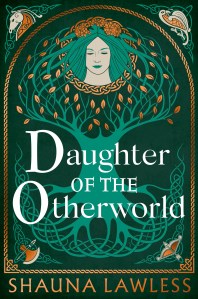
 When we think about the Norman Conquest, we often think about how it impacted England, Wales, and Scotland, but we tend to forget about Ireland. Early medieval Ireland do not get a whole lot of attention in historical fiction. That is, until Shauna Lawless’s Gael Song trilogy. Now, fifty years after the events of the original trilogy, Lawless has brought in a new cast of characters, as well as old characters, into the fight between the Descendants of the Tuatha De Danann and the Fomorians. When a child of prophecy is introduced into the mix that is said to be able to defeat the Fomorians, the race is on to protect the child or to kill her. Will the Descendants survive, or will the Fomorians torch the land and the Descendants’ hope? Shauna Lawless jumps back into this work with the Gael Song Era 2 book 1, “Daughter of the Otherworld.”
I would like to thank Bloomsbury USA and Net Galley for sending me a copy of this novel. I am new to this series, but I wanted to read it because I have never read a book about medieval Ireland or about Irish mythology, so when I saw this book available, I decided to give it a shot, especially with such a stunning cover.
We pick up fifty years after the Battle of Clontarf, and a man named Donnchad is on the run from Broccan of the Tuatha De Danann. Donnchad is a Fomorian, which means he can use fire magic and is the mortal enemy of those descendants of the Tuatha De Danann. Donnchad can reunite with his mother, Gormflaith, in Rome. Meanwhile, Broccan has a dream that tells him that he must go back to Rathlin Island and protect the daughter of Fodla, who has been in the Otherworld for a long time. The daughter, Isolde, is destined to defeat the fire, which might be a reference to the Fomorians.
Broccan raises Isolde as his own daughter until she is 17, but he never tells her who she is or her purpose in this giant conflict. But that all changes when the Fomorians find out about Isolde and decide to attack Rathlin Island. They believe that the threat has been neutralized, but Isolde lives and must travel to the mainland to find her cousin Colmon in Seir Kieran. While Isolde is searching for family and to figure out who she is, the Fomorians seek to control Ireland with the Norman lords of England.
This is a novel full of conflict, both magical and mortal, romance and heartbreak. Lawless does a great job of not only balancing numerous perspectives but also balancing mythology with historical battles and figures to create an original story. While I did enjoy the story, it did take me a while to figure out who the characters were and the overall conflict. I think after reading this particular book, I want to read the previous books in the series before I jump into the latest one. If you have read the previous books in the Gael Song trilogy, I think you will enjoy “Daughter of the Otherworld” by Shauna Lawless.
 Do you have a favorite historical figure whom you have wondered what would have happened if they survived their dark fate? Have you wondered what would happen if they had fantastical abilities, such as transforming into animals? Maybe the last piece sounds a bit too far-fetched, but it makes for an interesting concept for a novel. What if we took the story of Lady Jane Grey, the Nine-Day Queen of England, and turned the tale into a fantastical comedy full of romance and adventure? Then, you would get the premise of “My Lady Jane” by Cynthia Hand, Brodi Ashton, and Jodi Meadows.
 For centuries, fairy tales have entertained and taught lessons to those young and young at heart. One of the most memorable stories was the tale of Rapunzel, the maiden a witch kidnapped because her parents stole a Rapunzel plant from her while Rapunzel’s mother was pregnant. For years, Rapunzel languished in a Tower, her hair growing exponentially until a rogue/ prince climbs her hair and rescues the damsel in distress. The witch dies and Rapunzel and her hero live happily ever after. At least, that is how the story has been passed down to us throughout the centuries, but where did the story come from and how are the stories of three women from different generations and countries connected? Kate Forsyth weaves together the stories of three women and their fates into one delightful novel called, “Bitter Greens.”
 Adventures of a Tudor Nerd