Book Review: “Florenzer” by Phil Melanson

Florence, Italy, in the 16th century, was a city of opportunity and full of art and architecture. It was also a city on the precipice of great change. The great banking family, the Medicis, holds the reins of government in Florence, and Lorenzo de’ Medici is the family’s current head. However, two bastards will radically change his life and the Medici family. One was a bastard son of a notary who became one of the most famous artists ever. The other was a bastard son who became a priest and the enemy of the Medici family. Their stories of power and ambition intersect in the city of Florence in Phil Melanson’s debut novel, “Florenzer”.

I would like to thank Liveright Publishing and Net Galley for sending me a copy of this novel. The description of this novel attracted me to it, rather than the cover, as the cover was released after I requested to read this novel. I have slowly been diving into the world of Renaissance Italy, but I have yet to encounter Leonardo da Vinci or Lorenzo de’ Medici in my adventures, so when I saw a novel that featured both and a new historical person to me, Francesco Salviati, I jumped at the chance to read it.

We begin with the funeral of Cosimo de’ Medici, the grandfather of Lorenzo de’ Medici, in 1464. It is the point where all three characters are introduced, and in the case of Leonardo da Vinci, it is the point before his apprenticeship where we begin to see the tumultuous relationship between Leonardo and his father, Piero, the notary. We then jump forward to 1471, when Leonardo is working as an apprentice painter for Andrea del Verrocchio. Around this time, Leonardo meets Lorenzo de’ Medici, a young man who is trying to achieve greatness, but issues arise, such as the death of the Pope and his brother Giuliano not wanting to be part of the family business. Lorenzo desires military glory, but it doesn’t go well. Finally, we have Francesco Salviati, a man who was destined to be a banker, but because he was a bastard son with darker skin, he decided to devote his life to the church, working alongside the new Pope Sixtus IV, also known as Francesco della Rovere.

As the three men grew up, they had obstacles to deal with. Leonardo fell in love with another man, known as Iac in this novel, and his love might cost him everything. While Lorenzo is trying to make sure his family is the most prominent in all of Italy, Francesco Salviati is using his influence at the Vatican to turn the tables on Lorenzo, which culminated in the Pazzi Conspiracy of 1478. The Pazzi Conspiracy was something that I had never heard of before this novel, so it was interesting to see it play out and the aftermath. While I did enjoy reading about Leonardo and Lorenzo, I didn’t feel a connection to Salviati, so when his story concluded, I didn’t feel any sort of way. I think the formatting of the book, almost like a screenplay, was a unique idea, but I don’t think it added anything to the context of the novel.

Overall, I think this was a decent novel. It was a slow start, and it was a bit of a challenge to get used to three different perspectives, but the stories of ambitions, love, and power truly shone. As a debut for someone who does not usually focus on historical fiction, I think Melanson does an admirable job of portraying 15th-century Florence in such a believable way. I think if you want a novel that’s set in 15th-century Italy, you will enjoy “Florenzer” by Phil Melanson.

Book Review: “Medici Heist” by Caitlin Schneiderhan

The year is 1517, and Florence is experiencing great change. No longer is it a grand republic that it once was; instead, it is under the control of the Medici family. They ruthlessly controlled Florence, especially Pope Leo X, who was born Giovanni di Lorenzo de’ Medici. The people suffer as the Medici become increasingly wealthy, but a band of misfits and thieves plan to give some power back to the people with one of the greatest heists of 16th century Italy. Can they survive as a group when revelations from the past and dangers lurk around every corner? The adventure with this ragtag team of thieves as they fight for Florence is explored in Caitlin Schneiderhan’s novel, “Medici Heist.”
I want to thank Feiwel and Friends and Net Galley for sending me a copy of this novel. It’s been a little bit since I read a new YA historical fiction novel, and so when I read the description of this one, I jumped at the chance to read it. I like a good novel set in Italy during the Renaissance, so I wanted to see what Schneiderhan could bring to the genre.

We kick off with Pope Leo X in all his grandeur entering the city and being greeted by a girl named Cat throwing a mud pie at the Pope. This incident sets the mood of the city towards the Medicis. We then jump to meeting our main four protagonists; the con woman/ leader of the misfits Rosa Cellini, Sarra the Tinkerer, Khalid the skilled fighter, and Giacomo the master of disguise. Along with the apothecary Agata, Dominic the apprentice, and even Michelangelo, the crew has decided that the only way to free Florence from Medici rule was to steal the indulgences that the people gave the church for the forgiveness of their sins so they spend less time in purgatory when they died. The Medicis were able to gather about 10,000 florins, an impressive amount that the band of thieves hoped to split evenly. However, complications do arise such as unexpected reminders of the past, romances, and those who want the treasure for their nefarious purposes.

While I do applaud Schneiderhan for writing her first-ever historical fiction novel, which is not an easy task, I did have a few issues when I was reading this particular novel. I felt like this book read more like a screenplay in that it gave locations and information, but it was hard to visualize for someone who cannot see these locations as images. The characters felt a bit generic and blended together, especially with the short chapters that might have been purposeful to get through the story quickly, but I was not able to build a connection to these characters. Finally, I feel like this story does not feel like it could take place in the 16th century, except for a few famous name drops, historical places, and the currency used at the time. It feels too modern and it could be put into any period and it would still work. I wanted to get lost in 16th century Florence and that did not happen for me.

Overall, as a YA heist book, I think it is a pretty good book, but it missed the mark when it came to the historical element for me. I feel like the concept of this book was strong, but the execution was a bit lacking. It was a difficult book for me to read and at times, I did want to put it into a did not finish pile, which I never do with books. I know that some books just are not right for me, but they might be right for other people, which is why I continued to read this book. If you do want to read this book, it might be a good idea to have a device next to you to look up the locations mentioned to help visualize what is happening. If you want a heist book with some history sprinkled in, “Medici Heist” by Caitlin Schneiderhan might be the book for you.

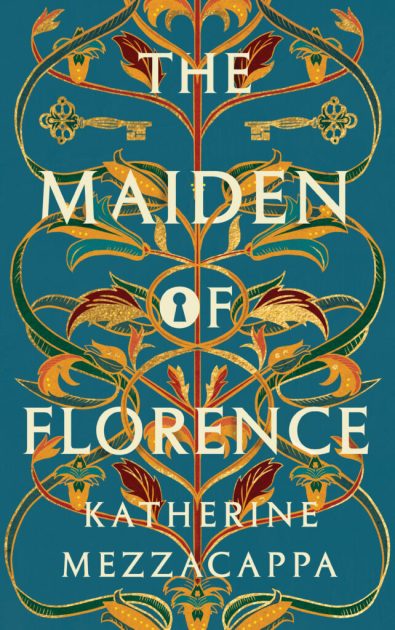
Book Review: “The Maiden of Florence” by Katherine Mezzacappa

The Maiden of Florence
The year is 1584 in Florence and a test is about to take place, but it is different from your typical test. It involves a Prince whose wife can only give him daughters and an attractive orphan girl who will be given a dowry and a husband when the task is done. The stories of these young women have been lost to the past, but the story of orphan Giulia is now coming to light. Katherine Mezzacappa tells the tale of the orphan who took back her life from the most powerful men in Italy in her novel, “The Maiden of Florence.”

I want to thank Fairlight Books and NetGalley for sending me a copy of this novel. I saw the cover on social media and thought it was stunning, but then I read the description and realized that it was deceptively beautiful. This is a haunting tale of a horrific situation in the life of an orphan and how she overcame it to find hope.

Our story begins with Giulia Albizzi, a former orphan, writing about the ordeal she had to overcome as a young girl over thirty years ago. When she was young, Giulia grew up in the orphanages Innocenti and Pieta. One day, while she was staying at the Pieta, a group of men, including a man named Vinta, and a woman showed up and asked to take Giulia away. She was later told that she was going to be used in a sort of test for Prince Vincenzo Gonzaga, who was destined to become the next Grand Duke of Mantua, but there was a catch. Since Prince Vincenzo’s previous bride had only had living daughters before he married into the Medici family, the Prince must prove that he could perform the marital act, hence why he needs the beautiful virgin, Giulia. In exchange, Giulia would be given a substantial dowry and a husband who would be willing to turn the other cheek when it came to her past.

The test, the examination, and the interrogation are brutal to read, but Giulia is soon released from her duties and is allowed to marry a man that Vinta chooses for her. Her husband, Giuliano Sperati, is a musician for the Grand Duke. Though the relationship has a rocky start, there is love between Giulia and Giuliano. While they start to make a new life and a family, Giulia’s past comes back to haunt her and threatens to destroy everything.

This was a sensational novel, full of heart and heartbreak. By giving the victim a voice and allowing the royals to take a step back, Mezzacappa sheds light on a dark secret in Renaissance Italy. This may have been my first novel by Katherine Mezzacappa, but it will not be my last. To me, this is a brilliantly written, raw, and compelling story. If you are a fan of historical fiction, especially those who have an interest in 16th-century Italy, “The Maiden of Florence” by Katherine Mezzacappa is an absolute must-read.

Guest Post: “The Hearts of All on Fire” by Alana White Blurb

The Hearts of All on Fire Tour BannerI am pleased to welcome Alana White to my blog today to share a blurb from her latest novel, “The Hearts of All on Fire.” I would like to thank The Coffee Pot Book Club and Alana White for allowing me to be part of this tour.
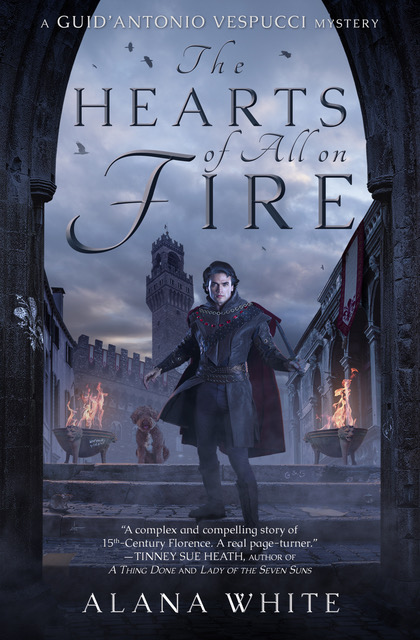
The-Hearts-of-All-on-Fire_coverBlurb:

Florence, 1473. An impossible murder. A bitter rivalry. A serpent in the ranks.
Florentine investigator Guid’Antonio Vespucci returns to Florence from a government mission to find his dreams of success shattered. Life is good—but then a wealthy merchant dies from mushroom poisoning at Guid’Antonio’s Saint John’s Day table, and Guid’Antonio’s servant is charged with murder. Convinced of the youth’s innocence and fearful the killer may strike again, Guid’Antonio launches a private investigation into the merchant’s death, unaware that at the same time, powerful enemies are conspiring to overthrow the Florentine Republic—and him. A clever, richly evocative tale for lovers of medieval and renaissance mysteries everywhere, The Hearts of All on Fire is a timeless story of family relationships coupled with themes of love, loss, betrayal, and, above all, hope in a challenging world.


Buy Links:

Universal Link: https://books2read.com/u/md1RGZ

Amazon UK:
Kindle: https://www.amazon.co.uk/Hearts-All-Fire-Alana-White-ebook/dp/B0BGJ1XHXS/
Paperback: https://www.amazon.co.uk/Hearts-All-Fire-Alana-White/dp/1639884211

Amazon US:
Kindle: https://www.amazon.com/Hearts-All-Fire-Alana-White-ebook/dp/B0BGJ1XHXS/
Paperback: https://www.amazon.com/Hearts-All-Fire-Alana-White/dp/1639884211/

Amazon Canada:
Kindle: https://www.amazon.ca/Hearts-All-Fire-Alana-White-ebook/dp/B0BGJ1XHXS/
Paperback: https://www.amazon.ca/Hearts-All-Fire-Alana-White/dp/1639884211/

Amazon Australia:
Kindle: https://www.amazon.com.au/Hearts-All-Fire-Alana-White-ebook/dp/B0BGJ1XHXS/
Paperback: https://www.amazon.com.au/Hearts-All-Fire-Alana-White/dp/1639884211


Barnes & Noble:
Paperback: https://www.barnesandnoble.com/w/the-hearts-of-all-on-fire-alana-white/1141662345

Bookshop:
Paperback: https://bookshop.org/books/the-hearts-of-all-on-fire/9781639884216

Waterstones:
Paperback: https://www.waterstones.com/book/the-hearts-of-all-on-fire/alana-white/9781639884216

Parnassus Books (Nashville, Tennessee)
Paperback: https://www.parnassusbooks.net/book/9781639884216


Alana White author photoAuthor Bio:

Alana White’s passion for Renaissance Italy has taken her to Florence for research on the Vespucci and Medici families on numerous occasions. There along cobbled streets unchanged over the centuries, she traces their footsteps, listening to their imagined voices, including that of her protagonist, Guid’Antonio Vespucci, and his friends, Sandro Botticelli, Michelangelo, Lorenzo de’ Medici.

Alana’s first short story featuring real-life fifteenth-century lawyer Guid’Antonio Vespucci and his favorite nephew, Amerigo Vespucci, was a Macavity Award finalist and led to the Guid’Antonio Vespucci Mystery Series featuring “The Sign of the Weeping Virgin” (Book I) and “The Hearts of All on Fire” (Book II).

She is a member of the Women’s National Book Association and the Historical Novel Society, among other organizations. She loves hearing from readers, and you can contact her at her website, http://www.alanawhite.com.

Social Media Links:

Website: http://www.alanawhite.com

Twitter: https://twitter.com/AlanaWhite1480

Facebook: https://www.facebook.com/authoralanawhite/

LinkedIn: https://www.linkedin.com/feed/

Instagram: https://www.instagram.com/alanawhiteauthor/

Pinterest: https://www.pinterest.com/writerawhite/


Book Review: “The Pope’s Greatest Adversary: Girolamo Savonarola” by Samantha Morris

57165112When we think about men who challenged the Church and are known as Reformers, we tend to think of Martin Luther, Jan Hus, and John Calvin. However, a man fought against corruption in his beloved Florence who should be included in the list of great reformers. He was a Dominican monk who was not afraid to preach against sin and took aim at the most powerful men in all of Italy, including Pope Alexander VII. His sermons were so scandalous that they would lead to his demise upon a pyre in the middle of Florence. His name was Girolamo Savonarola, and his story is told in Samantha Morris’s latest biography, “The Pope’s Greatest Adversary: Girolamo Savonarola.”

I want to thank Pen and Sword Books and Net Galley for sending me a copy of this biography. I read Samantha Morris’s previous joint biography of Cesare and Lucrezia Borgia and thoroughly enjoyed it. When I heard that she was writing a new biography about a famous figure in Italian history, I was intrigued.

Girolamo Savonarola was a scholar, like his father and grandfather before him, destined to be a doctor like his grandfather. His plan for his life took a drastic turn when the girl he was fell for rejected his advances, so he decided to join the Dominican order as a friar. Talk about not taking a break-up well. Savonarola studied the Humanist teachings and incorporated them into the way he understood his faith. Of course, as a friar, he couldn’t keep his opinions to himself, so he began preaching against corruption and the vices that he saw during his travel.

Savonarola’s preaching was appealing to the people of Florence, yet it did not sit well with the leader of Florence, Lorenzo de ’Medici. Lorenzo tried to silence the troublesome friar, but his son Piero de Medici took on the challenge when he passed away. Piero was nothing like his father and was overthrown as ruler of Florence by Savonarola. Of course, Savonarola was not satisfied with reforming Florence, and he decided to take on the Catholic Church itself and attack another powerful family.

Charles VII of France wanted to conquer Italy, which to the Dominican friar was a good idea, so Savonarola helped the king. This incident drew the ire of Rodrigo Borgia, also known as Pope Alexander VI, and Ludovico “Il Moro” Sforza of Milan, who just wanted the friar to shut up. Even with numerous ex-communications, Savonarola kept preaching against corruption and vices, leading to the Bonfires of the Vanities in 1497. He took artwork and writings deemed inappropriate and burned them in a humongous bonfire. A year later, on May 22, 1498, Girolamo Savonarola lost his life because of his heretic teachings.

This book has so many scandals and dynamic characters that you will forget you are reading a biography. Morris has done it yet again, and this was a brilliantly engaging and extremely well-researched biography. The way she can capture the thrilling world of 15th and 16th century Italy is astounding, and I hope she will write more about Italian history in the future. If you want a fun biography about a man who fought to reform the Catholic Church, I highly recommend you read “The Pope’s Greatest Adversary: Girolamo Savonarola” by Samantha Morris.