
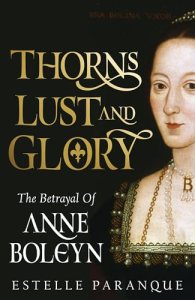
 A young woman catches the attention of a king already married to a princess from a faraway kingdom. The king desires the young lady and divorces his wife to marry her. However, there is a catch. The young lady spent some time in the French court of Francis I and Claude of France, whereas the king’s wife was the daughter of the Spanish King and Queen as well as the aunt of the Holy Roman Emperor. The Great Matter of Henry VIII, Anne Boleyn, and Catherine of Aragon is considered one of the messiest divorces in English history and rightfully so when you consider the diplomatic consequences that this divorce would have across Europe. Estelle Paranque highlights the connection between Anne Boleyn and the French court in her latest book, “Thorns, Lust, and Glory: The Betrayal of Anne Boleyn.”
I want to thank Hachette Books and Net Galley for sending me a copy of this book. I heard that Estelle Paranque was writing a new book about the 16th century, but when I heard that it dealt with Anne Boleyn’s connections with the French court, I jumped at the chance to read it. While I do know quite a bit about the rise and fall of Anne Boleyn, it is her connection with the French court that I have never really explored in depth.
Paranque begins her book by examining the meeting between King Henry VIII and King Francis I with Anne Boleyn at Calais between October 25th and 27th, 1532. This was a significant meeting as it was right before Henry and Anne married in secret and they desired that Francis would support their side in the Great Matter. But how did they get to this meeting in Calais? This is where this book shines as Paranque takes the time to show her audience what life was like for Anne in the French court and the connections that she forged with women like Louise of Savoy, Claude of France, and Marguerite of Angouleme Queen of Navarre. It was fascinating to see how the Boleyns were able to use their connections to forge alliances with the French court that would prove useful in the future.
Possibly my favorite part of this book was seeing how the diplomatic channels across Europe interacted with one another during the Great Matter, the queenship of Anne Boleyn, and the fall of the Boleyns. I think we so often overlook that there were diplomats who were working on the sidelines to convey messages between kings and emperors to form or strengthen alliances. While many might consider the way Paranque wrote the correspondence and dialogue between diplomats and the monarchy as hard to get used to because she does insert emotions, I believe it adds depth to the story because they were human beings not in a vacuum. They had feelings about what was happening around them, passionate feelings in fact, and that should be displayed to readers.
While the actual events of this book were not new to me, the way that Paranque was able to present the information and show the men behind the scenes was fascinating. It presents the relationship between Henry VIII and Anne Boleyn in a different more complex light. If you want a different angle to the rise and fall of Anne Boleyn, I recommend you read, “Thorns, Lust, and Glory: The Betrayal of Anne Boleyn” by Estelle Paranque.
 The 16th century is known to be a century full of powerful women rulers; Mary I, Elizabeth I, Catherine de Medici, and Mary Queen of Scots, just to name a few. However, these rulers were towards the end of the 16th century. For the first half of the 16th century, Europe and the Middle East rulers were predominantly male. Four men truly dominated this period, each with their objectives and desire for glory; Henry VIII of England, Francis I of France, Charles V the Holy Roman Emperor, and Suleiman the Magnificent the ruler of the Ottoman Empire. In his book, “Four Princes: Henry VIII, Francis I, Charles V, Suleiman the Magnificent, and the Obsessions that Forged Modern Europe,” John Julius Norwich hopes to shed some light on the relationships of these men and how they shaped the political landscape of Europe.
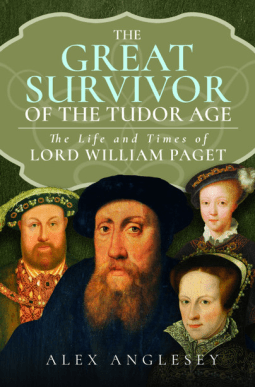 Rulers cannot govern alone. They require a team of men and women behind them to operate as a cohesive unit. The same can be said for rulers during the Tudor dynasty. We know the stories of men like Cardinal Wolsey and Thomas Cromwell, two men who rose through the ranks to prominent seats of power to ultimately have disastrous falls from grace. However, there was a third Tudor politician who should be in this discussion about rags-to-riches stories. He was the son of a common merchant who went to serve most of the Tudor monarchs as an advisor. Conspiracies and rebellions kept him on his toes, but he ultimately survived the Tudor dynasty, which was a difficult thing to achieve. His name was Lord William Paget and his story is told by his descendant Alex Anglesey in his debut book, “The Great Survivor of the Tudor Age: The Life and Times of Lord William Paget.”
 Adventures of a Tudor Nerd