
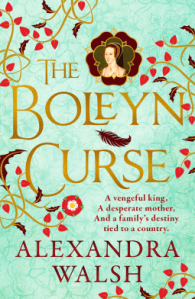
 The court of Henry VIII was a treacherous place for anyone, but especially for the Boleyn family. We all know the stories of Anne, Mary, George, and Thomas, but one figure from this illustrious family does not get enough attention: Elizabeth Boleyn, the mother of Anne, Mary, and George. What was her relationship like with her family, her husband, and most importantly, King Henry VIII? And what does a Chaucer manuscript recently discovered at Cerensthorpe Abbey have to do with Elizabeth and the Boleyns? Alxandra Walsh explores the life of Elizabeth Boleyn and the mystery of the missing Chaucer in her latest dual-timeline novel, “The Boleyn Curse.”
I would like to thank Boldwood Books and Net Galley for sending me a copy of this novel. I enjoy a good dual-timeline novel, and when I saw that this one also featured Elizabeth Boleyn as the main character, I was intrigued. Elizabeth Boleyn has not been the focus of novels of the Boleyn family that I have read, so I was interested to see how her story would translate into historical fiction.
Since this is a dual timeline novel, there are two main timelines. We get to explore the Tudor period with Elizabeth Boleyn and the modern day with Tabitha Mundy, the archivist of Cerensthorpe Abbey. We begin with the modern storyline and Tabitha, who is employed by the owner of Cerensthorpe Abbey, Edith Swanne, to archive the entire estate. Tabitha is dealing with the death of her husband, Blake, when she meets Edith’s nephew and heir to the estate, Gulliver. Edith gives Tabitha the task of finding a missing Chaucer manuscript by decoding clues left behind in a journal from the 1900s. The journey to the missing manuscript holds a connection to Elizabeth Boleyn and the curse upon the family.
We also jump back to the life of Elizabeth Boleyn, who was Elizabeth Howard when the audience is introduced to her in 1485. Her father was arrested by the new King Henry VII for supporting King Richard III, but eventually the family rebuilt their reputation. Elizabeth falls in love with Thomas Boleyn and joins the glittery court of King Henry VIII, where she catches the eye of Henry VIII himself. Elizabeth fights for her family and the love of her husband, even if it means making an enemy of the crown itself.
I think this was a decent novel, even though it explored my least favorite rumor about the Boleyn family. I also thought the diary entries were a bit distracting from the rest of the narratives, a case of too many stories going on at once. Overall, I did enjoy this book. If you want a novel that is a dual timeline or a novel that features Elizabeth Boleyn, you should check out “The Boleyn Curse” by Alexandra Walsh.
 Marriage has been an integral part of life for centuries. It has been used to create strong alliances and cement love matches. However, once the wedding ceremony is finalized, the facade often fades and the truth about the families is revealed. Jane Parker finally marries the love of her life, George Boleyn, but she soon realizes that her new family is full of ambition, especially her new sister-in-law Anne Boleyn. As one of the greatest marriages of the 16th century is beginning to fall apart, can a new romance be waiting in the wing to rock England and all of Europe to its core and whose side will Jane join in the end? Danielle Marchant continues her exploration of Jane Parker Boleyn, Lady Rochford’s life in her novel, “The Lady Rochford Saga Part 2: Tourmens de Mariage.”
 Treason is the crime of betraying one’s country or monarch by trying to overthrow the government or kill a sovereign. While many English dynasties dealt with treason in their ways, the most infamous were the Tudors and how they dealt with the nobility. By the end of 1572, there were no more dukes in England, until 1623 when George Villiers became the Duke of Buckingham. What was classified as treason during the Tudor dynasty and why did the members of the nobility have to die? Helene Harrison hopes to answer these questions in her latest book, “Tudor Executions: From Nobility to the Block.”
 The story of the Boleyn family in the 16th century and their ultimate fall from grace has been told for centuries. However, there is a more intriguing tale hidden in the Boleyn family tree. The origins of the family and how they became such a dynamic family that revolutionized the 16th century. How did this family of peasants rise through the ranks to have one of their own become the Queen of England? It is a tale of struggle, survival, and triumph that is told in Claire Martin’s debut book, “Heirs of Ambition: The Making of the Boleyns.”
 The 1520s in England were a raucous time. As the years pass, King Henry VIII’s desire for a legitimate son grows and his resentment towards his wife Katherine of Aragon increases. Henry has decided to divorce his wife of over 20 years to marry a new fling, Anne Boleyn, who would surely give him the son and heir. All of Europe, especially the Pope, is horrified at the direction Henry is taking, but one man stands firmly on the side of the King. Thomas Cromwell rose through the ranks to become Henry VIII’s right-hand man, even though he had rather humble origins. Can Thomas Cromwell help the man who made him and survive the king’s wrath? Hilary Mantel explores the origins of Cromwell’s rise and The Great Matter in the first book in her Thomas Cromwell trilogy, “Wolf Hall.”
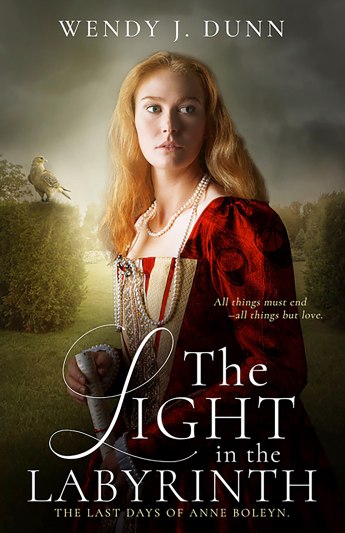 The year is 1535 and a young girl whose mother was a shining light at court, dreams of getting away from her family and joins her aunt at court. Her name is Kate Carey, the daughter of Mary (Boleyn) Carey, and her aunt is Queen Anne Boleyn. Little does Kate know that the court life she desires is full of danger and enemies around every corner. In the labyrinth of court life, Kate must navigate it successfully to come out alive, even as her aunt’s reign is coming to an end and a secret is revealed that will radically change her life forever. Wendy J. Dunn tells Kate Carey’s story in her young adult novel, “The Light in the Labyrinth: The Last Days of Anne Boleyn.”
 The tragedies of the Boleyns and the Howards left many with scars and heartache, none more so than Jane Parker. The daughter of Henry Parker, Lord Morley, Jane is seen to be destined for a great marriage and a successful career at court. As one of the ladies to serve Queen Catherine of Aragon, Jane witnesses the splendor, glam, and intrigue needed to survive in the court of Henry VIII. Danielle Marchant has taken inspiration from what she has studied about Jane Parker to create “The Lady Rochford Saga- Part 1: Into the Ranks of the Deceived.”
 When we study the past, the stories of queens often begin when they marry their prince or the king. We don’t see their formative years unless they are extraordinary. One of the more extraordinary queens in English history was Anne Boleyn, a woman who was able to capture the heart of King Henry VIII, divide her nation, and gave birth to the legendary Queen Elizabeth I. We all know how the story of Anne Boleyn ends, but how did she become the woman who would one day be Queen of England? Hever Castle currently has an exhibition about Anne Boleyn’s formative years. This corresponding book, “Becoming Anne: Connections, Culture, Court” by Owen Emmerson and Kate McCaffrey, gives readers an in-depth look into her early years.
 Have you ever wondered what it would be like to travel into the past? You could interact with your favorite historical figures and truly understand what they were like. You could dine like a king or a commoner, dress to impress and experience everyday life. There would be risks involved, but any history nerd might jump at the chance to explore the past. One lucky history student named Beth Wickers discovers that a ring in her professor’s office allows her to travel back into the past to visit her favorite historical icon, Anne Boleyn. Can Beth help Anne to survive the dangerous Tudor court of Henry VIII? Follow Beth’s adventures in Tudor England in Phillipa Vincent-Connolly’s first historical fiction novel, “Timeless Falcon- Volume One”.
 Adventures of a Tudor Nerd