
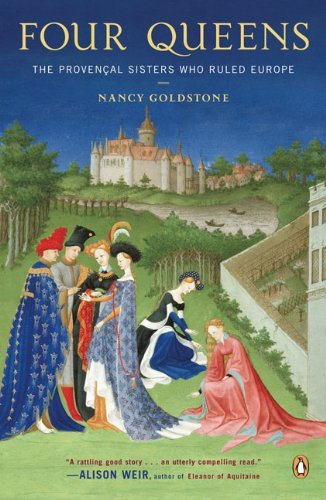
 In southeastern France, there is a region called Provence, known today for its lavender fields and its vineyards. In 13th-century France, Provence would be known as the birthplace of four queens who dominated European politics. The daughters, Marguerite, Eleanor, Sanchia, and Beatrice were the daughters of Raymond Berenger V Count of Provence, and his wife Beatrice of Savoy. They would become the queens of France, England, Germany, and Sicily. While the sisters were known for their beauty, how they acted as queen consorts for their husbands cemented their legacies in history. Nancy Goldstone tells the tale of these remarkable siblings and how they changed European history in her book, “Four Queens: The Provencal Sisters Who Ruled Europe.”
I am always looking for a new history story to familiarize myself with to read and grow as a history nerd. I was familiar with Eleanor of Provence as she is mentioned in biographies about Henry III, but her sisters were a complete mystery to me and so when I heard about this book and its exploration into the sister queens and 13th-century European history, it intrigued me.
Goldstone begins with a story of how the English King Henry III met with the French King Louis IX in Paris during Christmas 1254, and this extraordinary meeting was orchestrated by two sisters, Eleanor and Marguerite of Provence. We then jump back in time to the childhood of the four sisters in Provence, full of wine and songs of the troubadours. At the heart of this glamorous court was Raymond Berenger V and Beatrice of Savoy, Count and Countess of Provence, along with their four daughters; Marguerite, Eleanor, Sanchia, and Beatrice. All around Provence, wars raged, and without a male heir, Raymond Berenger V and his beloved Provence risked the wars coming into his home and taking everything he loved. What is a father to do, but make exceptional matches for his daughters?
Marguerite, the oldest daughter, was married to the young Louis IX of France, thanks to the deal made by her father and her new mother-in-law, the formidable Blanche of Castile, the White Queen. Guillaume of Savoy, the sisters’ uncle, decided to arrange the next marriage, which was between Eleanor of Provence and the King of England, Henry III, who had been ruling a turbulent nation for over 20 years. The two eldest sisters would help weather civil wars and crusades to allow the dynasties that they married to survive.
The younger sisters, Sanchia and Beatrice, married men who were also younger siblings and were fighting for their rights to rule in Europe. Sanchia married Richard, Earl of Cornwall, the younger brother of Henry III. They would become King and Queen of Germany for only a brief time, but they would pave the way for the Habsburgs. Finally, Beatrice married the younger brother of Louis IX, Charles Count of Anjou; they would soon become the King and Queen of Sicily.
In the world of 13th-century Europe which was dominated by kings and popes fighting crusades and civil wars, it was the women at home and their husbands’ sides that helped stabilize nations. Marguerite, Eleanor, Sanchia, and Beatrice were fierce women who were loyal to their own families even if that meant that they had to step in the way of their sister’s glory. Goldstone can weave together a narrative of all four siblings that is compelling, engaging, and academically fascinating. If you want a book that explores the familial bonds of four sisters and the lengths that they had to go to to protect what they loved the most, I highly suggest you read, “Four Queens: The Provencal Sisters Who Ruled Europe” by Nancy Goldstone.
 When we think of the German Duchy of Cleves, our first thoughts tend to go to Anna of Cleves, King Henry VIII’s fourth wife, whom he immediately divorced due to not being attracted to her looks, at least according to English tales. We tend to leave Anna’s German life to the side and forget about her family’s story when we study the ever-changing 16th and 17th centuries, even though Germany was dealing with the Reformation. We have an inkling about how life might have been like for Anna of Cleves in England with the fabulous book, “Anna, Duchess of Cleves: The King’s Beloved Sister,” but what about Anna’s siblings, Sybylla, Wilhelm, and Amalia? Heather Darsie has decided to take up the challenge of telling the story of Anna of Cleves’ family from the German perspective in her latest book, “Children of the House of Cleves: Anna and Her Siblings.”
 A foreign princess who travels to England to marry the king to establish a strong political alliance. To those who study history, this is a story that has been told numerous times, but what makes this particular story unique is the people involved. The bridegroom was the recently-widowed Henry VIII, the shadow of his former self and notorious throughout Europe for having his second wife Anne Boleyn executed. His new bride to be is the German princess Anna of Kleve. To say that they did not see eye to eye would be an understatement as the marriage did not last long. Her story is often swept under the rug. Anna is often viewed as the “lucky” wife of Henry VIII, but was she? What was Anna’s story and what was her marriage with Henry really like? Alison Weir has taken up the challenge to give her readers a taste of what Anna’s life might have been like in this novel, “Six Tudor Queens: Anna of Kleve, Queen of Secrets”.
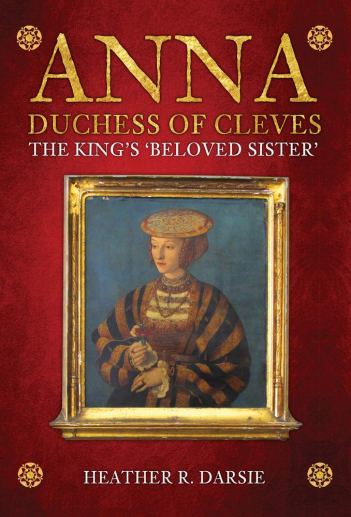 The wives of Henry VIII are some of the most hotly-discussed women of the Tudor Dynasty. They all had unique lives and origins before and after they met the man that connects them all. Two of his brides, Catherine of Aragon and Anna, Duchess of Cleves, were foreign princesses and their marriages were used to create alliances with Spain and Germany respectfully. While Catherine of Aragon and the rest of the wives of Henry VIII get a ton of attention, Anna Duchess of Cleves tends to be brushed aside. She is often seen as the wife that Henry did not approve of because of her looks. However, Heather R. Darsie decided to change how we view Anna with her groundbreaking debut biography, “Anna, Duchess of Cleves: The King’s ‘Beloved Sister’”.
  Henry VIII, the king who was notorious for his six marriages. His first three marriages, to Catherine of Aragon, Anne Boleyn, and Jane Seymour, gave Henry VIII his only children that were considered eligible for succession. Catherine of Aragon was his first foreign bride, but he would divorce her to marry Anne Boleyn. Anne Boleyn would later be executed and Jane Seymour would die after giving birth to Henry’s son Edward. Henry wanted to marry again, so his most trusted advisors decided to try for a foreign alliance as well as a new bride for the king. They decided that Anne of Cleves from Germany would be the perfect bride, but it did not work out and Henry decided to divorce her and claim Anne as his “sister”. She is often viewed as Henry’s “lucky wife”, but who was she and what was her life like before and after she met her husband Henry VIII? That is exactly the question that Sarah-Beth Watkins wanted to explore in her latest book, “Anne of Cleves: Henry VIII’s Unwanted Wife”.
 Adventures of a Tudor Nerd