
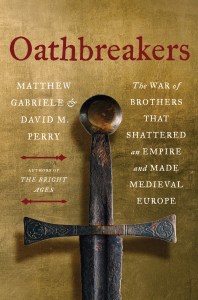
 The life of an empire is very cyclical: the birth of a people group united under one ruler, the empire’s expansion through conquest, and ultimately its demise. When we think of empires, we often think about the Roman and British empires, but another significant one in medieval Europe is the Carolingian Empire. It was an empire that hit its zenith with the reign of Charlemagne in the 9th century, but within two generations, it fell due to forces inside its court. What happened to this once glorious empire that fell after the Carolingian Civil War? Matthew Gabrielle and David M. Perry tell how a once glorious empire fell quickly after its height in their latest book, “Oathbreakers: The Wars of Brothers that Shattered an Empire and Made Medieval Europe.”
I want to thank David M. Perry and Harper for sending me a copy of this book. I don’t know much about the Carolingian Empire other than Charlemagne and his coronation on Christmas day in the year 800, so when I saw the premise of this book, it was intriguing to me.
Before we have the fall of an empire, we must understand the rise of the empire and how the empire worked. Gabriele and Perry begin their book by explaining the origins of the empire starting with the Franks and how they gained power. It starts with a legendary hero named Merovech, the Merovingians, and his grandson King Clovis I who converted to Christianity around the year 500. The Merovingians did not last long because Charles Martel would begin the reign of the Carolingians with a battle, which is almost a bit of foreshadowing of how the Carolingians fell. After Charles Martel came Pepin III and after the death of Pepin III, the kingdom was split between two co-emperors, Carolman and Charlemagne; ultimately Carolman died leaving Charlemagne to be the sole Roman emperor and was crowned on Christmas Day in the year 800.
Charlemagne’s reign was by no means perfect as his son Pepin I the Hunchback, staged a failed rebellion. Like Pepin III before him, Charlemagne decided to divide the empire between his three legitimate sons because sharing is caring. His son Louis the Pious would succeed his father and this is where the troubles ramped up to a civil war between Louis’s sons, Lothar I, Louis the German, and Charles the Bald. It was a time full of chaos, revolts, the Battle of Fontenoy, and oaths that could not save an empire.
As someone relatively new to this subject material, I thought it was a decent read. It took me a while to figure out which Pepin was which (because, shockingly, there are multiple Pepins as well as Louises and Charles all in one family, not confusing at all). I think it was interesting to read about a dynasty that I have heard mentioned in passing in other historical books about great kings, but I never personally dived into until now. In short, the Carolingians were a messy empire and I think they should get more attention. If you want a solid nonfiction book that tells the tale of one of the major empires of Europe, I suggest you read, “Oathbreakers: The Wars of Brothers that Shattered an Empire and Made Medieval Europe” by Matthew Gabriele and David M. Perry.
 The field of history for centuries has been focused on men and the struggles that mankind has had to endure for society to survive. We tend to get only a mere glimpse at the lives of women when they are next to powerful men. Some will write about women, mostly royal women, who lead extraordinary lives and left an imprint on the past. But what about those who lived ordinary lives? What about the women who lived daily, fighting to survive every obstacle? What can we learn about history through the eyes of ordinary women? Philippa Gregory has taken on the mammoth task of trying to answer these questions and more with her tome, “Normal Women: Nine Hundred Years of Making History.”
 Adventures of a Tudor Nerd