
 We all know the story of Anne Boleyn. The story of the English noblewoman who caught the eye of King Henry VIII, who decided to divorce his first wife, Katharine of Aragon, to marry Anne. He broke away from Rome and created the Church of England to do it, but marital bliss did not last long, as a few years later, Anne would leave their three-year-old daughter Elizabeth behind when she was executed by Henry over charges of adultery. We know this version of the story, but what if we look at Anne’s story from a continental European perspective? How does her story change when we view her life through a religious lens? Heather R. Darsie hopes to show her audience a different side of Anne Boleyn in her latest book, “‘If Any Person Will Meddle of My Cause’: The Judicial Murder of Anne Boleyn.”
I would like to thank Amberley Publishing for sending me a copy of this book. I have thoroughly enjoyed Darsie’s previous books because she adds depth to the Tudor dynasty by exploring European sources that are not prevalent in other nonfiction books about the Tudors. When I heard that she was writing a book about the fall of Anne Boleyn, I was curious to see what new information her continental sources would provide to Anne’s story.
So, how do you add something new to Anne Boleyn’s story when it is one of the most discussed topics when it comes to studying the Tudors? Darsie explains that her book is not a typical book about Anne Boleyn, as it focuses briefly on Anne’s life and examines the legal, religious, and international contexts surrounding her life. Each chapter of this book begins with part of a poem by Sir Thomas Wyatt, which is a nice touch as he was an admirer of Anne Boleyn. The first part of the book was a bit of an overview of Anne’s life, but Darsie did not go into much depth about Anne’s fall. Instead, she shows the relationships between England and continental Europe with the different political powerhouses. I found the information about the relationship between England and the German princes particularly interesting. It is these relationships that would prove pivotal in Anne’s life, reign, and fall from grace.
It is truly part two where Darsie shines. It is here that she focuses on the religious aspects of Anne’s fall. We all know that Anne was a bit more radical when it came to her religious views, but Darsie takes it a step further. She shows how England was trying to break from Rome centuries before Henry came along. Then, we get to see the religious reformers of England and of Europe who impacted Anne’s religious leanings. There is also an incident in Munster with the Anabaptists that freaked out Henry VIII very badly. Once you put the pieces together that Darsie lays out, it is quite astounding.
As someone who reads a lot about Anne Boleyn, I am always looking for a new approach to her life. This is exactly what I wanted. By the end, I was speechless, and it brought new life to Anne’s fall and ultimate death. If you are a Tudor nerd and want a new angle to Anne Boleyn’s story, I highly recommend you read “‘If Any Person Will Meddle of My Cause’: The Judicial Murder of Anne Boleyn” by Heather R. Darsie.
 We all know the gist of the tragic tale of Katharine of Aragon. A Spanish princess who was brought to England to marry the heir of the Tudor throne, Prince Arthur Tudor. When the prince died mere months after their wedding day, Katharine was left in limbo and desolate as the Kings of Spain and England bickered over her dowry. Eventually, she would marry King Henry VIII, was his wife for over twenty years, and have numerous miscarriages before Henry decided to divorce her and marry Anne Boleyn. We know how Katharine’s story ends, but how did the stories of her Trastamara family influence her life and her reign as Queen of England? Heather R. Darsie explores Katharine’s Spanish origins in her latest book, “Katharine of Aragon, Spanish Princess: ‘I Am Not as Simple as I May Seem.’”
 English royal history is filled with fantastic stories of triumphs and tribulations, grand romances, and divorces that shook the foundations of the monarchy. It is also filled with struggles over religion, wars both inside England and with foreign nations, and heartbreaking child losses. We often think about the spouses of the Plantagenets and the Tudors when we think about royal romances, but we shouldn’t forget about the dynasties that came after, like the Stuarts. So how did the Stuart dynasty come to be and how did the unions between monarchs and their significant others affect the dynasty and England? Heather R. Darsie explores this often-overlooked dynasty and the stories of their marriages and romances in her latest book, “Stuart Spouses: A Compendium of Consorts from James I of Scotland to Queen Anne of Great Britain.”
 Today, I am pleased to welcome Heather R. Darsie to my blog to share an excerpt from her latest book, “Children of the House of Cleves: Anna and Her Siblings.” I would like to thank Heather R. Darsie and Amberley Publishing for allowing me to be part of this blog tour. \
 If this excerpt piqued your interest, consider reading Children of the House of Cleves: Anna and Her Siblings, set for release in the UK on 15 June 2023 and in the US/Internationally on 12 September 2023. Can’t wait until September? The US Kindle version is released on 15 June, too! You might also like to read Heather R. Darsie’s biography on Anna of Cleves, the first researched and written from the German perspective, Anna, Duchess of Cleves: The King’s Beloved Sister. Links below.
 Heather R. Darsie works as an attorney in the US. Along with her Juris Doctorate, she has a BA in German, which was of great value in her research. She completed multiple graduate-level courses in Early Modern History, with her primary focus being the Holy Roman Empire under Charles V. She runs the website MaidensAndManuscripts.com and is a co-host of the Tudors Dynasty podcast.
 When we think of the German Duchy of Cleves, our first thoughts tend to go to Anna of Cleves, King Henry VIII’s fourth wife, whom he immediately divorced due to not being attracted to her looks, at least according to English tales. We tend to leave Anna’s German life to the side and forget about her family’s story when we study the ever-changing 16th and 17th centuries, even though Germany was dealing with the Reformation. We have an inkling about how life might have been like for Anna of Cleves in England with the fabulous book, “Anna, Duchess of Cleves: The King’s Beloved Sister,” but what about Anna’s siblings, Sybylla, Wilhelm, and Amalia? Heather Darsie has decided to take up the challenge of telling the story of Anna of Cleves’ family from the German perspective in her latest book, “Children of the House of Cleves: Anna and Her Siblings.”
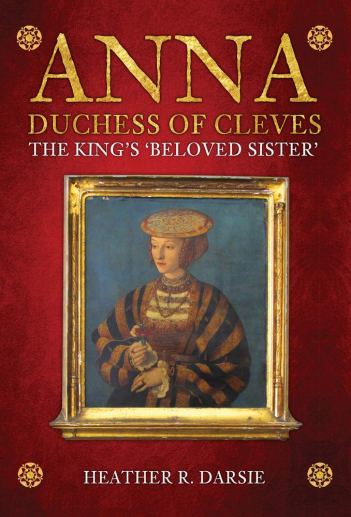 The wives of Henry VIII are some of the most hotly-discussed women of the Tudor Dynasty. They all had unique lives and origins before and after they met the man that connects them all. Two of his brides, Catherine of Aragon and Anna, Duchess of Cleves, were foreign princesses and their marriages were used to create alliances with Spain and Germany respectfully. While Catherine of Aragon and the rest of the wives of Henry VIII get a ton of attention, Anna Duchess of Cleves tends to be brushed aside. She is often seen as the wife that Henry did not approve of because of her looks. However, Heather R. Darsie decided to change how we view Anna with her groundbreaking debut biography, “Anna, Duchess of Cleves: The King’s ‘Beloved Sister’”.
  Adventures of a Tudor Nerd