
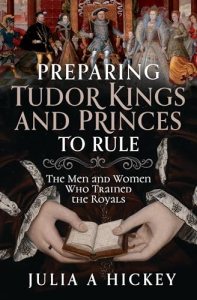
 In life, when it comes to a new skill or job, you must be trained to become good at it. The same can be said for the monarchy, which in a sense is a job that encompasses one’s entire life. You have to understand different languages, rhetoric, the arts of dancing, and music, as well as diplomacy and physical activities if you want to rule a nation. It may seem like a lot for one person to handle, but from the moment of their birth, a prince or princess has a team of people behind them to make sure that they are ready to either rule their home country or create an alliance with other nations. The Tudors knew how important educating their future monarchs was for the survival of the dynasty. Julia A. Hickey examines the people behind the teams raising the future Tudor monarchs in her book, “Preparing Tudor Kings and Princes to Rule: The Men and Women Who Trained the Royals.”
I want to thank Pen and Sword Books and Net Galley for sending me a copy of this book. The premise of this book was fascinating to me and I wanted to see if Hickey would introduce any new people from the Tudor dynasty in this book.
Hickey begins her book by exploring the origins of the Tudor family, starting with the matriarch herself Margaret Beaufort, followed by Owen, Edmund, and Jasper Tudor, and concluding with how Henry Tudor’s education and his lifestyle shaped him to become the first Tudor king. While I do enjoy a review section about the Wars of the Roses, I felt like this section went a bit too long.
Once we see Henry Tudor on the throne, we get to see how the Tudor dynasty grew with the children of Henry Tudor and Elizabeth of York. We get to see how Arthur Tudor as the heir had a much different education than his brother Henry, who was deemed a spare. The education of the princes was vastly different than the education allocated to the princesses even though it was based on humanism. With the death of Prince Arthur, Henry had to go through a crash course on how to rule a country before his father died in 1509. Hickey also shows her audience how the children of Henry VIII, Mary I, Henry Fitzroy, Elizabeth I, and Edward VI, were raised and educated. She also takes the time to show what happens to his children after Henry VIII’s death. Finally, we do get appendixes that feature mini-biographies for all the men and women who are featured in this book to show a different aspect of the Tudor court.
Overall, I found this a rather nifty little book about the Tudor court. Hickey does a decent job of telling the stories of these men and women who trained the Tudor rulers, both male and female. If you want a book that explores what it takes to rule England during the Tudor dynasty, you should check out “Preparing Tudor Kings and Princes to Rule: The Men and Women Who Trained the Royals” by Julia A. Hickey.
 A king’s eldest child is usually the next in line to inherit the throne and become the next ruler. At least that is how the line of succession is supposed to work if the heir is male. Mary I knew this better than anyone. As the eldest daughter of King Henry VIII, she knew that once her mother Katherine of Aragon had a son, Mary would become a pawn in the marriage game. She was willing to accept this fate until her father fell in love with Anne Boleyn. Mary is declared a bastard and must fight for her inheritance and the crown of England while maintaining her Catholic faith. Alison Weir tells the tale of this remarkable woman, from her tumultuous childhood to her short reign that marked her legacy, in her latest novel, “The Passionate Tudor: A Novel of Queen Mary I.”
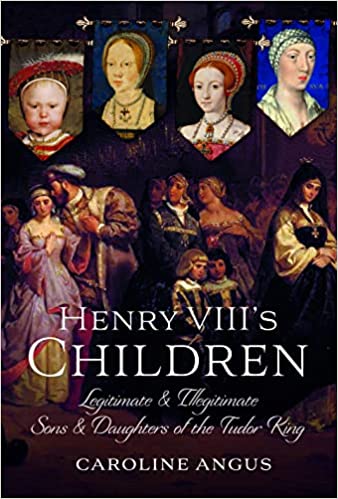 When we think about the title royal children, images of children who get whatever they want, being spoiled with gems and gowns, and ruling kingdoms, they are married to create alliances. In that sense, it would define a life of luxury. However, for the children of King Henry VIII, luxury was not always in their dictionary. What was life like for the legitimate and illegitimate children of Henry VIII? Caroline Angus explores this question in her latest book, “Henry VIII’s Children: Legitimate and Illegitimate Sons and Daughters of the Tudor King.”
 Numerous castles with remarkable stories dot the landscapes of many European countries, especially England. Few are in good condition whereas others are in a rather ruinous stage. In the village of Sheriff Hutton, there is a shell of a once illustrious castle that protected England and its monarchs for centuries, aptly named Sheriff Hutton Castle. For those who are familiar with the family York and the Nevilles of the Wars of the Roses, you might be familiar with the name of this castle, but do you know the entire story of the castle? Why was this castle so significant to the history of northern England and why did it fall into disarray? These questions and more are explored in Alexander Hill’s debut book, “A Princely Lodging: A History of Sheriff Hutton Castle”.
 The study of history is all about asking questions about how and why events happened. We understand that history is very much a study of cause and effect; if a certain person causes something to happen, we study the effect of those actions. But what if the person changes what they do? What would happen to the course of history? These are considered the “what ifs” of history, which is something that history fans and students like to discuss with one another. These questions rarely are discussed in books, until now. Timothy Venning explores some of the “what ifs” of the Tudor Dynasty in his book, “An Alternative History of Britain: The Tudors”.
  The children of Henry VIII have been the center of historical studies for centuries. Edward VI, Mary I, and Elizabeth I were all considered Henry’s “legitimate” children and were able to obtain the crown of England. Henry Fitzroy was the illegitimate son of the king, but he was still able to gain titles and a good marriage before he died. They all had something in common; they were all recognized by their father, Henry VIII. However, there was another child who many believed to have been the daughter of the king. The name of this intriguing lady was Lady Katherine Knollys and her story comes to life in Sarah-Beth Watkins’ book, “Lady Katherine Knollys- The Unacknowledged Daughter of King Henry VIII”.
 Adventures of a Tudor Nerd