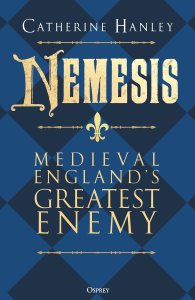
Book Review: “Nemesis: Medieval England’s Greatest Enemy” by Catherine Hanley

The Plantagenets, one of England’s most dynamic dynasties, were always in the middle of some sort of conflict. Whether they were fighting foreign adversaries, their own people, or their own family, it felt like the Plantagenets were always getting into some sort of trouble. And there was one king who knew how to use the weaknesses of the kings of England to his advantage. He was King Philip II of France, also known as Philip Augustus. He had to deal with four different Plantagenet kings and had a strategy for each one of them. Just what were Philip II’s strategies, and how did his reign affect English/French relationships as a whole? These questions are answered in Catherine Hanley’s book, “Nemesis: Medieval England’s Greatest Enemy.”
I would like to thank Osprey Publishing and Net Galley for sending me a copy of this book. I enjoy reading about the Plantagenets and their impact on England and Europe as a whole. When I saw that this book took a French approach to the Plantagenets and focused on Philip Augustus, it was an intriguing premise to me.

As Hanley states in the introduction, this book is not your typical biography, as she focuses on the relationship between Philip Augustus and his Plantagenet opponents. That does not mean that we do not get biographical information for Philip, who was the son of Louis VII and Adela of Blois. Per tradition, as the heir to the French throne, Philip was crowned as Junior King of France on November 1, 1179, which meant that his father was still alive when he was crowned, and he trained to become the proper King of France.

While Philip knew that he had factions to deal with inside of France, his main concerns were overseas with the Plantagenets, primarily King Henry II and his sons. Over the course of his forty-year reign, Philip dealt with Henry II, Richard I the Lionheart, John, and Henry III. Each English king presented his own challenges for Philip, but Philip took them in stride and worked hard to make France stronger. At the same time, Philip had to deal with his own family dramas. He was married three times to Isabelle of Hainault, Ingeborg of Denmark, and Agnes of Merania. It was his marriage to Agnes of Merania that gave Philip his heir, the warrior King Louis VIII of France. However, it was Ingeborg of Denmark who gave Philip the biggest headache as she never gave up fighting for her marriage.

From military to political strategies, Hanley shows how Philip maneuvered against the English, and yet she shows that he was not a perfect person or a king. Philip was a flawed human who had to deal with the cards he was dealt like anyone else. Hanley presents a comprehensive book that explores the complex nature of medieval politics and how one man battled against an entire dynasty during his reign. If you are someone who wants to explore the early Plantagenets from the eyes of their enemy, King Philip II of France, I recommend you read “Nemesis: Medieval England’s Greatest Enemy” by Catherine Hanley.

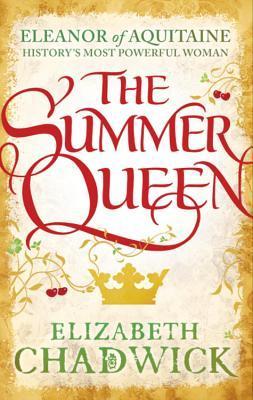
Book Review: “The Summer Queen” by Elizabeth Chadwick

The Summer QueenA legendary Queen of both France and England. A wife who went on the Crusades with her first husband and chose her second husband. A fierce mother who defended her Plantagenet children no matter the cost. Eleanor of Aquitaine has been revered and reviled for centuries, some saying she was a powerful woman ahead of her time while others considered her someone who could manipulate those around her by having affairs, including supposedly with her uncle in Antioch. Her story has been told in numerous ways through different mediums throughout the centuries, but now Elizabeth Chadwick has decided to write her interpretation of Eleanor of Aquitaine’s life in a trilogy of historical fiction novels. The first in the series, “The Summer Queen,” explores Eleanor’s early years, her marriage to a young French king, and the man destined to become King of England.

I have always been drawn to Eleanor of Aquitaine’s story since I first learned about her and the origins of the Plantagenet dynasty. I remember watching “The Lion in Winter” in college and I enjoyed the film, so I decided to study more about Eleanor and Henry II. When I heard that Elizabeth Chadwick had written a trilogy about the legendary queen, I knew I wanted to read it to see how she felt about Eleanor.

We begin our journey into the past when Eleanor (in this novel, Alienor) and her sister Petronella are getting ready to bid their father, William X Duke of Aquitaine, is about to set off on a pilgrimage, leaving the control of the duchy to Eleanor as his heiress. Her father’s final wish for his heiress was that she would marry the heir to the French throne, the soon-to-be King Louis VII. Eleanor reluctantly agrees and at first, the marriage seems to be successful, but after a miscarriage of a boy, Louis’ extreme piety, and his meddling mother Adelaide of Maurienne, Eleanor is at her wits end.

After giving birth to a daughter named Marie, Louis has decided to join the Crusades and Eleanor must tag along, although she would rather have an annulment. The journey that the two embark on drives even more of a wedge between the couple as it is rumored that she was close to her uncle Raymond of Poitiers, Prince of Antioch and one Geoffrey de Rancon. In 1152, Louis and Eleanor receive their divorce; Eleanor may return to Aquitaine and remarry, but she must leave her two daughters, Marie and Alix, with their father in France. Eleanor does not stay single for long as Geoffrey of Anjou convinces the former queen to marry his young, hotheaded, handsome son who would become King Henry II of England by birthright thanks to his mother Empress Matilda.

I have read both historical fiction and nonfiction accounts of Eleanor of Aquitaine’s life, but this novel truly made her feel alive, as well as the men and women that surrounded her at court. Even though I knew what was going to happen, it was still thrilling to read the story from multiple perspectives. I cannot wait to read the rest of this trilogy to see the birth of the Plantagenet dynasty. If you are a fan of the life and times of Eleanor of Aquitaine, you must check out, “The Summer Queen” by Elizabeth Chadwick.

Book Review: “Women of the Anarchy” by Sharon Bennett Connolly

Women of the AnarchyCivil wars, clashes between cousins, are known to be full of battles between men on foot and horseback, with their eyes set on the throne of their desired country. Many stories of civil wars tend to leave out the women who often were left on the sidelines, ready to pick up the pieces. The story of the Anarchy is a bit different than other civil wars as one of the main figures was not a man, but Empress Matilda, the daughter of King Henry I and the rightful heiress of England facing off against the man who stole the throne from her, her cousin, King Stephen. However, it was not just Empress Matilda who defined what it meant to be a woman during the Anarchy. In her latest book, “Women of the Anarchy,” Sharon Bennett Connolly tells the stories of the mothers, sisters, and wives who defined this turbulent period that saw the end of one dynasty and the beginning of another.
I want to thank Amberley Publishing for sending me a copy of this book. I have enjoyed Sharon Bennett Connolly’s previous books that I have read, “Ladies of the Magna Carta,” “Silk and Sword,” “Defenders of the Norman Crown,” and “King John’s Right Hand Lady.” When I heard that Connolly was writing about the women who were involved in the Anarchy, I was excited because it is one of my favorite conflicts in history to study. I wanted to see what new information Connolly would present in her book.

Connolly begins by explaining how the conflict around the Anarchy arose and how Empress Matilda and Queen Matilda became the female faces of opposing sides of this civil war. Empress Matilda, the daughter of King Henry I, was the wife of the Holy Roman Emperor Henry V. However, her life took a dramatic turn when her only legitimate brother William Aetheling died on November 25, 1120, when the ship he was on, the White Ship, sank after a night of drunk sailing. As King Henry I’s last living legitimate child, Empress Matilda was the rightful heir to the English throne, even though she was a woman and she was willing to fight with everything in her power to sit on the throne. On the other side of the conflict was Queen Matilda of Boulogne, the wife of King Stephen. Although Queen Matilda or Empress Matilda could not wield a sword in battle, they showed that they were capable of fighting in their own unique ways.

Empress Matilda and Queen Matilda had grandmothers and mothers who showed them what it meant to be a queen and a mother who was willing to fight for their family. Women like Matilda of Flanders, Saint Margaret of Scotland, Matilda of Scotland, and Adeliza of Louvain showed the two Matildas how to help their husbands run a country while maintaining their strong identities as women rulers. However, Connolly does not stop just at the two Matildas when discussing royal women who had to navigate the Anarchy. We are introduced to interesting characters like Isabel de Vermandois, Ada de Warenne, Lucy Countess of Chester, Ela de Talvas, Mary of Boulogne, Isabel Countess of Warenne and Surrey, culminating with the story of Eleanor of Aquitaine.

While other books focus on the Anarchy, by focusing on the two Matildas and other women affected by this conflict, Connolly brings something fresh to this story that is centuries old. It shows how their actions to protect their families brought forth change in England through the birth of the Plantagenet dynasty. This book is rich in details and is so well written as Connolly takes the time to distinguish between the Matildas, which there are quite a few in this book, and explain how the conflict started and finally how it was concluded. I think if you want a fabulous book about the Anarchy and the women who defined this period, I highly recommend you check out, “Women of the Anarchy” by Sharon Bennett Connolly.

Book Review: “Foundation: The History of England From Its Earliest Beginnings to the Tudors” by Peter Ackroyd

FoundationEngland is a nation that is rich in history and conflicts galore. Through the centuries, England has seen so much change. Many of us know the stories of the medieval and the Tudor kings and queens of England, covered in numerous books, but Peter Ackroyd has taken this concept a step forward. Ackroyd embarked on an epic quest to chronicle the history of England from its prehistoric origins to the modern age. In “Foundation: The History of England From Its Earliest Beginnings to the Tudors,” Peter Ackroyd begins his epic journey into the past to explore the origins of English history.
This book is one that I have seen every time I go to a bookstore and look at the history nonfiction section. I have heard great things about Ackroyd and this series, however, I have yet to read any of his books. It was always an intriguing book to me, but it was one that I never read until now.

Ackroyd has decided to begin his book with one of the most ancient sites in all of England, Stonehenge, explaining that before the first stone was set in Stonehenge, the origins of England were centuries old. We travel through the Stone Age, the Bronze Age, the Iron Age, and into Roman Britain before we dive into the time of the Anglo-Saxons and the Viking invasions. There is a lot of history to cover in less than a hundred pages, but Ackroyd can get his point across about how much change England went through during that time and that it continued to grow throughout the following centuries.

We see the impact that the Norman Conquest and William the Conqueror’s reign. The fall of the Normans with the death of King Stephen led to the rise of the Plantagenets and the reign of King Henry II. It was the Plantagenets that Ackroyd focuses the bulk of this book on as the dynasty lasted over 300 years and witnessed much change. From the Crusades, the Hundred Years War, and the Wars of the Roses, to the Black Death, rebellions, and religious changes, the Plantagenets saw England through major highs and lows. It was not just the monarchs that Ackroyd highlights in this book, he also examines how normal life changed with each dynasty and through the centuries, which adds a bit of depth to his examination of the past. Ackroyd concludes with the fall of Richard III and the rise of Henry VII and the Tudor dynasty. I wish Ackroyd would have waited until his next book to discuss the reign of Henry VII, but it is a minor qualm in the long run.

Overall, I found this an enjoyable and informative read. This is not only a tale of warring kings but a story of the people of England and what makes England so unique. A story whose origins are centuries old, but are rich and vivid in details. I look forward to seeing how Ackroyd will chronicle the Tudors and the rest of England’s history. If you want a book that explores as much of the beginnings of England’s story through multiple dynasties and dramatic changes, I would suggest you read, “Foundation: The History of England From Its Earliest Beginnings to the Tudors” by Peter Ackroyd.

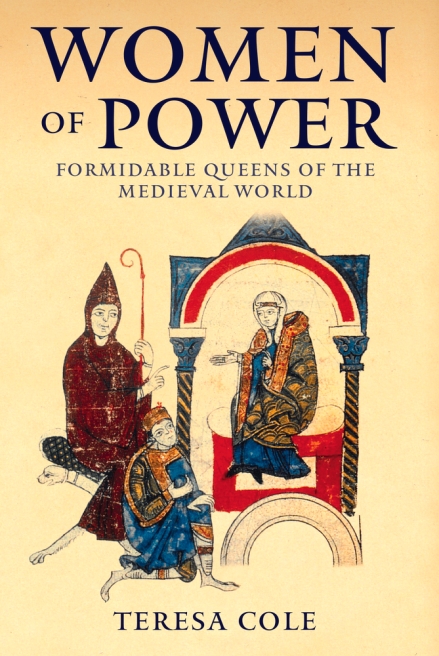
Book Review: “Women of Power: Formidable Queens of the Medieval World” by Teresa Cole

Women of PowerWhen we think about medieval women, we often think about very pious figures who relied on men, had numerous children, and would often fade into obscurity when they died. While this would be the ultimate fate for many women, it was not so for those close to thrones worldwide. In times of war and political upheaval, the daughters, the wives, and the queens picked up the pieces and patched their respective kingdoms back together. In her latest book, “Women of Power: Formidable Queens of the Medieval World,” Teresa Cole has chosen a select group of women to highlight her point about the strength of women who held power in the Middle Ages.

I would like to thank Amberley Publishing for sending me a copy of this book. When I heard about this book, I had an inkling about which women would be included in this conversation, but I wanted to see who else Cole included in her book and if she decided to stay in England or venture off to other countries.

The group of powerful women that Cole has chosen to highlight in this book are Emma of Normandy, Matilda of Tuscany, Empress of Matilda, Matilda of Boulogne, Melisende of Jerusalem and her sisters of the Outremer, and Eleanor of Aquitaine. In terms of history, it is a span of close to three hundred years, covering everything from the Viking invasions of England, the Anarchy, the Holy Roman Empire vs the Papacy, the Crusades, and the reign of Henry II. It is a lot to cover in one book, but what Cole does well is that she has chosen women whose stories are interconnected to create a glimpse of the political environment in Europe and the Middle East during this time.

Before reading this book, I knew quite a bit about Emma of Normandy, Empress Matilda, Matilda of Boulogne, and Eleanor of Aquitaine, so those sections felt like a review for me. The stories of Matilda of Tuscany and Melisende of Jerusalem with her sisters of the Outremer were filled with new information for me and while I thoroughly enjoyed learning about Melisende of Jerusalem and the Outremer, I had such a struggle reading about Matilda of Tuscany.

There were so many popes, anti-popes, and Holy Roman Emperors during that period in which Matilda ruled Tuscany, I wish Cole had included some sort of chart to make it easier to follow. I also wish that Cole spent a little bit more time focusing on the women instead of their male counterparts in the chapters to truly highlight their strengths because there were points where I felt like the women were being lost in their chapters.

Overall, I think Cole does a decent job highlighting the women and the periods in this book. It does show a glimpse into the hardships women had to endure to hold onto power in the medieval world. If you want to explore the Middle Ages with some new historical figures who left their marks on the past, I recommend you read, “Women of Power: Formidable Queens of the Medieval World” by Teresa Cole.

Book Review: “Eleanor of Aquitaine: Queen of France and England, Mother of Empires” by Sara Cockerill

eleanor of aquitaineWhen we think of the infamous queens of England, some names come to mind, but one rises to the top for the number of black myths and influence surrounding her name: Eleanor of Aquitaine. The orphaned Duchess of Aquitaine, who married the future King Louis VII of France, went on the Second Crusades with her husband, survived battles and kidnappings, and ended up divorcing her first husband because she couldn’t give a male son. So, she married the young Count of Anjou, who would become the first king of the Plantagenet dynasty, King Henry II, who had a large family and split her time between England and France. Eleanor would eventually side with her sons, rebel against Henry, and spend 15 years in prison. A fire-cracker of a queen, but how many of the stories surrounding the titular queen are true? In her latest biography, “Eleanor of Aquitaine: Queen of France and England, Mother of Empires,” Sara Cockerill dives deep into the archives to tell the true story of this much-maligned queen of England and France.
I want to thank Amberley Publishing for sending me a copy of this book. I have enjoyed reading books about Eleanor of Aquitaine, and when I heard about this biography, I was fascinated. A few of my history friends have read this book and enjoyed it, so I wanted to see what the hype was about regarding this particular title.

Cockerill begins by showing what myths are typically associated with Eleanor of Aquitaine and how these myths have developed over time. She explains that Eleanor was a much more subdued queen than we imagined her to be and that her dive into the primary sources will show her readers the true Eleanor of Aquitaine. Cockerill then moves into the history of the Duchy of Aquitaine and Eleanor’s family, shaping her into the ruler and mother she would become.

The bulk of this book explores Eleanor of Aquitaine’s married life, first to King Louis VII of France and then to King Henry II of England. As Queen of France, Eleanor had two daughters, went on the Second Crusades, was kidnapped by pirates, and saw numerous battles. Eleanor’s reputation was blackened during the Crusades with the alleged Affair at Antioch. Still, Cockerill takes the time to go through the origins of each myth and show what might have happened according to the primary sources available. With the demise of the marriage of Eleanor and Louis VII, we see how Eleanor met Henry II and how her time as Queen of England was different than her time as Queen of France. We see her relationships with her sons and daughters and how her marriage with Henry went sour.

Most of the primary sources Sara Cockerill explores are charters that Eleanor of Aquitaine worked on as Duchess of Aquitaine and as Queen of France and England. This means it is more academic, and for casual history lovers, it can come across as a bit dry in some places. Overall, I found this a compelling retelling of Eleanor of Aquitaine’s story that gave me a lot to think about her and her time. Suppose you want a new biography that will present a fresh approach to the life and times of Eleanor of Aquitaine. In that case, I highly recommend you read “Eleanor of Aquitaine: Queen of France and England, Mother of Empires” by Sara Cockerill.

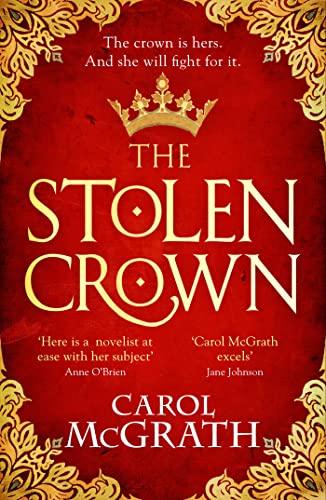
Book Review: “The Stolen Crown” by Carol McGrath

The Stolen CrownA nautical disaster has left Henry I of England in a bind. His only legitimate child is his daughter Matilda, the former Holy Roman Empress. Matilda’s path to the throne may seem straightforward as she has the oaths of all the leading men in the kingdom and a new younger husband named Geoffrey of Anjou, but things take a drastic turn when Henry I dies. Chaos reigns supreme as her cousin, Stephen of Blois, is declared King of England. Matilda knows that the throne is rightfully hers, and she will fight tooth and nail to recover what has been lost. Her story is told in Carol McGrath’s latest novel, “The Stolen Crown.”

Thank you, Headline  Publishing and Carol McGrath, for sending me a copy of this novel. I have enjoyed reading about Empress Matilda and The Anarchy, so when I heard about this novel, I jumped at the opportunity to read it.

We begin with the all-important oath ceremony, where the great lords of England pledge their loyalty to Matilda as Henry I’s heir. Matilda is an 18-year-old widow who is headstrong and is willing to fight to become the rightful ruler of England, even though she is a woman and no woman has ever ruled England. She was deeply in love with her first husband, Henry V, Holy Roman Emperor, but her father has decided that she must marry again to keep his legacy alive, and the man he has chosen is the young Count of Anjou, Geoffrey. It would be an understatement to say their relationship was rocky initially, but they would have a family, including the future King Henry II.

On top of the typical cast of characters that one would expect in a novel about The Anarchy, McGrath invented new characters, Alice, Xander, Pipkin, and Sir Jacques. Alice, Xander, and Pipkin are performers willing to spy for Matilda, no matter how dangerous the mission, to ensure Matilda sits on the throne. McGrath shows the thrilling back-and-forth struggle between Matilda and Stephen for the throne that lasts for years. This novel has many strong women, not just Empress Matilda and Alice, but Stephen’s wife, Matilda of Boulogne.

McGrath has created an immersive story with strong, independent characters who are not afraid to fight for what they believe is right. The Anarachy was a time in history that is slowly getting more attention, and this novel will entice readers to learn more about this period in English history. A dynamic adventure full of intrigue and emotion, “The Stolen Crown” by Carol McGrath is a thrilling read for anyone interested in the birth of the Plantagenet dynasty and Empress Matilda’s fight for the throne.

Book Review: “Medieval Royal Mistresses: Mischievous Women who Slept with Kings and Princes” by Julia A. Hickey

61816116When we think about royal relationships from the past, we do not associate them with love; it is more about cementing power. Princes and kings knew how much was at stake, so they tended to have wives for politics and produce legitimate heirs that would inherit their kingdoms. For matters of love and lust, kings and princes would have mistresses, either of noble birth or lower, on the side. These women have been deemed whores and homewreckers but is that a fair assessment of their legacies? Julia A. Hickey takes a closer look at these misunderstood mistresses in her latest book, “Medieval Royal Mistresses: Mischievous Women who Slept with Kings and Princes.”

Thank you, Pen and Sword Books and Net Galley, for sending me a copy of this book. When I saw this title, it intrigued me, and I was hoping to learn something new.

Hickey covers several hundred years in this book, starting around the year 1000 and ending in 1485. We begin with Queen Emma, Aelfgifu, and the confusion of whether Aelfgifu should be considered a mistress. With these Anglo-Saxon and Norman kings of England, we see many relatively hidden mistresses of William I and Henry I (who had quite a few). We then move to the Plantagenets with Henry II, King John, Edward II, Edward III, and Edward IV. Hickey also pays attention to other affairs in different countries, such as King David of Scotland and the Tour de Neste Affair.

Some of these mistresses would be familiar to readers, such as Isabella of Angouleme, Fair Rosamund, Piers Gaveston, Alice Perrers, Katherine Swynford, Isabella of France and Roger Mortimer, Jane Shore, Eleanor Talbot, and Elizabeth Woodville. Many were new to me, including Princess Nest of Wales, whose abduction started a war, Edith Forne Sigulfson, and Elizabeth Wayte. She even included Eleanor of Aquitaine as one of the mistresses mentioned in this book, which I’m afraid I have to disagree with, as most of this stems from the black legend that has tainted her legacy.

I found the information provided in this book rather intriguing, but my one concern about this book was how it was structured. I wish Hickey had sections marked for each king she mentioned in this book so we could distinguish which mistress was associated with which king or prince.

Overall, I found this book enjoyable and informative. It was a bit repetitive, and there were some arguments that I disagreed with. Still, the fact that Hickey could combine nearly 500 years’ worth of history about relatively hidden royal mistresses is quite admirable. Suppose you want a solid introduction to medieval England’s world of royal mistresses. In that case, I recommend you read “Medieval Royal Mistresses: Mischievous Women who Slept with Kings and Princes” by Julia A. Hickey.

Book Review: “Lady of the English” by Elizabeth Chadwick

15931913The year 1120 was a horrible year for King Henry I. His only legitimate son William died when his ship, The White Ship, sank in the middle of the night. This tragedy left Henry with one option, his legitimate daughter Matilda, the former Holy Roman Empress, would become Queen of England, and her sons would continue the royal line. Unfortunately, Matilda’s throne was taken by Stephen of Blois, and now Matilda must join forces with her stepmother Her stepmother Adeliza has always stood by Matilda’s side. Still, when she remarries after Henry’s death, Adeliza struggles to support the rightful queen but stays loyal to her new husband, who supports Stephen. Matilda and Adeliza are caught in the middle of the Anarchy in Elizabeth Chadwick’s novel, “Lady of the English.”

We are introduced to Matilda at one of her lowest moments when her first husband, Holy Roman Emperor Henry V, dies, and she must go back to England. Her father, Henry I, has decided that Matilda will be his heiress, and she must marry again to secure his legacy if his current wife, Adeliza, cannot give him another heir. Matilda’s second husband is Geoffrey V Duke of Anjou, a braggart and is abusive towards his wife, even though she outranks him. It is a contentious relationship, but Matilda holds her head up high to try and make this arrangement work for her sons, Geffory, William, and the future Henry II.

Unfortunately for Adeliza, she cannot give her husband the heir he desires, which means that the greatest men in the land must swear oaths to honor Matilda as the next Queen of England. The plan is set, but when Henry I dies, Matilda is in France, so her cousin Stephen of Blois takes the opportunity to become the next King of England. Matilda is furious and decides to fight for her right to the English throne while Geoffrey is in Anjou, but then shifts her position that her eldest son, Henry II, will be the next King of England.

After Henry I’s death, Adeliza decides what is best for her is to live the rest of her life in a nunnery, but that is not her fate. A handsome young man named William D’Albini sweeps her off her feet and gives Adeliza the one thing she long desired, a family. Unfortunately, when Stephen becomes King of England, William D’Albini joins forces with the new king, while Adeliza stays loyal to her step-daughter and friend, Matilda.

This is my first time reading a novel by Elizabeth Chadwick, and I loved it so much. The way Chadwick blended elements of fiction with historical facts was nothing short of astounding. From battles to religious moments, politics to intimate moments, Chadwick brought the story of The Anarchy to life for a modern audience. Reading this novel felt like I was transported to 12th century England and showed where Henry II got his strength and determination to rule England. If you want a vivid and compelling novel about two dynamic women in the 12th century, I highly recommend reading “Lady of the English” by Elizabeth Chadwick.

Book Review: “Harry of England: The History of Eight Kings, From Henry I to Henry VIII” by Teresa Cole

52509401English kings are some of the most recognizable monarchs in all of European history, and when we think of Kings of England, a few names pop into our minds. Edward, George, and William tend to be popular, but you cannot study English history without Henry. Eight kings of England were Henry, and they would change the history of England forever. These eight kings give us an entire range of what kingship was like in medieval Europe. From men born to be king to opportunists who decided to take the throne as their own, from saints to warrior kings, the Henrys of English history were a colorful group of characters. Each king has had numerous biographies written about him, but there has never been a collection of biographies about the kings named Henry until now. This is “Harry of England: The History of Eight Kings, From Henry I to Henry VIII” by Teresa Cole.

I want to thank Amberley Publishing for sending me a copy of this book. When I saw this title, I was fascinated by the concept. I have read several books about certain Henrys, but I have never read one that talks about them all in one book.

Cole begins her book with the first Henry, the 4th son of William the Conqueror. The prospects of him ever becoming king was very slim, especially when William the Conqueror passed away and the crown went to William Rufus, the eldest son. Yet destiny took an unexpected turn when William Rufus was killed in a hunting accident, and Henry was there to take the throne before his other brothers had a chance. Henry had to deal with numerous rebellions and the tragedy of the White Ship, which killed his only legitimate son and heir. This led to the period of fighting between Henry’s daughter Matilda and Stephen of Blois, known as the Anarchy, which led to the reign of King Henry II and the beginning of the Plantagenet Dynasty.

King Henry II had his fair share of family drama with his sons and his wife Eleanor of Aquitaine, plus a deadly confrontation with his former best friend, Thomas Becket. The following Henry, Henry III did not have the best of starts to his reign as he followed King John and had to deal with barons’ war and external threats to the throne while balancing the Magna Carta. Luckily for Henry III, he had the longest reign of any medieval English king, fifty-six years.

We enter the Hundred Years’ War with France during the reign of Henry IV, the son of John of Gaunt, who took the throne from Richard II. Henry IV’s son Henry V was the great warrior king who won a decisive victory against the French at Agincourt. Henry V’s son Henry VI became king when he was just a baby, and it was during his reign, that we saw the emergence of what we call today the Wars of the Roses. Finally, Cole tackles the Tudor kings, Henry VII and his second son Henry VIII.

Cole has done her research and given her readers a collection of biographies that are easy to read. Each king has his moment to shine, and Cole does not show favoritism as she explains important battles, events, policies, and changes to the law and religion that each king brought forth. If you want an excellent book that gives you an introductory course into the English kings named Henry, I would recommend “Harry of England: The History of Eight Kings, From Henry I to Henry VIII” by Teresa Cole.