
 (Born November 1431- Died December 21, 1495). Son of Owen Tudor and Catherine of Valois. Married to Catherine Woodville. Jasper was really one of the unsung heroes of the Wars of the Roses. He never gave up on fighting for the cause he believed in and he did his best to keep his nephew Henry Tudor safe.
Jasper Tudor was the second son born to Owen Tudor and Catherine of Valois born in 1431. He was the brother of Edmund Tudor and half- brother of King Henry VI. After his mother’s death on January 3, 1437, Jasper and Edmund were sent to Barking Abbey where they were raised and educated by Katherine de la Pole from July 1437 until March 1442. Around that time, their half-brother Henry VI allowed for Edmund and Jasper to live at court, where they received the military training that would be essential for their survival later in life. In 1449, Jasper was knighted and in 1452, he was created the earl of Pembroke.
Jasper worked hard to stop the fighting between the Yorks and the Lancasters while he was still living in the courts. Jasper’s brother Edmund took in a young Margaret Beaufort as his ward and he later married her on November 1, 1455. The following year, on November 3, 1456, Edmund died of the plague, leaving his young and pregnant widow in Jasper’s custody. Henry Tudor, earl of Richmond was born on January 28, 1457. Jasper was also responsible for maintaining the Lancastrian ties in Western Wales between 1456 and 1459. In 1460, Jasper was able to capture the Duke of York’s North Welsh stronghold of Denbigh Castle.
Jasper and his father Owen Tudor raised an army in Wales for Henry VI and met against the Yorkist forces at the battle of Mortimer’s Cross on February 2, 1461. It was an utter defeat for the Lancastrians. Owen Tudor was taken into custody and executed while Jasper escaped first into Ireland and then into Scotland. Jasper then went to France where he was welcomed by King Louis XI in 1462. He stayed in France for 6 years, until he returned to Wales in 1468, when he lost his title of earl of Pembroke and Pembroke Castle to William Herbert.
Jasper did regain the earldom of Pembroke when Henry VI was restored to the throne, but in 1471, he fled to the continent yet again once Edward IV was crowned king. Jasper and Henry tried to gather more support for the Lancastrian cause but they got caught in a bad storm in the English Channel while escaping from Tenby. They landed in Brittany where they sought the protection of Francis II, Duke of Brittany, which he did give to them.The Lancastrians along with Jasper and Henry, were housed at the Château de Suscinio in Sarzeau. Edward IV tried his best to apprehend Jasper and Henry but he failed to do so.
In October 1483, Jasper and Henry tried to go back to England, but it failed and they were forced to return to Brittany. When the Duke of Brittany got very ill in 1484, his treasurer Pierre Landais made a deal with Richard III to give over Jasper and Henry in exchange for 3,000 English archers to defend a French attack. A bishop in Flanders John Morton heard about the deal and warned Jasper and Henry just before Landais could reach them. Jasper and Henry fled into France where King Charles VIII allowed them to stay until Duke Francis II felt better.
Jasper and Henry made their way back to England in August 1485, where they faced off against Richard III at the Battle of Bosworth Field on August 22, 1485. Richard III was defeated and Henry became Henry VII. Jasper’s titles and properties were all returned to him and he was made a Knight of the Garter as well as Duke of Bedford. On November 7, 1485, Jasper married Catherine Woodville, the sister of Queen Elizabeth Woodville. They had no children. Jasper would die on December 21, 1495 at Thornbury Castle at the age of 64.
 Owen Tudor, the second husband of Catherine of Valois and the father of Edmund and Jasper Tudor. His affair with Catherine changed English history forever, yet not much is known about his past before he met Catherine. Was he married before he met Catherine and after she died? What must have been like for him as the Wars of the Roses began to take hold of England and everything he worked hard for began to fade away. The man who started as a Welsh servant turned step- father to King Henry VI and the grandfather of King Henry VII, the patriarch of the Tudor Dynasty, this is the protagonist in Tony Riches’ book, “Owen: Book One of the Tudor Trilogy”.
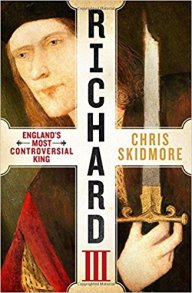 When we often think about Richard III, we tend to focus on the princes in the tower, Bosworth Field where he died, and the discovery of his body in 2012. But he was a brother to a king, a protector and he did rule as king of England. There should be more to his story than this. Chris Skidmore believed so and decided to write a modern biography on Richard called “Richard III: England’s Most Controversial King”.
 Adventures of a Tudor Nerd