
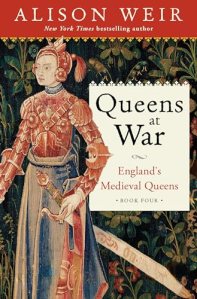
Book Review: “Queens at War: England’s Medieval Queens” by Alison Weir

The fifteenth century in England was a time of war. Between a usurper king, fighting with France, and fighting amongst themselves, an English king must be prepared to go into battle at any moment, and his queen must be ready to support him in any way. During this period, there were five kings and queens, and while the kings get a lot of attention, it is the queens who should get their flowers for what they did in times of distress. Alison Weir explores the lives of the final five Plantagenet queens in her final book in the England’s Medieval Queens series, entitled “Queens at War.”

I would like to thank Ballantine Books and NetGalley for providing me with a copy of this book. I am a big fan of Weir’s books, and I have thoroughly enjoyed her England’s Medieval Queens series. I wanted to see which queens Weir would focus on in this book and how she would approach their lives.

The years covered in this last book are 1399-1485, covering the reigns of Henry IV, Henry V, Henry VI, Edward IV, and Richard III. The queens featured in this book are Joan of Navarre, Katherine of Valois, Margaret of Anjou, Elizabeth Woodville (spelled Widville in this book), and Anne Neville. While I am familiar with the stories of Katherine, Margaret, Elizabeth, and Anne, Joan is a less well-known figure to me. Weir gives her readers a bit of background information about how Joan of Navarre was Henry IV’s second wife after his first wife, Mary de Bohun, died. Joan was married previously as well, to John IV de Montfort, Duke of Brittany. While she did have children with John, she never had royal children with Henry IV. Weir shows how Joan was treated as the stepmother to King Henry V after he married Katherine of Valois.

Weir explores Katherine of Valois’ relationships with both Henry V, the warrior king, and Owen Tudor, the man she fell in love with after the death of Henry V. We get to see how Katherine’s son, Henry VI, and his wife, Margaret of Anjou, dealt with the rising Yorkist faction. With her husband taking ill, it was Margaret of Anjou who was the figurehead for the Lancastrian cause in a conflict that would be known as the Wars of the Roses. Eventually, a young man named Edward IV would become King of England, and he shook the English court by marrying an English woman, Elizabeth Widville (Woodville). Finally, Weir explores the downfall of the Plantagenet dynasty and the end of the young Yorkist regime with Richard III and his wife Anne Neville.

Overall, I found this an informative and easy-to-follow book. It was a bit of a review for me as I am familiar with this period, but I found myself learning new information in this book, which was exciting. I think if you want to learn about 15th-century queens or if you are a fan of England’s Medieval Queens series, I recommend you read “Queens at War” by Alison Weir.
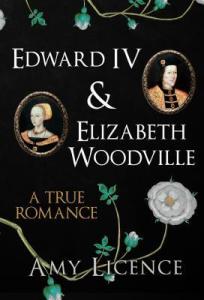
Book Review: “Edward IV & Elizabeth Woodville: A True Romance” by Amy Licence


When we think of a fairy tale romance, we think about stories like Cinderella. A girl of lower status captures the heart of the handsome prince. They overcome the odds and live happily ever after. But that kind of romance only exists in books. The closest story we have to that in medieval English history might be the story of Edward IV and Elizabeth Woodville. A widow who begged the handsome and younger King of England for help, but ended up becoming his wife. It’s a story that any romance-loving history lover will swoon over, but how accurate is that story? What is the real story of Edward IV and Elizabeth Woodville? Amy Licence explores the nature of their relationship in her book, “Edward IV & Elizabeth Woodville: A True Romance.”

I have been reading books by Amy Licence for a few years now, so when I saw this title, I knew I wanted to read it. The Wars of the Roses is one of my favorite areas of history to study, but I have not read a joint biography of Edward IV and Elizabeth Woodville. When I saw this title, I knew that this was a must-read for me.

We begin in 1431 in Rouen, France, where the Maid of Orleans, who we know as Joan of Arc, is about to die on the pyre. In the same town, eleven years later, the future King Edward IV would be born to Cecily Neville and Richard, Duke of York. Edward’s future bride, Elizabeth Woodville, was born around six years after the death of Joan of Arc. Her mother, Jacquetta of Luxembourg, had married below her station after the death of her first husband, John Duke of Bedford passed away; Jacquetta would marry a knight, Sir Richard Woodville, Elizabeth’s father. Jacquetta was close to King Henry VI and Margaret of Anjou, the Lancastrian rulers of England, and Edward IV’s father, Richard, Duke of York, would fight against the Lancastrians for the right to rule England during the conflict that we know today as the Wars of the Roses. To top it all off, Elizabeth was married to Sir John Grey of Groby Old Hall, a man who fought and died for King Henry VI.

In other words, Edward and Elizabeth were on different sides of the Wars of the Roses, but somehow these two found each other after Edward IV became king. The obvious choice for Edward’s bride should have been a foreign princess to create an alliance, but there was something about Elizabeth that convinced Edward to forgo the wisdom of Warwick and marry her. Their court was based on the Burgundian court. They had a large family, but the fight for the crown with the Lancastrian cause and Edward’s own family continued. Just when the throne is secure, Edward passes away. Elizabeth had to fight for her children, fight against her brother-in-law, and join forces with her enemy Margaret Beaufort to help usher in the Tudor dynasty.

Licence was able to present the information not only about this period, but also about Edward and Elizabeth in such a comprehensive way that both novices and experts can understand. She can present theories that she either agrees with or disagrees with respectfully. I thoroughly enjoyed this joint biography as it gave me a better appreciation for the reign of Edward IV and Elizabeth Woodville. If you want to learn more about the Wars of the Roses, the first Yorkist king, and his wife, I highly recommend you read “Edward & Elizabeth Woodville: A True Romance” by Amy Licence.

Book Review: “The Queen and the Countess” by Anne O’Brien

Medieval wars were not just fought on the battlefield. They also fought in court through marriage alliances and politics. While we often think about wars and men, we should also consider the women who played their parts either in exile or glistening palaces. We often think about medieval queens like Margaret of Anjou as these strong women who fought in their ways, but we have to consider the wife of Richard Neville Earl of Warwick, known as the Kingmaker; her name was Anne Beauchamp Countess of Warwick. The relationship between Margaret of Anjou and Anne Beauchamp has not been discussed much until now. Anne O’Brien tells the stories of these two women and the wars that bound them together in her latest novel, “The Queen and the Countess.”
I want to thank Orion Publishing and Net Galley for sending me a copy of this novel. What attracted me to this novel was the cover at first and then the description. I love reading novels about the Wars of the Roses, so when I saw it was a novel featuring both Margaret of Anjou and Anne Beauchamp Countess of Warwick, it was a must read for me.

We begin in the year 1480 as both Margaret and Anne reflect on their lives while they are in exile. Then, we get a flashback to the famous Love Day “celebration” of 1458, when members of the Lancaster and York families joined hands as a way to try to mend the rift that was bound to tear the country apart. It is the idea of King Henry VI that his wife, Margaret of Anjou, joins hands with the Duke of York. It is a complete and utter failure as the Wars of the Roses kick off in full force. Since the King is very weak, it is Margaret who must take the reigns of government to protect the Lancaster family and the throne for not only her husband but also for their only son, Prince Edward.

On the other side of the conflict is Anne Beauchamp Countess of Warwick, the wife of Richard Neville, Earl of Warwick, also known as the King Maker. She is the mother of two daughters, Isabel and Anne, but she desires a son. Being on the rebellious Yorkist side means that Anne is directly an enemy of Margaret of Anjou, but something remarkable happens: the two women form a thorny friendship. For over twenty years, the relationship between Anne and Margaret ebbs and flows as the crown passes from Henry VI to Edward IV like a ping-pong ball. Both Anne and Margaret understand what it means to lose their husbands and children whom they love; they know the glory of victory, the terror of defeat, and the uncertainty of being in exile.

I enjoyed this novel very much. It gave more depth and heart to the conflict as a whole, as well as a better understanding of both women. Anne O’Brien was able to create such dynamic characters and a thrilling novel that any fan of medieval novels will enjoy. If you are a fan of novels set during the Wars of the Roses featuring strong women, I highly suggest you read, “The Queen and the Countess” by Anne O’Brien.

Book Review: “Elizabeth of York and the Birth of the Tudor Dynasty: Uniting the Roses” by Beverley Adams

Throughout English history, some of the most famous queens have been associated with the Tudor dynasty. We have the six wives of Henry VIII (Catherine of Aragon, Anne Boleyn, Jane Seymour, Anna of Cleves, Catherine Howard, and Catherine Parr), Queen Mary I, and Queen Elizabeth I. However, one Tudor queen is often overlooked for her daughters-in-law and granddaughters, the first Tudor queen, Elizabeth of York. So who was Elizabeth of York and what role did she play in the transition between the Plantagenet dynasty and the Tudor dynasty? Beverley Adams hopes to enlighten readers about this remarkable queen in her latest book, “Elizabeth of York and the Birth of the Tudor Dynasty: Uniting the Roses.”

I want to thank Pen and Sword Books and Net Galley for sending me a copy of this book. While I know quite a bit about Elizabeth of York, the Wars of the Roses, and the origins of the Tudor dynasty, I wanted to see how Adams would portray these topics for beginners. 

To begin with, Adams lays out the origins of the conflict that we know today as the Wars of the Roses with Edward III and his sons, John of Gaunt 1st Duke of Lancaster, and Edmund of Langley, 1st Duke of York. This led to a clash between King Henry VI and Richard Duke of York. Elizabeth of York’s father, the future King Edward IV, was the son of Richard Duke of York and he had to fight for his throne. Adams explores Elizabeth’s childhood as the eldest child of Edward IV and his wife Elizabeth Woodville during this tumultuous period of English history, which would form the foundation of what kind of queen she would be in the future.

Everything changed when Edward IV died suddenly, which meant that Elizabeth’s younger brother became Edward V and left Richard Duke of Gloucester as Lord Protector. For some reason, Richard Duke of Gloucester decided to take matters into his own hands, took control of the country, declared the children of Edward IV and Elizabeth Woodville illegitimate (including Elizabeth of York), and was crowned King Richard III in a matter of months. Some resisted the new king including the son of Margaret Beaufort and Edmund Tudor, Henry Tudor. Margaret Beaufort and Elizabeth Woodville arranged a marriage between Henry and Elizabeth that would occur if Henry was able to defeat Richard III and become King of England, which he did at the Battle of Bosworth Field. The rest of this book is dedicated to showing how Elizabeth of York was as a wife, queen, and mother as she dealt with death, treachery from Lambert Simnel and Perkin Warbeck, and triumphs as she was able to see the start of the Tudor dynasty.

I think Adams does a decent job with a book that is an introduction to Elizabeth of York, the Wars of the Roses, and the beginning of the Tudor dynasty. There are some myths that she repeats to debunk, but I feel like, in some places, Elizabeth of York was not the main focus, which was a bit disappointing. Overall, if you want a solid introductory book to the life and times of the first Tudor queen, I would recommend you read, “Elizabeth of York and the Birth of the Tudor Dynasty: Uniting the Roses” by Beverley Adams.

Book Review: “Henry V: The Astonishing Triumph of England’s Greatest Warrior King” by Dan Jones

English history is filled with kings who had to fight for their crown, both at home and away in foreign lands. Men like William the Conqueror, Henry II, Henry IV, Edward IV, and Henry VII can be considered warrior kings, but one stands above them all. He only ruled for a little over nine years, but he proved his worth time and time again, especially against his French adversaries, and secured the crown of France for his young son. He was the son of Henry Bolingbroke, King Henry IV, and the grandson of John of Gaunt. He was Henry V and his story is one of the most remarkable tales in English medieval history, told masterfully in Dan Jones’ latest book, “Henry V: The Astonishing Triumph of England’s Greatest Warrior King.”
I have been a fan of Dan Jones and his books for a few years now and always jump at the chance to read his latest book. When I heard that he was writing a biography about Henry V, it was an instant pre-order for me because it is Dan Jones’ first biography and I did not know much about Henry V minus the main points about his life and reign.

It was a miracle that Henry V became King of England. Henry was the son of Henry Bolingbroke and Mary de Bohun, the grandson of John of Gaunt, and cousin to King Richard II. He was the son of an Appellant lord who was banished from England for opposing Richard II, so the likelihood that he would even be the next Duke of Lancaster was significantly small. Jones shows his audience what Henry’s childhood was like before his father was banished and after he returned and took the throne from Richard II. It was a dramatic change for the young man as it meant that he had to adapt to life as the Prince of Wales, which meant that he had to fight for English control of Wales and against those who also claimed his title, primarily Owain Glyndwr and the Percy family (including Henry Hotspur Percy). The fight for Wales culminated in the Battle of Shrewsbury where Henry Percy died and the army of Henry IV was victorious. Henry V was shot in the face with an arrow and almost died, but Doctor John Bradmore saved his life.

After the arrow incident, we see a different side of the young Prince as he is more mindful of religious matters. When his father Henry IV falls ill, we also see Prince Henry take more of a leading role in politics as part of a council meant to help the king rule England. When Henry IV died on March 20, 1413, the young King Henry V was ready to rule. He believes that to be a strong ruler, he must show it by facing the English’s mortal enemies, primarily France, in battle. He led England to great victories against the French, including the Battle of Agincourt, which was marked as one of the greatest victories for the English during the Wars of the Roses. Henry V was a competent ruler who made England a powerhouse in European history. He was able to secure the French throne for his young son Henry VI, the only child of Henry V and his wife Catherine of Valois before the great warrior king died on August 30, 1422.

I was thoroughly impressed with this biography and I am surprised that it took Dan Jones this long to write a biography. You can tell his passion for the life of Henry V through every page. I hope Jones will write another biography soon. If you are a Dan Jones fan, a medievalist, or just a fan of fantastic biographies, I highly suggest you read, “Henry V: The Astonishing Triumph of England’s Greatest Warrior King” by Dan Jones.

Book Review: “A Good Deliverance” by Toby Clements

A Good DeliveranceThe world of King Arthur and his Knights of the Round Table is filled with stories of adventures and romance. Many authors have tried to tell these tales in a way that will allow their books to live for centuries, but none were more successful than Sir Thomas Malory and his book Le Morte Darthur. King Arthur, Lady Guinevere, Sir Lancelot, Merlin, and Sir Gawain embark on numerous adventures including the Lady of the Lake, Camelot, the sword Excalibur, and the Quest for the Holy Grail. These tales were the epitome of chivalry and valiant knights in shining armor, but the author behind them was anything but perfect. Sir Thomas Malory has had his fair share of time in a prison cell. Who was Sir Thomas Malory and why did his book about King Arthur and the Knights of the Round Table still resonate with readers centuries after it was written? In his latest novel, “A Good Deliverance,” Toby Clements hopes to reveal the truth of this famous author whose story has been overshadowed by the myths he wrote down in his legendary tome.

I would like to thank Faber Books for sending me a copy of this novel. I have heard about the book Morte Darthur, as it is considered one of the most prominent texts about King Arthur, but when it comes to the author himself, I know nothing about his life. When I heard about this novel, the premise intrigued me enough to read it.

Clements begins his novel with Malory’s surprise arrest at a very old age. Malory is unsure why he has returned to prison as he has tried to live an honest life after he spent some time in the same cell over 20 years ago. He is at the mercy of King Edward IV. While imprisoned, waiting for word from his lawyer, Malory befriends a boy who is the son of one of the jailers named Brunt and he tells the young man his tale. Malory was the son of a knight who fought under King Henry IV in the search for the Welsh miscreant Owen Glendower. We get to see Malory become a knight and his fascination for King Arthur and the Knights of the Round Table that would become his magnum opus Morte Darthur. We see Malory’s moments of glory and utter defeat, his rivals, and the women that he admired from afar. Through Malory, we get to see how England changed, starting with Henry IV to his son Henry V, the young King Henry VI, and finally the first Yorkist King Edward IV. We also get to witness events such as the year of the 3 popes, the coronation of Henry V, Agincourt, the death of Jeanne d’Arc, the coronations of King Henry VI, and the beginning of the conflict known as the Wars of the Roses.

In a way, Clements created his Arthurian legend for Sir Thomas Malory with the way he chose to write this novel. However, it was the structure of this novel that bothered me when I was reading it, specifically the bullet points that Clements chose to include. When I am reading a novel, I want to read a cohesive piece, but the bullet points made it feel messy, which was probably used to simulate Malory as a storyteller figuring out what he wants to say to his young audience and what he wants to omit, however, it was just irritating for me to read. I don’t mind bullet points in nonfiction books, but it just doesn’t work for me in historical fiction. As for the main character, Sir Thomas Malory is okay, but there were moments where he rubbed me the wrong way. I did, however, enjoy his relationship with the boy.

Overall, it was a decent book. I think there were elements that I didn’t enjoy entirely, but the way Clements was able to incorporate the changes of the 15th century with the Arthurian legends to tell the story of this author was very unique. I think if you are a fan of Sir Thomas Mallory, the Arthurian legends, or the events of the 15th century, you might enjoy, “A Good Deliverance” by Toby Clements.

Book Review: “On This Day in the Wars of the Roses” by Dan Moorhouse

On this day in the Wars of the RosesThe Wars of the Roses, a conflict that engulfed English politics for over 30 years and heralded a new dynasty, the Tudors. While there were battles and political intrigue galore during this period of unrest, there were also births, marriages, and deaths of powerful figures. Each day during the Wars of the Roses holds significance to nobles and commoners alike. Dan Moorhouse has compiled his years of research into this conflict into his book, “On This Day in the Wars of the Roses.”

I would like to thank Dan Moorhouse for sending me a copy of this book. I have been studying the Wars of the Roses for a few years now and so when I hear about books on the subject, I jump at the chance to read them to see if they bring any new revelations to the period.

Like many other books that focus on historical events of the past, Moorhouse highlights each date, starting from January and ending in December. However, unlike other books, the dates do not go in chronological order by year the entries jump from decade to decade, telling a more comprehensive story of the conflict.

Throughout this book, Moorhouse explores major battles, the disappearances of the Princes in the Tower, the madness of King Henry VI, and plots and executions of nobles and commoners alike. We also get to see how commoners got along during these tumultuous times through advancements in trade, alchemy, military tactics, and marriages. By focusing on the stories of those who were not nobility, Moorhouse is showing that even though this was a conflict for the crown, normal life moved on, as it always does.

Moorhouse is very knowledgeable about the period and can share all that he knows succinctly. He is also able to keep a neutral tone, neither siding with the Lancastrians nor the Yorkists, for the historical facts to speak for themselves. I found myself enjoying this book and the new stories from this conflict that I never knew. If you want a different approach to the Wars of the Roses, I recommend you read, “On This Day in The Wars of the Roses” by Dan Moorhouse.

Book Review: “The Queen’s Rival” by Anne O’Brien

the queen's rivalEngland is in the midst of chaos in a conflict known as the Wars of the Roses. The Yorkist cause is formulating a case to take the throne’s power from Henry VI and the Lancastrians and replace the king with Richard, Duke of York, whose claim to the throne is a bit stronger. Caught in the middle of the Wars of the Roses was one strong and courageous woman who would fight tooth and nail for her family and the Yorkist cause. Her name was Cecily Neville, Duchess of York, and her story is masterfully told in Anne O’Brien’s novel, “The Queen’s Rival.”
A few years ago, I hosted Anne O’Brien to discuss this book as part of a blog tour for The Coffee Pot Book Club. I will admit that this was the first time I had read a novel by Anne O’Brien, but I had heard amazing things about her writing style, so when I saw this novel at a bookstore, it was an instant buy for me.

We begin in the year 1459 and the house of York is facing a disaster. The Yorkists have lost the Battle of Ludford Bridge and must now separate and go into exile. Cecily can only watch as the Lancastrians lay siege to her home, forcing her and her young children to be imprisoned at Tonbridge Castle. This moment might have broken Cecily’s spirit, but Cecily is a proud Neville, willing to fight until the bitter end to see her family safe and secure on the throne of England. Along the way, she must endure heartache (such as the death of her husband Richard Duke of York) and moments of betrayal, such as George, Duke of Clarence, and Richard, Earl of Warwick. Cecily’s name and reputation are dragged through the mud on numerous occasions. However, she gets to witness moments of glory, the crowning of her sons Edward IV and Richard III, and the birth of her grandchildren, to create the House of York.

My favorite aspect of this novel is that the chapters are not written like traditional chapters. The chapters are a series of letters to and from Cecily to her family members or those she considers her enemies to convince them to give her and her family leniency. Cecily’s main correspondences are with her sisters, Anne Duchess of Buckingham, and Katherine Dowager Duchess of Norfolk. One of my favorite characters is the author of England’s Chronicle, who reminds me of a gossip columnist, ready to spill all the secrets and rumors to anyone who will hear it.

I had such a fun time reading this novel. Even though I knew the events of the Wars of the Roses and what would happen, I found it refreshing to read it as a series of letters so that you can sense how the historical figure might have felt during that moment. This may have been my first novel by Anne O’Brien, but it definitely will not be my last. If you want a thrilling novel about the Wars of the Roses from the perspective of Cecily Neville, I highly suggest you read, “The Queen’s Rival” by Anne O’Brien.

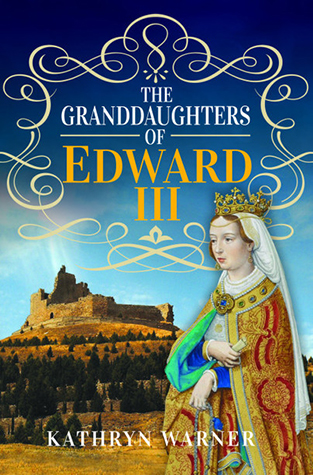
Book Review: “The Granddaughters of Edward III” by Kathryn Warner

Granddaughters of Edward IIIWhen we think about the legacy of Edward III, we often think about a warrior king who became king after his father, Edward II’s disastrous fall from grace. We know about his sons that he had with his beloved wife, Philippa of Hainault: Edward the Black Prince, Lionel of Antwerp, Duke of Clarence, John of Gaunt 1st Duke of Lancaster, Edmund of Langley, 1st Duke of York, and Thomas of Woodstock, Duke of Gloucester. Famously, we get the 15th-century conflict known as the Wars of the Roses through the descendants of Edward III. However, the male descendants only tell half the story of Edward III and Philippa of Hainault’s legacy in England and throughout Europe. In her latest book, “The Granddaughters of Edward III,” Kathryn Warner examines the lives of Edward III’s female descendants to better appreciate the strength of this group of branches of the Plantagenet family tree.

Thank you, Pen and Sword Books and Net Galley, for sending me a copy of this book. I am always looking for more books about the Plantagenets, and I know a bit about Edward III’s sons but not much about his granddaughters.

Warner has chosen to take a joint biography approach to this book by focusing on nine out of eleven of Edward III’s granddaughters. These eleven granddaughters were the daughters of Lionel Antwerp, John of Gaunt, Isabella Woodstock, Edmund of Langley, and Thomas of Woodstock. The eleven granddaughters of Edward III and Philippa of Hainault were: Philippa of Clarence, Philippa of Lancaster, Elizabeth of Lancaster, Marie de Coucy, Philippa de Coucy, Catalina of Lancaster, Constance of York, Joan Beaufort, Anne of Gloucester, Joan of Gloucester, and Isabel of Gloucester.

These women were not just great ladies in England, but in the case of Philippa of Lancaster and Catalina of Lancaster, they were Queens of Portugal and Castile, respectively. Philippa of Lancaster ushered in the Illustrious Generation in the history of the royal family of Portugal. Catalina married her mother’s mortal enemy to create a stronger connection between England and Castile. Back in England, the remaining granddaughters had to deal with rebellions against King Henry IV, resulting in husbands and sons being beheaded. One had married her former brother-in-law when her husband died, and another had an affair with the king’s half-brother, resulting in the birth of an illegitimate daughter. A granddaughter had her marriage annulled when her husband decided to marry a lady-in-waiting. One began her life as an illegitimate child and would end up being the grandmother to two Kings of England.

Warner has been able to take the stories of these eleven women who shared a grandfather and show how their tales transformed England, Castile, and Portugal forever. The amount of love and attention she dedicated to this book is admirable. I appreciate how Warner could give readers who only understood the English side of these tales a better understanding of the political situations in Castile and Portugal. If you want a book with brand new medieval heroines with a connection to the Plantagenet dynasty, I highly recommend you read “The Granddaughters of Edward III” by Kathryn Warner.

Book Review: “Red Rose, White Rose” by Joanna Hickson

20892659One woman is torn between the loyalty to her birth family and the loyalty to her family by marriage. Now, this may sound like the story of Elizabeth of York, but alas, it is not. This story does take place in the fifteenth century, but it is the story of Elizabeth of York’s grandmother, “The Rose of Raby,” Cecily Neville. Born to the proud Neville family, who were proud Lancastrians, Cecily’s father, Ralph Neville, the Earl of Westmorland, arranged a marriage for his daughter to the young and ambitious Richard, Duke of York. She is now one of the most powerful women in England, but with power comes risks of ruin as Cecily has a secret that could be disastrous. War looms between the Red Roses of Lancaster and the White Roses of York, one that will transform English history forever, with Cecily caught in the middle. Her story is told in Joanna Hickson’s novel, “Red Rose, White Rose.”

Hickson begins her book by showing the interaction between Cecily and her half-brother, Cuthbert or Cuddy. Cecily is engaged to Richard Duke of York when she is kidnapped but is later rescued by John Neville, a distant cousin. In John Neville’s care, Cecily Neville’s life takes an unexpected turn, and a secret relationship is formed between the two. Although I know this was a fictitious relationship invented for this book, it still did not sit well with me. I have always thought Cecily was loyal and devoted to her husband and family (even though there were rumors of her and a knight having an affair), so this did not fit my view of Cecily Neville.

The bulk of this novel explores how Cecily and Richard were able to navigate the complex world of 15th-century English politics while their family grew. We also see Cuthbert fall in love and have his own family while he stays by Cecily’s side during such a tumultuous time.

This novel did not spend much time on the Wars of Roses. We get to see the origins of the major battles and how Edward became king, but we don’t see Cecily trying to hold her family together. I wanted to see her interactions with her sons Edward, George, and Richard during their feuding years. I wanted to see her reactions to Edward’s marriage to Elizabeth Woodville and her interactions with her daughter-in-law. In short, I wanted a longer story that focused more on the Wars of the Roses and how Cecily Neville dealt with the changes in her family dynamic due to the throne’s power.

Overall, this novel was enjoyable and well-written. Some elements were included that I disagreed with their concept. The story was engaging and gave Hickson’s audience a sneak-peek into Cecily Neville, Richard Duke of York, and their children. If you want a solid novel about Cecily Neville, I recommend reading “Red Rose, White Rose” by Joanna Hickson.