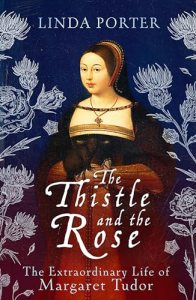
Book Review: “The Thistle and The Rose: The Extraordinary Life of Margaret Tudor” by Linda Porter

The Tudors have been an area of fascination for historians and history nerds alike for centuries. The attention tends to focus on either Henry VIII and his six wives or his daughter, Elizabeth I, but we need to remember that they were not the only Tudors. In fact, we should remember that Henry VIII had siblings, Arthur, Margaret, and Mary. While Arthur and Mary tend to get more attention due to their proximity to Henry VIII and his marital life, Margaret Tudor had her own eventful life as Queen of Scotland and the mother of King James V. Linda Porter tells Margaret’s story in her latest biography, “The Thistle and the Rose: The Extraordinary Life of Margaret Tudor.”

I had heard that Porter was writing a new biography about Margaret Tudor, so I knew I wanted to read it. I have read a few books about Margaret Tudor, but they have been relatively short, so I wanted to see what new information Porter would include in this book.

Margaret Tudor was the second child of King Henry VII and Queen Elizabeth of York. As such, she was destined to marry a foreign prince and create a strong alliance for the brand-new Tudor dynasty. Since her brother Arthur was betrothed to Catherine of Aragon, Margaret’s parents chose a match with Scotland and King James IV, who was twice the age of Margaret. As Queen of Scotland, Margaret did her best to bridge the gap between England and Scotland, deal with her husband’s mistresses and illegitimate children, and be a mother to her son, King James V.

Everything changed when James IV died at the Battle of Flodden. Margaret was now a widow and regent for the young King James V. To protect her family, Margaret decided to marry Archibald Douglas, 6th Earl of Angus, which turned out to be a trainwreck. Although Archibald did give Margaret her daughter, Margaret Douglas, he was stealing from Margaret’s own properties, which was a jerk move. Margaret wanted a divorce, but her dear brother Henry VIII was against the idea. A bit hypocritical, especially since he would divorce Catherine of Aragon a few years later. Eventually, Margaret would divorce Archibald and marry a third time to Henry Stewart, Lord Methven.

Throughout history, Margaret Tudor has been viewed negatively because she married Archibald so quickly, but Porter showed that Margaret should be applauded for how she survived during difficult circumstances. She fought for herself and her children, even if it meant that she was at odds with her husbands or her brother. Through her letters, we see how Margaret was a diplomat trying to make peace between England and Scotland.

Porter does an excellent job telling Margaret’s story in a respectful manner. This book is extremely well researched and easy to read. If you are a Tudor fan and you want to learn more about Henry VIII’s sister Margaret Tudor, I highly recommend you read “The Thistle and the Rose: The Extraordinary Life of Margaret Tudor” by Linda Porter.

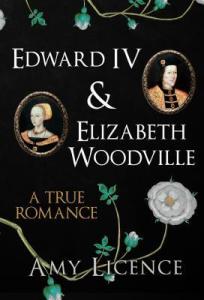
Book Review: “Edward IV & Elizabeth Woodville: A True Romance” by Amy Licence


When we think of a fairy tale romance, we think about stories like Cinderella. A girl of lower status captures the heart of the handsome prince. They overcome the odds and live happily ever after. But that kind of romance only exists in books. The closest story we have to that in medieval English history might be the story of Edward IV and Elizabeth Woodville. A widow who begged the handsome and younger King of England for help, but ended up becoming his wife. It’s a story that any romance-loving history lover will swoon over, but how accurate is that story? What is the real story of Edward IV and Elizabeth Woodville? Amy Licence explores the nature of their relationship in her book, “Edward IV & Elizabeth Woodville: A True Romance.”

I have been reading books by Amy Licence for a few years now, so when I saw this title, I knew I wanted to read it. The Wars of the Roses is one of my favorite areas of history to study, but I have not read a joint biography of Edward IV and Elizabeth Woodville. When I saw this title, I knew that this was a must-read for me.

We begin in 1431 in Rouen, France, where the Maid of Orleans, who we know as Joan of Arc, is about to die on the pyre. In the same town, eleven years later, the future King Edward IV would be born to Cecily Neville and Richard, Duke of York. Edward’s future bride, Elizabeth Woodville, was born around six years after the death of Joan of Arc. Her mother, Jacquetta of Luxembourg, had married below her station after the death of her first husband, John Duke of Bedford passed away; Jacquetta would marry a knight, Sir Richard Woodville, Elizabeth’s father. Jacquetta was close to King Henry VI and Margaret of Anjou, the Lancastrian rulers of England, and Edward IV’s father, Richard, Duke of York, would fight against the Lancastrians for the right to rule England during the conflict that we know today as the Wars of the Roses. To top it all off, Elizabeth was married to Sir John Grey of Groby Old Hall, a man who fought and died for King Henry VI.

In other words, Edward and Elizabeth were on different sides of the Wars of the Roses, but somehow these two found each other after Edward IV became king. The obvious choice for Edward’s bride should have been a foreign princess to create an alliance, but there was something about Elizabeth that convinced Edward to forgo the wisdom of Warwick and marry her. Their court was based on the Burgundian court. They had a large family, but the fight for the crown with the Lancastrian cause and Edward’s own family continued. Just when the throne is secure, Edward passes away. Elizabeth had to fight for her children, fight against her brother-in-law, and join forces with her enemy Margaret Beaufort to help usher in the Tudor dynasty.

Licence was able to present the information not only about this period, but also about Edward and Elizabeth in such a comprehensive way that both novices and experts can understand. She can present theories that she either agrees with or disagrees with respectfully. I thoroughly enjoyed this joint biography as it gave me a better appreciation for the reign of Edward IV and Elizabeth Woodville. If you want to learn more about the Wars of the Roses, the first Yorkist king, and his wife, I highly recommend you read “Edward & Elizabeth Woodville: A True Romance” by Amy Licence.

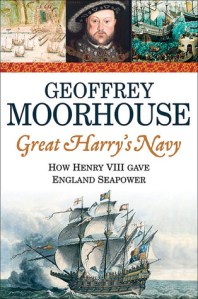
Book Review: “Great Harry’s Navy: How Henry VIII Gave England Sea Power” by Geoffrey Moorhouse

One would assume that, since England is an island nation, its navy has been its strength since its foundation. That, however, was not always the case. While there were naval battles during the Middle Ages, it was not a navy like we know today. The concept of the Royal Navy was founded during the time of the Tudors, especially under the reign of Henry VIII. So, how did Henry VIII turn a navy from 7 ships to over fifty ships that could stand with other European navies? Geoffrey Moorhouse examines the creation of the English navy in his book, “Great Harry’s Navy: How Henry VIII Gave England Sea Power.”
This particular title was a used bookstore find for me. I saw that it was about the Tudors, and an aspect that I am not super familiar with. I don’t read a lot of nautically-based books, especially nonfiction, so I decided to go on a whim and try it out.

Moorhouse recognizes that this is a highly specialized book, so before delving into the history, he includes an extensive glossary at the beginning of the book to assist those unfamiliar with nautical terminology. He then dives into the origins of the English navy pre-Henry VII, and we can see that Henry VII did not leave his son, Henry VIII, many ships. However, Henry VIII had such a passion for ships that he got to work right away making shipbuilding centers and making sure that the right men were in the positions of power to make his navy superior to those in Europe. Moorhouse goes into minute detail to show how the Tudor navy rose, fell, and rose again to create a foundation that Henry’s children, Edward VI, Mary I, and Elizabeth I would build upon to create a sea superpower.

I am a fan of challenging books and discovering new topics in history. I wanted to learn more about naval history, presented in an easy-to-follow writing style. While Moorhouse does attempt to do this, his exuberant nerdy side for naval history comes out, and it felt like he was having a conversation with experts, not novices. It was one of those books that took me a long time to read because there was so much information that I was trying to digest as a novice.

I think this book is definitely written for a specific group of people, and they are those who love nautical history and learning about the Tudors. For novices, like myself, it may be quite a trial to read. If you are in the latter category and you want to read this, take your time and take notes if need be. I think this is a book that could be a great resource for historical fiction authors and just those who want a different approach to the Tudors. If that is you, “Great Harry’s Navy: How Henry VIII Gave England Sea Power” by Geoffrey Moorhouse might be a book to add to your collection.

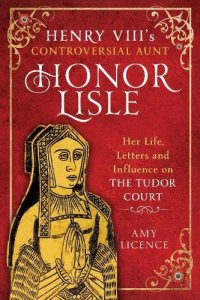
Book Review: “Henry VIII’s Controversial Aunt, Honor Lisle: Her Life, Letters, and Influence on the Tudor Court” by Amy Licence

Marrying into the royal family is not all sunshine and rainbows. Of course, we tend to think about those who marry the king, the queen, the prince, or the princess. But we also need to consider the aunts and the uncles of the royals as part of the family. Take, for example, Arthur Plantagenet, the illegitimate son of Edward IV and the uncle of Henry VIII. His second wife, Honor Lisle, would help him rule Calais; however, she is best known for her letters and her devout Catholic faith during the Reformation in England. So why is Honor Lisle considered a controversial figure, and what was the cause of the fall of Honor and Arthur from the royal good graces? Amy Licence explores the life of Henry VIII’s step-aunt in the first full biography dedicated to Honor Lisle, which is entitled “Henry VIII’s Controversial Aunt, Honor Lisle: Her Life, Letters, and Influence on the Tudor Court.”
I would like to thank Pen & Sword Books and NetGalley for providing me with a copy of this book. I have heard of Honor Lisle and her letters, but I did not know much about her life before this book. I did know that she was married to Arthur Plantagenet, but I had assumed that he was her first husband, so I didn’t know about her life before Arthur. When I saw that Amy Licence was writing a biography about Honor Lisle, I knew I wanted to read it.

Licence begins with the birth of Honor Grenville, Lady Basset, Lady Lisle Plantagenet. She was born in 1493 to Thomas and Isabel Grenville in the small town of Bideford, Devon. Her father served the first Tudor king, Henry VII, as Esquire of the Body, so Honor’s family did have some connection before Honor’s marriage to Arthur. Honor’s mother died a year after she was born, but her father did not die until 1513. In 1515, Honor would marry her first husband, Sir John Basset, and they would have between 7 and 8 children before his death in January 1528. 

A year later was a monumental year for England as it was the start of the divorce between Henry VIII and Catherine of Aragon, which would be known as the Great Matter. It was also the year that Honor married Arthur Plantagenet. The couple would move to Calais, where Arthur would rule for his nephew. This is where we get to see the Lisle letters, Honor’s dictated correspondence to prominent figures in Tudor England. Honor and Arthur would go into debt, dealing with the constant threat of war, balance their faith and be loyal to the King, and handle a plot by Reginald Pole that would try to remove Henry VIII from the throne. 

I found it so interesting to see Honor’s perspective on the big issues of the Tudor court while staying in France, as well as how life in Calais was different from it was in London during this time. Honor Lisle’s life and letters give us great insight into the reign of Henry VIII from the perspective of someone who was outside of England during the major events of his reign. Licence’s research, combined with an easy-to-follow writing style, makes this a very well-written biography. If you want a biography about a lesser-known Tudor woman and her famous letters, I highly recommend you read “Henry VIII’s Controversial Aunt, Honor Lisle: Her Life, Letters and Influence on the Tudor Court” by Amy Licence.

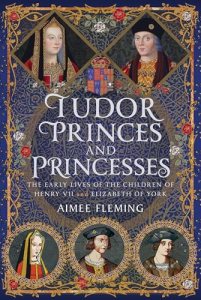
Book Review: “Tudor Princes and Princesses: The Early Lives of the Children of Henry VII and Elizabeth of York” by Aimee Fleming

The year is 1485, and the last Plantagenet king, Richard III, is dead. The young man whose army defeated the king is Henry Tudor, and he is about to start a dynasty that will reshape world history forever. Henry Tudor, now King Henry VII, married the daughter of King Edward IV and Elizabeth Woodville, Elizabeth of York. Their marriage and their children would lay the foundation for the Tudor dynasty, but what was life like for the children who were the first generation of this remarkable dynasty? Aimee Fleming explores the lives of these royal siblings in her latest book, “Tudor Princes and Princesses: The Early Lives of the Children of Henry VII and Elizabeth of York.”

I would like to thank Pen and Sword Books and NetGalley for sending me a copy of this book. I enjoyed her previous book about Margaret More Roper, so when I heard that she was writing a book about the children of Henry VII and Elizabeth of York, I was curious to see what new information Fleming would include in this book.

Fleming begins with the aftermath of Bosworth as King Henry VII begins his new life as a king and husband to Elizabeth of York. As they anticipate the arrival of their firstborn child, we get to see how their childhoods influenced their parenting style. The couple’s firstborn child, Prince Arthur Tudor, would be born in Winchester, the city where the mythical Camelot is supposed to be. As the heir to the dynasty and a boy named after the legendary King Arthur, the young prince was seen as the embodiment of the Tudor rose and the hope of the dynasty’s future. No pressure at all for the young prince.

After the birth of Prince Arthur, Henry and Elizabeth welcomed Margaret, Henry, Elizabeth, Edward/Edmund, and Mary into the family. While Princess Elizabeth and Prince Edward/Edmund died young, we get to see Princesses Margaret and Mary, as well as Prince Henry, grow up in the royal nursery, being educated for their important roles as future monarchs, and the bond they shared as siblings. They had to deal with the ever-changing world of the 16th century and navigate the uncertainty of court life, especially with the pretenders waiting in the wings to snatch the crown. Margaret, Henry, and Mary had to deal with the death of Prince Arthur shortly after he married Catherine of Aragon, and their mother, Elizabeth of York, after she gave birth to her final daughter, who also died. Blood may have connected these siblings, but love and shared experiences made this family tight-knit.

Overall, I thought this book was a nice review book for those who know about the Tudors, and a nice introductory book for those who are not familiar with this family. If either of these descriptions sounds like you, if you are a Tudor nerd, I recommend you read “Tudor Princes and Princesses: The Early Lives of the Children of Henry VIII and Elizabeth of York” by Aimee Fleming.

Book Review: “The Cardinal” by Alison Weir

During the reign of King Henry VIII, the king would elevate well-qualified men to positions of power and prestige. We all know the story of Thomas Cromwell, but it is his mentor, Sir Thomas Wolsey, whose story shows how one can rise from humble beginnings, but whose fate is ultimately tied to the mood of the monarch. The son of a butcher turned scholar who became a priest, a lover, a father, and the closest advisor to the king. His life, his loves, his successes, and his struggles are told in Alison Weir’s latest novel, “The Cardinal.”
I would like to thank Ballantine Books and Net Galley for sending me a copy of this novel. I am a fan of Weir’s novel, so when I saw her writing a new one about Sir Thomas Wolsey, I knew I wanted to read it. Wolsey is someone who tends to be a side character, so to have a novel dedicated to his life was an exciting idea.

Weir begins her story with Thomas (known in this novel as Tom) at the age of 11, going to school. His father, Robert Wolsey, is a butcher from Ipswich who wants his son to climb the social ladder in the church. Tom will eventually rise to the level of becoming King Henry VII’s chaplain and will begin working with King Henry VIII. Life for Tom is thrilling with the twists and turns of court life, but the one thing that is missing in his life is someone to share it with. Since he is a member of the church, he cannot marry or have his own family, but things change for Tom when he meets Joan Larke. Their love for each other is genuine, even though it is taboo in the eyes of the church and King Henry VIII, which comes across as quite hypocritical.

It was under King Henry VIII that Tom’s star rose to remarkable heights. He became a Cardinal, was the King’s right-hand man and best friend, and was able to create the architectural marvel of Hampton Court Palace. But his rise in prominence came with a cost. Tom must help the king navigate not only international affairs, such as the Field of Cloth of Gold, but also more personal matters, such as the divorce of King Henry VIII and Katherine of Aragon, which would become known as The Great Matter. Tom would have many enemies at court, including Anne Boleyn, the future wife of King Henry VIII, who would ultimately lead to Tom’s fall from grace.

This is such an engrossing novel about one of the most complex figures of the Tudor dynasty. Thomas Wolsey’s story shows the struggle of fighting for those you love over the ambitions and prestige of the glittering court life. If you want an excellent novel about one of Henry VIII’s closest advisors and his life, I would highly recommend you read “The Cardinal” by Alison Weir.

Book Review: “The Pretender” by Jo Harkin

The Wars of the Roses are ending, and with it comes uncertainty about who will lead the country. On one side is King Richard III, who many believe killed his nephews to become King of England; on the other is Breton Henry, Henry Tudor, who believes he is the rightful king due to his bloodline. However, there is a third player in this entire debacle. A young farm boy named John Collan may spend his days daydreaming and studying to his heart’s content, but he is destined for more. A path that will lead him to hobnob with nobility and become the enemy of a king who just sat on his throne. Just who is John Collan, and how did this boy go from the farm to a life of infamy? Jo Harkin tells the story of how John Collan became Lambert Simnel in her novel, “The Pretender.”

I would like to thank Knopf and Net Galley for sending me a copy of this novel. As someone who reads a lot about the Wars of the Roses, I tend to gravitate towards the main players and the nobility. However, there was something about a novel all about one of the pretenders, Lambert Simnel, that piqued my curiosity. Plus, the fact that this was the author’s first foray into historical fiction was a nice touch. I wanted to see how well Harkin would do with an obscure figure and her first historical fiction novel.

We begin with John Collan, a son of a farmer who dreams of being a scholar and running away from a rather vicious goat. John’s father, Will Collan, is a pretty wealthy man, but he is also connected to a man named Maister Richard Simons, who agrees to tutor John at Oxford. Such a remarkable turn of luck for a farm boy, but why choose him over others? Maister Simons explains that Will Collan is not John’s father. His name is not even John. He is to be known as Lambert Simnel, and his true father is none other than George, Duke of Clarence, which makes him Edward, Earl of Warwick. It’s a lot to take in, but then John/Lambert is taken to both Burgundy and Ireland so that he can gain powerful allies such as Margaret, Dowager Duchess of Burgundy, John de la Pole, 1st Earl of Lincoln, and the Earl of Kildare.

John/Lambert continues to study, falls in love with a girl named Joan, is crowned king, and even goes to war against the Tudor king. But the boy will soon learn the bitter taste of betrayal and the heartache of losing those he loves the most to try and wrest the crown from Henry VII. While the dialogue was at times borderline vulgar, I did enjoy most of the story until the aftermath of the Battle of Stoke Field. It was when John/Lambert was held captive that it fell flat, and it was a bit difficult to follow along for me. I also wish Harkin had included some sort of author’s note or explanation of her research to help those who are new to Lambert Simnel’s story understand why she wrote the novel in the way she did.

Overall, I think this was a decent novel. It is ambitious to tackle an obscure figure like a pretender as a protagonist of a historical novel, but I think Harkin does a good job. It makes you wonder what must have been going on when this young man decided that he was going to take on a crowned king. Such a small footnote in history makes one compelling tale. If you want a novel about someone who does not get enough attention, I recommend you read “The Pretender” by Jo Harkin.

Book Review: “Mary Tudor: Queen of France” by Amy McElroy

The life of a 16th-century princess is not all that it is cracked up to be. You can have jewels, and glamorous dresses, attend the glittering yet treacherous court, and have numerous homes. You must marry the person the king says you should marry to create strong alliances for the kingdom, so the concept of marrying for love is not in your vocabulary. You had to ensure your opinions were kept in line with the monarch’s views so you didn’t meet a disastrous end. In other words, the closer you are to the throne, the more scrutiny is forced upon you. No one understood this advice better than Mary Tudor, the daughter of King Henry VII and the younger sister of Henry VIII. She was a daughter, a sister, a wife, a queen, a duchess, and a mother. Her remarkable story is told in Amy McElroy’s book, “Mary Tudor: Queen of France.”
I want to thank Pen and Sword Books and Net Galley for sending me a copy of this book. I have read Amy McElroy’s previous books, “Women’s Lives in the Tudor Era” and “Educating the Tudors,” and I enjoyed both books. When I heard that she would write her first-ever biography on Mary Tudor, I jumped at the chance to read it because Mary is my favorite of the children of Henry VII and Elizabeth of York.

McElroy begins with a quick overview of the conflict that brought the Tudors to the throne, the Wars of the Roses. The marriage of Mary’s parents, Henry VII and Elizabeth of York united the kingdom and started the Tudor dynasty. Like any dynasty, it was important to have heirs, spares, and daughters who could be used essentially as pawns in the marriage market to create strong alliances. Mary’s eldest brother Arthur married Katherine of Aragon to form an alliance with Spain and her older sister Margaret married James IV of Scotland for another alliance. From a young age, Mary Tudor was a proposed bride for Charles of Castile, the son of King Philip the Handsome and Queen Joanna of Castile and Aragon, who would become Holy Roman Emperor Charles V. Unfortunately, this marriage plan fizzled, but another bride groom was waiting in the wing, King Louis XII of France.

Mary’s marriage to King Louis XII of France and her time as Queen of France did not last long because Louis died mere months after their wedding. Now Mary could have returned to England or stayed in France and waited for another royal match to happen, but Mary chose option number three. Mary’s heart belonged to her brother Henry VIII’s best friend Charles Brandon, and the two devised a plan to marry in secret. It was out of the ordinary and it did create quite the scandal, but at the end of the day, it was a love match. Charles and Mary had a family and were involved in court politics including the Great Matter, before Mary died on June 26, 1533.

I think what has impressed me about McElroy’s books, including this one, is her ability to reveal something new to the subject material. While I knew quite a bit about Mary’s life, it was the marriage negotiations and her inner circle that truly fascinated me. If you want a new book about the sister of Henry VIII with new insight into her life and the politics of marriage, I highly suggest you read, “Mary Tudor: Queen of France” by Amy McElroy.

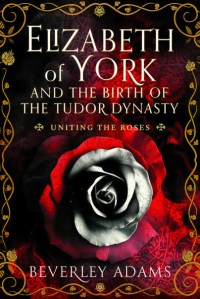
Book Review: “Elizabeth of York and the Birth of the Tudor Dynasty: Uniting the Roses” by Beverley Adams

Throughout English history, some of the most famous queens have been associated with the Tudor dynasty. We have the six wives of Henry VIII (Catherine of Aragon, Anne Boleyn, Jane Seymour, Anna of Cleves, Catherine Howard, and Catherine Parr), Queen Mary I, and Queen Elizabeth I. However, one Tudor queen is often overlooked for her daughters-in-law and granddaughters, the first Tudor queen, Elizabeth of York. So who was Elizabeth of York and what role did she play in the transition between the Plantagenet dynasty and the Tudor dynasty? Beverley Adams hopes to enlighten readers about this remarkable queen in her latest book, “Elizabeth of York and the Birth of the Tudor Dynasty: Uniting the Roses.”

I want to thank Pen and Sword Books and Net Galley for sending me a copy of this book. While I know quite a bit about Elizabeth of York, the Wars of the Roses, and the origins of the Tudor dynasty, I wanted to see how Adams would portray these topics for beginners. 

To begin with, Adams lays out the origins of the conflict that we know today as the Wars of the Roses with Edward III and his sons, John of Gaunt 1st Duke of Lancaster, and Edmund of Langley, 1st Duke of York. This led to a clash between King Henry VI and Richard Duke of York. Elizabeth of York’s father, the future King Edward IV, was the son of Richard Duke of York and he had to fight for his throne. Adams explores Elizabeth’s childhood as the eldest child of Edward IV and his wife Elizabeth Woodville during this tumultuous period of English history, which would form the foundation of what kind of queen she would be in the future.

Everything changed when Edward IV died suddenly, which meant that Elizabeth’s younger brother became Edward V and left Richard Duke of Gloucester as Lord Protector. For some reason, Richard Duke of Gloucester decided to take matters into his own hands, took control of the country, declared the children of Edward IV and Elizabeth Woodville illegitimate (including Elizabeth of York), and was crowned King Richard III in a matter of months. Some resisted the new king including the son of Margaret Beaufort and Edmund Tudor, Henry Tudor. Margaret Beaufort and Elizabeth Woodville arranged a marriage between Henry and Elizabeth that would occur if Henry was able to defeat Richard III and become King of England, which he did at the Battle of Bosworth Field. The rest of this book is dedicated to showing how Elizabeth of York was as a wife, queen, and mother as she dealt with death, treachery from Lambert Simnel and Perkin Warbeck, and triumphs as she was able to see the start of the Tudor dynasty.

I think Adams does a decent job with a book that is an introduction to Elizabeth of York, the Wars of the Roses, and the beginning of the Tudor dynasty. There are some myths that she repeats to debunk, but I feel like, in some places, Elizabeth of York was not the main focus, which was a bit disappointing. Overall, if you want a solid introductory book to the life and times of the first Tudor queen, I would recommend you read, “Elizabeth of York and the Birth of the Tudor Dynasty: Uniting the Roses” by Beverley Adams.

Book Review: “Tudor Executions: From Nobility to the Block” by Helene Harrison

Tudor ExecutionsTreason is the crime of betraying one’s country or monarch by trying to overthrow the government or kill a sovereign. While many English dynasties dealt with treason in their ways, the most infamous were the Tudors and how they dealt with the nobility. By the end of 1572, there were no more dukes in England, until 1623 when George Villiers became the Duke of Buckingham. What was classified as treason during the Tudor dynasty and why did the members of the nobility have to die? Helene Harrison hopes to answer these questions in her latest book, “Tudor Executions: From Nobility to the Block.”

I would like to thank Pen and Sword Books and Net Galley for sending me a copy of this book. I enjoyed Harrison’s previous book about Elizabethan Rebellions, so when I heard that she was writing a new book about Tudor executions, I knew I wanted to read it.

Harrison begins by giving her readers a quick overview of what treason meant during the time of the Tudors through the numerous Treason Acts, the significance of the Act of Attainders and scaffold speeches. She also explains that this book explores the lives and ultimate deaths of nine men and five women and that each chapter can be read separately as an essay. The 14 figures that are featured in this book are: Edward Plantagenet 17th Earl of Warwick, Edward Stafford, 3rd Duke of Buckingham, Queen Anne Boleyn, George Boleyn Viscount Rochford, Margaret Pole, Countess of Salisbury, Queen Katherine Howard, Jane Boleyn Viscountess Rochford, Henry Howard Earl of Surrey, Thomas Seymour 1st Baron Seymour of Sudeley, Edward Seymour 1st Duke of Somerset, John Dudley 1st Duke of Northumberland, Queen Jane Grey, Thomas Howard 4th Duke of Norfolk, and Robert Devereux 2nd Earl of Essex.

With each case, Harrison explores their origins, how they gained fame, their ultimate falls from grace, and their fate on the execution block. The main focus of each chapter is to show what each monarch considered treasonous behavior, which varied from case to case. We see charges range from treason for having royal blood to being too ambitious, adultery to down right rebellious acts. The Tudors did not hold back when it came to noble women as two queens, Anne Boleyn and Katherine Howard, were executed which was a first for England.

I think Harrison does a decent job in sharing the stories about these nobles and their unfortunate ends. Though there were no real surprises in this book, but the way Harrison presented the information was easy to follow. She shows that the closer one is to the throne, the more likely they would fall victim to power, greed and paranoia. If you are a Tudor nerd who is interested in the more gruesome side of the glamorous Tudor court, I would suggest you read, “Tudor Executions: From Nobility to the Block” by Helene Harrison.