
 August 22, 1485, marked the end of the Plantagenet Dynasty with the death of King Richard III at the Battle of Bosworth Field. The man who succeeded him as King of England after his death was young Henry Tudor, whose dynasty would live in infamy in English history, thought that he was done fighting on the battlefield for his right to rule. This was only the beginning of a decades-long war against those who claimed to be lingering shadows of the past. They claimed to be the Princes in the Tower, whose disappearances in 1483 left to doubt and confusion on what happened to them and gave those who despised this new dynasty opportunity to exploit a young king’s fear of being overthrown. The young men who made this king who won his way to the throne on a battlefield quake in his boots are known today as “the Pretenders”, but who were they? In Nathen Amin’s much-anticipated book, “Henry VII and the Tudor Pretenders: Simnel, Warbeck, and Warwick”, he traces the origins of each pretender to show what type of threat that they posed to the first Tudor king.
I would like to thank Amberley Publishing for sending me a copy of this book. When Nathen Amin announced that he was writing this particular book, I was instantly interested in reading it. I thoroughly enjoyed his “ The House of Beaufort”, so I wanted to see how he would approach the enigmas of the pretenders. I was not disappointed as this was a historically riveting masterpiece.
To understand why the pretenders were able to gain supporters, Amin takes his readers to the Tower where the two sons of King Edward IV disappeared under mysterious circumstances. Since neither King Richard III nor King Henry VII could answer if the princes were either alive or dead, we have been left with Schrodinger’s cat-like situation. This proved to be a mistake on Henry VII’s part as it allowed young men with relatively obscure origins to take advantage and try to overthrow the king and his family. Two of the most famous pretenders were Lambert Simnel and Perkin Warbeck, who had help near and far to try to end the Tudor dynasty before it really began. However, there were others including the tragic tale of Edward, Earl of Warwick, whose only crime was to be born of Yorkist royal blood.
There have been other books that have touched on the topic of the pretenders, but what Amin has done in this particular book is nothing short of remarkable. By acting as a historian/detective, Amin dived deep into the archives to follow the path that these men took from obscurity to prominent threats to the crown. Along the way, Amin kept Henry VII and his actions central to the narrative to show a different side to the first Tudor king that many might not have anticipated.
To write such a definitive and thought-provoking nonfiction book on such shadowy figures like the pretenders is no easy feat. Amin created an outstanding narrative that balances scrupulous attention to details with a coherent and engaging writing style to bring the complex story of Henry VII and the pretenders to life for the modern age. If you love learning about new aspects of the Tudor dynasty, “Henry VII and the Tudor Pretenders: Simnel, Warbeck, and Warwick” by Nathen Amin is the book for you. This is easily my favorite book Nathen Amin has written thus far.
 The year 1483 proved to be a pinnacle point of change for the short-lived Yorkist dynasty. After finally defeating the Lancastrian army, King Edward IV and his family bring peace and order to England, but even their happiness cannot last as King Edward IV dies unexpectedly on April 9, 1483. A power struggle ensues between Richard Duke of Gloucester and Elizabeth Woodville over who should be King of England. Most of Elizabeth Woodville’s children side with her, but there is one child who is staunchly loyal to the Yorkist cause and her uncle Richard; Cecily of York. In her latest novel, “Princess of Thorns”, Saga Hillbom tells the heartbreaking tale of Cecily of York showing how deep her loyalty to her family was and how loyalty came with a cost.
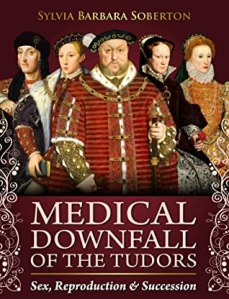 The story of the Tudor dynasty has been told from many different angles. Each monarch has been explored through lenses like social and political history numerous times. However, there is a new approach that is coming into the forefront of historical research and that is the focus on the medical history of the Tudors. Each Tudor monarch, from Henry VII to Elizabeth I, had some sort of bout with illness that would drastically alter the course of their reigns and the future of the dynasty. In Sylvia Barbara Soberton’s latest book, “Medical Downfall of the Tudors: Sex, Reproduction and Succession”, she explores the more intimate aspects of this turbulent dynasty to discover the truth about why they fell.
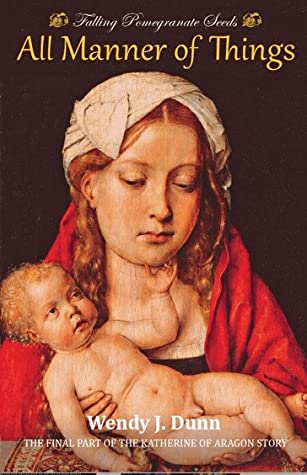 A journey to a foreign land for a long-promised marriage that will unite the royal families of Spain and England. Two friends caught in the middle far away from their beloved Spain. One is Princess Katherine of Aragon, who will marry Prince Arthur. The other is her cousin and close confidant, Maria de Salinas. Their journey like their friendship will last for decades, full of loyalty and love. Katherine’s story has been told many times in different ways, while Maria de Salinas has remained faithfully in the shadows. That is until now. In Wendy J. Dunn’s continuation of her Katherine of Aragon story, “Falling Pomegranate Seeds: All Manner of Things”, Maria de Salinas is the protagonist telling the tragic tale of love and heartache from her perspective.
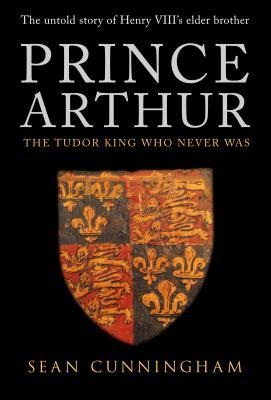 A new dynasty is born out of war and bloodshed. Hope is restored to the land as the remains of the Houses of York and Lancaster are united when Henry VII marries Elizabeth of York. It was not until the birth of their eldest child and heir, Prince Arthur, that the union was truly complete. Arthur was the hope for the nation, but when he tragically died shortly after marrying Catherine of Aragon, he was replaced by his younger brother who would become King Henry VIII. Arthur’s life was indeed very short, but his legacy and untimely death altered the course of history forever. Arthur tends to be a footnote in history, between Henry VII’s and Henry VIII’s reigns, but what was this young prince like? Why did his death leave such a large hole in the plans for the future of the Tudor dynasty? What was his relationship like with his family and those closest to the prince? These questions and more are explored in Dr. Sean Cunningham’s brilliant biography, “Prince Arthur: The Tudor King Who Never Was”.
 A series of wars that engulfed England for over thirty years finally comes to its conclusion. The Plantagenet dynasty is no more and the once outlaw is now the first king of the brand new dynasty, the Tudors. Margaret Beaufort is reunited with her beloved son, Henry Tudor as he is crowned King Henry VII. As Henry faces the numerous challenges of being a father and a king, his mother is right by his side to guide and protect him and his family. In the epic conclusion to her Beaufort Chronicle series, Judith Arnopp explores the transition for Margaret Beaufort in the early years of the Tudor dynasty in, “The King’s Mother”.
 A weak king caught in the middle of court drama, each side fighting for the control of the crown and the right to have their opinions heard. England is on the brink of civil war with a young heiress struggling to find where she belongs and to survive. The young heiress is Margaret Beaufort, the mother of Henry Tudor (the future of Henry VII) and a survivor of the Wars of the Roses. Her story has been told in many different ways, but the story of her early years has rarely been told, until now. Judith Arnopp has decided to tell Margaret’s story from her perspective in her novel, “The Beaufort Bride: Book One of The Beaufort Chronicle”.
 The stories of the men behind the English crown can be as compelling as the men who wore the crown themselves. They were ruthless, cunning, power-hungry, and for many of them, did not last long. However, there were a select few who proved loyal to the crown and lived long and eventful lives. They are not as well known as their infamous counterparts, yet their stories are just as important to tell. One such man was the grandfather of two of Henry VIII’s wives and the great-grandfather of Elizabeth I. He lived through the reign of six kings and led his men to victory at the Battle of Flodden against King James IV of Scotland towards the end of his life. Thomas Howard, 2nd Duke of Norfolk had his fair shares of highs and lows, including imprisonment, but his story is rarely told. That is until now. Kirsten Claiden-Yardley has taken up the challenge to explore the life of this rather extraordinary man in her book, “The Man Behind the Tudors: Thomas Howards, 2nd Duke of Norfolk”.
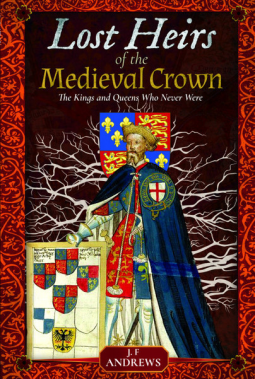 In history, we tend to focus on those who were crowned kings and queens of different nations. Their strengths and their weaknesses. Their accessions and the legacies that they left behind. With every story of someone who triumphed in gaining the throne, there are tales of those who were close to the throne but were never able to achieve the ultimate goal of ruling a nation. These “lost heirs” fall into two categories; either their names live on in infamy or they are thrown into the dust of the past. Who were these men and women and why did they lose their chances to sit on the throne? These questions are explored in J.F. Andrews’ book, “Lost Heirs of the Medieval Crown: The Kings and Queens Who Never Were”.
 The story of the reign of King Henry VIII has been told mainly through his numerous marriages and through the lives of his children. Although his immediate family was a big part of his legacy, there is much more to his story than his tempestuous relationships. There were also his legal, religious, and military exploits. The ones who were with Henry when he made these decisions were the men who were loyal to him, his counselors and companions. Their tales are often told separately, until now. Tracy Borman has decided to masterfully combine their tales to explore the life of their infamous king in her latest biography, “Henry VIII and the Men Who Made Him”.
  Adventures of a Tudor Nerd