
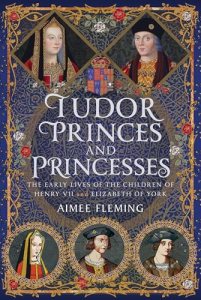
 The year is 1485, and the last Plantagenet king, Richard III, is dead. The young man whose army defeated the king is Henry Tudor, and he is about to start a dynasty that will reshape world history forever. Henry Tudor, now King Henry VII, married the daughter of King Edward IV and Elizabeth Woodville, Elizabeth of York. Their marriage and their children would lay the foundation for the Tudor dynasty, but what was life like for the children who were the first generation of this remarkable dynasty? Aimee Fleming explores the lives of these royal siblings in her latest book, “Tudor Princes and Princesses: The Early Lives of the Children of Henry VII and Elizabeth of York.”
I would like to thank Pen and Sword Books and NetGalley for sending me a copy of this book. I enjoyed her previous book about Margaret More Roper, so when I heard that she was writing a book about the children of Henry VII and Elizabeth of York, I was curious to see what new information Fleming would include in this book.
Fleming begins with the aftermath of Bosworth as King Henry VII begins his new life as a king and husband to Elizabeth of York. As they anticipate the arrival of their firstborn child, we get to see how their childhoods influenced their parenting style. The couple’s firstborn child, Prince Arthur Tudor, would be born in Winchester, the city where the mythical Camelot is supposed to be. As the heir to the dynasty and a boy named after the legendary King Arthur, the young prince was seen as the embodiment of the Tudor rose and the hope of the dynasty’s future. No pressure at all for the young prince.
After the birth of Prince Arthur, Henry and Elizabeth welcomed Margaret, Henry, Elizabeth, Edward/Edmund, and Mary into the family. While Princess Elizabeth and Prince Edward/Edmund died young, we get to see Princesses Margaret and Mary, as well as Prince Henry, grow up in the royal nursery, being educated for their important roles as future monarchs, and the bond they shared as siblings. They had to deal with the ever-changing world of the 16th century and navigate the uncertainty of court life, especially with the pretenders waiting in the wings to snatch the crown. Margaret, Henry, and Mary had to deal with the death of Prince Arthur shortly after he married Catherine of Aragon, and their mother, Elizabeth of York, after she gave birth to her final daughter, who also died. Blood may have connected these siblings, but love and shared experiences made this family tight-knit.
Overall, I thought this book was a nice review book for those who know about the Tudors, and a nice introductory book for those who are not familiar with this family. If either of these descriptions sounds like you, if you are a Tudor nerd, I recommend you read “Tudor Princes and Princesses: The Early Lives of the Children of Henry VIII and Elizabeth of York” by Aimee Fleming.
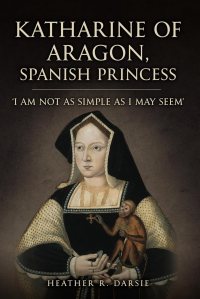 We all know the gist of the tragic tale of Katharine of Aragon. A Spanish princess who was brought to England to marry the heir of the Tudor throne, Prince Arthur Tudor. When the prince died mere months after their wedding day, Katharine was left in limbo and desolate as the Kings of Spain and England bickered over her dowry. Eventually, she would marry King Henry VIII, was his wife for over twenty years, and have numerous miscarriages before Henry decided to divorce her and marry Anne Boleyn. We know how Katharine’s story ends, but how did the stories of her Trastamara family influence her life and her reign as Queen of England? Heather R. Darsie explores Katharine’s Spanish origins in her latest book, “Katharine of Aragon, Spanish Princess: ‘I Am Not as Simple as I May Seem.’”
 Do you have a favorite painting? One that grabs your attention whenever you look at it and discover something new. Most paintings are from da Vinci, van Gogh, Rembrandt, Picasso, or Michelangelo, just to name a few. However, there is one artist that I feel doesn’t get a whole lot of attention unless you study the 16th century: Hans Holbein the Younger. While Holbein is known for his single portraits, his double portrait, known as The Ambassadors, is stunning to look at and is filled with symbolism. Tracy Borman, in collaboration with the National Gallery, has written a short book about this remarkable painting entitled “Holbein: The Ambassadors.”
 A princess born to a king and his second wife lost her title and legitimacy when her father decided that her mother, Anne Boleyn, needed to die. Elizabeth Tudor knows the meaning of resilience as she survived her childhood during her father King Henry VIII’s reign. Now that her father is dead Elizabeth is at the mercy of her half-siblings Edward and Mary, plus any scheming man who wants to marry her and get closer to the crown. Can Elizabeth survive her siblings’ reigns or is she destined to be locked in the Tower to await her ultimate fate like her mother? Janet Wertman explores the life of Elizabeth Tudor in her latest series
 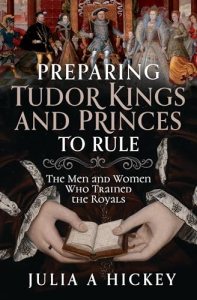 In life, when it comes to a new skill or job, you must be trained to become good at it. The same can be said for the monarchy, which in a sense is a job that encompasses one’s entire life. You have to understand different languages, rhetoric, the arts of dancing, and music, as well as diplomacy and physical activities if you want to rule a nation. It may seem like a lot for one person to handle, but from the moment of their birth, a prince or princess has a team of people behind them to make sure that they are ready to either rule their home country or create an alliance with other nations. The Tudors knew how important educating their future monarchs was for the survival of the dynasty. Julia A. Hickey examines the people behind the teams raising the future Tudor monarchs in her book, “Preparing Tudor Kings and Princes to Rule: The Men and Women Who Trained the Royals.”
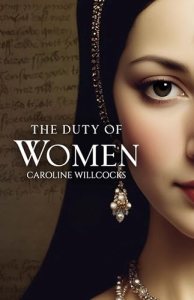 The Tudor court during the reign of King Henry VIII was a treacherous place to be, even for the humble female musician. It was full of men and women vying for a position of power, and they were ready to give anything and everything for that power. This is the world that Kat Cooke finds herself in. After faithfully serving Queen Katherine of Aragon for years, she must switch her loyalties to Anne Boleyn, but when things get dangerous, where will Kat’s loyalties lie? Can Kat survive such turbulent times or sacrifice everything she holds dear? Kat’s story is told in the second book of Caroline Willcocks’ Tudor Queens series, “The Duty of Women.”
 A love that can get through any obstacle even when the couple is married to other people is considered very rare. However, star-crossed lovers at court were practically unheard of, especially multiple couples from the same family. Anne Brandon knows how rare these matches are as her father Charles Brandon married the sister of King Henry VIII. Now she must figure out her feelings about romance while navigating court life. In the modern day, Caroline Harvey has relationship problems while she navigates the loss of her famous writer, grandfather Dexter Blake. How are these two women from different centuries connected and can they fight for who they love or are they destined to be alone? Alexandra Walsh tells both women’s stories in her novel, “The House of Echoes.”
 The life of a 16th-century princess is not all that it is cracked up to be. You can have jewels, and glamorous dresses, attend the glittering yet treacherous court, and have numerous homes. You must marry the person the king says you should marry to create strong alliances for the kingdom, so the concept of marrying for love is not in your vocabulary. You had to ensure your opinions were kept in line with the monarch’s views so you didn’t meet a disastrous end. In other words, the closer you are to the throne, the more scrutiny is forced upon you. No one understood this advice better than Mary Tudor, the daughter of King Henry VII and the younger sister of Henry VIII. She was a daughter, a sister, a wife, a queen, a duchess, and a mother. Her remarkable story is told in Amy McElroy’s book, “Mary Tudor: Queen of France.”
 Christmas is a time of merriment and joy unless you are in the court of Henry VIII in 1536. Then it is a time of stress and murder. Henry’s second wife Anne Boleyn has only been dead for a few months while his third wife Jane Seymour is slowly adjusting to her new role as queen. A rebellion known as the Pilgrimage of Grace is taking over northern England and the leader Robert Aske wants to visit the court to discuss matters with King Henry VIII. To top it all off, a servant of Queen Jane has been murdered and the only one who can solve the crime is a fool, Will Somers. Can Will Somers connect the dots and save those closest to him, or will the treasonous act be another downfall in such a tumultuous year? This is the premise for the third book in the A King’s Fool Mystery series, “Rebellious Grace” by Jeri Westerson.
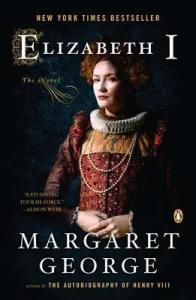 The stories of queens have been told in numerous ways for centuries, but one of the most famous queens in human history is the Virgin Queen, Elizabeth I. The daughter of Anne Boleyn and Henry VIII who famously decided not to marry any man and instead devout her entire life to serve England’s people. That does not mean she was subservient to others she demanded respect and adoration from her subjects. Most stories of Elizabeth I begin in her golden years, but what could a novel about the queen’s silver years tell us about her personality, her reign, and the people who choose to follow or rebel against the famous queen? Margaret George gives her readers an innovative look at the titular queen in her novel, “Elizabeth I.”
 Adventures of a Tudor Nerd