
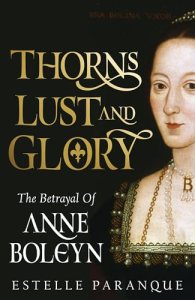
 A young woman catches the attention of a king already married to a princess from a faraway kingdom. The king desires the young lady and divorces his wife to marry her. However, there is a catch. The young lady spent some time in the French court of Francis I and Claude of France, whereas the king’s wife was the daughter of the Spanish King and Queen as well as the aunt of the Holy Roman Emperor. The Great Matter of Henry VIII, Anne Boleyn, and Catherine of Aragon is considered one of the messiest divorces in English history and rightfully so when you consider the diplomatic consequences that this divorce would have across Europe. Estelle Paranque highlights the connection between Anne Boleyn and the French court in her latest book, “Thorns, Lust, and Glory: The Betrayal of Anne Boleyn.”
I want to thank Hachette Books and Net Galley for sending me a copy of this book. I heard that Estelle Paranque was writing a new book about the 16th century, but when I heard that it dealt with Anne Boleyn’s connections with the French court, I jumped at the chance to read it. While I do know quite a bit about the rise and fall of Anne Boleyn, it is her connection with the French court that I have never really explored in depth.
Paranque begins her book by examining the meeting between King Henry VIII and King Francis I with Anne Boleyn at Calais between October 25th and 27th, 1532. This was a significant meeting as it was right before Henry and Anne married in secret and they desired that Francis would support their side in the Great Matter. But how did they get to this meeting in Calais? This is where this book shines as Paranque takes the time to show her audience what life was like for Anne in the French court and the connections that she forged with women like Louise of Savoy, Claude of France, and Marguerite of Angouleme Queen of Navarre. It was fascinating to see how the Boleyns were able to use their connections to forge alliances with the French court that would prove useful in the future.
Possibly my favorite part of this book was seeing how the diplomatic channels across Europe interacted with one another during the Great Matter, the queenship of Anne Boleyn, and the fall of the Boleyns. I think we so often overlook that there were diplomats who were working on the sidelines to convey messages between kings and emperors to form or strengthen alliances. While many might consider the way Paranque wrote the correspondence and dialogue between diplomats and the monarchy as hard to get used to because she does insert emotions, I believe it adds depth to the story because they were human beings not in a vacuum. They had feelings about what was happening around them, passionate feelings in fact, and that should be displayed to readers.
While the actual events of this book were not new to me, the way that Paranque was able to present the information and show the men behind the scenes was fascinating. It presents the relationship between Henry VIII and Anne Boleyn in a different more complex light. If you want a different angle to the rise and fall of Anne Boleyn, I recommend you read, “Thorns, Lust, and Glory: The Betrayal of Anne Boleyn” by Estelle Paranque.
 Marriage has been an integral part of life for centuries. It has been used to create strong alliances and cement love matches. However, once the wedding ceremony is finalized, the facade often fades and the truth about the families is revealed. Jane Parker finally marries the love of her life, George Boleyn, but she soon realizes that her new family is full of ambition, especially her new sister-in-law Anne Boleyn. As one of the greatest marriages of the 16th century is beginning to fall apart, can a new romance be waiting in the wing to rock England and all of Europe to its core and whose side will Jane join in the end? Danielle Marchant continues her exploration of Jane Parker Boleyn, Lady Rochford’s life in her novel, “The Lady Rochford Saga Part 2: Tourmens de Mariage.”
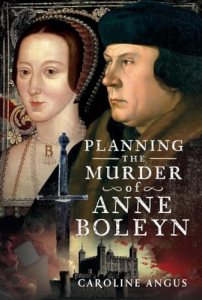 The 16th century was filled with tales of remarkable women. Still, one of the most defining figures of the century was a woman of noble birth who the King of England fell in love with and decided that he was going to divorce his first wife of over twenty years to marry her. The Great Matter caused a great scandal across Europe, however, it was a love match that would not last long. The relationship between Henry VIII and his second wife Anne Boleyn would turn volatile and in the end, Anne and the men around her would be executed. We often blame Anne Boleyn’s death at the foot of Henry VIII’s right-hand man Thomas Cromwell, but who was behind the death of this famous queen? Caroline Angus has chosen to re-examine the case to find out who was truly responsible for the fall of this famous queen in her latest book, “Planning the Murder of Anne Boleyn.”
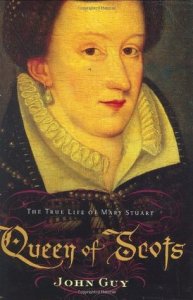 Women rulers in the past have either been praised or pushed down. They are either seen as ideal women or power-hungry villains. One such figure who suffered the worst from having her image raked through the mud for centuries was Mary Stuart, known throughout history as Mary, Queen of Scots. The Queen of Scotland who was married three times, was once the Queen of France, the mother of the future King of both England and Scotland, accused of having a hand in her second husband’s murder, plotted to overthrow Elizabeth I, and was executed for treason. Her story is well known, but what does the archival information tell us about Mary Stuart? John Guy scoured the archives to find the truth about this queen and presented his research in his biography, “Queen of Scots: The True Life of Mary Stuart.”
 The 16th century is known to be a century full of powerful women rulers; Mary I, Elizabeth I, Catherine de Medici, and Mary Queen of Scots, just to name a few. However, these rulers were towards the end of the 16th century. For the first half of the 16th century, Europe and the Middle East rulers were predominantly male. Four men truly dominated this period, each with their objectives and desire for glory; Henry VIII of England, Francis I of France, Charles V the Holy Roman Emperor, and Suleiman the Magnificent the ruler of the Ottoman Empire. In his book, “Four Princes: Henry VIII, Francis I, Charles V, Suleiman the Magnificent, and the Obsessions that Forged Modern Europe,” John Julius Norwich hopes to shed some light on the relationships of these men and how they shaped the political landscape of Europe.
 Treason is the crime of betraying one’s country or monarch by trying to overthrow the government or kill a sovereign. While many English dynasties dealt with treason in their ways, the most infamous were the Tudors and how they dealt with the nobility. By the end of 1572, there were no more dukes in England, until 1623 when George Villiers became the Duke of Buckingham. What was classified as treason during the Tudor dynasty and why did the members of the nobility have to die? Helene Harrison hopes to answer these questions in her latest book, “Tudor Executions: From Nobility to the Block.”
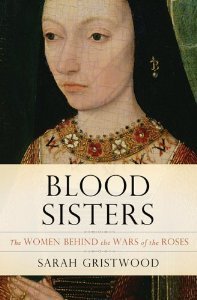 When it comes to studying wars from the past, we often focus on the men who fought during the battles the strategies that were implemented to win and the plans that backfired spectacularly. So frequently in the study of wars, we forget about the women left behind, but in fact, they had bigger roles to play than sitting on the sidelines. For example, the royal women who lived in England during the conflict known as the Wars of the Roses played an essential role in how the wars concluded. These women are slowly coming into the spotlight in biographies and historical fiction novels, but it is rare to read a book about the Wars of the Roses where the central figures are the women, until now. Sarah Gristwood has taken seven women from this age and weaved their stories into her book, “Blood Sisters: The Women Behind the Wars of the Roses.”
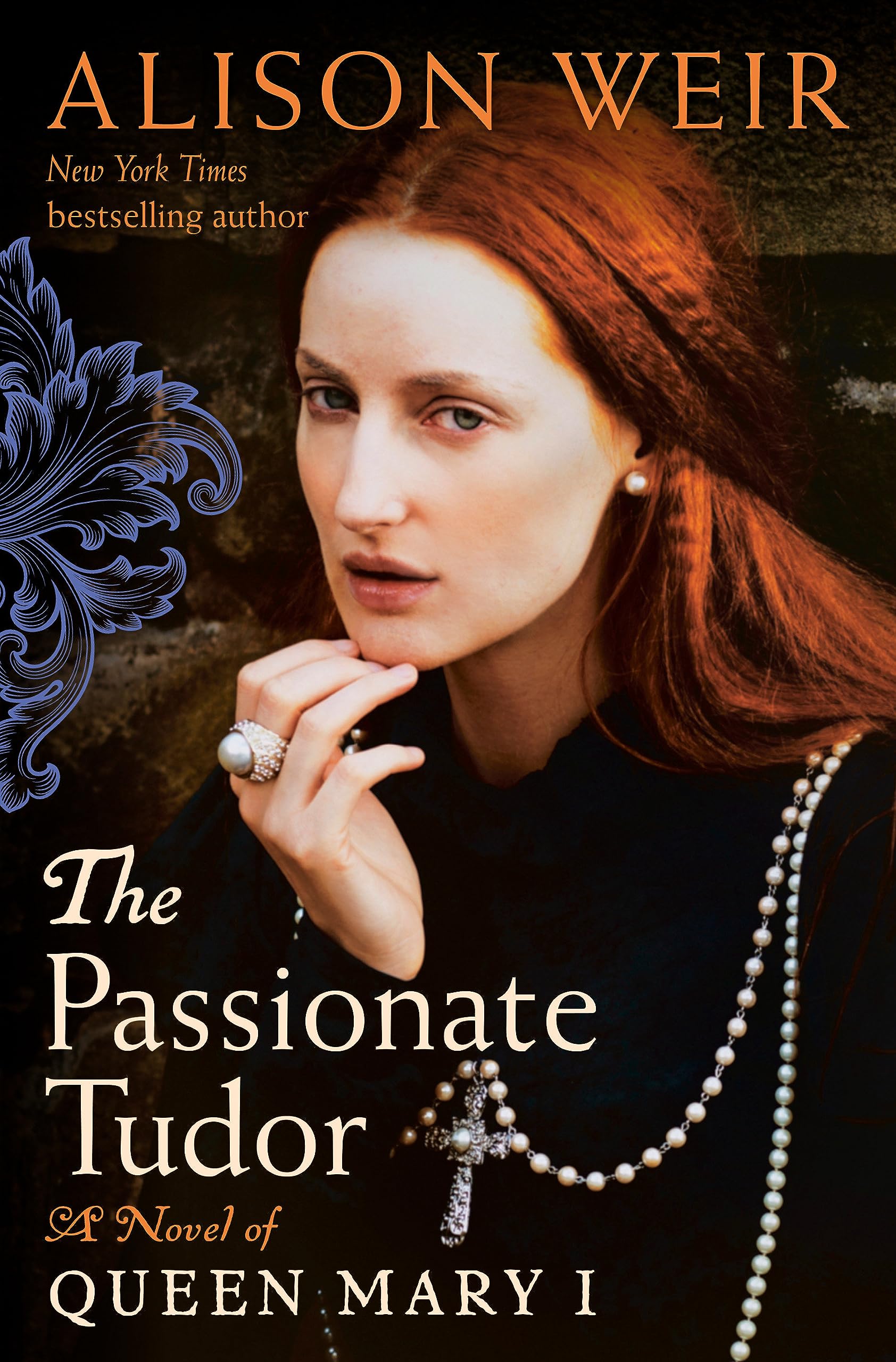 A king’s eldest child is usually the next in line to inherit the throne and become the next ruler. At least that is how the line of succession is supposed to work if the heir is male. Mary I knew this better than anyone. As the eldest daughter of King Henry VIII, she knew that once her mother Katherine of Aragon had a son, Mary would become a pawn in the marriage game. She was willing to accept this fate until her father fell in love with Anne Boleyn. Mary is declared a bastard and must fight for her inheritance and the crown of England while maintaining her Catholic faith. Alison Weir tells the tale of this remarkable woman, from her tumultuous childhood to her short reign that marked her legacy, in her latest novel, “The Passionate Tudor: A Novel of Queen Mary I.”
 The final wife, the one who survived. These words are what people think about when it comes to Katherine (Kateryn) Parr. However, before she even met Henry VIII, she had already lived quite a life, being married twice before meeting the king. She was a scholar, reformer, daughter, stepmother, wife, and mother. A woman who lived a rather intriguing life and happened to marry the King of England, Kateryn Parr’s life has been told in numerous mediums for centuries. Now, Laura Adkins has chosen to write about this famous Tudor wife in the biography, “Kateryn Parr: Henry VIII’s Sixth Wife.”
 I am pleased to welcome Judith Arnopp back to my blog to share a snippet from her latest novel. “A Matter of Time.” I would like to thank Judith Arnopp and The Coffee Pot Book Club for allowing me to be part of this blog tour.
 Blurb:
 Author Bio
 Adventures of a Tudor Nerd