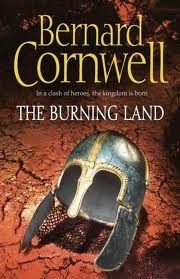
Book Review: “The Burning Land”(Book Five of the Saxon Stories series) by Bernard Cornwell

the burThe ninth century is coming to a close. King Alfred is dying, and his young son Edward is untested on the battlefield. Alfred wants Uhtred to swear his loyalty to his son Edward, but Uhtred wants to be free to recapture his beloved Bebbanburg. The Danes, led by the warrior Harald Bloodhair are on the warpath—just a typical mission for our intrepid Saxon lord who was raised by Danes warrior Uhtred of Bebbanburg. However, there is always a catch, and the major obstacle in his path is a fair woman with a fiery temper named Skade. How can one woman and her plans make Uhtred of Bebbanburg quake in his boots? Book number 5 in the Saxon Stories, “The Burning Land” by Bernard Cornwell, holds all the answers in the next adventure for Uhtred and his men.

We begin our latest adventure with Uhtred as he embarks on a journey in his ship Seolferwulf to make a deal with Jarl Haesten in Alfred’s name. There, we first hear the names Harald Bloodhair and Skade as Haesten warns our hero to be wary of what they will do. As Uhtred and his men raid another town, they come across the sorceress Skade and bring her to the court of Alfred to lure Harald out of hiding to have one epic battle to protect Wessex.

Uhtred’s plan works well, and he does secure a significant victory, but success comes with a heavy price. Skade is furious and curses Uhtred, which he laughs off until he discovers that his wife, Gisela, and their third child died during childbirth. We have seen Uhtred go through so many moments of grief and loss, but this moment pushes him over the edge and causes him to lose control. Uhtred’s actions are so deplorable in front of King Alfred and his court that he is banished, and his children are taken away from his care to be raised as Christians, against Uhtred’s wishes.

Here, Uhtred’s loyalty to Alfred and his family is tested as he is reunited with his friends Ragnar and Brida. He is given a choice on whether to stay loyal to the king he has served for years or to join his Danish family once again. I wouldn’t have blamed him if he abandoned Alfred and Edward to join Ragnar and Brida. Still, an unexpected person calls for his aid, that person being Aethelflaed, the one person in Alfred’s family that he cares about. The final battle in this book cements where Uhtred’s loyalty will remain, but it will also be challenging for Uhtred.

Cornwell continues to weave a fascinating tale of sorrow, woe, and triumphs for the fearless Uhtred of Bebbanburg. Another delightful adventure with Uhtred of Bebbanburg; if you have been reading the Saxon Stories, I recommend you read book 5, “The Burning Land” by Bernard Cornwell.

Guest Post: “The War Wagon” by Griffin Brady

The Hussar's Duty Tour Banner 1Today, I am pleased to welcome Griffin Brady to my blog to share a guest post as part of the blog tour for her novel, “The Hussar’s Duty.” I would like to thank Griffin Brady and The Coffee Pot Book Club for allowing me to be part of this blog tour. 

War wagon, war fortress, rolling fortress, rolling stock, stock, wagon fort, mobile fortress, and tabor. These terms all mean the same thing. Until I did my research on the Battle of Cecora for The Hussar’s Duty, I wasn’t familiar with any of them. I came up to speed quickly because the war wagon played an essential role in the story.

When Poland’s Grand Hetman of the Crown, Stanisław Żółkiewski, first set out to meet the Ottomans on a battlefield just east of Cecora (modern-day Țuțora in Romania), he took 9,000 Polish troops with him. Despite his recruiting efforts, his force was less than he had hoped for, but he wasn’t concerned—he didn’t expect a clash. He was confident he and the Ottoman commander, Iskender Pasha, would negotiate without bloodshed, as they had done before. What Żółkiewski didn’t anticipate, however, was inaccurate intelligence that led to underestimating the enemy’s strength. Further complicating matters, Żółkiewski’s army was comprised largely of magnates’ private troops with their agendas, and he had great difficulty controlling them.

Żółkiewski had proved himself a brilliant strategic commander in the past, but he was now in his early seventies and poor health. Recognizing combat was imminent—and that a Tatar army had joined Ottoman ranks—Żółkiewski showed flashes of his genius when he struck upon employing the tabor at Cecora, harkening back to 15th-century Hussite victories. The battlefield’s open, flat ground lent itself well to the mobile fortresses, which could be used to devastating effect.

Image 2 War Wagon

The tabor was a square or rectangular arrangement of wagons equipped with guns and manned by soldiers, artillerymen, and crossbowmen/archers. Within the formation, surrounded by the wagons, a calvary was placed. The wagons were pulled by teams of horses arranged so they nearly touched the back of the wagon before them, creating a sort of impenetrable “chain.”

Tabor tactics were broken into two phases: defensive and counterattack. As the enemy advanced on the mobile fortress, they were fired upon until weakened. Then the counterattack began, and cavalry and infantry filed inside the wagon formation, engaging the demoralized troops.

Żółkiewski laid out a plan that involved two tabors. The tabors were each defended by 500-700 men and flanked each side of his main strike force. That strike force comprised five cavalry regiments, a mix of Polish winged hussars and light cavalry. The scale of his formation was massive, a whopping .68-.75 miles wide and .62 miles deep. It’s difficult for me to wrap my head around what it must have looked like!

For all its innovation, though, the scheme held several devastating flaws. First, rather than a wide, shallow formation, it compressed the regiments into tight columns, limiting their mobility. Second, the success of the mission depended on the tabor remaining intact. One breach and the entire formation would be compromised.

The battle began at noon on September 19, 1620. At first, the Poles succeeded in pushing the enemy back. However, the right tabor encountered a trench that caused it to swing to the right, opening a gap at its rear and exposing the central strike force. Though Żółkiewski had beefed up the sides and rear to counter any potential breach, it proved too little. Tatar horsemen swept in, overwhelming the trapped Polish cavalry and wreaking havoc.

The Poles fell back, abandoning the men in the compromised tabor. Sadly, most of those left behind were captured or killed. At the end of the day, Żółkiewski’s force was reduced by a third. Making matters worse, that night, Polish troops fled from camp in a mass crossing over the Prut River. Some made it to safety, but many drowned during the attempt or were captured by Tatars.

After days of failed negotiations with Iskender Pasha, with supplies rapidly depleting and morale plummeting among his remaining ranks, Żółkiewski decided to retreat. But how could he preserve his weakened army with the enemy poised to pursue? Enter the tabor once more in a different configuration.

This time, it was a single formation with six rows of wagons, in lines of one hundred each, placed behind tethered horses. The horses acted as battering ram and a shield to protect against Tatar arrows. Their grouping also prevented any of Żółkiewski’s men from escaping on horseback. The wagons in the lead were loaded with cannons and hook guns and protected by infantry and artillerymen. Beside the wagons marched three rows of hussar and other cavalry banners carrying loaded firearms. The rear was defended by more cannons and guns, along with additional infantry and the Lisowczycy (a Polish mercenary cavalry also known as the Lost Men or Forlorn Hope). The wounded and sick were placed on carts at the interior of the tabor.

The retreat began on September 29, ten days after the battle itself. The enemy pursuit began in earnest the following day (the enemy was either caught by surprise by the exodus and/or was too busy plundering the abandoned camp to go after the fleeing army). However, when the attacks did come, they were rebuffed without much consequence, despite the Poles being harangued daily. The tabor was doing its job. That’s not to say Żółkiewski’s troops weren’t under tremendous duress. Unable to dismantle the Poles’ formation, the enemy took to a scorched earth policy, burning fields and buildings in the Poles’ path, leaving no resources whatever. To avoid enemy encounters, Żółkiewski’s men marched at night, suffering from lack of sleep, food, and water. Despite the hardships, the army averaged an astonishing pace of seventeen miles per day (27.5 km). It was a mere six miles from Mohylów, a fortified Polish border town, on October 5 when they chose to stop and rest—despite Żółkiewski urging them on.

Image 3 Cecora_Death of Zolkiewski_1620

That ill-advised layover, along with several other critical errors in judgment, would cause an ensuing cascade of calamities during the night of October 5-6. Among other tragedies, Żółkiewski lost his life—and his head. Ultimately, only a few thousand of his original 9,000 troops made it back to Poland alive. Had he had better control, had his army remained disciplined and stuck to their formation, they would have likely crossed the border into safety that night. In the end, the tabor’s undoing was not its concept, formation, or parts. Its final failing came at the hands of human nature.

The Hussar's Duty CoverBlurb:

Poland’s most valiant winged hussar is called to fight in a campaign ripe for disaster. But he must also protect those he loves from jackals waiting to pounce. How does he choose between duty and devotion when death is on the line?

When Sultan Osman II sends Poland’s envoy packing, the Commonwealth must prepare for war against one of the largest armies the Ottomans have ever assembled. Tasked with repelling the invasion is Grand Hetman of the Crown Stanisław Żółkiewski, and he knows who to turn to: Jacek Dąbrowski, the Commonwealth’s most valiant Polish winged hussar.

Jacek has been idle far too long, and the call to arms is a siren’s song he can’t resist. But he has built a life far from the battlefield with his wife, Oliwia, and their children. If he pursues his quest for glory, who will safeguard them?

Oliwia knows her husband is restless. In fact, she’s been sending Jacek on cross-country errands for years in the hopes of quelling his lust for battle. When she realizes her efforts are futile, she resolves herself to letting him go—after hatching a scheme to accompany him.

Honor. Obligation. Devotion. These forces push and pull Jacek in different directions. His country needs him, but so does his family. Where does his duty lie? His choice will cause catastrophic ripples no matter which path he follows … and could very well bring the loss of his loved ones or his life.

Will the cost of defending the king and country prove too steep for this warrior?

This is a standalone continuation in The Winged Warrior Series.

Buy Links:

This title is available to read on #KindleUnlimited.

Universal Link: https://readerlinks.com/l/3336453

Amazon US: https://www.amazon.com/dp/B0C2VZ2963/

Amazon UK: https://www.amazon.co.uk/dp/B0C2VZ2963/

Amazon AU: https://www.amazon.com.au/dp/B0C2VZ2963/

Amazon CA: https://www.amazon.ca/dp/B0C2VZ2963/ 

Griffin Brady authorAuthor Bio:

Griffin Brady is an award-winning historical fiction author interested in the Polish Winged Hussars of the 16th and 17th centuries. She is a member of the Historical Novel Society and Rocky Mountain Fiction Writers. Her debut novel, The Heart of a Hussar, was a finalist for the 2021 Chaucer Early Historical Fiction Award and a 2021 Discovered Diamond.

The proud mother of three grown sons, she lives in Colorado with her husband. She is also an award-winning bestselling romance author who writes under the pen name G.K. Brady.

Social Media Links:

Website: https://www.griffin-brady.com/historical-fiction/

Twitter: https://twitter.com/griffbrady1588

Facebook: https://www.facebook.com/AuthorGriffinBrady

Book Bub: https://www.bookbub.com/profile/griffin-brady

Amazon Author Page: https://www.amazon.com/author/griffinbrady

Goodreads: https://www.goodreads.com/author/show/20675881.Griffin_Brady


Guest Post: “The Auld Alliance” by J R Tomlin

The Douglas Bastard Tour Banner 1Today, I am pleased to welcome J R Tomlin to my blog to share a guest post as part of the blog tour for her latest novel, “The Douglas Bastard / The Archibald the Grim Series.” I would like to thank J R Tomlin and The Coffee Pot Book Club for allowing me to be part of this blog tour. 

Many people think that Scotland always fought alone against the English conquest. This was partially true.

In 1290, civil war loomed after the death of Scotland’s seven-year-old queen, Margaret, the Maid of Norway. The Scots turned to what they thought was a friendly monarch, England’s King Edward I. (Sounds crazy, I know, but Scotland and England had been at peace for most of the 13th century). The Scottish government started looking for allies. Phillip IV had just declared England’s possession of Gascony forfeit, so an alliance between Scotland and France looked like a good idea. A Scottish embassy traveled to negotiate with King Phillip, and the Treaty of Paris was signed on October 24, 1295.

In the short term, the alliance was no protection for Scotland. Edward invaded Scotland in 1296, temporarily crushed resistance, stripped the King of Scots, John de Balliol, whom he had chosen, and temporarily ended any Scottish government. It was, in effect, a province of England. Three years later, England and France signed a treaty of perpetual peace, leaving Scotland on its own. In France’s defense, there was effectively no Scottish government for it to support.

As we all know, Scotland refused to remain crushed. Andrew de Moray led the resistance in the north of Scotland, and William Wallace, aided by Robert the Bruce and Sir William Douglas, raised an army in the south. They joined forces to defeat the English at the Battle of Stirling Bridge. De Moray was killed in that battle. Wallace had probably met with the King of France but received no French aid, and the Scottish resistance was once more crushed, ending with the execution of Wallace. 

Again, Scotland refused to stay crushed and rose once again under the leadership of King Robert the Bruce. But the Bruce had killed one of the Balliol (remember them?) inside a church. (I reject the idea that it was a planned ambush. The Bruce was too intelligent a man to plan to do something so stupid) The pope almost immediately excommunicated him and all of his followers. Luckily for him and Scotland, many Scottish bishops rejected the ex-communication based on English lies to the pope. But the effect was that the King of France would defy the pope by coming to the aid of a government under anathema. 

The war lasted a very long time, and it was not until In 1324 that Bruce’s nephew, Thomas Randolph, Earl of Moray, met the Pope in person at his court in Avignon. Randolph successfully persuaded Pope John to recognize Robert as King of Scots, a major diplomatic coup that allowed the French the option of renewing relations with Scotland. A new, largely precautionary, treaty between France and Scotland, again negotiated by the Earl of Moray, was signed two years later.

The following year, King Edward III signed a treaty recognizing Scotland’s independence and Robert the Bruce as the rightful King of Scots. That should have been the end of it. See me roll my eyes.

King Robert died in 1327, leaving his only son, then five years old, as king and Thomas Randolph as regent.

Edward III felt humiliated by his defeat in the field by a Scottish army led by Sir James Douglas and Thomas Randolph and by having had to sign a peace treaty with Scotland. He backed John Balliol’s claim to the throne of Scotland and repudiated the peace treaty. Randolph died on his way to fight the invasion by Balliol, which the English king secretly backed. So now, that treaty with France would have some use.

At first, the defense against the invasion went badly. Many leading nobles were killed at the Battle of Dupplin Moor, including the new Guardian and thousands of Scottish troops. Although Balliol was then driven from Scotland by a later attack by the Scots, King Edward openly invaded. Soon most of Scotland was in English hands, with only a few castles holding out, and a majority of Scottish nobles, at least for a time, swore fealty to the English and their pretender. 

Now Scotland needed that ally.  In the winter of 1332, King Phillip dispatched a flotilla of ten ships to aid the Scots, but they were blown off course in a storm and never arrived. In the spring of 1334, £1000 came from France to be distributed to the Scottish defenders along with an offer of sanctuary to young King David, his queen, and members of his court. David or Moravia, Bishop of Moray and determined defender of Scottish independence, founded the Scots College of the University of Paris in 1333. He had to have been in Scotland at the time and may have had some influence on France.

The situation in Scotland was desperate enough that the Scots accepted the offer. In May 1334, King David and Queen Joanna arrived in France, along with their confessors, tutors in arts and arms, the king’s sisters, the Douglas children, the late regent’s sons, other children of Scottish nobles, and a number of clerics and nobles. They were given Château Gaillard as a residence. The French regularly sent supplies to Scotland and paid an annual pension of £2000 for the upkeep of King David’s court in exile. In June 1339, William Douglas, Lord of Liddesdale, visited King David in France and returned to Scotland, taking with him Arnoul d’Audrehen in command of 200 French troops and several ships, which aided in the attack on and capture of Perth. I have some doubt that Scotland as a kingdom would have survived without this ongoing aid.

In 1346, Edward overwhelmed French forces at the Battle of Crécy. Two months later, David II of Scotland was captured at the Battle of Neville’s Cross in response to a request from the French to attack England in order to force King Edward to return home; King David invaded England. The English captured him at the disastrous Battle of Neville’s Cross. However, the French continued to supply money and some troops to distract King Edward from his war in France, sending substantial funds and about sixty knights to aid in the capture of Berwick. Berwick was quickly lost, but it distracted Edward, who led a large army to ravage southern Scotland. William Douglas, later 1st Earl of Douglas, took part in that and, the following year, led 200 men-at-arms and forty knights to fight with the French at the Battle of Poitiers.
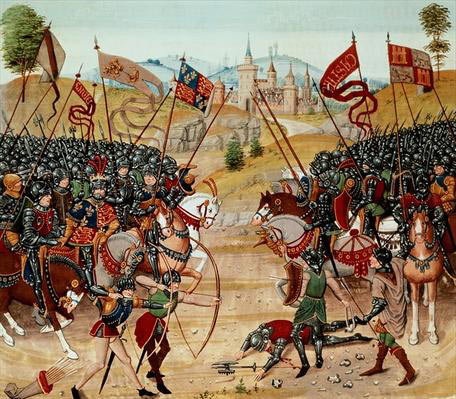
Battle of Poitiers - public domain

For a time, France was so battered as to have no funds for sending to Scotland, and Scotland’s King David I took peace with England as a policy. Even after King Robert II’s accession and the treaty’s renewal, neither nation saw any effects. It was in the following century that thousands of Scots once more went to the defense of Scotland. The Earl of Douglas’s son, the Earl of Wigtoun, and the Earl of Buchan helped the French defeat the English at the Battle of Baugé in 1421. It was a turning point in the Hundred Years’ War. King Charles VII granted Douglas the Duchy of Touraine, the first foreigner to be granted a dukedom in France. On May 8, 1429, Scots fought with Joan of Arc in the relief of Orléans, where legend has it bagpipes played Marche des Soldats de Robert Bruce as she entered the city.

England’s War of the Roses reduced the danger to both Scotland and France, at least for a time, but sometimes for good but often for bad, very bad; the Auld Alliance went on until James VI of Scotland, heir to the throne of England, repudiated it to strengthen his ties with England.

That, however, did not end the strong cultural ties between Scotland and France. The Scots’ language absorbed many French words. The ties with France could be seen in Scottish architecture, such as at Bothwell and Kildrummy Castle, built on French models. Many Scots who fought for France stayed to become citizens eventually. Scottish poets, bishops, and authors studied in France for centuries and brought the French influence home with them. The founder of Scotland’s first university, Bishop Henry Wardlaw, studied in France. So if you study there, you are benefiting from the Auld Alliance.
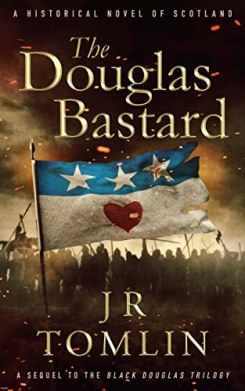
Cover - The Douglas BastardBlurb:

Young Archibald, the Black Douglas’s bastard son, returns from exile to a Scotland ravaged by war. The war-hardened Knight of Liddesdale will teach him what he must learn. And with danger on every side, he must learn to sleep with one eye open and a claymore in his hand because even their closest ally may betray them…

Buy Links:

The Douglas Bastard:

Universal Link:  https://books2read.com/u/4AAwdp 

Amazon UK: https://www.amazon.co.uk/dp/B0968X5V3Y 

Amazon US: https://www.amazon.com/dp/B0968X5V3Y 
Cover - Trust and TreasonAmazon CA: https://www.amazon.ca/dp/B0968X5V3Y 

Amazon AU: https://www.amazon.com.au/dp/B0968X5V3Y

Barnes and Noble: https://www.barnesandnoble.com/w/the-douglas-bastard-a-historical-novel-of-scotland-j-r-tomlin/1140930069 

Kobo: https://www.kobo.com/ebook/the-douglas-bastard

iBooks: https://books.apple.com/us/book/id1606972264 

Google Play: https://play.google.com/store/books/details/J_R_Tomlin_The_Douglas_Bastard?id=AM12EAAAQBAJ

Archibald the Grim Series on Amazon:

Amazon UK: https://www.amazon.co.uk/dp/B0BDW1VJ61 

Amazon US:  https://www.amazon.com/dp/B0BDW1VJ61 
BIM-BLD224477 - © - Steve Smith

Author Bio:

J R Tomlin is the author of twenty historical novels.

Her historical novels are mainly set in Scotland. You can trace her love of that nation to the stories of Robert the Bruce and the Black Douglas that her grandmother read her when she was small and to her hillwalking through the Scottish Cairngorms, where the granite mountains have a gorgeous red glow under the setting sun.

In addition to having lived in Scotland, she has traveled in the US, mainland Europe, and the Pacific Rim. She now lives in Oregon.

Social Media Links:

Website: http://www.jrtomlin.com  

Twitter: https://twitter.com/TomlinJeanne 

Book Bub: https://www.bookbub.com/profile/j-r-tomlin 

Amazon Author Page: https://www.amazon.com/stores/J.R.-Tomlin/author/B002J4ME1S

Goodreads: https://www.goodreads.com/author/show/4094154.J_R_Tomlin

Guest Post: “Alternate Endings Anthology” by Historical Writers Forum Spotlight

Alternate Endings Tour BannerToday, I am pleased to welcome the Historical Writers Forum to my blog to promote their latest novel, “Alternate Endings Anthology.” I would like to thank The Coffee Pot Book Club and the Historical Writers Forum for allowing me to be part of this blog tour. 

Alternate Endings coverBlurb: 

We all know the past is the past, but what if you could change history?

We asked eight historical authors to set aside the facts and rewrite the history they love. The results couldn’t be more tantalizing.

What if Julius Caesar never conquered Gaul?

What if Arthur Tudor lived and his little brother never became King Henry VIII?

What if Abigail Adams persuaded the Continental Congress in 1776 to give women the right to vote and to own property?

Dive into our collection of eight short stories as we explore the alternate endings of events set in ancient Rome, Britain, the United States, and France.

An anthology of the Historical Writers Forum.

Buy Links:

This title is available to read on #KindleUnlimited.

Universal Link:  https://mybook.to/AltEnd 

Amazon UK: https://www.amazon.co.uk/dp/B0BKC33GFX 

Amazon US: https://www.amazon.com/Alternate-Endings-Short-Anthology-Historical-ebook/dp/B0BKC33GFX/ 

Amazon CA: https://www.amazon.ca/dp/B0BKC33GFX 

Amazon AU: https://www.amazon.com.au/dp/B0BKC33GFX 

Author Bios:

Samantha WilcoxsonSamantha Wilcoxson

Samantha Wilcoxson is an author of emotive biographical fiction and strives to help readers connect with history’s unsung heroes. She also writes nonfiction for Pen & Sword History.

Samantha loves sharing trips to historic places with her family and spending time by the lake with a glass of wine. Her most recent work is Women of the American Revolution, which explores the lives of 18th-century women, and she is currently working on a biography of James Alexander Hamilton.

Sharon Bennett ConnollySharon Bennett Connolly

Historian Sharon Bennett Connolly is the best-selling author of five non-fiction history books, with a new release coming soon.

A Fellow of the Royal Historical Society, Sharon has studied history academically and just for fun – and has even worked as a tour guide at a castle. She writes the popular history blog, http://www.historytheinterestingbits.com. 

Sharon regularly talks about women’s history; she is a feature writer for All About History magazine, and her TV work includes Australian Television’s ‘Who Do You Think You Are?’

Cathie DunnCathie Dunn

Cathie Dunn writes historical fiction, mystery, and romance. The focus of her historical fiction novels is on strong women through time.

She loves researching for her novels, delving into history books, and visiting castles and historic sites

Cathie’s stories have garnered awards and praise from reviewers and readers for their authentic descriptions of the past.

Karen HeenanKaren Heenan

As an only child, Karen Heenan learned early that boredom was the enemy. Shortly after, she discovered perpetual motion and has rarely been seen holding still since.

She lives in Lansdowne, PA, just outside Philadelphia, where she grows much of her own food and makes her own clothes. She is accompanied on her quest for self-sufficiency by a very patient husband and an ever-changing number of cats. 

One constant: she is always writing her next book.

Salina B BakerSalina Baker

Salina Baker is a multiple award-winning author and avid student of Colonial America and the American Revolution. 

Her lifelong passion for history and all things supernatural led her to write historical fantasy. Reading, extensive traveling, and graveyard prowling with her husband keep that passion alive. 

Salina lives in Austin, Texas.

Virginia CrowVirginia Crow

Virginia Crow is an award-winning Scottish author who grew up in Orkney and now lives in Caithness.

Her favorite genres to write are fantasy and historical fiction, sometimes mixing the two. Her academic passions are theology and history, her undergraduate degree in the former and her postgraduate degree in the latter, and aspects of these frequently appear within her writings.

When not writing, Virginia is usually to be found teaching music. She believes wholeheartedly in the power of music, especially as a tool of inspiration, and music often plays when she writes. Her life is governed by two spaniels, Orlando and Jess, and she enjoys exploring the Caithness countryside with these canine sidekicks.

She loves cheese, music, and films but hates mushrooms.

Elizabeth K CorbettElizabeth K Corbett

Elizabeth K. Corbett is an author, book reviewer, and historian who has recently published a short story, “Marie Thérèse Remembers.” She is working on her debut novel, a gothic romance set in Jacksonian America.

When she is not writing, she teaches academic writing, something she is very passionate about. She believes in empowering students to express themselves and speak their truth through writing. Additionally, she is a women’s historian who studies the lives of women in eighteenth and nineteenth-century North America. Mostly, she is fascinated by the lives of the lesser-known women in history.

A resident of gorgeous coastal New Jersey, she takes inspiration from local history to write her historical fiction. She is an avid reader who adores tea and coffee.

Stephanie ChurchillStephanie Churchill

After serving time as a corporate paralegal in Washington, D.C., then staying home to raise her children, Stephanie Churchill stumbled upon writing, a career path she never saw coming.

As a result of writing a long-winded review of the book Lionheart, Stephanie became fast friends with its New York Times best-selling author, Sharon Kay Penman, who uttered the fateful words, “Have you ever thought about writing?” 

Stephanie’s books are filled with action and romance, loyalty and betrayal. Her writing takes on a cadence that is sometimes literary, sometimes genre fiction, relying on deeply-drawn and complex characters while exploring the subtleties of imperfect people living in a gritty, sometimes dark world.

She lives in the Minneapolis area with her husband, two children, and two dogs while trying to survive the murderous intentions of a Minnesota winter.

Michael RossMichael Ross

Best-selling author Michael Ross is a lover of history and great stories.

He’s a retired software engineer turned author with three children and five grandchildren, living in Newton, Kansas, with his wife of forty years. He was born in Lubbock, Texas, and still loves Texas.

Michael attended Rice University as an undergraduate and Portland State University for his graduate degree. He has degrees in computer science, software engineering, and German. In his spare time, Michael loves to go fishing, riding horses, and play with his grandchildren, who are currently all under six years old. 

Connect with the Historical Writers Forum:

Twitter: https://twitter.com/HistWriters 

Facebook: https://www.facebook.com/profile.php?id=100063689944203 

Book Review: “Of Judgement Fallen: An Anthony Blanke Tudor Mystery” by Steven Veerapen

Of Judgement FallenThe year is 1523, and England is again preparing for war against its mortal enemy, France. Cardinal Wolsey is firmly in power as King Henry VIII’s right-hand man who is about to open Parliament, but Sir Thomas More’s star is slowly rising. London is busy, and at the center of it, all is Wolsey’s trumpeter and groom, Anthony Blanke. In this chaos of Wolsey’s household where murder and betrayal lie, and the enemies of the Cardinal begin to pile up. It is up to Anthony Blanke to clear his name and find the murderer before it is too late. Anthony’s latest thrilling adventure occurs in Steven Veerapen’s novel, “Of Judgement Fallen: An Anthony Blanke Tudor Mystery.”

Thank you, Polygon Books and Steven Veerapen, for sending me a copy of this novel. I enjoyed the first Anthony Blanke novel, “Of Blood Descended,” so when I heard that there was going to be a second mystery, I could not wait to read it.

Veerapen opens his novel with his first victim, Lancelot Cosyn, a scholar who is in a lot of pain and is on a mission. He is a man who detests Cardinal Wolsey, who he thinks is the source of evil in England, and he has chosen to take action by visiting the great man. Unfortunately, he is found dead inside Wolsey’s home before the meeting. Wolsey assigns Anthony Blanke the task of finding the person behind the murder of Cosyn before the news reaches the King’s ear and before Parliament opens.

As Anthony begins his investigation, more bodies of the Cardinal’s enemies start to pile up around him, so he enlists the help of Sir Thomas More to find the murderer. The color of his skin and how close Anthony is to the case make people suspect him of being involved in these dastardly deeds. Anthony, his friend Mark, and a pup named Bo work with Thomas More to prove Anthony’s innocence and determine why these people were murdered and who was behind the chaos in London.

What I love about this series is the diversity that Veerapen has chosen to show in Tudor England. Racism and religious issues are complex issues to discuss. Still, Veerapen has given his audience a window into the past and showed what it might have been like for a person of color to prove themselves in the court of Henry VIII while also dealing with people deemed as heretics for their beliefs.

This was a well-written mystery full of twists and turns that kept me guessing until the end. I had no clue who might have done it until the end, a sign of a fantastic mystery writer. If you are a fan of the first Anthony Blanke murder mystery and want another adventure, “Of Judgement Fallen: An Anthony Blanke Tudor Mystery” by Steven Veerapen must be on your to-be-read pile.

Book Review: “The King’s Pleasure: A Novel of Henry VIII” by Alison Weir

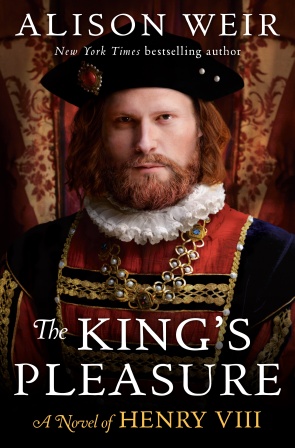
The King's PleasureWhen we think about the Tudor dynasty, we often focus on the women in King Henry VIII’s life and his children, at least when it comes to novels. Writing about this larger-than-life figure, this notorious king and controversial figure in English history, are usually considered ambitious. Few have attempted to write a book about the king’s entire reign, but Alison Weir has embarked on this endeavor in her latest novel, “The King’s Pleasure: A Novel of Henry VIII.”

I want to thank Ballantine Books and Net Galley for sending me a copy of this novel. I have not read many books about the reign of King Henry VIII, except for “The Autobiography of King Henry VIII” by Margaret George, so when I heard that Alison Weir was writing a novel about the titular king, I knew I had to read it.

Weir begins her novel with a moment that must have been difficult for young Prince Henry or Harry as he is referred to in this book. His brother died recently, and his beloved mother, Elizabeth of York, just died, leaving Henry as King Henry VII’s only heir. Henry does not have the best relationship with his father, but he now must fill the void as the heir apparent after Arthur died, leaving his young wife, Katherine of Aragon, a widow. When King Henry VII died, Henry became King Henry VIII and selected a woman he had fallen for to become his queen, Katherine of Aragon.

The bulk of this novel revolves around the relationships between Henry and his first two wives, Katherine of Aragon and Anne Boleyn. Weir is sympathetic toward Katherine of Aragon’s struggles, whereas her portrayal of Anne Boleyn may come across as a bit harsh. Jane Seymour is portrayed as a quiet and obedient queen, and Anna of Cleves’ focus is more on her looks and how Henry treated her more as a sister than a wife. Katherine Howard is someone Henry falls for hard and is devastated by her downfall, and Katherine Parr is the firebrand reformer who wants to heal Henry’s family at the end of his life.

Weir also touches on the complex political web that Henry was involved in, not just in England but European politics of the 16th century. We also see how Henry interacted with his children and how the emotional weight of all of his decisions weighed on him.

I think for how much of a challenge it is to write a novel about King Henry VIII, Alison Weir has done an admirable job in the king’s portrayal. I don’t necessarily agree with how some of the queens were portrayed, but I did enjoy this novel as a whole. I would suggest reading this novel before the Six Tudor Queens series to understand Henry’s perspective before his wives’ stories. If you have enjoyed the latest books about Henry VIII’s wives and his mother, Elizabeth of York, you should read “The King’s Pleasure: A Novel of Henry VIII” by Alison Weir.

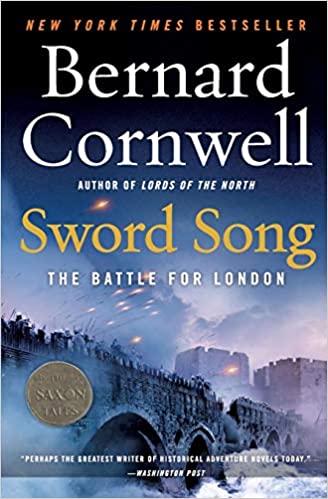
Book Review: “Sword Song”(Book Four of the Saxon Stories series) by Bernard Cornwell

sword songThe year is 855, and the country that one day will be known as England is relatively peaceful. The Danes have their kingdom in the north, while the Saxons, under King Alfred, rule Wessex in the south. Uhtred of Bebbanburg, a Saxon man raised by Danish warriors, lives with his wife Gisela and his children in Wessex, where he is sworn to protect Alfred and his family. It is a touchy alliance, but when rumors about a dead man speaking reach Uhtred’s home, he knows that he must pick up Serpent-Breath once again and make a choice that could change the direction of England as a whole. What do the dead man and new Viking invaders have in plan for Uhtred, and how will it affect Wessex and the rule of King Alfred? Another engaging adventure for Uhtred of Bebbanburg is book four of The Saxon Tales, “Sword Song” by Bernard Cornwell.

As someone who has grown to love the adventures of Uhtred of Bebbanburg, first from the TV show “The Last Kingdom” and now through the books, I wanted to continue the journey through the books. There is something so compelling about this Saxon world that Bernard Cornwell crafted with love and attention.

We join Uhtred and his men, Sihtric and Finan, on a night raid where they come across a brand new batch of Vikings. When Uhtred returns home, Aethelwold tells him how a dead man was brought back to life and says that he would be the King of Wessex and Uhtred would become King of Mercia. A far-fetched tale, but Uhtred decides that he must check it out, even if that means breaking his oath to Alfred. It is when he hears the dead man speak himself that he meets Haesten, and he hears about the Viking brothers Siegfried and Erik, who have lofty ambitions.

Meanwhile, in Alfred’s court, Alfred’s daughter Aethelflaed marries Aethelred of Mercia to form a strong alliance. It looks like it is a perfect match. Behind closed doors, Aethelred is abusive to Aethelflaed when Siegfried and Erik attack. Uhtred and Aethelred must reluctantly work together for the survival of Wessex and England as a whole.

Epic battles, twisted political ploys, and romance all intertwine in this novel as Uhtred works hard to fulfill his oath to Alfred. “Sword Song” is a bit slower in pace compared to the first three books in the series, but I see it as Cornwell showing that not every adventure with Uhtred is going to be fast-paced. There will be times when he has to negotiate and think methodically to ensure his mission is complete and no one he cares about will be harmed. It is a different side to Uhtred of Bebbanburg’s story, but it is one that I appreciate. If you have enjoyed the first three books in the Saxon Tales series, you need to read “Sword Song” by Bernard Cornwell.

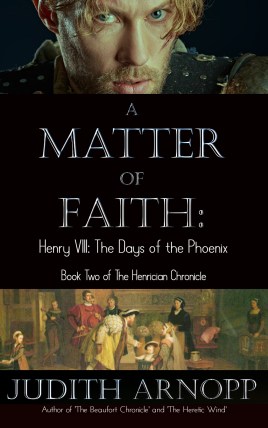
Guest Post: “Spotlight for ‘A Matter of Faith’ by Judith Arnopp

Today, I am pleased to welcome Judith Arnopp to my blog to share the blurb from her latest novel, “A Matter of Faith.” I would like to thank Judith Arnopp and The Coffee Pot Book Club for allowing me to be part of this tour. 

Blurb:

Finally free of Catherine of Aragon, Henry VIII is now married to Anne Boleyn and eagerly awaiting the birth of his son. In a court still reeling from the royal divorce and growing public resentment against church reform, Henry must negotiate widespread resentment toward Anne. He places all his hopes in a son to cement his Tudor bloodline, but his dreams are shattered when Anne is delivered of a daughter.

Burying his disappointment, Henry focuses on getting her with child again, but their marriage is volatile, and as Henry faces personal bereavement and discord at court, Anne’s enemies are gathering. When the queen miscarries a son, and Henry suffers a life-threatening accident, his need for an heir becomes critical. Waiting in the wings is Jane Seymour, a lady-in-waiting who offers the king comfort and respite from Anne’s fiery passions.

But, when Anne falls foul of her former ally, Thomas Cromwell, and the king is persuaded he has been made a cuckold, Henry strikes out, and the queen falls beneath the executioner’s sword, taking key players in Henry’s household with her. 

Jane Seymour, stepping up to replace the fallen queen, quickly becomes pregnant. Delighted with his dull but fertile wife, Henry’s spirits rise even further when the prince is born safely. At last, Henry has all he desires, but even as he celebrates, fate is preparing to deliver one more staggering blow. 

Henry, the once perfect Renaissance prince, is now a damaged middle-aged man, disappointed in those around him but most of all in himself. As the king’s optimism diminishes, his intractability increases and the wounded lion begins to roar.

Buy Links:

This title is available to read on #KindleUnlimited. 

Universal Link: http://mybook.to/amofaith 

Amazon UK: https://www.amazon.co.uk/dp/B0BWF2WL1Q 

Amazon US: https://www.amazon.com/dp/B0BWF2WL1Q 

Amazon CA: https://www.amazon.ca/dp/B0BWF2WL1Q 

Amazon AU: https://www.amazon.com.au/dp/B0BWF2WL1Q 

Author Bio: 

When Judith Arnopp began to write professionally, there was no question about which genre to choose. A lifelong history enthusiast and avid reader, Judith holds an honors degree in English and Creative writing and a Masters in Medieval Studies from the University of Wales, Lampeter. 

Judith writes both fiction and non-fiction, working full-time from her home overlooking Cardigan Bay in Wales, where she crafts novels based on the Medieval and Tudor periods. Her primary focus is on the perspective of historical women from all life roles, from prostitutes to queens, but she has recently turned her attention to Henry VIII himself.

Her novels include: 

A Matter of Conscience: Henry VIII, the Aragon Years. (Book one of The Henrician Chronicle)

A Matter of Faith: Henry VIII, the Years of the Phoenix (Book Two of The Henrician Chronicle)

The Beaufort Bride: (Book one of The Beaufort Chronicle)

The Beaufort Woman: (Book two of The Beaufort Chronicle)

The Kings Mother: (Book three of The Beaufort Chronicle)

The Heretic Wind: the life of Mary Tudor, Queen of England

A Song of Sixpence: The Story of Elizabeth of York

Intractable Heart: The Story of Katheryn Parr

The Kiss of the Concubine: A Story of Anne Boleyn

Sisters of Arden: on the Pilgrimage of Grace

The Winchester Goose: at the court of Henry VIII

The Song of Heledd: 

The Forest Dwellers

Peaceweaver

Her non-fiction articles feature in various historical anthologies and magazines, and an illustrated non-fiction book, How to Dress like a Tudor, will be published by Pen & Sword in 2023.

Social Media Links:

Website: https://www.judithmarnopp.com

Blog: http://juditharnoppnovelist.blogspot.co.uk/

Twitter: https://twitter.com/JudithArnopp

Facebook: https://www.facebook.com/thetudorworldofjuditharnopp

LinkedIn: https://www.linkedin.com/in/judith-arnopp-ba999025/

Instagram: https://www.instagram.com/tudor_juditharnopp/ 

Book Bub: https://www.bookbub.com/authors/judith-arnopp

Amazon Author Page: http://author.to/juditharnoppbooks 

Guest Post: “Horse Breeds in the Middle Ages” by Rowena Kinread

The Scots of Dalriada Tour Banner 1Today, I am pleased to welcome Rowena Kinread to my blog as part of the blog tour for her novel, “The Scots of Dalriada.” I want to thank The Coffee Pot Book Club and Rowena Kinread for allowing me to be part of this blog tour.

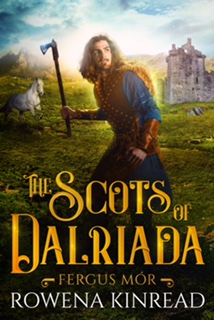
In ‘The Scots of Dalriada’ Fergus hides in a horse breeding- and training- centre on Aran. Is it realistic that such studs existed in the early Middle Ages? The answer is yes!

Throughout this period, horses were rarely considered breeds, such as today we have the Clydesdale horse, Haflinger, or Lipizzaner, to name just three; but instead, they were defined by type, by describing their purpose or physical attributes.

Breeders practiced selective breeding, as opposed to certain bloodlines as usual today. For example, the destrier or war horse was required to be strong, fast, and agile. Horses that had already proved themselves in battle would be used to breed new generations.

Horses from this age differed in size and build to the modern horse. Generally speaking, they were much smaller. The average horse of the time was 12 to 14 hands (48 to 56 inches, 122 to 142 cm). The destrier was described in contemporary sources as ‘tall and majestic and with great strength’. It was frequently referred to as the ‘great horse’ because of its size and reputation. This was a subjective term by medieval standards, and the destrier would appear small to our modern eyes. In my novel, I name the height as 14.2 hands; this would be exceptionally tall in the day.

 In addition to selective breeding, training was also common. Kings would not have the time to train their horses themselves. It would take a minimum of two years to fully train a destrier. A lot of schooling is required to overcome a horse’s natural instinct to flee from noise, the smell of blood, and the confusion of combat. It must also learn to accept smoke and fire and any sudden movements.

For this reason, war horses were more expensive than normal riding horses, and destriers the most prized, but figures vary greatly from source to source. Destriers are given values ranging from seven times the price of an ordinary horse to seven hundred times. The Bohemian king Wenzel II rode a horse ‘valued at one thousand marks’ in 1298. At the other extreme, a 1265 French ordinance ruled that a squire could not spend more than twenty marks on a rouncey. Knights were expected to have at least one war horse (as well as riding horses and packhorses), with some records from the later Middle Ages showing knights bringing twenty-four horses on the campaign. Five horses were perhaps the standard.


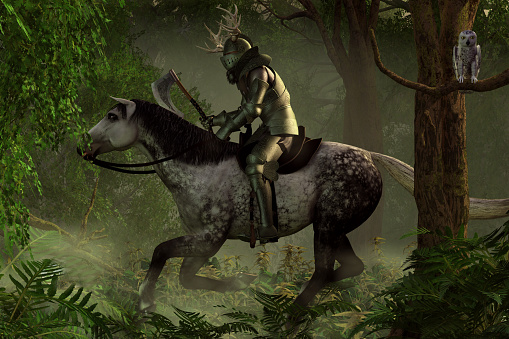
Image destrier
An armored medieval knight, axe in hand, and with a helmet decorated with antlers, rides his horse through a dense forest. 3D Rendering


Other horse ‘types’ in the Middle Ages:

  1. Palfreys = riding horses. The well-bred palfrey, which could equal a destrier in price, was popular with nobles and highly-ranked knights for riding, hunting, and ceremonial use. Ambling was a desirable trait in a palfrey, as the smooth gait allowed the rider to cover long distances quickly in relative comfort.
  2. cart horses or packhorses
  3. ‘Coursers’ were generally preferred for hard battles as they were light, fast, and strong. They were valuable but not as costly as the destrier. They were also used frequently for hunting.
  4. ‘Rouncey’ is a more general-purpose horse, which could be kept as a riding horse or trained for war. It was commonly used by squires, men-at-arms, or poorer knights. A wealthy knight would keep rounceys for his retinue. Sometimes the expected nature of warfare dictated the choice of horse; when a summons to war was sent out in England in 1327, it expressly requested rounceys for swift pursuit rather than destriers. Rounceys were sometimes used as pack horses but never as cart horses.
  5. ‘Jennet’ is a small horse first bred in Spain from Barb and Arabian bloodstock. Their quiet and dependable nature, as well as size, made them popular as riding horses for ladies; however, they were also used as cavalry horses by the Spanish.
  6. The ‘hobby’ was a lightweight horse, about 13 to 14 hands, developed in Ireland from Spanish or Libyan bloodstock. This type of quick and agile horse was popular for skirmishing and was often ridden by light cavalry known as Hobelars. Hobbies were used successfully by both sides during the Wars of Scottish Independence, with Edward I of England trying to gain an advantage by preventing Irish exports of horses to Scotland. Robert Bruce employed the hobby for his guerilla warfare and mounted raids, covering 60 to 70 miles a day.

The Scots of Dalriada coverBlurb:

THREE BROTHERS

Fergus, Loarn, and Angus, Princes of the Dalriada, are forced into exile by their scheming half-brother and the druidess Birga One-tooth.

THREE FATES

Fergus conceals himself as a stable lad on Aran and falls helplessly in love with a Scottish princess, already promised to someone else. Loarn crosses swords against the Picts. Angus designs longboats.

TOGETHER A MIGHTY POWER

Always on the run, the brothers must attempt to outride their adversaries by gaining power themselves. Together they achieve more than they could possibly dream of.

Fergus Mór (The Great) is widely recognized as the first King of Scotland, giving Scotland its name and its language. Rulers of Scotland and England from Kenneth mac Alpín until the present time claim descent from Fergus Mór.

Full of unexpected twists and turns, this is a tale of heart-breaking love amidst treachery, deceit, and murder.

Buy Links:

Universal Link:   https://books2read.com/u/47VXAL 

Amazon UK: https://www.amazon.co.uk/gp/product/B0BS78THF3 

Amazon US: https://www.amazon.com/gp/product/B0BS78THF3 

Amazon CA: https://www.amazon.ca/gp/product/B0BS78THF3 

Amazon AU: https://www.amazon.com.au/gp/product/B0BS78THF3 

Rowena Kinread 1Author Bio:

Rowena Kinread grew up in Ripon, Yorkshire, with her large family and a horde of pets. Keen on traveling, her first job was with Lufthansa in Germany.

She began writing in the nineties. Her special area of interest is history. After researching her ancestry and finding family roots in Ireland with the Dalriada clan, particularly in this era. 

Her debut fiction novel titled “The Missionary” is a historical novel about the dramatic life of St. Patrick. It was published by Pegasus Publishers on Apr.29th, 2021, and has been highly appraised by The Scotsman, The Yorkshire Post, and the Irish Times.

Her second novel, “The Scots of Dalriada,” centres around Fergus Mór, the founder father of Scotland, and takes place in 5th century Ireland and Scotland. It is due to be published by Pegasus Publishers on Jan.26th, 2023.

The author lives with her husband in Bodman-Ludwigshafen, Lake Constance, Germany. They have three children and six grandchildren.

Social Media Links:

Website: https://www.rowena-kinread.com/ 

Twitter: https://twitter.com/RowenaKinread 

Facebook: https://www.facebook.com/rowena.strittmatter 

LinkedIn: https://www.linkedin.com/in/rowena-kinread-6b054b228/ 

Instagram: https://www.instagram.com/rowenakinread/ 

Guest Post: “Excerpt from ‘Close Your Eyes- A Fairy Tale’ by Chris Tomasini

Close Your Eyes A Fairy Tale Tour BannerI am pleased to welcome Chris Tomasini to my blog today to share an excerpt from his novel, “Close Your Eyes- A Fairy Tale.” I would like to thank Chris Tomasini and The Coffee Pot Book Club for allowing me to be part of this tour. 
Tycho

The first year Tycho spent with us at Gora, he was like a child running frenzied through a kitchen full of Christmas delicacies. The gossip which arose about him was voluminous. I often sat in the castle kitchen, a mug of beer in my hand, listening to what the women said about the boy. What amused me most, as I watched them roll their eyes when his name was again mentioned in a less than lustrous light, was that they adored Tycho. They pretended they didn’t, not wishing to be teased, but I could see it in their eyes, in their rapt attention when the boy walked into a room, in their troubled breathing when he touched his hands to their shoulders or hair.

I don’t know what drew them to him, but it was much more than his youth and good looks. He was playful and irreverent, and the aura of foreign lands hung about him. Tycho could speak a dozen languages fluently, he could tell those magical stories, twinkle his eyes seemingly at will, and when they twinkled for you, it felt like you were sharing something with him, a sort of blissful astonishment at being alive.

It was also in the way he moved. Tycho eased through a room like a breeze across a field. He was around you; you raised your face to allow the wind to sweep close, and then he was gone, around a table, talking to someone else. He was here and there, here and gone, coming and going, a smile for you, a smile for someone else, and from watching him in the kitchen, in the dining hall, amongst crowds, I think what made him so sought after was that people felt a need to be alone with him, to possess him unreservedly, if only for a few short moments.

I have spoken, in the years since he left, to many people about Tycho. I asked the women why they chased him, why they desired him when he was unabashedly a scamp who was sleeping with every woman in the castle. I asked other of our friends why it felt such a privilege to be alone with him, and I think we all knew, unconsciously, that the road was not yet done with Tycho and that he had only been given to us for a short time.

Ahab has spoken to me of a Greek historian named Herodotus and of his fascination with a people named the Scythians, who lived around the Black Sea. Ahab thought that Tycho resembled these people, who did not live in cities or settle farms, but rather followed their herds of cattle across endless prairies, riding on wagons, carrying their tents with them. The Greek word for this way of life was aporia – to be a nomad, to be without a home, to be inaccessible to others.

I have been a child of the road. I lived that life for three years, and Ahab, with his delight in things ancient, things intellectual, did not grasp the fundamental difference between Tycho and the Scythians. To be a Scythian, I imagine, was to carry your life with you – your family, your belongings, your past, your history. But Tycho was a single boy, an orphan, alone upon a road.

The road forces you to decide if your destination is worth the hardship – making this decision is the traveler’s burden. But Tycho was more than a traveler. He was a wanderer who did not even have a destination. I think it was this sadness which many of us saw in the boy beneath the charm and the winning smile. We saw the sadness of a soul which would forever be in transit, which would never know a home, and which would forever be apart.

Close Your Eyes CoverBlurb:

Set in early 1400s Europe, Close Your Eyes is a sincere yet light-hearted and lustful ode to love. As Samuel, the court jester, struggles to describe why his friends, Agnieszka, the cook, and Tycho, the storyteller, fled the King of Gora’s service, he learns that love was the beating heart behind everything that happened in the castle. 

He learns as well that more ghosts than he knew of walked the midnight halls and that the spirit of Jeanne d’Arc haunted his friend and once slid into bed with Tycho, daring him to leave – to take to the cold roads of Europe, where he had once wandered orphaned and alone, and find his destiny there.

Buy Links:

Universal Link: https://books2read.com/u/4DJN6g 

Amazon UK: https://www.amazon.co.uk/dp/B09NRYXDM9

Amazon US: https://www.amazon.com/dp/B09NRYXDM9

Amazon CA: https://www.amazon.ca/Close-Your-Eyes-Fairy-Tale/dp/B09NRK3ZQH

Amazon AU: https://www.amazon.com.au/Close-Your-Eyes-Fairy-Tale/dp/B09NRK3ZQH

Chris Tomasini

Author Bio:

Chris Tomasini lives in Ontario, Canada. He has studied creative writing via Humber College’s “Correspondence Program in Creative Writing” and through the University of Toronto School of Continuing Studies. 

In the 1990s, Chris taught English as a Second Language and had stops in England, Poland, and Japan.

Since 2000, Chris has worked in bookstores, publishing, and libraries.

Chris is married with two children and can often be found (though not very easily) on a bicycle on country roads in central Ontario.

Social Media Links:

Website: http://www.christomasini.ca/

Instagram: https://www.instagram.com/chrisfindsthelight/

TikTok: https://www.tiktok.com/@chrisfindsthelight

Book Bub: https://www.bookbub.com/authors/chris-tomasini

Amazon Author Page: https://www.amazon.com/stores/author/B019NO9NO2

Goodreads: https://www.goodreads.com/author/show/14814659.Chris_Tomasini