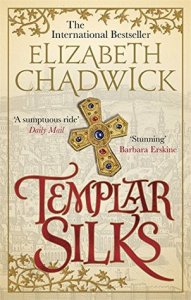
One of the greatest knights in English history is lying on his deathbed. As his loved ones stay near his bedside, William Marshal remembers his time in the Outremer, where he is to perform a final duty to his lord. William and his companions soon realize that the Holy Land is more treacherous than they could ever imagine, and the most dangerous person for William is the concubine Paschia de Riveri. Elizabeth Chadwick concludes her William Marshal series with novel six in the series, “Templar Silks.”
I have enjoyed the previous novels that I have read by Elizabeth Chadwick, and I wanted to read more from her. I saw this book at a used book store, and I wanted to read it, even though I had not read the previous five books in the series.
We begin this final adventure with William Marshal in the year 1219. William is on death’s door and has asked his squire, Jean D’ Earley, to retrieve his burial silks from Wales. These were not just any burial silks, but the ones that he was given by the Templars when he was in Jerusalem. To understand why William went to Jerusalem, Chadwick goes back to 1183, when William was in the service of the Young King Harry, the son of Henry II and Alienor of Aquitaine. Harry decides that they would raid Rocamadour to pay for their endeavours, but this would be one of the last decisions he would ever make. On his deathbed, Harry asked William and his men to take his cloak to Jerusalem so that he could be forgiven for his sins of robbing the church.
William agrees, and so he, his brother Ancel, and a handful of others make their way to Jerusalem. Once they make it into the Outremer, they soon realize that they are in the midst of a fight for the throne. King Baldwin IV of Jerusalem is dying, and there is a fight within his court for the throne, primarily from Baldwin’s sister Sybilla and her husband Guy de Lusignan, William’s mortal enemy. To top it all off, William falls in love with the concubine of Heraclius, Paschia de Riveri. William and his men must survive the politics of the Outremer to return home to his beloved England.
Overall, I thoroughly enjoyed this novel, despite not having read the previous books in the series. Now, I want to read the rest of the series to see William Marhsal’s life through Chadwick’s eyes. If you have read the previous books in the William Marshal series, I would recommend that you read the final book in the series, “Templar Silks” by Elizabeth Chadwick.
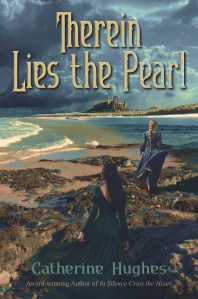
I am pleased to welcome Catherine Hughes to my blog today to share an excerpt from her latest novel, “Therein Lies the Pearl.” I would like to thank The Coffee Pot Book Club and Catherine Hughes for allowing me to participate in this blog tour.
Excerpt
Her voice lifted in confusion. “Father?”
Margaret had been breathing in the musky smell of the woodlands and the flowering anemone that lined their path when she saw her father’s body, as it was positioned in the saddle, tilt further and further toward the side.
That morning, the family had left the inn and began traveling toward Favreshant, following a path made fragrant by the flowers and plants newly opened for spring. The weather did much to improve Margaret’s spirits as the sun shone brightly upon them from a clear, blue-domed sky. An occasional puffy cloud floated across the heavens, but never did it linger long enough to diminish the warmth that embraced her. Walking with a bemused smile upon her face, Margaret surrendered to the charms of the countryside, relishing in the way the light accentuated the many shades of green that colored the leaves, the bushes, and the flower stems. A random look toward the front of the cavalcade snapped her pleasant daydream when she noticed the rider near the head of the train—her father—was about to fall.
Abandoning her usual sauntering walk, she broke into enormous strides, trying to close the gap between her father and herself. The rapid turnover of her feet upon the soil alarmed the flock of yellowhammers who had been flitting about the blossoms. To escape the disruption, they rose higher and hovered above, waiting for the
tumult to settle.
“Father!”
Her shout coincided with the loud thud of his body landing on solid ground, his head coming to rest in a patch of wildflowers.
Before Margaret reached him, she could see Gerhard was already there. He had carefully removed young Edgar from the saddle and then ran toward Edward, dropping to his knees for closer inspection.
Margaret skidded to a halt and took the same posture on the other side of her father’s fallen body. Hesitantly, she repeated again, “Father…?”
His lips parted, but no sound issued forth.
After a quick glance in her direction, Gerhard moved closer to Edward, placing one hand beneath his master’s neck and bringing his own closer. “Edward! Edward, can you hear me?” Nothing. “Blink your eyes if you can hear me.” Gerhard’s voice cracked with worry, his usual composure gone. Because Gerhard had leaned so closely over her father’s head, Margaret had to slide further up toward his shoulder to be able to see whether or not her father had comprehended Gerhard’s words.
To her relief, she saw his eyelashes flutter—he understood! He was still there, he was still with them!
Gerhard continued. “Can you move your legs, my lord? Your arms? Just blink to let me know if you still have some control over your limbs.”
The words hung in the air as other people soon gathered around the group of three upon the ground. Margaret heard Edgar sniffling somewhere outside the circle and felt Harold, the priest, and his two brothers glaring down upon them from their seats. None of them had dismounted; instead, they surrounded the trio like a band of
highwaymen waiting to pounce on an unsuspecting victim. To Margaret’s dismay, her father’s eyelids did not flicker.
She studied Gerhard and watched the changing color of emotion move across his face—from confusion to concern, from fear to speculation, from suspicion to anger. When they both noticed the parting of her father’s lips, their hopes lifted. Together, she and Gerhard leaned in closer.
Her father’s eyes remained open but unfocused, and he whispered gently, more so to the air than to them. “No … feeling …my legs. My feet… cannot feel them… cannot move them… nothing there.”
Gerhard was about to respond, but stopped when he saw Edward gather his breath once more. Unable to inhale deeply, he spoke in shallow exchanges. “Dizzy … since morn…could not get… legs…to keep hold … of the horse… chest feels … full… crushed.” He paused here for a lengthier break.
Margaret could feel her eyes welling up, her lashes wet with moisture.
“Cannot… take …. in … air.” With his gaze still focused at some point in the far distance, he whispered in a hushed tone, “Twas… foul… play.” Silence, and he moved no more.
Margaret felt tears stinging her eyes. They burned her skin as they tumbled down her face until they left small, individual droplets of water on her father’s tunic. She watched as Gerhard placed his hand over Edward’s face, his fingers gently extending to close each eyelid.
Tiny bright-blue flowers with yellow centers formed a soft, decorative pillow where his sleeping head lay. Reminded of Jesus’ promise when he created these delicate blossoms, Margaret trusted that the Blessed Virgin would watch over her father’s soul. And she also knew that her father—like the flower itself—was urging her to “forget-me-not.”
Blurb:
Normandy, 1064
Celia Campion, a girl of humble background, finds herself caught in a web of intrigue when Duke William commands her to work as his spy, holding her younger sister hostage. Her mission: to sail across the sea to Wilton Abbey and convince Margaret, daughter of Edward the Exile, to take final vows rather than form a marriage alliance with the newly crowned king to the North, Malcolm III of Scotland. Preventing a union between the Saxons and Scots is critical to the success of the Duke’s plan to take England, and more importantly for Celia, it is the only way to keep her sister alive.
In this sweeping epic that spans the years before and after the Conquest, two women from opposite sides of the English Channel whisper across the chasm of time to tell their story of the tumultuous days that eventually changed the course of history. As they struggle to survive in a world marked by danger, loss, and betrayal, their lives intersect, and they soon come to realize they are both searching for the same thing–someone they can trust amidst the treachery that surrounds them.
Together, their voices form a narrative never before told.
Award-winning writer Catherine Hughes is a first-time author who, from her earliest years, immersed herself in reading. Historical fiction is her genre of choice, and her bookshelves are stocked with selections from ancient, Medieval, and Renaissance Europe as well as those involving New England settlements and pioneer life in America. After double-majoring in English and business management on the undergraduate level, Catherine completed her Master’s degree in British literature at Drew University and then entered the classroom, where she has been teaching American, British, and World Literature at the high school level for the last thirty years.
Aside from teaching and reading, Catherine can often be found outdoors, drawing beauty and inspiration from the world of nature. Taking the words of Thoreau to heart, “It is the marriage of the soul with nature that makes the intellect fruitful,” Catherine sets aside time every day to lace up her sneakers and run with her dog in pre-dawn or late afternoon hours on the beaches of Long Island. When her furry companion isn’t busy chasing seagulls or digging up remnants of dead fish, she soaks in the tranquility of the ocean setting, freeing her mind to tap into its deepest recesses where creativity and imagination preside.
In Silence Cries the Heart, Hughes’s first book, received the Gold Medal in Romance for the Feathered Quill 2024 Book of the Year contest, the Gold Medal for Fiction in the 2024 Literary Titan competition, and the 2024 International Impact Book Award for Historical Fiction. In addition, the Historical Fiction Company gave it a five-star rating and a Silver Medal in the category of Historical Fiction Romance. The book was also featured in the February 2024 Issue 31 of the Historical Times magazine and was listed as one of the Best Historical Fiction Books of 2024 by the History Bards Podcast. Therein Lies the Pearl is her second venture into the world of historical fiction.
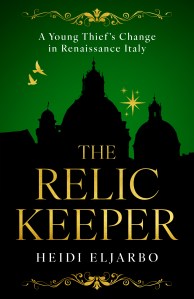
I am pleased to welcome Heidi Eljarbo back to my blog to share a spotlight for her latest novel, “The Relic Keeper.” I would like to thank Heidi Eljarbo and The Coffee Pot Book Club for allowing me to participate in this blog tour.
Blurb:
Inspired by Gerrit van Honthorst’s masterpiece, The Adoration of the Child, and the novel Oliver Twist by Charles Dickens.
Italy, 1620.
Angelo is an orphan, lonely and forgotten. Having been passed on from one family to the next, he ends up as a common thief, subject to and under the thumb of a ruthless robber called Tozzo.
Angelo knows no other life and has lost hope that any chance of providence will ever replace his lonely, misfortunate existence. When he loses his master, his livelihood is shaken. Tozzo’s plunder is hidden in a safe place, but what will happen if someone comes after Angelo to get their hands on the stolen relics? More than that, he feels threatened by words he’s heard too many times; that he’ll always remain unforgiven and doomed.
One day, a priest invites Angelo to help with chores around the church and rectory and, in exchange, offers him room and board. Padre Benedetto’s kindness and respect are unfamiliar and confusing, but Angelo’s safety is still a grave concern. Two older robbers have heard rumors about the hidden treasures and will stop at nothing to attain them.
With literary depictions and imagery, Angelo’s story is a gripping and emotional journey of faint hope and truth in seventeenth-century Italy—an artistic and audacious tale that crosses paths with art collector Vincenzo Giustiniani and the powerful Medici family.
Using invisible threads, Heidi Eljarbo weaves together her fictional stories with historical figures and real events.
This title is available to read on #KindleUnlimited.
Author Bio:
HEIDI ELJARBO grew up in a home full of books, artwork, and happy creativity. She is the author of historical novels filled with courage, hope, mystery, adventure, and sweet romance during challenging times. She’s been named a master of dual timelines and often writes about strong-willed women of past centuries. After living in Canada, six US states, Japan, Switzerland, and Austria, Heidi now calls Norway home. She lives with her husband on a charming island and enjoys walking in any kind of weather, hugging her grandchildren, and has a passion for art and history. Her family’s chosen retreat is a mountain cabin, where they hike in the summer and ski the vast white terrain during winter. Heidi’s favorites are her family, God’s beautiful nature, and the word whimsical.
15th-century Estonia was at the edge of Christendom. It also just finished facing off against the notable Victual Brothers, a band of brigands and pirates who wreaked havoc across the land. In the town of Tallinn, St. Olaf’s Church is being constructed, but nefarious dealings are coming to the surface. A serial killer is turning this once peaceful town, which is finding its identity on its head. Now, an apothecary named Melchior Wakenstede must help the magistrate solve the case before anyone else is killed. This is the premise for the first Apothecary Melchior Mystery by Indrek Hargla, entitled “The Secret of Saint Olaf’s Church.”
I would like to thank Pushkin Vertigo and Net Galley for sending me a copy of this novel. I am not familiar with Indrek Hargla’s works, nor was I familiar with medieval Estonian history, so I was excited to learn more in this novel.
We begin with a bit of background information about Estonia and Tallinn during this period. The Victual Brothers, a band of pirates loosely joined together, have just been defeated by the Teutonic Order. One of the former commanders of the Teutonic Order, Henning von Clingenstain, is found murdered, he is beheaded, and a coin is stuck in his mouth. This mystery novel is based on the true case of Henning von Clingenstain, with liberties obviously taken where the written record falls short.
Hargla has chosen to focus on the stories of those who live in the town of Tallinn, primarily the apothecary Melchior Wakenstede. We also get to see the stories of his wife Keterlyn, Magistrate Dorn, Mertin Tweffell, Kilian Rechpergerin, Burckhart Casendorpe, Prior Eckell, and Brother Wunbaldus. For a small town that is growing, it holds many secrets, including deadly ones. One murder turned into multiple dead bodies. It is up to Melchior to solve the murders and make sure the murderers are brought to justice.
I will be honest. It took me a while to get used to this book as I am not familiar with this author or Estonian history and culture, which is a bit different than other medieval stories I have read, but I am glad I read it. Hargla showed his audience what life was like in medieval Estonia with a thrilling tale full of twists, turns, and secrets. If you want a medieval murder mystery but you want something different, I suggest you give “The Secret of Saint Olaf’s Church” by Indrek Hargla a try.
The year is 1540, and King Henry VIII is looking for a wife. He has been a widower for over three years, and his councilor Thomas Cromwell believes that a foreign alliance will be the best path forward for England, so he arranges a marriage between Henry and Anne of Cleves. In theory, it should be a good match, but it falls apart quickly. To top it all off, one of Anne of Cleves’ Maid of Honour brought her own drama to court that ended with a murder. Can Will Somers, the King’s Fool, navigate the drama at court while dealing with his own love life, or will the mystery of the missing body prove too much for him to handle? This is the premise of the next book in the King’s Fool Mysteries series called “Devil’s Gambit.”
I would like to thank Old London Press and Net Galley for sending me a copy of this novel. I enjoyed the previous books in this series that I have read, so I wanted to see what would happen next for Will Somers.
We begin with the disastrous first meeting between Henry VIII and Anne of Cleves before their wedding. Since Anne did not understand English or English customs, she was confused. Henry wanted to send her away immediately, but Will convinced Henry to become friends with Anne. At the same time, Will is introduced to Anne’s Maid of Honour, Margaret Loy, a German woman who has fallen in love with an English gentleman. However, the gentleman’s father does not approve of the match.
Things take a drastic turn when Lord Humphrey, the gentleman’s father, is found dead in Margaret’s chamber. The only person for the case is, of course, Henry’s jester Will Somers, but as soon as he starts the case, the body goes missing. To top it all off, Will is dealing with his relationships with his wife Marion and his lover Sir Nicholas Pachett Lord Hammond. Sir Nicholas has recently gotten married and is now asking Will for help in his marriage. Talk about an awkward situation. Will must choose who he truly loves, while giving relationship advice to the King, helping Anne navigate the English court, and solving a murder mystery.
While I did think the relationship exploits of Will Somers did take up a bit too much of this book and took away from the mystery itself, I think it was a decent novel. If you are a fan of the previous novels in the King’s Fool Mysteries, you will enjoy “Devil’s Gambit” by Jeri Westerson.
Have you ever believed in something or someone so much that you were willing to do anything to be with them? What if it meant isolating yourself from everyone and everything you loved? Aleys knows this all too well. Born near Bruges during the 13th century, Aleys believes that she is destined for great things and has religious visions. Can this young woman survive both religious and political challenges to make her aspirations of being closer to God a reality, or will she fly too close to the sun and lose everything? Janet Rich Edwards tells Alleys’ tale in her debut novel, “Canticle.”
I would like to thank Spiegel & Grau and Net Galley for sending me a copy of this novel. I am always looking for a fresh approach to the past, so when I read the premise of this novel, it sparked an interest in me. As it is a debut featuring a religious group of women that I was not familiar with, the beguines, I wanted to see how Edwards’s writing style would bring something new to medieval historical fiction.
“Canticle” is a novel that follows three main narrators: Aleys, the young woman who longs to have a deeper relationship with God; Friar Lukas, who wants to grow his monastery; and Jaan Smet, Bishop of Tournai, who wants to get closer to the pope and power. We begin with Aleys as a young woman. She lives with her mother, father, brothers, and sister. Her mother died during childbirth, leaving the family broken. Aleys’s father decides to marry her off to a rich merchant, but Aleys decides that she wants to live a religious life, so she runs away. It is here she meets Friar Lukas, a Franciscan, and she wants to become a Franciscan, but Lukas convinces her to join the community of beguines.
It is in the community of beguines that Aleys discovers her true self and a series of translations that will send shockwaves all the way to Rome. The Bishop wanted to take down this community so that he could earn the respect of Rome and possibly become a cardinal. However, it was Aleys who was about to change with a miracle that sent the town into a frenzy. It was Friar Lukas who convinced Aleys to take the ultimate step and become an anchoress. It was when Aleys became an anchoress that Edwards truly shines because she shows the isolation that an anchoress might feel in her cell. But life has a way of reaching even an isolated cell, and Aleys must choose whether to save herself or her beloved beguines.
I found this a delightfully evocative novel about medieval religious life. It made me feel sympathy for the beguines and the anchoresses who were willing to risk it all to get closer to God. I really enjoyed Edwards’ writing style, and I can’t wait to see what she will write about next. If you want something medieval that focuses on religious life, I would recommend you read “Canticle” by Janet Rich Edwards.
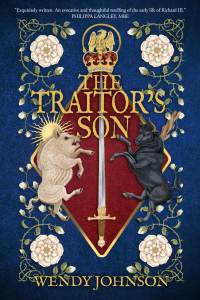
I am pleased to welcome Wendy Johnson to my blog today to share information about her research for her novel, “The Traitor’s Son.” I would like to thank Wendy Johnson and The Coffee Pot Book Club for allowing me to participate in this blog tour.
I’ve been fascinated by the period known retrospectively as the Wars of the Roses since childhood, so when I came to write ‘The Traitor’s Son’ I already had a grounding in the history. Over the years, I’ve amassed a number of secondary sources: biographies of the principal figures, battlefield histories, political commentaries, and so on, and these have proved invaluable in forming the backbone of the novel. These days, a great deal of primary sources are digitally transcribed, and can be a valuable means of verifying details which would be more difficult to access.
My intention was always to underpin my fiction with fact. I didn’t want to invent things for the sake of the story—for me, the events of the fifteenth century are in themselves dramatic and exciting enough without the need for fabrication. But of course, the duty of a historical novelist is to add flesh to the bones, to bring the past to life, and this is essential as the reader has to be able to empathise with the characters and understand their motivation. So, how did I go about researching the lives of Edward IV, Richard Neville, earl of Warwick— and of course, my protagonist, young Richard Plantagenet, the future Richard III?
I do feel as though I’ve grown up with these figures—the first castle I ever visited as a child was Raby Castle, in County Durham, home to the dynamic Neville family, and a fascination for this remarkable dynasty was formed. My lifelong interest in Richard III himself was kindled during a visit to Middleham Castle, Yorkshire, at the age of eight and has remained with me ever since. I’ve always had a sense of what I feel my characters were really like, but of course, that wasn’t enough: to write a believable novel, I needed to fully research their lives and the events which formed them, before I could consider recreating them on paper. Biographies proved extremely helpful, most providing a clear background to the lives of each individual and helping to form a realistic picture of that particular person, what their personalities may have been, and, in particular, who and what may have influenced them. This was significantly important when it came to Richard himself.
The frustrating thing about the study of the fifteenth century is that, although some primary sources do survive, they are fewer in number than those of the following century, and those that do survive are mostly official documents. It would be wonderful if we could consult, for example, a greater number of personal letters from those concerned. We do have some, but once again, these tend to be letters composed in an official capacity. Those which remain, however, can help cast small rays of light on the people as individuals, for example, the letter sent by a youthful Edward IV, and his brother Edmund, to the Duke of York, thanking him for the gowns he has sent them and requesting him to deal with ‘the odious rule’ of Richard Croft and his brother, fellow trainee knights, who appear to have been bullying them. Although my novel does not cover this earlier period, the letter is illustrative of the comfortable relationship the sons of York had with their father. Likewise, Richard’s letter to his mother, written as king and signed ‘your most humble son’, requesting her ‘daly blessing to my synguler comfort’ offers a small insight into the affection and respect he bore for her. Although such correspondence is rare, many documents having been destroyed in the following century, letters like these do provide a glimpse of both Edward and Richard’s closeness to their parents.
The relationships of the York family, one to another, are the focus of ‘The Traitor’s Son’. Rather than a sweeping saga, I very much wanted to keep the action close, concentrating on Richard and his brothers, Edward IV and George, duke of Clarence, their sister, Margaret, mother, Cecily—and the man, whom I believe played a huge part in young Richard’s upbringing, his cousin and mentor, Richard Neville, earl of Warwick. Research into the life of Richard III indicates a deep reverence for the memory of his father, the Duke of York. York’s death in battle, when Richard was only eight years old, and the danger in which the family was placed thereafter, must have had a devastating effect on the boy. According to the Centre for Male Psychology…research shows the father-child relationship is an important one. In fact, it can be more influential than the mother-child relationship. This is especially true for the 8-12 year old child as they try to make sense of the outside world…’ i This observation helped confirm my theory that following the death of the Duke of York, it would have been natural for Richard to have searched for a father figure in his life, and that this figure could well have been his cousin, Warwick.
Regarding locations, I found I could call on personal experience for some, but had to research others. Having grown up close to Middleham, I know the castle inside and out, so it was very easy to imagine the scenes set within its walls. The city of York, which was very familiar to Richard, remains in part unchanged, and again, it was an easy matter to reimagine his time there. Warwick Castle is another fortress I’ve visited in person, although naturally there have been additions since the days of Richard Neville. London needed to be researched carefully, as very little remains from the medieval period. I found an amazing resource on the Internet entitled the Agas Map of Early Modern London, which uses the Civitas Londinium, a detailed woodcut created in 1561. This incredible, interactive tool allows the user to search for particular streets, churches, parishes, gates, and so on. Highlighting these on the map, it becomes possible to visualise the city at a time not too distant from the period in which my novel is set. For Richard’s exile in the Low Countries, both at the age of eight and again at eighteen, I had to rely on published histories and on images and information I found online. A visual recreation of the Bishop’s Palace at Utrecht (where Richard and his brother, George, resided following their father’s defeat) was extremely useful, as was a delightful video I found of the adjacent tower, the Dom Toren, which actually featured the sound of its bells—so different in their melody from the chimes which would have been a constant accompaniment to life in London.
My favourite element of the writing process will always be the creative part—seeing the characters in my mind’s eye, imagining their emotions and bringing them to life—but my greatest desire with the novel was to create an authentic narrative, and that meant remaining true to the facts and to the people who populate its pages. These were, after all, real people, and I felt I had a duty to portray them with respect and in the most accurate way I could. Therefore, research and facts remain twin components of ‘The Traitor’s Son’.
Blurb:
Caught between a king and a kingmaker, young Richard Plantagenet knows he’ll have to choose…
1461: Richard, Duke of York, King by Right, has been branded a traitor and slain by his Lancastrian foes. For his eight-year-old son—Richard Plantagenet—England has become a dangerous place.
As the boy grapples with grief and uncertainty, his elder brother, Edward, defeats the enemy and claims the throne. Dazzled by his glorious sibling, young Richard soon discovers that imperfections lurk beneath his brother’s majestic façade. Enter Richard Neville, Earl of Warwick—cousin, tutor, luminary—whose life has given him everything but that which he truly craves: a son. A filial bond forms between man and boy as they fill the void in each other’s lives. Yet, when treachery tears their world asunder, Richard faces an agonizing dilemma: pledge allegiance to Edward—his blood brother and anointed king—or to Warwick, the father figure who has shaped his life and affections.
Painfully trapped between duty and devotion, Richard faces a grim reality: whatever he decides will mean a fight to the death.
In “The Traitor’s Son”, Wendy Johnson weaves a tapestry of loyalty, love, and sacrifice against the backdrop of England’s turbulent history. Through the eyes of a young Richard III, readers are transported into a world where every choice is fraught with peril, and the bonds of kinship are tested to their limits.
Perfect for fans of Hilary Mantel, Annie Garthwaite, and Sharon K. Penman.
Praise for The Traitor’s Son:
“Exquisitely written. An evocative and thoughtful retelling of the early life of Richard III.”
~ Philippa Langley, MBE
“Sometimes the perfect use of the written word takes my breath away. Not very often, but this book is it. A wonderful story written so beautifully that I shall not forget it for a long time. Everything to my mind is perfect. The language, the story, the pacing. Just wonderful.”
~ Kindle Customer, 5* Amazon Review
“Wonderfully woven story of a young Richard III. Woven with a sure knowledge of the history and a realistic telling of a story about a young boy finding his way through tragedy and triumph, uncertainty, and a legacy he cannot escape. Brilliant debut which promises more and more.”
~ Cris, 5* Amazon Review
“I loved this novel, it was beautifully written, extremely atmospheric, the characters’ personalities came through perfectly, can’t wait for the next instalment.”
~ Linda Hayward, 5* Amazon Review
“Really enjoyed this book. Holds the reader enthralled from the first paragraph to the last. The next volume can’t be released soon enough.”
This title is available to read on #KindleUnlimited.
OLYMPUS DIGITAL CAMERA
Author Bio:
Wendy Johnson has a lifelong passion for medieval history, its people, and for bringing their incredible stories to life. Her specific areas of interest are the fifteenth century, the Wars of the Roses, and Richard III in particular. She enjoys narratives that immerse the reader in the past and tries faithfully to recreate the later Middle Ages within her own writing. She has contributed to a number of historical anthologies and was a runner-up in the Woman and Home Short Story Competition 2008.
Wendy is also a founder member of Philippa Langley’s Looking for Richard Project, which located the king’s lost grave in 2012. She co-authored Finding Richard III: the Official Accountof Research by the Retrieval and Reburial Project in 2014, and in 2019 received the Richard III Society’s Robert Hamblin Award.
THE TRAITOR’S SON, volume one in a Richard III trilogy, is Wendy’s debut novel, and she is currently working on the sequel.
I am pleased to welcome Deborah Swift back to my blog today to share information about the real-life locations for her latest novel, “The Cameo Keeper.” I would like to thank Deborah Swift and The Coffee Pot Book Club for allowing me to participate in this blog tour.
Santo Spirito Hospital
One of my characters, Jacopo Vanelli, is a surgeon, so he spends his time at the Santo Spirito Hospital in Rome. The ‘Holy Spirit’ hospital was founded in the Middle Ages and was recognised as one of Europe’s oldest and most advanced hospitals. Its remit included not only tending to the sick and the poor, but also taking in unwanted babies, abandoned children, and travellers who fell ill within the bustling heart of Rome.
Within its grand Renaissance walls, was a museum, an apothecary shop, a public operating theatre and an orphanage run by nuns. The operating theatre became an influential centre for medical education — hosting lectures, dissections, and practical training sessions that drew aspiring doctors from across Italy and Europe.
Here is the octagonal tower of the main building, below.
The architecture of the hospital was striking, with vast wards, airy cloisters, and a famous spiral staircase designed to allow for the swift transfer of patients. Ornate chapels and frescoes adorned the interior, along with stained glass windows. It was seen as an extension of the Church, in what was considered the holiest city in the Western world.
The Ruined Roman Baths
By the 17th century, the once-magnificent Roman baths of the city stood as haunting reminders of Rome’s imperial past. Structures such as the Baths of Caracalla and the Baths of Diocletian, though partially collapsed and overgrown, continued to inspire awe with their towering arches and crumbling mosaics. Locals and visitors alike wandered amidst these grand ruins, imagining the bustling social life and sophisticated engineering that had filled these halls centuries before.
This was an ideal place for lovers to meet, and two of my characters meet at the Baths of Caracalla. Mostly in decay, the stone was pillaged to build new buildings, but there was also a market in trinkets and souvenirs that went on there amongst the ruins. Artists and antiquarians flocked to the baths, sketching their weathered columns and broken statues, and imagining the naked bathers of centuries before.
The Vatican Apartments
One of my characters is the Pope’s sister-in-law, Donna Olimpia Maidalchini, a powerful and wealthy woman who dominated Roman life. Many of my scenes take place in the Vatican Apartments, which represent the heart of papal authority and splendour. These lavish chambers were home to the Pope and his closest advisors, serving as both living quarters but also the centre of Rome’s governance. The apartments showcased the best artistry of Renaissance and Baroque craftsmen. Daily life within the Vatican Apartments was a blend of solemn ritual and political intrigue, with cardinals, diplomats, and foreign dignitaries as regular visitors.
The most celebrated rooms, such as the Raphael Rooms and the Sistine Chapel—already famed for Michelangelo’s ceiling—were objects of wonder and inspiration for all who visited. The Vatican Apartments thus stood not only as the spiritual and administrative core of the Catholic world, but also as a testament to Rome’s enduring patronage of the arts and its pivotal role in shaping the cultural legacy of the 17th century.
Rome is a fabulous place to set a novel with many beautiful and atmospheric locations, and I hope I’ve used them all to advantage in The Cameo Keeper.
Blurb:
Rome 1644: A Novel of Love, Power, and Poison
Remember tonight… for it is the beginning of always ― Dante Alighieri
In the heart of Rome, the conclave is choosing a new Pope, and whoever wins will determine the fate of the Eternal City.
Astrologer Mia and her fiancé Jacopo, a physician at the Santo Spirito Hospital, plan to marry, but the election result is a shock and changes everything.
As Pope Innocent X takes the throne, he brings along his sister-in-law, the formidable Donna Olimpia Maidalchini, known as La Papessa – the female Pope. When Mia is offered a position as her personal astrologer, she and Jacopo find themselves on opposite sides of the most powerful family in Rome.
Mia is determined to protect her mother, Giulia Tofana, a renowned poisoner. But with La Papessa obsessed with bringing Giulia to justice, Mia and Jacopo’s love is put to the ultimate test.
As the new dawn of Renaissance medicine emerges, Mia must navigate the dangerous political landscape of Rome while trying to protect her family and her heart. Will she be able to save her mother, or will she lose everything she holds dear?
For fans of “The Borgias” and “The Crown,” this gripping tale of love, power, and poison will keep you on the edge of your seat until the very end.
Praise:
‘historical fiction that is brisk, fresh and bristling with intrigue’ ~ Bookmarked Reviews ★★★★★
Deborah Swift is the author of twenty novels of historical fiction.
Her Renaissance novel in this series, The Poison Keeper, was recently voted Best Book of the Decade by the Wishing Shelf Readers Award. Her WW2 novel Past Encounters was the winner of the BookViral Millennium Award, and is one of seven books set in the WW2 era.
Deborah lives in the North of England close to the mountains and the sea.
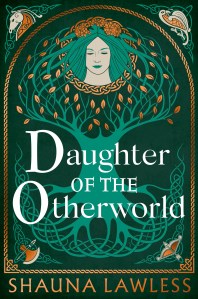
When we think about the Norman Conquest, we often think about how it impacted England, Wales, and Scotland, but we tend to forget about Ireland. Early medieval Ireland do not get a whole lot of attention in historical fiction. That is, until Shauna Lawless’s Gael Song trilogy. Now, fifty years after the events of the original trilogy, Lawless has brought in a new cast of characters, as well as old characters, into the fight between the Descendants of the Tuatha De Danann and the Fomorians. When a child of prophecy is introduced into the mix that is said to be able to defeat the Fomorians, the race is on to protect the child or to kill her. Will the Descendants survive, or will the Fomorians torch the land and the Descendants’ hope? Shauna Lawless jumps back into this work with the Gael Song Era 2 book 1, “Daughter of the Otherworld.”
I would like to thank Bloomsbury USA and Net Galley for sending me a copy of this novel. I am new to this series, but I wanted to read it because I have never read a book about medieval Ireland or about Irish mythology, so when I saw this book available, I decided to give it a shot, especially with such a stunning cover.
We pick up fifty years after the Battle of Clontarf, and a man named Donnchad is on the run from Broccan of the Tuatha De Danann. Donnchad is a Fomorian, which means he can use fire magic and is the mortal enemy of those descendants of the Tuatha De Danann. Donnchad can reunite with his mother, Gormflaith, in Rome. Meanwhile, Broccan has a dream that tells him that he must go back to Rathlin Island and protect the daughter of Fodla, who has been in the Otherworld for a long time. The daughter, Isolde, is destined to defeat the fire, which might be a reference to the Fomorians.
Broccan raises Isolde as his own daughter until she is 17, but he never tells her who she is or her purpose in this giant conflict. But that all changes when the Fomorians find out about Isolde and decide to attack Rathlin Island. They believe that the threat has been neutralized, but Isolde lives and must travel to the mainland to find her cousin Colmon in Seir Kieran. While Isolde is searching for family and to figure out who she is, the Fomorians seek to control Ireland with the Norman lords of England.
This is a novel full of conflict, both magical and mortal, romance and heartbreak. Lawless does a great job of not only balancing numerous perspectives but also balancing mythology with historical battles and figures to create an original story. While I did enjoy the story, it did take me a while to figure out who the characters were and the overall conflict. I think after reading this particular book, I want to read the previous books in the series before I jump into the latest one. If you have read the previous books in the Gael Song trilogy, I think you will enjoy “Daughter of the Otherworld” by Shauna Lawless.
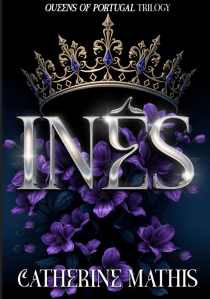
Today, I am pleased to welcome Catherine Mathis to my blog to discuss Ines de Castro, the main protagonist of her novel, “Ines,” the first book in her Queens of Portugal trilogy. I would like to thank The Coffee Pot Book Club and Catherine Mathis for allowing me to participate in this blog tour.
Inês resides more in our imaginations than in fact. She lived, had children, and died.
Her family came from Galicia, in the northwest of Spain, where the famous city of Santiago de Compostela is located. Her father was a powerful noble, Pedro Fernãndez de Castro. Her mother, a noblewoman of Portuguese antecedents, was the mistress of her father. Her birth was illegitimate, which narrowed many of the choices available in her social class. She had kings in her lineage. Her parents also had a son, Alvaro. It is recorded that Alvaro became a good friend of the Pedro in this tale.
Some accounts say she was raised in Portugal, and others in Castile. Inés could have been a young woman serving in the court of Portugal. But the legend says she came from Castile with Constanza, who married Portugal’s Infante Pedro. Coming with Constanza feels more probable because they were cousins and knew each other. If the legend is true that she and Pedro fell in love quickly, then the odds fall on the side to say their first knowledge of each other was a sudden arrival at court, not her growing up there.
What comes down in the legend is her blonde hair and long neck, neither particular markers of great beauty in medieval Portugal. Yet, she is held out as a beauty. In those days, a high forehead was greatly prized, so women plucked their hair to make their foreheads taller. Did Inês? Probably – what young woman does not follow current fashion?
There are no paintings or drawings for most people at this time. Pedro did leave us with an incredible gift, their sarcophagi. He was instrumental in their design. This is how Pedro remembers Inês.
My underlying belief for Inês is that her beauty stems partly from appearance and partly from personality. I see her as easy to talk with, an attentive listener, and someone who gives you her full attention. She is loyal. She is determined.
Most of all, Inês is true to herself. She is likely just 14- or 15-years old when she arrives on the scene. We know nothing of her years beforehand. I expect she could read and write as well as stitch and hunt, all skills of a medieval noblewoman. I believe that having suffered the shame of her birth, she desired the life of a legitimately married woman. She would eschew being mistress of any man, even the heir to the throne. Combine her marriage goal with her loyalty to her cousin Constanza, Pedro’s wife, and just sleeping with Pedro was out of the question. When you are marked young with an unfortunate circumstance, the power of motivation to alter the course of your life is strong. She will suffer for her choices, losing the trust of the king and being exiled. Repeatedly, the crown of Portugal throws obstacles in her way, and she perseveres.
Then comes the day when Pedro plays his part. A widower, he holds out the promise of marriage. No one sees her as fit to be a queen. Of course, there is political intrigue involving her brothers. Life is never simple when you are in the orbit of the royal family. She loves children. She cares for her cousin’s children and her own with recorded affection.
She is the glue of the story. In the novel, she is caught between two men, one whom she is unworthy to wed and one who repels her. When she rejects the king’s trusted adviser, Gonçalves, his hurt turns to jealous anger. “If I cannot have her, then no man can.” Who will the king trust, his son or his adviser? The choices she makes have dire consequences for our protagonist and antagonist.
Blurb:
An heir to the throne, a gorgeous blonde lady-in-waiting, the king’s trusted advisor. When a father and son don’t understand each other, the son pays an outrageous price.
Love, jealousy, loyalty, and revenge roil the court of 14th-century Portugal.
In this engrossing launch to the Queens of Portugal trilogy, Catherine Mathis gives a fresh take on the tale of Pedro and Inês, Portugal’s real-life Romeo and Juliet. Pedro’s father would not have been king if not for his trusted advisor, Gonçalves. Once king, he wants no part in neighboring Castile’s royal convulsions, though his son, Pedro, befriends powerful Castilians.
The all-consuming drive of the king is to ensure his line rules Portugal for centuries to come. He needs legitimate, strong heirs. The Infante Pedro loves a woman not deemed worthy to wear the crown as queen. Between father and son is Gonçalves, the king’s powerful, unquestioned counselor, who is a mentor to the son. Both Gonçalves and Pedro seek the attention of Inês.
There is a horrific cost to winning the love of Inês. She will not release her grip on Pedro until he keeps the two sworn oaths he made to her. Can Pedro do the impossible to satisfy Inês?
Inês is based on real people and events, exploring a cultural touchstone of Portuguese history.
Praise for Inês:
“Mathis masterfully weaves emotional depth into the narrative, creating a deeply engaging experience that leaves a lasting impression and invites readers on an unforgettable journey through the grandeur and intrigue of Portugal’s past.” ~ Mary Anne Yarde, The Coffee Pot Book Club 5* Review
“This exciting start to the Queens of Portugal trilogy describes the legendary love story of Pedro and Inês, and I was amazed at the excellent storytelling and how the author brings the courts to life. There is a lot of drama and intrigue, and the characters’ emotions are beautifully captured in this engrossing tale.” ~ Readers’ Favorite 5* Review
Catherine Mathis was born in Berlin, the daughter of an American spy. As she grew up in Washington, D.C., her spy father turned into a drug enforcement agent. His career change wrecked any chance at high school popularity. She graduated from Sewanee | The University of the South with a degree in history focused on the medieval period. After a career in finance, she returned to her first love of medieval history to ‘Share Iberian Tales.’ Outside of writing, spare time joys are family, friends, reading, collecting folk/outsider art, and travel.

 I am pleased to welcome Catherine Hughes to my blog today to share an excerpt from her latest novel, “Therein Lies the Pearl.” I would like to thank The Coffee Pot Book Club and Catherine Hughes for allowing me to participate in this blog tour.
  Blurb:
 Author Bio
 I am pleased to welcome Heidi Eljarbo back to my blog to share a spotlight for her latest novel, “The Relic Keeper.” I would like to thank Heidi Eljarbo and The Coffee Pot Book Club for allowing me to participate in this blog tour.
 Blurb:
  Author Bio:
 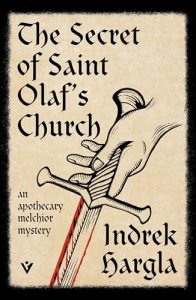 15th-century Estonia was at the edge of Christendom. It also just finished facing off against the notable Victual Brothers, a band of brigands and pirates who wreaked havoc across the land. In the town of Tallinn, St. Olaf’s Church is being constructed, but nefarious dealings are coming to the surface. A serial killer is turning this once peaceful town, which is finding its identity on its head. Now, an apothecary named Melchior Wakenstede must help the magistrate solve the case before anyone else is killed. This is the premise for the first Apothecary Melchior Mystery by Indrek Hargla, entitled “The Secret of Saint Olaf’s Church.”
 The year is 1540, and King Henry VIII is looking for a wife. He has been a widower for over three years, and his councilor Thomas Cromwell believes that a foreign alliance will be the best path forward for England, so he arranges a marriage between Henry and Anne of Cleves. In theory, it should be a good match, but it falls apart quickly. To top it all off, one of Anne of Cleves’ Maid of Honour brought her own drama to court that ended with a murder. Can Will Somers, the King’s Fool, navigate the drama at court while dealing with his own love life, or will the mystery of the missing body prove too much for him to handle? This is the premise of the next book in the King’s Fool Mysteries series called “Devil’s Gambit.”
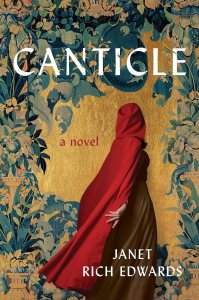 Have you ever believed in something or someone so much that you were willing to do anything to be with them? What if it meant isolating yourself from everyone and everything you loved? Aleys knows this all too well. Born near Bruges during the 13th century, Aleys believes that she is destined for great things and has religious visions. Can this young woman survive both religious and political challenges to make her aspirations of being closer to God a reality, or will she fly too close to the sun and lose everything? Janet Rich Edwards tells Alleys’ tale in her debut novel, “Canticle.”
 I am pleased to welcome Wendy Johnson to my blog today to share information about her research for her novel, “The Traitor’s Son.” I would like to thank Wendy Johnson and The Coffee Pot Book Club for allowing me to participate in this blog tour.
 Blurb:
 I am pleased to welcome Deborah Swift back to my blog today to share information about the real-life locations for her latest novel, “The Cameo Keeper.” I would like to thank Deborah Swift and The Coffee Pot Book Club for allowing me to participate in this blog tour.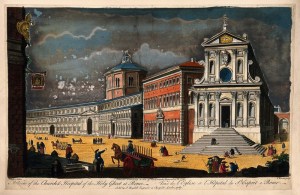


 Blurb:
 Author Bio
 When we think about the Norman Conquest, we often think about how it impacted England, Wales, and Scotland, but we tend to forget about Ireland. Early medieval Ireland do not get a whole lot of attention in historical fiction. That is, until Shauna Lawless’s Gael Song trilogy. Now, fifty years after the events of the original trilogy, Lawless has brought in a new cast of characters, as well as old characters, into the fight between the Descendants of the Tuatha De Danann and the Fomorians. When a child of prophecy is introduced into the mix that is said to be able to defeat the Fomorians, the race is on to protect the child or to kill her. Will the Descendants survive, or will the Fomorians torch the land and the Descendants’ hope? Shauna Lawless jumps back into this work with the Gael Song Era 2 book 1, “Daughter of the Otherworld.”
 Today, I am pleased to welcome Catherine Mathis to my blog to discuss Ines de Castro, the main protagonist of her novel, “Ines,” the first book in her Queens of Portugal trilogy. I would like to thank The Coffee Pot Book Club and Catherine Mathis for allowing me to participate in this blog tour.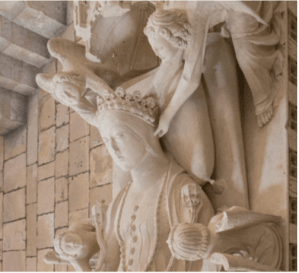
 Blurb:
  Author Bio
 Adventures of a Tudor Nerd