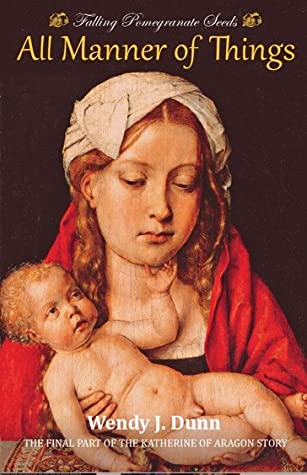
Book Review: “Falling Pomegranate Seeds: All Manner of Things” by Wendy J. Dunn

48815162._SY475_A journey to a foreign land for a long-promised marriage that will unite the royal families of Spain and England. Two friends caught in the middle far away from their beloved Spain. One is Princess Katherine of Aragon, who will marry Prince Arthur. The other is her cousin and close confidant, Maria de Salinas. Their journey like their friendship will last for decades, full of loyalty and love. Katherine’s story has been told many times in different ways, while Maria de Salinas has remained faithfully in the shadows. That is until now. In Wendy J. Dunn’s continuation of her Katherine of Aragon story, “Falling Pomegranate Seeds: All Manner of Things”, Maria de Salinas is the protagonist telling the tragic tale of love and heartache from her perspective.

I would like to thank Wendy J. Dunn for sending me a copy of her latest novel. I have heard wonderful things about Wendy’s novels from my friends. When I heard that Dunn was writing a novel about Maria de Salinas, I was intrigued by the concept. I only knew about Maria de Salinas through brief mentions of her in biographies and other novels about Katherine of Aragon, so I was excited to read her story.

Dunn’s novel begins as a letter that Maria de Salinas is writing to her only daughter. It is the story of her life with Katherine with the intention that her daughter understands the tough decisions that she made throughout her life and how unbelievably loyal she was to her queen, Katherine of Aragon. By having Maria recalling the story, Dunn adds another layer of depth to Katherine’s story. Maria knew Katherine her entire life so she knew how Katherine was feeling even when Katherine hid her emotions from the rest of the world. Her initial reactions to her new home, England. The love she had for Arthur and what happened on their wedding night. Katherine’s opinions of her father and her father-in-law. And of course, her tumultuous relationship with her second husband, Henry VIII.

Maria’s personal story is full of love and tragedy as well. Her love story with the man of her choice, who will be her husband, is gut-wrenching yet so beautiful. You will root for Maria to get her happily ever after. There were so many points in this book that I was on the brink of tears. I did not want this novel to end. Dunn created a protagonist with her own strength and a story that is nothing short of remarkable. The vivid descriptions that are in this work of art create a realistic Tudor world that you never want to leave.

This novel was a masterpiece in Tudor historical fiction. Maria’s story and how she helped Katherine of Aragon is riveting you will find yourself wanting to know more about Maria de Salinas. I wish we did have more of the relationship between Maria and her daughter, but that is because I wanted more of the tale. I have read many historical fiction novels about the Tudors and their world and I have to say this novel is one of the pinnacle Tudor novels that I have ever read. This is the first time that I have read a novel by Wendy Dunn, but now I want to read her other works. If you want a sensational novel centered around the astounding friendship of Maria de Salinas and Katherine of Aragon, “Falling Pomegranate Seeds: All Manner of Things” by Wendy J. Dunn is a must-read for any Tudor nerd.

Guest Post: “Between Two Kings: Book One in the Anne Boleyn Alternate History Trilogy” Q & A by Olivia Longueville

Today, I am pleased to welcome Olivia Longueville back to my blog to discuss her latest novel, “Between Two Kings: Book One in the Anne Boleyn Alternative History Trilogy”. 

B2K cover_page_jpgAuthor Q&A

Anne Boleyn has been featured in many books, movies, and television shows.  Her story has been told by writers many times.  How is your historical fiction series different?

In my first book, Between Two Kings, I re-imagined the life of Anne Boleyn, the second wife of King Henry VIII of England. When I think about Anne and her tragic fate, I want to rescue her from execution on trumped-up charges of adultery, high treason, and incest. Every time I visit the Tower of London, I see the place where she was executed, and I imagine that if I had been in the crowd watching her unjust death, I would have shouted, “Stop it! She is innocent!” 

As a result of my fascination with Anne and her tragic life, I decided to write an alternate history novel about her where she does not die on the 19th of May 1536.  Between Two Kings is part one of my exciting series that reimagines Anne Boleyn’s story in a unique way: having narrowly escaped her execution, she becomes the Queen of France.  In a sense, Anne follows in Eleanor of Aquitaine’s footsteps.  

My writing style is characterized by lush romanticism and passionate lyricism with beautiful and compact descriptions. In this series, I’m working to re-create the cultural atmosphere of the Renaissance and Tudor eras (my favorite periods!), giving my readers a strong sense of place to let them make the imaginative leap into these captivating times. 

This series will appeal to you because this story is about a one-of-a-kind medieval woman, who excelled in a man’s world, and whose fate has been transformed into something utterly spectacular.  Over the course of the novel, Anne emerges as a great Renaissance queen, whose indomitable nature refuses to surrender and enables her ascent to power again.  

Perfect for fans of Alison Weir, Philippa Gregory, Judith Arnopp, Laura Andersen, Tony Riches, and other Tudor authors, as well as fans of movies and shows of the Tudors. 

Are there sequels to Between Two Kings? 

In the second book, The Queen’s Revenge, Anne perseveres in her quest for justice and vengeance on the narcissistic, homicidal King Henry.  Her odyssey takes Anne from a world of gloom, across the barren landscape of ruin and the tempestuous waters of peril, to a realm of potential happiness in her marriage to the flamboyant, chivalrous King François.  Meanwhile, politics and disquieting intrigues abound… 

The later sequels explore deadly plots against Queen Anne and King François, including those of Anne’s Catholic enemies. The Valois couple struggle and intrigues against Emperor Charles V and King Henry VIII are woven into their story, for the English monarch will try to exact his own vengeance on his former wife. This culminates in a war of kings with unexpected participants. King Henry’s marriages to his historical wives have their own interpretation. Charles V’s union with Isabella of Portugal might not have an outcome as tragic as the one in history.

Beyond its theme of vengeance, The Queen’s Revenge is an optimistic tale of good triumphing over adversity and of Anne finding new love and building a life in France.  The third book, The Boleyn Queen of France, is the tale of Anne’s life in France after everyone in Europe learns the identity of the mysterious French queen. It also explores how she grows into her new role as a French queen. The political background of the story is organically embedded into the romantic and suspenseful storyline.   

Do any of the books in the series end in cliff-hangers? Are the books stand alone?  

I’ve structured the trilogy so that the books end with exciting, pivotal moments. I created a sense of completion in Between Two Kings. Although The Queen’s Revenge concludes the plotline of Anne’s vengeance, it includes a political cliff-hanger centering on themes that will be developed and resolved in the third book.  

Enough information is provided in every book, so a new reader will not be lost. 

What is important for writers to create a plausible alternate history reality? 

I love history because it shows how people lived in a completely different world. It reveals something new about the world, people, human evolution, traditions, and the way of life in different periods of time.  Nevertheless, I often wish to explore history from new angles and to re-imagine events or fates of my favorite historical figures. What if certain events had never happened or had occurred in a different way? 

It is a challenge to imagine and construct a plausible alternate history reality. You have to take real historical events and people, analyze them meticulously, and think how events could have unfolded differently, and how people would have responded to altered circumstances. If you like alternate history, you will definitely adore my alternate history universe. 

Many are aggrieved with the unjust end of Anne Boleyn’s life. She was most certainly innocent of all the accusations leveled against her, and our hearts weep at the thought of her last days in the Tower of London and how she lost everything, even her life. In my series, I’ve created an alternate universe for Anne that includes the Tudor, Valois, Habsburg, and even Medici storylines, combining them in a plausible way. 

I hope you will join me as we reimagine the fate of one of history’s most intriguing woman. 

Blurb

Anne Boleyn is imprisoned in the Tower of London on false charges of adultery, high treason, and incest on the orders of her husband, King Henry VIII of England. Providence intervenes – she escapes her destined tragedy and leaves England. Unexpectedly, she saves King François I of France, who offers her a foolhardy deal, and Anne secretly marries the French monarch.

With François’ aid, she seeks vengeance against the English king and all those who betrayed her and designed her downfall in England. Henry must face the deadly intrigues of his invisible enemies, while his marital happiness with his third queen, Jane Seymour, is lost and a dreadful tragedy also strikes the king. The course of English and French history hangs in the balance.

From the gloomy Tower of London to the opulent courts of England, France, and Italy, brimming with intrigue and danger – Anne Boleyn survives, becoming stronger and wiser, and fights to prove her innocence. Her hatred of Henry is inextricably woven into her existence.

If you are interested in “Between Two Kings”, you can purchase it either on Amazon or Amazon UK by clicking on the following links: 

https://bit.ly/Between2Kings

https://bit.ly/Between2Kings-UK

About the Author- Olivia Longueville

Olivia has always loved literature and fiction, and she is passionate about historical research, genealogy, and the arts.  She has several degrees in finance & general management from London Business School (LBS) and other universities.  At present, she helps her father run the family business.  

During her first trip to France at the age of ten, Olivia had a life-changing epiphany when she visited the magnificent Château de Fontainebleau and toured its library.  This truly transformed her life as she realized her passion for books and writing, foreshadowing her future career as a writer.  In childhood, she began writing stories and poems in different languages.  Loving writing more than anything else in her life, Olivia has resolved to devote her life to creating historical fiction novels.  She has a special interest in the history of France and England.  

Olivia’s social media profiles:

Personal website: http://www.olivialongueville.com/

Project website: http://www.angevinworld.com/

Twitter: @O_Longueville

Facebook: http://www.facebook.com/OliviaLongueville/

Tumblr: http://www.olivia-longueville.tumblr.com/

Book Review: “Betrayal” by Judith Arnopp, Cryssa Bazos, Anna Belfrage, Derek Birks, Helen Hollick, Amy Maroney, Alison Morton, Charlene Newcomb, Tony Riches, Mercedes Rochelle, Elizabeth St. John, and Annie Whitehead

In life, one of the hardest decisions that we must decide is who to trust. Who can we truly depend on to be by our side when times get rough or when they are going our way. Most of the time, we can rely on those who we put our trust in, but there are extraordinary times when our trust in someone is utterly shattered. Betrayal of one’s trust is like a knife in the back, it can be devastating no matter who is being betrayed. It is not a new concept in human nature to betray others. Whether for money, for power, or lust, betrayal can destroy the lives of everyone involved. Can there be redemption after betrayal? In this anthology of historical fiction tales, twelve authors explore every aspect of betrayal throughout history. This is “Betrayal” by the Historical Fictioneers.
I would like to thank the Historical Fictioneers for sending me a copy of this anthology to read and review. The Historical Fictioneers is a group of twelve historical fiction authors whose works span from early Roman ruled Brittania to the modern-day. The members of this illustrious group are Judith Arnopp, Cryssa Bazos, Anna Belfrage, Derek Birks, Helen Hollick, Amy Maroney, Alison Morton, Charlene Newcomb, Tony Riches, Mercedes Rochelle, Elizabeth St. John, and Annie Whitehead. When I heard about this project, I knew that I wanted to read this book, since this would be my first historical fiction anthology. I had read some of the authors who have written about the Tudors and the Wars of the Roses, but many of the authors in this group I had not had the pleasure of reading their works yet, so I was very excited to go on brand new historical adventures.

This anthology was a time-traveling delight, exploring numerous centuries from every possible angle. From early British history under Roman rule to 21st-century Italian history and everything in between, these twelve authors bring their respective periods and characters to life. What is particularly lovely is that these tales cover different positions in life. From knights and peasants to kings and noblewomen, and a few pirates for good measure. Each of these entries is a short sample of novels that each author has written. They are right in the middle of intense moments, which are tantalizing to read. For the authors that I have read before, it was like visiting old friends and for the authors that I had never read before, it was discovering new favorite stories that I might want to read soon.

I did not know what to expect with this book, since it was an anthology and a few of the stories were out of my comfort zone when it came to their eras. I found myself falling in love with these new characters and the new perspectives that these authors took. Each author showed betrayal and why someone betrayed someone else in a different light. From lust for power to greed, broken alliances, and romance, to downright treacherous acts.

Every snippet of a story was a smash hit, but collectively as a whole, this anthology was a triumph. To take twelve different tales that don’t have much in common and to join them in a common theme, such as betrayal, is extraordinary. I want more anthologies like this one by the Historical Fictioneers. This was a historical delight that will appeal to all history nerds. If you want a fabulous escape into different eras of the past, I highly recommend you read, “Betrayal” by Judith Arnopp, Cryssa Bazos, Anna Belfrage, Derek Birks, Helen Hollick, Amy Maroney, Alison Morton, Charlene Newcomb, Tony Riches, Mercedes Rochelle, Elizabeth St. John, and Annie Whitehead
.

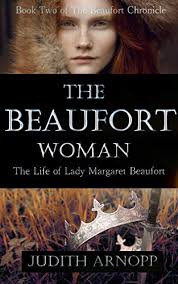
Book Review: “The Beaufort Woman: Book Two of The Beaufort Chronicle” by Judith Arnopp

download (3)A young woman separated from her only son as a war divides the nation that she dearly loves. The struggle between York and Lancaster, the Wars of the Roses, grows in intensity and the only hope for the Lancastrians is the son of Margaret Beaufort, Henry Tudor. To keep him safe, Margaret must allow him to go into hiding as she adapts to the court of Edward IV and his wife Elizabeth Woodville. Margaret’s journey through love, death, and court intrigue continues in Judith Arnopp’s second book in her Beaufort Chronicle, “The Beaufort Woman”.

As someone who is a fan of Margaret Beaufort and her life story, I have been finding myself enjoying The Beaufort Chronicle series by Judith Arnopp. Since I read the first book, “The Beaufort Bride”, I knew that I wanted to continue Margaret’s adventure.

We join Margaret as she is enjoying her third marriage to Sir Henry Stafford. This was probably her happiest and longest marriage, yet it is not elaborated on much. I think the way that Arnopp describes this relationship is thoughtful, considerate, and full of love. Obviously, like most relationships, there were hardships between Henry and Margaret, but Henry knew that what Margaret was doing was for her son. Life looks like it is going Margaret’s way, but then her husband Henry dies and she must make a difficult choice.

Margaret decides to choose her fourth and final husband, Thomas Stanley. Unlike her marriage to Henry, Margaret never really loved Thomas. Thomas was more of a tool to get her into the court of Edward IV to make sure her beloved son Henry could come home. When I have read Margaret’s biographies in the past, I have always wondered what life must have been like for her while she was in the court of her former enemies. To see her interacting with Elizabeth Woodville and her children was a delight and makes you wonder what life might have been like for Margaret if she had more children.

With the sudden death of King Edward IV in 1483 and the mysterious affair with his sons, Edward’s brother becomes King Richard III and fortune’s wheel takes another turn for Margaret. She must take dangerous steps to make sure that her beloved son can return home, even if it means risking her own. The amount of courage and patience that Margaret had was nothing short of extraordinary. You cannot help but admire Arnopp’s Margaret Beaufort.

I found this a thrilling second book to this stunning trilogy. Arnopp made Margaret Beaufort and her family even more relatable. I felt sympathy for Margaret as she had to make some extremely difficult decisions. I did know what was going to happen, but I still wanted to continue reading just to see how Arnopp would interpret the events in Margaret’s life. If you have read “The Beaufort Bride” and you want to continue the journey, you need to read “The Beaufort Woman” by Judith Arnopp.

Book Review: “Timeless Falcon- Volume One” by Phillipa Vincent- Connolly

53298476._SY475_Have you ever wondered what it would be like to travel into the past? You could interact with your favorite historical figures and truly understand what they were like. You could dine like a king or a commoner, dress to impress and experience everyday life. There would be risks involved, but any history nerd might jump at the chance to explore the past. One lucky history student named Beth Wickers discovers that a ring in her professor’s office allows her to travel back into the past to visit her favorite historical icon, Anne Boleyn. Can Beth help Anne to survive the dangerous Tudor court of Henry VIII? Follow Beth’s adventures in Tudor England in Phillipa Vincent-Connolly’s first historical fiction novel, “Timeless Falcon- Volume One”.

I would like to thank Phillipa Vincent-Connolly for sending me a copy of this book. I was a bit skeptical at first about a historical fiction novel that involved time travel, but it did sound intriguing so I decided to give it a try.

We are first introduced to Beth Wickers as she is experiencing a typical day at her university, studying and attending lectures by Professor Marshall. She finds herself going into Professor Marshall’s office where she finds an extraordinary ring that allows Beth to go back in time, to 1522. There, she finds herself in the colorful home of the Boleyn family, Hever Castle. It all seems like a fanciful dream, that is until Beth encounters the legend herself, Anne Boleyn.

While their first encounter is indeed memorable, I do have some concerns with it, especially when it comes to the time travel idea. My main concerns are that Beth mentions to Anne that she is from the future and she allows Anne to handle objects from the twenty-first century. This is probably me just being nit-picky, but as someone who is a fan of the idea of time travel, I do have issues when a character from one time period flat out says that they are from the future to someone from the past, not to mention allowing them to interact with objects from the future. My understanding is that with time travel, those from the future should be inconspicuous, but in this case, it does work.

Besides the logistics of time travel, I found this story rather enjoyable. It is a charming tale of when a 21st-century girl is thrown into the Tudor era. Her interactions with the past and how she copes with it all is thrilling as you wonder if she will ever get back to her own time and if she can help those who she holds dear. I love how Connolly creates two believable worlds and a protagonist who is so relatable. Beth’s interactions with her family and friends in her time paralleled the interactions with the Boleyn family. I loved how the Boleyns seemed like another family for Beth; Thomas Boleyn welcoming Beth into his home, kind Lady Boleyn, her complex relationship with the ever-charming George Boleyn, and her friendship with Anne that truly lasts centuries. We also see Beth interacting with other famous figures like Jane Parker, Mary Boleyn, Thomas Wolsey, Katherine of Aragon, and the big man himself, King Henry VIII.

I was not sure about this novel when I first read the description because of the time travel element, however, I think it was a delightful read. I think Beth was such a relatable heroine for so many fellow history nerds who would just want to protect their favorite historical figure from any harm. This book will make you question whether you would make the same decisions that Beth does and whether you can protect the integrity of the past. If you want a historical fiction novel about the Tudors that is fun and unlike any novel you have read before, check out, “Timeless Falcon- Volume One” by Phillipa Vincent-Connolly. I am looking forward to the next volume to see how far Beth will travel into the past.

Book Review: “Drake -Tudor Corsair” by Tony Riches

54845924._SY475_When we think of pirates, we tend to think of Caribbean pirates that are popular in fiction and in movies. They are swashbuckling rogues who are only looking out for themselves, booze, and treasure. We tend to think about the 1600s-1800s as the height of piracy on the open seas, but there were pirates that existed even earlier than that. In England, they were known as corsairs, and one of the best during the reign of Queen Elizabeth I was the suave and debonair Sir Francis Drake. Although he did circumnavigate the world and helped the English defeat the Spanish Armada, his story is rarely told in novels. That is until now. In the first book in his Elizabethan series, Tony Riches takes on the challenge to explore what Drake’s life was like and what kinds of adventures he took in order to protect his beloved homeland. This is Tony Riches’ latest novel, “Drake- Tudor Corsair”.
I would like to thank Tony Riches for sending me a copy of his latest novel. I have enjoyed Tony’s novels in the past and when I found out that he was doing an Elizabethan series and had a new book about Sir Francis Drake, I knew I wanted to read it. I did not know much about Sir Francis Drake and his adventures, except that he traveled the world and helped defeat the Spanish Armada before I read this book so I was excited to learn more.

We are introduced to Francis Drake when he is a young lad, dreaming of adventure and far away lands. He wants to sail the high seas, but things are not as picture-perfect as he imagined. He is involved in the slave trade, which is something that he comes to deplore later in life. Drake tries to think about the well-being of the slaves and will become friends with a former slave named Diego. However, Drake does contradict his own beliefs when it comes to slavery and taking someone’s life when his beloved country England is in danger from the Spanish, who he finds diabolical and does not mind attacking them whenever he discovers the location of their ships. This complex dynamic makes him more of a believable, three-dimensional character.

At the heart of this novel is the countless adventures Drake and his crew of corsairs partake in on different ships, including the famous The Golden Hind. As a connoisseur of Tony Riches’ novels, I know that he doesn’t do a ton of action sequences in his novel as he tends to focus on the relationships between characters, yet he is able to transport the reader into high action battle scenes where you wonder if Drake and his crew will survive. Since many Tudor novels tend to focus on England and Europe during the reign of this infamous dynasty, it is a breath of fresh air to explore the world with Drake and his men. Whether it is fighting the Spanish sailors or fighting indigenous people from far away lands, there is always a perilous adventure for Drake and his crew to embark on. What never changes is Drake’s faith and how his religious views are a constant comfort to his even when things become dire.

If I did have a small area of concern it would be that Riches does include modern names for locations and items found around the world so that modern readers would understand what is going on. I am not sure if the factual Francis Drake and his crew knew the names of these locations and mysterious objects while they were traveling or if the names came afterward.

Like any stellar novel by Tony Riches, he does focus on Drake’s relationships with the people who are closest to him. Drake was married to two different women, Mary and Elizabeth, and it is quite interesting to see how both women react differently to his life full of risk and danger on the high seas. Then there are his relationships in the Elizabethan court. Of course, there is his relationship with Queen Elizabeth I, since he is considered to be one of her favorites at court, yet it is not always smooth sailing for Drake. He also interacts quite a bit with William Cecil and Sir Francis Walsingham to make sure England is secure. Drake wants to be included in court life, but although he looks the part, he knows that he will never be one of the colorful courtiers.

Francis Drake has always been a side character, never the gallant corsair hero. Tony Riches has changed all of that. He has thrown open the doors to a colorful and treacherous world of the seas with his first book in the Elizabethan series. Drake is so real and raw. You can understand why he made the decisions that he did to protect his crew and his homeland. This is an absolutely captivating read that will bring the adventures of this distinguished Elizabethan corsair to life. If you want an enthralling Tudor historical fiction novel that takes you to places unknown and where there are dangers galore with a caring and charismatic hero at the heart of all of the adventures, I highly recommend you read Tony Riches’ latest novel, “Drake- Tudor Corsair”. A true triumph and a brilliant way to start a brand new series. I cannot wait for the second novel in this Elizabethan series.


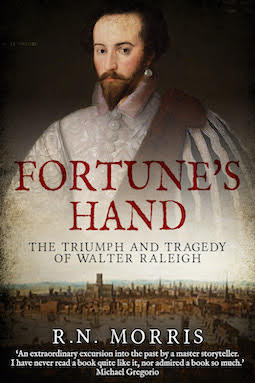
Guest Post: Walter Raleigh, The Self Made Myth- By R.N. Morris, author of Fortune’s Hand, a new novel about Walter Raleigh

unnamedI am not sure how I came to write a novel about Walter Raleigh. I think I can trace it back to visiting an exhibition on the myth of El Dorado at the British Museum in 2013. But thousands of people went to that exhibition and I dare say very few of them were foolish enough to start writing a 100,000 word novel under its influence. 

The dream of the fabled city of gold was one that obsessed Raleigh for decades. He pinned his political hopes on finding it and bringing home its treasure, first for Queen Elizabeth I, so that he could provide her with the funds she needed to defend herself against her great enemy Spain; and later for her successor James I, no longer at war with Spain, but still, like every sovereign in history, desperately short of finances.

In both instances, however, the dream proved to be illusory. 

Nonetheless, it was a dream that sustained him through periods of imprisonment and personal tragedy. A dream that he invested his reputation in, and one that he used to entice investors into his highly speculative voyages of discovery and predation. However, it surprised me to discover that Raleigh took part in surprisingly few of these voyages himself; he was an indifferent sailor who suffered badly from seasickness. 

Raleigh first heard about El Dorado from a captured conquistador called Pedro Sarmiento de Gamboa. It was just a rumour. A rumour carried on a warm breeze from a distant land. 

It seems ironic that a man who was so talented at creating his own mythology should fall victim to a myth. But perhaps that was why he was so drawn to the story, because he knew a great myth when he saw one, and understood more than most its power to inspire minds and influence behaviour. The myth of El Dorado was useful to Raleigh, not because he himself necessarily believed it to be true (there is evidence he didn’t) but because he knew that other men – and, most importantly, one woman – would. 

I fell under its spell too. 

When I started my research for the book, I knew very little about Walter Raleigh. The one thing I did know was the one thing that everyone knows: he spread his cloak across a puddle so that Elizabeth could walk across it without getting her feet wet. The more I progressed in my research, the less sure was I that this incident actually happened, at least not as it is depicted in countess children’s history books. 

It is a compelling idea imbued with meaning. There’s another word for compelling ideas imbued with meaning: myths. 

As a child, I thought the point of the story was simply to illustrate what a gentleman Raleigh was. Now I realize there was a bit more to it than that. Raleigh was positioning himself (to borrow a term from modern marketing) as the man who would safeguard his sovereign’s passage across a body of water. In other words, he would be the instigator of England’s colonial project on the other side of the Atlantic. 

Raleigh’s life seems to be filled with stories that, even if they fall short of mythical, have at the very least a strong whiff of the apocryphal about them. I don’t believe it’s an accident. Whatever else he was, Raleigh was a poet. His life was his greatest poem, even if it didn’t quite have the ending he might have planned.  

In my novel, I see him as a man of boundless imagination. There was nothing he could not envisage. And for him, imagining something was tantamount to accomplishing it. As he gets older, the lines between what he dreams and what he does blur. 

Of course, reality did not always play along. But that never seemed to deter him from putting even greater faith in the power of his imagination. 

This was the age of Dr John Dee, after all, the great conjuror of angels and demons. Raleigh consulted Dee on navigational matters as well astrological ones. You could say between them they conjured up the British Empire. 

In Fortune’s Hand, I imagine Raleigh reciting the names of the places in Guiana that lead to Manoa – the city identified with El Dorado – as if he is uttering the words of an incantation. He even uses this litany of exotic names to soothe Elizabeth when she is distressed. 

Raleigh wrote a long, unfinished epic poem in which Ocean addresses his love, Cynthia – AKA the moon. He was given the nickname ‘Water’ by Elizabeth, mocking his West Country pronunciation of his own name. He clearly identified himself with Ocean and Elizabeth with Cynthia, in other words he saw them both as mythic figures. I think it’s a very compelling image for their relationship. The moon is ever remote, changeable, presenting a cool, pale beauty. The ocean’s tides are subject to the lunar gravity, just as Raleigh was subject to Elizabeth’s commands, and whims. 

The problem with such self-mythologizing is that it tends to be self-aggrandizing too. And if you see yourself as a hero or a demi-god, it probably means you don’t have much empathy for others. Especially those who have to be defeated, displaced and destroyed to make your myth a reality. 

Empathy is not a quality much evident in the Raleigh of my novel. I said above that I saw him as a man of boundless imagination, but it is only boundless when it applies to himself and his interests. He has a curious imaginative blind spot when it comes to considering those whose interests are at odds with his, whether they are his rivals for Elizabeth’s favor, or the rebels he massacred in Ireland. 

That makes him a problematic figure in today’s world. But then, to be fair to Raleigh, he wasn’t living in today’s world. The attitudes and beliefs that were woven into the intellectual fabric of the Elizabethan age strike us now as at best baffling and at worst appalling. 

So why write a novel about this pre-eminent Elizabethan, at a time when others are petitioning to pull down his statue? The mythology that he created and others have added to has become entangled with England’s national story. I wanted to explore and try to understand the impulses that drove Raleigh through his remarkable life, in which he laid the groundwork for the British Empire. That is clearly a contested legacy now. To challenge and critique that legacy fully, I felt the need to confront one of its key originators – warts, myths and all. 

R.N. Morris Bio:

Roger (R. N.) Morris is the author of thirteen novels. The latest is Fortune’s Hand, a historical novel about Walter Raleigh.  He is also the author of the Silas Quinn series of historical crime novels and the St Petersburg Mysteries, featuring Porfiry Petrovich, the investigating magistrate from Crime and Punishment. 

His website is rogernmorris.co.uk. Roger has a Facebook page for his novels, which is https://www.facebook.com/RNMorrisauthor

He is on twitter as @rnmorris and on Instagram as rogermorris7988. He would love to hear from you so drop him an email at contact@rogernmorris.co.uk

Book Review: “Wolf Hall Companion” by Lauren Mackay

52659696 (1)One of the most popular Tudor historical fiction series in recent memory has revolved around the enigmatic Thomas Cromwell. Of course, I am talking about the famous Wolf Hall trilogy by Dame Hilary Mantel. As many dive into this monumental series, certain questions arise. How true is Mantel’s portrayal of Cromwell and the court of Henry VIII during some of the most tumultuous times of his reign? What was life like for those who lived in privilege during Henry VIII’s reign? How did Cromwell rise to the pinnacle of power and why did he fall spectacularly? In Dr. Lauren Mackay’s third book, she takes up the monumental task of explaining to readers what is fact and what is fiction in Mantel’s series. Her book is aptly titled “Wolf Hall Companion”. 

I would like to thank Batsford Books and Net Galley for allowing me the opportunity to read and review this book. I will admit that I have not yet read the Wolf Hall trilogy, but this book might have convinced me to take up the challenge and read the trilogy soon.

Mackay starts this delightful book by exploring Thomas Cromwell’s origins and what his family life was like. To uncover the truth about Cromwell’s life, Mackay relies heavily on the behemoth biography of Cromwell written by Diarmaid MacCulloch, which makes perfect sense. She also looks into the lives of those who either influenced Cromwell or were affected by Cromwell’s decisions. People like Anne Boleyn and the entire Boleyn family, Cardinal Wolsey,  Katherine of Aragon, Thomas Cranmer, Anne of Cleves, and Stephen Gardner just to name a few. Mackay balances how Mantel portrays these figures in her novels with the facts that we know about them and the events from numerous sources. 

Mackay also tackles the aspects of the Tudor court and life that adds another layer of details for readers. Things like important holidays, how Henry VIII’s court was structured,  gentlemanly activities and sports, and the Renaissance and the Reformation. It breathes new life into the Tudor dynasty and the people who lived during this time. 

Mackay’s challenge is how to write a book that is just as engaging for the readers as Mantel’s trilogy while still being educational and informative while incorporating her feelings about these novels. It is not an easy task, but Mackay can take on this task and write a gorgeous companion piece, with exquisite woodcut images to follow the story of Thomas Cromwell’s life, his rise to power, and his downfall.

I found this companion book a sheer delight. A combination of being well-researched, bite-size biographies, and gorgeous woodcut illustrations make this book an absolute treat for fans of Wolf Hall and the Tudor dynasty alike. The way Mackay describes Mantel’s writing style and how she created her characters may not be the way I envision them, but that is the great thing about historical fiction. It can challenge your views about a person while still being entertaining. I wish more historical fiction series had companion books like this one. If you are a fan of Hilary Mantel’s Wolf Hall trilogy or if you just love learning about the Tudor dynasty from a different point of view, you need to check out Lauren Mackay’s latest masterpiece, “Wolf Hall Companion”.

Book Series Review: The Matthew Shardlake Series by C.J. Sansom

Have you ever read a historical fiction series that made you stop and think that the plots of the books could be possible? They make you question the way you look at the past and wonder why no one had ever written a series like it before. You feel like you are friends with the protagonist and his pals and you despise the nefarious villains that try to thwart the efforts of the heroes. You feel like the books are true escapism and that you can visualize the world that the author has created using a combination of facts and fictional ideas.
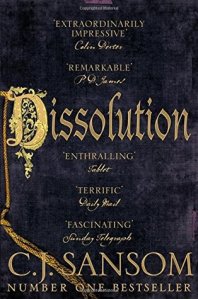
Now, I could be describing any number of historical fiction series, but this one, in particular, blew me away. If you have been following my blog or my page, you know that I am talking about the Matthew Shardlake series by C.J. Sansom. The books are all unique, yet read in the chronological order that Sansom intended, shows the amazing progress of England through the reign of the Tudors and how these changes affected those living during this time. We follow the hunch-back lawyer Matthew Shardlake on seven of his more infamous cases, each one more dangerous than the previous one: Dissolution, Dark Fire, Sovereign, Revelation, Heartstone, Lamentation, and Tombland.

Before I jumped into this series, I honestly had never heard of it, except when people mentioned these books in posts that I asked my followers what they are reading. I do not normally read murder mystery novels, but since it was based in the Tudor dynasty, I decided to give it a shot and I wholeheartedly loved it. I am so glad no one spoiled this series for me. I might fangirl a bit during this review, but I will try my best not to spoil this series for anyone else. I want to discuss the different elements of this series that I have comes to enjoy. I would love to continue to discuss this series with those of you who have read it and have enjoyed it as much as I have.

Characters

Matthew Shardlake

Matthew Shardlake is our main protagonist in this series, aptly named after him. As mentioned above, he is a hunch-back lawyer who works hard to solve mostly murder mysteries. He fights for what he believes is right, even when times get tough. There are sometimes when he is not even sure what he stands for, especially when it comes to his stance on religion and if he supports those in power. He is constantly the butt of everyone’s jokes and for the most part, they don’t bother him. He fights against notorious enemies while defending his friends and those who cannot defend themselves. Matthew is unlucky when it comes to love, but that does not mean that we can’t help but root for him to find his happily ever after. There were so many times that I was not sure Matthew was going to survive, but Sansom’s plan for his loveable protagonist throughout this series was simply brilliant. A protagonist who I will never forget.

Jack Barak

We are first introduced to Jack Barak in book two of the series, “Dark Fire”. He was a rogue working for the mighty Thomas Cromwell. He teams up with Shardlake for what seems like only one case, but the two men soon develop a lasting friendship, even when things get a bit rocky between them. In the third book, “Sovereign”, Jack is introduced to the love of his life, Tamasin. Their relationship will be tumultuous at times, but it is caring and it does survive the test of time. He is the bad boy turned family man that everyone loves. He does make stupid mistakes, but you cannot help but admire his tenacity.

Guy Malton

Next to Matthew Shardlake and Jack Barak, Guy Malton is probably one of my favorite characters. We are introduced to Guy when he was working in a monastery in “Dissolution”. Guy goes from a former monk to a well known and respected apothecary with his shop. He is unlike anyone who Matthew has ever met as he is a Moorish man turned Christian monk. I love the fact that Sansom went this direction to show how truly diverse the Tudor world was. Guy challenges Matthew when it comes to religion and what he believes is right when it comes to science. He is the wise old man that heals everyone’s wounds and is a comforting counsel when someone needs his help.

Nicholas Overton

Nicholas Overton is Matthew’s young assistant in the last two books, “Lamentation” and “Tombland”. He comes from a wealthy family, but when a disagreement happens, he goes to work for Matthew Shardlake. He is young and naive but loyal to a fault. He believes that everything should be handed to him on a silver platter until life gives him a rude awakening call. We don’t get to see him develop as a character as much as the others, but I hope if Sansom writes any more novels, he includes Nicholas Overton.

Historical Figures

Now, some characters are historical figures that make an appearance in the novels that left a lasting impression on me while I was reading. The calculating Thomas Cromwell, who was always trying to stay in his majesty’s favor and do his bidding until the bitter end. The dastardly Richard Rich, who I have always felt was a bit shady, but Sansom made me hate him even more. The legend himself, King Henry VIII, who is glittery and magnanimous to his people, but if you cross him, his true colors come out in full force. Catherine Parr, the scholar turned queen whose writings and her views on religious reform walk a fine line between what is acceptable and what is considered heretical. Elizabeth Tudor, the intellectual daughter of the king who has a similar temper to that of her father, but has a longing to help the Boleyn family in honor of her mother.

What is brilliant about Sansom’s series is that these historical figures are more background characters or they are villains. They are not the protagonists, as they are portrayed in other historical novels. The real heroes are the average people, reminding the reader that under all the glitz and glam of the Tudor court, there were regular men and women were trying to survive during such tumultuous times.

Cases

With such a remarkable cast of characters, Sansom had to put them through extremely difficult obstacles to test their limits and to give his readers a breathtaking look into the Tudor world. Whether it is the dissolution of a monastery, a race to find a mysterious flame, a radical killing based on the book of Revelation, or the sinking of the Mary Rose, Sansom takes us on a non-stop roller coaster of emotions. Just when you thought you had the case figured out, a monkey wrench is thrown into the mix and all of the sudden, our intrepid heroes are risking their lives because one of the villains knew that they were getting too close.

Since all of these novels revolve around murder mysteries, I think it is only right that we should discuss the murders themselves. In “Dissolution”, there is a typical advancement of murder to cover up the original crime. As the series progresses, you can see the wheels turning in Sansom’s head as he comes up with even more dastardly ways to kill off in his novels. There were points where I was starting to get concerned just from the graphic details of some of these deaths and executions. They will be engrained in my brain for a long time, which is a sign of how delightful Sansom’s writing style truly is, especially in this series.

The Details

As I mentioned before, what sets this series apart from others that I have read are those exquisite details. I think what helped is the fact that C.J. Sansom does have a Ph.D. in history, so he understands how important accurate facts are to historical fiction readers. The fact that Sansom decided to use his skills as a Doctor in History to write a Tudor historical fiction murder mystery series is awe-inspiring.

He was able to create a Tudor world that feels so real that you forget that you are reading novels. From scenic descriptions to the more gruesome accounts of horrific events, Sansom takes us on a trip to the past that we do not want to leave. We are craving more adventures after we finish every novel.

The Future

However, as I am writing this review, Tombland is the final book in the Shardlake series. C.J. Sansom is currently ill and I wish him nothing but the best in his recovery. These seven books make for a fabulous series, but Sansom has mentioned that he does wish for the series to go through the reign of Elizabeth I, which I would love.

As I was reading this series, I came up with some ideas for spin-off series to continue the adventures of Matthew Shardlake and his friends. For prequels, I was thinking that Sansom could either follow the adventures of Jack Barak working for Cromwell or Guy Malton as he learns how to be Moorish and a monk. Then there is the sequel, which I think would have Nicholas Overton as the protagonists and the children that we have seen grow up during this series. They could solve mysteries in the Elizabethan era into the Stewarts, bridging the gap between the two dynasties. I also think that if Sansom does write more novels with this cast of characters, it would be fun to explore other countries, in Europe or beyond, during the 15th and 16th centuries. I think it would expand the world for the readers and give them a taste of other royal dynasties and what else was going on in the world during the time of the Tudor dynasty in England.

Update: On Saturday, April 27, 2024, CJ Sansom died. Thank You CJ Sansom for sharing your passion for the past, especially the 16th century with The Matthew Shardlake series. Your stories have inspired countless historians and historical fiction writers, giving readers a historical escape for years.

Conclusion

I am so glad so many of you recommended that I should read this series. I would have never picked it up if it had not been for you. I now know why so many people love it. It is one of those series that you have to read from start to finish, even though each adventure is a treat by themselves. It is one of those series that I will reread soon so that I can visit Matthew Shardlake and his friends all over again.

I wanted to write this series review because the Shardlake series is easily becoming one of my favorite historical fiction series and I had a lot to say about it. I decided to leave major details of the individual novels out of this review so that those who are not familiar with these seven stunning, spellbinding novels can experience them for themselves without spoilers. If you do want to know how I feel about each book, I have included links to each of the reviews down below.

Dissolution:https://adventuresofatudornerd.com/2020/06/06/book-review-dissolution-by-c-j-sansom/

Dark Fire:https://adventuresofatudornerd.com/2020/06/20/book-review-dark-fire-by-c-j-sansom/

Sovereign: https://adventuresofatudornerd.com/2020/07/05/book-review-sovereign-by-c-j-sansom/

Revelation: https://adventuresofatudornerd.com/2020/07/21/book-review-revelation-by-c-j-sansom/

Heartstone: https://adventuresofatudornerd.com/2020/08/04/book-review-heartstone-by-c-j-sansom/

Lamentation: https://adventuresofatudornerd.com/2020/08/22/book-review-lamentation-by-c-j-sansom/

Tombland: https://adventuresofatudornerd.com/2020/09/21/book-review-tombland-by-c-j-sansom/

I want to leave the last part of this review for those who have read this remarkable series to discuss it. I know that is not a series that is often discussed, so I thought that you should have your say. What is your favorite book in the series and why? Who is your favorite character and why? Who is your favorite villain and why? Why do you enjoy this series?

Book Review: “Tombland” by C.J. Sansom

40095725._SY475_

The death of King Henry VIII has left his young son, Edward, as the new King of England. In 1549, Protestantism is on the rise and Lord Somerset is the Lord Protector for the young king. However, the people are not pleased with their treatment compared to the lifestyle of the gentry, causing many rebellions to sprout along the countryside. The mysterious death of a Boleyn relation of Lady Elizabeth has led Matthew Shardlake on a collision course with one of the major rebellions and to be reunited with an old friend, Jack Barak. Can Shardlake solve the mystery and find out where he truly belongs before time runs out? This is the scenario C.J. Sansom has chosen for his final, for now, book in the Shardlake series, “Tombland”.

To be honest, this was such a bittersweet read for me. I have grown to love Sansom’s writing style and his colorful cast of characters. I did not want to say goodbye. I savored every minute, even though it took me a bit longer to read than the other books in this amazing series.

We join Matthew Shardlake in his latest job, working for Lady Elizabeth when she gives him a new case to investigate. A distant relative of Elizabeth, one Edith Boleyn, has been found murdered and her ex-husband John Boleyn is accused of committing the heinous crime. We are introduced to John’s twin sons, who are the antithesis of charming, his curmudgeon of a father-in-law, and his much younger but devoted second wife. While Shardlake and Nicholas Overton dive into this case, they have the great pleasure of meeting up with everyone’s favorite rogue turned family man, Jack Barak, who is now working for the Assizes in Norwich.

As things heat up with this brand new case, Shardlake, Overton, and Barak are swept into a rebellion camp, led by the infamous yeoman Robert Kett. This is where this book truly shines. For many of us who study the Tudors, rebellions like Kett’s rebellion are just events that are briefly mentioned. Sansom dives into the life of the rebels in the camps to explore what it was like. How they were organized. How they were trained to fight. What they stood for and where they stood on religious issues. I never really considered the feelings of the rebels, but Sansom made me sympathetic to their cause and I understood why Shardlake and Barak found the rebellion so appealing.

It did feel like the murder case and the rebel storylines were two separate plots, but Sansom was able to masterfully combine the two to create a thrilling conclusion to this delightful series. If I did have a problem with this particular title it would be that the pace was a bit slower than the other books in the series. I was wondering if Shardlake was ever going to solve the Boleyn mystery, but of course, he does spectacularly.

There is always a concern with a fabulous series with how the author will end it. Will it satisfy the readers and their expectations. I can’t speak for every Shardlake fan, but I was thoroughly engrossed with this series and the ending was perfection. If this is indeed the last Shardlake adventure, it was truly a ride I will never forget. If you are a Shardlake fan or you want a remarkable novel about the Kett’s rebellion, “Tombland” by C.J. Sansom is the book for you. A truly mesmerizing culmination for a dazzling series.