
Book Review: “The Pillars of the Earth” by Ken Follett

91wIRMJzYSLWhen one thinks about epic tales stories of adventures and romance tend to come to mind. One hardly thinks about the construction of a magnificent building as an “epic tale” with monks and builders as the main characters. We see cathedrals as these massive buildings from the past used as churches, but we rarely think about how they were constructed and why. Who were the people who decided to make these spectacular buildings and what might have their lives have been like? These are just some of the questions that Ken Follett wanted to try and answer in his monumental historical fiction masterpiece, “The Pillars of the Earth”.

Ken Follett is known worldwide as an author of spy thrillers, but for decades the story of a 12th-century cathedral in a town called Kingsbridge and the people who helped build it was always in the back of his mind. In 1989, he decided to take a risk and publish his first ever historical fiction novel. To say the book was a sensation would be an understatement. In the 25th anniversary edition of this wonderful novel, Follett explores why he thinks this particular story made such a splash:

Many times in the last twenty-five years, I have been asked why “Pillars” has had such a big impact. There’s no simple answer, because a novel is so complex. But I come back again and again to the people who built the cathedrals. Those men and women were, by modern standards, poor and ignorant. They lived in wooden huts and slept on the floor. Yet they created the most beautiful and awesome buildings the world has ever known. Human beings have the capacity to rise above mundane circumstances and touch the eternal. This is what “Pillars” is about, and, in the end, I think that may be why it has so profoundly touched the hearts of so many readers for so many years. (Follett, xxii).

Follett introduces his readers to the world of 12th-century Kingsbridge, England with the execution of a thief. Compared to the rest of the story this prologue seems a bit odd since it happened over a decade before the actual story begins, but Follett was able to use the details of the prologue throughout the entire novel. Twelve years after the execution, we are introduced to Tom Builder and his family as they struggle to survive after he was fired from a building job for William Hamleigh, who was dumped by Lady Aliena. Tom’s life is turned upside down when his wife Agnes dies giving birth to a son and he falls in love with a woman named Ellen, who is the mother of Jack Jackson. Meanwhile, we are introduced to Prior Philip, a man who wants to reform Kingsbridge Priory. Tom and Philip both have a dream of making a wonderful cathedral in Kingsbridge.

This is the story of the building of Kingsbridge Cathedral, but it is also a story of those who lived in Kingsbridge. It is about their triumphs and tragedies. It is about family and love, revenge and heartache. There were some very dramatic scenes that shocked me, however, I believe Follett used these scenes to grow his characters to be strong; physically, mentally and emotionally. Follett may not be a spiritual man, but he was able to capture the spirituality of the age through Prior Philip and the struggle between the church and the state through the building of the cathedral. The cast of characters, both good and bad, are very well-rounded and complex and you really want to know what will happen to them by the end of the story.

I usually read books about the Wars of the Roses and the Tudor dynasty, but I decided to take a chance and read the Kingsbridge series because I heard amazing things about this series. I did have to remind myself about Queen Maud, King Stephen, King  Henry II, and Thomas Becket since I don’t study this time period often. Follett was able to make the 12th-century to come alive. I did not want to stop reading this book. I absolutely loved the story, the scenery, the amount of details and the colorful cast of characters. This was a huge risk for Follett to jump into the world of historical fiction, but it paid off extremely well. “The Pillars of the Earth” by Ken Follett is a stunning masterpiece and I highly recommend it to anyone who really enjoys a thrilling historical fiction novel.
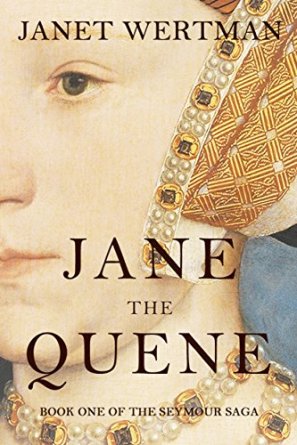
Book Review: “Jane the Quene” by Janet Wertman

513yHRNsuFLHenry VIII may have had six wives, but only one could give him the desired son that he wanted. She was kind, demure and everything that Henry VIII’s second wife Anne Boleyn was not. Her name was Jane Seymour, Henry’s third wife. Sadly, she is often remembered for the birth of her son and her death. However, there was a lot more to Jane’s story than the ending. What was her relationship with her family like? How did she fall in love with the King? And how was her relationship with her romantic rival, Anne Boleyn? These are just some of the questions that Janet Wertman strives to answer in her first novel of her new Seymour Saga called, “Jane the Quene”.

I would like to thank Janet Wertman for sending me a copy of “Jane the Quene”. This was a delightful read and a fantastic start to the Seymour Saga.

Wertman begins her book with a prologue of Jane Seymour entering the services of Henry’s first wife Catherine of Aragon. In this opening scene, we begin to see a rivalry bloom between Jane and her cousins Anne and Mary Boleyn. After Catherine and Henry divorce, Anne Boleyn becomes Queen and Jane Seymour is in the services of the new queen, hoping to help and serve while looking for a husband. Her brother Edward does not think that having Jane in court is really working to help her find a husband. He wants to send her home so that her younger sister can possibly find a husband, but things change when King Henry VIII and Anne Boleyn visit Wolf Hall. Wertman description of how the king and Jane become friends during this visit is rather charming and very natural. Jane tries to ignore the king’s interest in her, but Henry can’t forget the kind and demure nature of Jane and eventually, the two fall in love, even though Henry is still married to Anne.

In the middle of this tangled love mess is Thomas Cromwell, a clerk who wants to please his king in order to make his own career grow. Henry is not happy with his marriage to Anne Boleyn since she has not been able to give him  a son, so he gives Cromwell the task of “getting rid of her”. However, Cromwell needs to find another wife who would be the opposite of Anne Boleyn. That is when he comes up with a plan to make Jane Seymour Henry’s next wife and queen, which does succeed.  

Wertman’s Jane Seymour is a complex character who cares about her family and her husband. She is not just some plain wallflower who merely followed Anne Boleyn as Henry’s wife for a short time. With strong allies, like Cromwell and her brothers Edward and Thomas, Jane rises like a phoenix and survives all of the hate from Anne to become Henry’s beloved wife and queen. Wertman portrays Henry VIII as a man who is intelligent, caring and who struggles with how to reform the church.

Wertman breathes new life into the story of Jane Seymour. I thoroughly enjoyed reading this novel, which is the first book in her Seymour Saga, as it balances the political intrigue of the Tudor court with the romance between Henry and Jane. Their love story is one that is often forgotten in the chaos of Henry’s marriage track record, but one that needs to be told. Jane will not be just the “third wife” or “the mother of Edward VI” after this book. She was a strong woman who truly loved Henry VIII.  If you really want to read a novel about Jane Seymour, I highly recommend you read “Jane the Quene” by Janet Wertman.

Book Review: “Wars of the Roses: Trinity” by Conn Iggulden

61793uzwgql._sx324_bo12c2042c2032c200_England is on the brink of civil war. Families with royal blood in their veins are fighting amongst each other as King Henry VI has fallen ill.  Mistrust runs rampant and sacrifices are made in order to gain the throne. This is the England of 1454 and the beginning of the period in English history that we know today as the Wars of the Roses. Families like the Nevilles,  the Percys, and the houses of York, Lancaster, and Tudor would gain fame and infamy during this time. Conn Iggulden decided to explore this tumultuous time after the Jack Cade rebellion, which he explored in his first book “Stormbird”, in the second book of his “Wars of the Roses” series called “Trinity”.
Many who study the Wars of the Roses believe that it started in 1455 with the First Battle of St. Albans. However, Conn Iggulden begins “Trinity” with a conflict between the Percys and the Nevilles, which is known as the Battle of Heworth Moor. Iggulden explains why he chose this point to begin his story in his Historical Note:

The ambush by some seven hundred Percy retainers and servants on the Neville wedding party took place a little earlier than I have it here, in August 1453- around the same time King Henry VI fell into his senseless state. It was a key event among years of low-level fighting between the families as they struggled to control the north and widen their holdings. That attack by Thomas Percy, Baron Egremont, was one of the most brutal actions in that private war, sparked by the marriage of Salisbury’s son to the niece of Ralph Cromwell, a union which placed estates claimed by the Percy family into Neville hands. The ‘Battle of Heworth Moor’ failed in its main aim of slaughtering Richard Neville, Earl of Salisbury. I have not included a dozen minor skirmishes, but that feud played a key part in deciding where the Nevilles and the Percys stood in the first battle of St. Albans in 1455- and its outcome. (Iggulden, 463).

The Battle of Heworth Moor is a unique place to start. We are thrust into the middle of the Percy family’s feud with the Nevilles. The plan is to attack the Nevilles during a wedding, but the Percys fail. It would not be a wedding that either family would forget for a long time. The Percy family decides to side with the Lancasters and the King, while the Nevilles side with the Yorkist cause. In the beginning, the Wars of the Roses was nothing but feuds between families to determine who should be taking care of the sick King Henry VI. Iggulden describes Henry VI in a way that shows the King as weak in body but his mind is sharp. When he wakes from his first bout of illness, he dismisses Richard Duke of York from being Lord Protector and reverses everything that  Richard did.

Richard and the Yorkist cause are not upset with the king, but rather those who they believe are responsible for being in control of the king; Queen Margaret of Anjou, the Duke of Somerset and the Nevilles. Anger boils until it bursts at the First Battle of St. Albans in 1455. This battle was so pivotal in the evolution of the conflict that Iggulden goes into great detail to explain how the battle unfolded. The Yorkist cause may have one the “first” battle of the Wars of the Roses, but it ignited a flame inside of Margaret of Anjou to not only protect her son and her husband but to also completely destroy Richard Duke of York. As the story progresses, we see both sides working hard to gain control of the king in a more complex version of “capture the king”.

Conn Iggulden delivers a high action and extremely descriptive sequel to “Stormbird” with “Trinity”. He incorporates beloved characters from the previous novel, like Margaret of Anjou and the charismatic Derry Brewer, with new faces like the Tudors, Thomas Percy Baron Egremont, Warwick, Richard Duke of York and his eldest son Edmund Earl of Rutland. Iggulden transports the reader to this volatile time in English history. This book is so engaging and it keeps the reader wanting more, so he included a side story that is equally entertaining. Once again, Iggulden makes the Wars of the Roses and all of its intrigue come alive. If you were a fan of Conn Iggulden’s first book in the “Wars of the Roses” series “Stormbird”, I strongly encourage you to read “Trinity”.   

Guest Post by Tony Riches – Telling the Stories of the Tudors

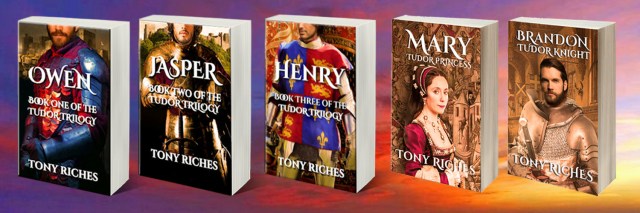
tudor books

It began with my research for a novel about the life of Henry Tudor, who like me was born in the Welsh town of Pembroke. I decided to write it as an historical fiction novel in the hope of reaching a wider audience, including those who might never read a textbook about the Tudors. I also enjoy the challenge of ‘filling the gaps’ in the historical record and bringing these men and women to life.

I’d collected more than enough material for a book – and discovered that although Henry features (with varying degrees of accuracy) in many works of fiction, there were no novels devoted to telling his amazing story. I believe this was partly because Henry had been labelled as dull and miserly, when in fact he was an extravagant gambler, who spent a fortune on clothes, knew how to broker peace and brought an end to the Wars of the Roses.

I also discovered there were no novels about Henry’s Welsh grandfather, Owen Tudor, or Owen’s son, Jasper Tudor, who helped Henry become king. The Tudor trilogy provided the perfect ‘vehicle’ for Henry to be born in the first book, ‘come of age’ in the second and become King of England in the third.

I’m pleased to say the books of the Tudor trilogy became best sellers in the US, UK, and Australia, with the final book being the only historical fiction novel shortlisted for the Amazon Kindle Storyteller award. (Henry was a runner up but I won a Kindle Oasis and a bottle of good Champagne.)

The challenge I then faced was how to follow a successful trilogy. I’d enjoyed developing the character of Henry’s daughter, Mary Tudor, and realized the story of how she became Queen of France is little known. (In the TV series ‘The Tudors’ Mary was ‘merged’ with her sister Margaret – and some people understandably confuse her with her brother’s daughter, also Mary Tudor.)

I wrote Mary – Tudor Princess, which become my best-selling book last year, then followed up with my latest book, Brandon – Tudor Knight. Readers are probably familiar with Charles Brandon’s story of how he risked everything to marry Mary Tudor against the wishes of her vengeful brother, Henry VIII. What they might not know is how Brandon found himself seriously out of his depth fighting Henry’s wars in France, or that after Mary’s death he married his fourteen-year-old ward, wealthy heiress Lady Katherine Willoughby.

Now I have two ‘sequels’ to the Tudor Trilogy, with the five books forming a series providing a continuous narrative throughout the reign of the two King Henrys. Where to go next?  All the books are now available as audiobooks and are being translated into Spanish and Italian. I’ve also been recording podcasts about the stories of the Tudors each month, (see https://tonyriches.podbean.com/.)  

I’m now enjoying researching and writing the amazing story of what became of Katherine (Willoughby) Brandon after the death of Charles. Her story deserves to be told – and leads right up to the coronation of Queen Elizabeth I and my planned next series, which will explore the fascinating world of the Elizabethan Tudors.


Tony Riches
image1

About the Author

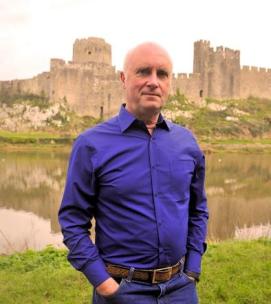
Tony Riches is a full-time UK author of best-selling historical fiction. He lives in image2Pembrokeshire, West Wales and is a specialist in the history of the Wars of the Roses and the lives of the early Tudors. For more information about Tony’s books please visit his website tonyriches.com and his popular blog, The Writing Desk and find him on  Facebook and Twitter @tonyriches
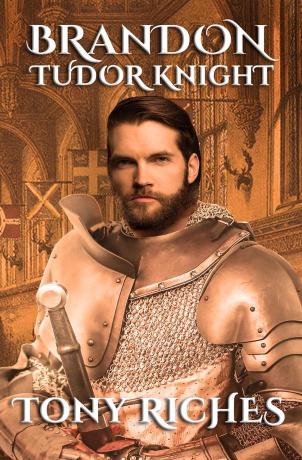


Brandon – Tudor Knightimage3

By Tony Riches

New on Amazon UK and Amazon US


From the author of the international bestselling Tudor Trilogy comes a true story of adventure, courtly love and chivalric loyalty. 

Handsome, charismatic and a champion jouster, Sir Charles Brandon is the epitome of a Tudor Knight. A favourite of King Henry VIII, Brandon has a secret. He has fallen in love with Henry’s sister, Mary Tudor, the beautiful widowed Queen of France, and risks everything to marry her without the King’s consent.

Brandon becomes Duke of Suffolk, but his loyalty is tested fighting Henry’s wars in France. Mary’s public support for Queen Catherine of Aragon brings Brandon into dangerous conflict with the ambitious Boleyn family and the king’s new right-hand man, Thomas Cromwell. 

Torn between duty to his family and loyalty to the king, Brandon faces an impossible decision: can he accept Anne Boleyn as his new queen? 


Book Review: “A Column of Fire” by Ken Follett

9780451477996_p0_v1_s550x406After the death of Henry VIII and Edward VI, there was an explosion of religious intolerance, not just in England, but in Europe as a whole. Many believe that it was Mary I “Bloody Mary” who really started this trend, however, the fires of hatred between Protestants and Catholics extended further into the reigns of Elizabeth I and James I of England. We often focus on the monarchs and their inner circles during this time and how the religious persecutions affected the decisions that they made. That tells only part of the story, but how did this religious fighting between Protestants and Catholics affect the normal person? What were their lives like? Ken Follett explores this topic in his third book in his historical fiction series, the  Kingsbridge Series, “A Column of Fire”.

Every historical fiction book needs a great opening to engage the reader and Ken Follett delivers with his prologue:

We hanged him in front of Kingsbridge Cathedral. It is the usual place for executions. After all, if you can’t kill a man in front of God’s face you probably shouldn’t kill him at all. The sheriff brought him up from the dungeon below the guildhall, hands tied behind his back. He walked upright, his pale face defiant, fearless. The crowd jeered at him and cursed him. He seemed not to see them. But he saw me. Our eyes met, and in that momentary exchange of looks, there was a lifetime. I was responsible for his death, and he knew it. I had been hunting him for decades. He was a bomber who would have killed half the rulers of our country, including most of the royal family, all in one act of bloodthirsty savagery- if I had not stopped him. I have spent my life tracking such would-be murderers, and a lot of them have been executed- not just hanged but drawn and quartered, the more terrible death reserved for the worst offenders. Yes, I have done this many times: watched a man die knowing that I, more than anyone else, had brought him to his just but dreadful punishment. I did it for my country, which is dear to me; for my sovereign, whom I serve; and for something else, a principle, the belief that a person has the right to make up his own mind about God. He was the last of many men I sent to hell, but he made me think of the first…”(Follett, prologue).

This story follows the lives of several different people and their families, but the main story focuses on a man named Ned Willard. After he can’t marry the girl he loves, Margery Fitzgerald,  and his family is crushed by bad investments, he decides to work for a young Elizabeth Tudor, who would later become Elizabeth I. His works will lead him all over England and Europe to help thwart plots to kill Elizabeth and replace her with a Catholic ruler. One of his biggest opponents is the elusive Jean Langlais, a man who works in the shadows, yet he is closer than Ned thinks.

What Follett does so well is that he incorporates people from other countries into this story. Sylvie Palot from France, the young Protestant bookseller, who is not afraid to sell Bibles to those who wish to own a Bible. Pierre Aumande, the man who will do anything in order to gain power. Alison McKay, the fictitious best friend of Mary Queen of Scots, who would do anything for her queen. Ebrima Dabo, a slave who will do anything to be free. Barney Willard, Ned’s brother, who wants nothing in life, except to sail the high seas looking for adventure.

Follett’s cast of original characters adds a depth to an already tumultuous time in European history. Follett is able to blend the fictitious characters with real historical figures and actual events like the St. Bartholomew’s Day Massacre, the death of Mary Queen of Scots, and the Spanish Armada.

This is my first book by Ken Follett and I have to say I thoroughly enjoyed it. There were so many twists and turns in this story that I was not expecting that I really could not stop reading this book. I found it rather engaging and exciting. I found it interesting that Follett decided to end the book during the reign of James I and that he called King Philip II of Spain by his other less common Spanish name Felipe. These are more stylistic choices instead of historical choices.

Overall as a historical fiction book about the religious persecution in the Elizabethan era, I found this book dynamic and thrilling. Although this is the third book in a series, I believe it can stand on its own.  After reading this book, I really want to go back and read the first two books of the series. If you want a great historical fiction book that you can easily get lost in, I enthusiastically recommend you read “A Column of Fire” by Ken Follett.

Book Review: “First of the Tudors” by Joanna Hickson

30646371Historical fiction has always been a genre that I have had a love/hate relationship with. I was a big fan of the genre for a while and I would read every book I could get my hands on about the Tudors, but then I realized that what the authors were writing was not always true to the historical facts. As I moved away from the fictional genre into the historically academic genre, I found myself looking at historical fiction with a more critical lens. Historical fiction became less entertaining for me the more I learned about the people behind the stories. I told myself that I was not going to read another historical fiction book because they were not historically accurate. That was until I read “ First of the Tudors” by Joanna Hickson.

Now when I read the title of this book, my first thought was that it was either going to be about Owen Tudor and how he met Catherine of Valois or Henry Tudor and about how he came to the throne. While both were mentioned in this book, the true hero of “The First of the Tudors” is Jasper Tudor, the son of Owen Tudor and the uncle of Henry Tudor. To me, Jasper Tudor was always the unsung hero of the Tudor dynasty. I mean he kept Henry safe for all those years in exile while his mother Margaret Beaufort was working on a political solution to keep her son safe. He was an outlaw and in a sense a kingmaker.

However, Joanna Hickson decided to add her own twist to the story. In records of the nursery of Henry VIII, Margaret Beaufort brought in a woman named Jane Hywel to take care of the royal children. It would seem very odd that Margaret Beaufort would bring a woman of unknown origins into her son’s household to take care of his children, so how did Margaret know about Jane? In this book, Hickson puts out the idea that Jane was a cousin of Jasper and that he was the one who brought Jane into Margaret’s household to help with the birth of Henry Tudor and to help raise him.  Of course being historical fiction, there is an element of romance between Jasper and Jane that stretches throughout the entire first half of the Wars of the Roses (1455-1470).

Even though Jasper Tudor did marry Catherine Woodville in 1485, I found that the idea of Jasper having a wife or at least a mistress before this marriage a possibility. The idea of Jane adds a different level of intrigue to Jasper’s life, one that many might not expect; that while he was in exile and was fighting for his king and his nephew that he fell in love.

Hickson does an excellent job to navigate the intriguing details of Jasper’s life, both real and fictional. I found myself not caring about the historical facts as much with this book. I couldn’t put this book down. Hickson literally transported me into the world of Jasper and Jane with how she wrote this book. There was a lot of drama and romance mixed with historical facts that kept me wanting more. This was a page turner for sure. It made me re-evaluate reading more historical fiction in the future.  If you want a good historical fiction book about Jasper Tudor and his role in the Wars of the Roses, I highly recommend “ First of the Tudors” by Joanna Hickson.