
Today, I would like to welcome Olivia Longueville and J.C. Plummer to discuss their latest book, Robin Hood’s Widow (Book Two in the Robin Hood Trilogy).

Robin Hood has been featured in many books, movies, and television shows. How is your trilogy different?
We have taken a fresh approach to the Robin Hood story, and we’re excited to share our vision with fans of the legendary hero.
In our first book, Robin Hood’s Dawn, we re-imagined the origins of the Robin Hood legend, which included exploring his family dynamics: an aloof, selfish father, and a kind-hearted mother devoted to ministering to the poor. One theme is how the consequences of immoral actions and secret sins can reverberate across generations. This is part of Robin’s legacy from his father.
We cast Robin as a hero fighting against the tyranny of a lawless government official. When Robin is falsely accused of a shocking crime by the new Sheriff of Nottingham, he could have retreated to a safe place beyond the reach of the sheriff. However, he feels a responsibility to the people because he believes in the intrinsic value of every human being. Instead of running away, he stays to protect the people from the sheriff. And this points to another theme: one person can make a difference by taking a stand for what is right.
The second book, Robin Hood’s Widow, picks up where the first book ends. Robin is alive and still with King Richard in the Holy Land, but Marian, the sheriff, and Guy of Gisborne have returned to England thinking that Robin Hood is dead.
Robin Hood’s Widow explores themes of grief and redemption while featuring Marian’s adventures as leader of the outlaws. Her story is interwoven with Robin’s quest to return home while fulfilling his obligations to King Richard.
In this book, we wanted to explore both the stages of grief and their non-linear nature. Experiencing loss and grief is not like climbing stairs; you don’t complete one stage, progress to the next, and eventually arrive at acceptance. The emotional turmoil of an earlier stage can reappear and reassert itself during the process.
That being said, this story is not sad or depressing; Robin Hood’s Widow is an optimistic tale of triumphing over adversity.
You’ve emphasized how your Robin Hood story has been re-imagined. Will fans of the traditional ballads still recognize this as a Robin Hood story?
There is a lot of variety in the many books and screen adaptations of the Robin Hood legend. We wanted to create a story that was respectful towards fans of the original ballads and legends without adhering to the same storylines that have been previously written. We hope that all Robin Hood fans will enjoy this fresh retelling of the story.
However, we felt that Marian is a character who deserves more attention. All too often she is a background character with little to do. With this in mind, we have focused on creating a Lady Marian who will figure more prominently in the story, especially in Robin Hood’s Widow, where she takes center stage as the leader of the outlaws. She must learn how to lead while finding clever ways to thwart the sheriff and rob those supporters of Prince John who dare enter Sherwood Forest. We also wanted Marian to be feminine and believable as a woman of the 12th century.
Robin Hood’s Dawn introduced many familiar characters from the Robin Hood legends: Maid Marian, Little John, Allan-a-dale, Will Scarlet, Much the Miller’s son, Guy of Gisborne, and the Sheriff of Nottingham. In Robin Hood’s Widow, Brother Tuck, a Knight Templar, will join the outlaws.
Readers will also meet real historical figures such as Richard the Lionheart, King Philippe II of France, Prince John “the Lackland,” Eleanor of Aquitaine, and many others, including Ranulphus Besace. Who was he? Well, he was a real person who was King Richard’s personal physician!
Do the first two books of the trilogy end in cliff-hangers? Are the books stand alone?
We have structured the trilogy so that the books do not end in cliff-hangers, and we have endeavored to create a sense of completion in each of the books.
Although we want readers to start with Robin Hood’s Dawn, we know that some might be more interested in Robin Hood’s Widow. Therefore, we have endeavored to provide enough information in the second book so that a new reader will not be lost.
Both Robin and Marian are guarding secrets that will be revealed in Robin Hood’s Widow!
How did each of you become interested in writing this story and working together as co-authors?
Olivia:
I love to tell stories with multi-dimensional characters. I speak several languages, and I enjoy writing stories in different languages. My favorite legendary hero is Robin Hood, and my favorite historical figure is Anne Boleyn. My first novel is an English-language alternate history featuring Anne Boleyn.
The story of Robin Hood’s Widow is very special to me, and I wrote the original version after I experienced a devastating personal loss. Readers might be surprised to learn that Robin Hood’s Widow was written before Robin Hood’s Dawn!
I met Coleen (J.C.) on the Internet, and we decided to co-author a Robin Hood Trilogy with Robin Hood’s Widow as its centerpiece.
It is amazing that we have accomplished so much even though we have never met each other in real life. We talk on the phone and frequently exchange Skype messages and emails. We have been working together long-distance despite living in very different time zones.
Coleen (J.C.)
I had previously done editing work for other authors, and in 2015, I was inspired to create my own stories.
I wanted to write a book that would honor the legend of Robin Hood as a man who stood against the tyranny of a powerful government official; a man who fought for justice and fairness because he recognized the intrinsic value rooted in the humanity of all people.
So, you’ve never met, you come from different countries, different cultures, and speak different languages. How can you co-author a book? Is it because you have similar writing styles?
Coleen:
Fortunately, Olivia is fluent in English, because that’s the only language I know!
Olivia:
We have found that we have a lot in common—especially our love of writing and of history. We have to work hard to merge our writing styles, but we have successfully done this.
Coleen:
That’s true. Olivia and I have very different “voices” and writing styles. You might even say they are nearly opposite styles.
I write in a straightforward, expository style, with a minimum of descriptive elements and metaphorical flourishes. I am good at explaining things, organizing ideas, and creating natural-sounding dialogue.
Olivia:
My writing is characterized by lush romanticism and passionate lyricism. I love to create metaphors and descriptions which excite the imagination of the reader in a vivid and dramatic way.
Coleen:
In some respects, Olivia’s words are the emotional heart of the story, and my words represent the rational intellect. Of course, it’s not quite that cut-and-dried, but it is one way to describe how two people with such different styles have come together to create Robin Hood’s Dawn and Robin Hood’s Widow.
Robin Hood’s Dawn (The Robin Hood Trilogy Book 1)
England, 1154-1194
A kingdom under assault.
A conspiracy born of anarchy.
A hero standing against tyranny.
Falsely convicted of a shocking crime, Robin Fitzooth, the Earl of Huntingdon, finds refuge in Sherwood Forest and becomes Robin Hood. Leading a band of men against the injustices of a malevolent sheriff and his henchmen, Robin begins to unravel a web of treachery threatening the English royal family.
As shadowy forces gather to destroy the future of a nation, Robin faces deceit, betrayal, and the ravages of war as he defends his king, his country, his people, and the woman he loves from a conspiracy so diabolical, so unexpected, that the course of history hangs in the balance.
From the mists of an ancient woodland to lavish royal courts teeming with intrigue, to the exotic shores of the Holy Land—Robin Hood leads the fight in a battle between good and evil, justice and tyranny, the future and the past.
Part one of an exciting three-part retelling of the Robin Hood legend!
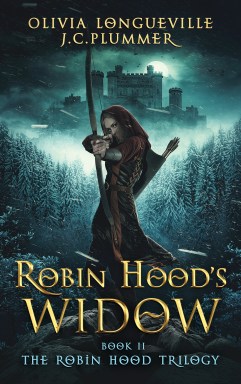 Robin Hood’s Widow (The Robin Hood Trilogy Book 2)
Robin’s duty to his king sends him on an odyssey that will unfold from the streets of Paris to the banks of the Danube. From incredible triumphs on the battlefields of the Crusade to harrowing sea voyages to a desperate dash across the frozen landscape of Central Europe, Robin Hood must ensure that King Richard safely returns to England.
Meanwhile, the outlaws of Sherwood Forest rise again under a new leader—and she is unwavering in her pursuit of justice against the tyranny of Sheriff de Argentan. Marian endures the heartbreak of widowhood only to find strength and purpose as she leads a small band of devoted men in her quest for vengeance while she protects Robin’s legacy.
Sir Guy of Gisborne, tormented by his conscience and enslaved by the sheriff, faces the wraith-like fury of the woman he once loved. How do you find forgiveness when you have committed an unforgivable crime? He must attempt a daunting journey of redemption while finding inspiration from an unexpected source.
And through it all, Robin, Marian, and Guy are entangled in a web of treachery spun by the King of France and his sinister advisor, Montlhéry, as the plot to dismantle the Angevin Empire and take the throne of England from the Plantagenets boldly continues.
Part two of an exciting three-part retelling of the Robin Hood legend!
Robin Hood’s Return (The Robin Hood Trilogy Book 3)
Robin and Marian are finally reunited as they confront an uncertain future.
While an increasingly reckless Prince John pursues the throne, Queen Eleanor collects an unprecedented king’s ransom. Social unrest and ruinous taxation threatens to tear England apart.
As opposing forces battle for control of the English throne, the King of France and his sinister advisor, Montlhéry, conspire to end the Plantagenet dynasty forever.
Dark secrets and unexpected revelations could destroy the future of England. The course of history hangs in the balance.
Robin and Marian must save both King Richard and Prince John. But can they prevail in the ultimate battle between the future and the past?
About the Authors
Olivia Longueville
Olivia has always loved literature and fiction, and she is passionate about historical research, genealogy, and the arts. She has several degrees in finance & general management from London Business School (LBS) and other universities. At present, she helps her father run the family business.
During her first trip to France at the age of ten, Olivia had a life-changing epiphany when she visited the magnificent Château de Fontainebleau and toured its library. This truly transformed her life as she realized her passion for books and writing, foreshadowing her future career as a writer. In childhood, she began writing stories and poems in different languages. Loving writing more than anything else in her life, Olivia has resolved to devote her life to creating historical fiction novels. She has a special interest in the history of France and England.
Having met on the Internet, Olivia and J. C. Plummer, a writer and historian, decided to co-author The Robin Hood Trilogy. Olivia and J. C. are retelling the Robin Hood story with an unusual and imaginative plot that is solidly grounded in 12th-century history. The trilogy incorporates twists and turns which will captivate and entertain readers.
Olivia’s social media profiles:
Personal website: http://www.olivialongueville.com/
Project website: http://www.angevinworld.com/
Twitter: @O_Longueville
Facebook: http://www.facebook.com/OliviaLongueville/
Tumblr: http://www.olivia-longueville.tumblr.com/
J. C. Plummer
J.C. Plummer (Jennie Coleen) graduated Summa Cum Laude from Washburn University with a Bachelor of Arts degree in History and Anthropology. She later earned a Master of Science degree in Computer Information Science from Dartmouth College.
Co-authoring The Robin Hood Trilogy has merged J.C.’s passions for history, culture, and technology into one unique, exciting project.
As an author and historian, J.C.’s goal is to provide thoughtful and entertaining storytelling that honors the past, is mindful of the present, and is optimistic for the future.
J.C.’s social media profiles:
Project website: http://www.angevinworld.com/
Twitter: @JC_Plummer
Facebook: http://www.facebook.com/jennie.newbrand/
 The story of the Crusades has been told in many different ways from numerous directions. The epic conflict between Christianity and Islam for the Holy Lands that went on for centuries that has lived in infamy. Many questions have arisen as historians try to separate facts from the myths surrounding this topic. How and why did it start? Why did it continue to go on for so long? Was there really a winner in this conflict? Who were the people who defined this conflict? Dan Jones has taken on the challenge of writing a comprehensive history of this conflict and the people who fought during this time in his latest book, “Crusaders: The Epic History of the Wars for the Holy Lands”.
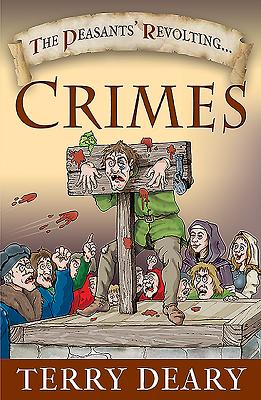 In history, we tend to look at people based on their class. There are the upper class (royalty and nobility), the middle class, and the underclasses (peasants). Most of the focus tends to be on the deeds of the upper and middle classes, yet the underclasses had there own struggles, some of which resulted in them committing crimes. What was life like for the criminals of the underclasses? What type of crimes did they commit and what sort of punishments did they suffer once they were caught? Terry Deary decided to explore the crimes of the British peasants throughout history, in his own humorous way, in his latest book, “The Peasants’ Revolting….Crimes”.
 The 16th century was filled with extremely strong women who went on to shape European and world history forever. This was true for England and Scotland, two countries whose stories were intertwined by powerful women. The women who ruled these two countries during this time were women that those who study this time period know about; Lady Jane Grey, Mary I, Elizabeth I, and Mary Queen of Scots. There was one woman who knew all four of these women and lived for over 80 years: Bess of Hardwick, Countess of Shrewsbury. The story of these five women is told in Jill Armitage’s book, “Four Queens and a Countess: Mary Queen of Scots, Elizabeth I, Mary I, Lady Jane Grey and Bess of Hardwick: The Struggle for the Crown”.
 Have you ever wondered what your favorite television series would be like on the big screen? To have all your favorite characters go on new adventures, even after the series had ended. However, you are worried that something will get lost once the series moves to the film adaptation. I know I was worried about it before I went to see
 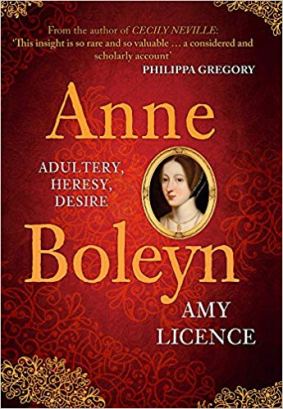 Anne Boleyn, the second wife of Henry VIII and the mother of the future Queen Elizabeth I, is one of the unique characters of the Tudor era. She was the sister of one of the king’s mistresses, Mary Boleyn, which she could have been, but Henry wanted Anne as his queen. Unfortunately, he was married to his first wife, Catherine of Aragon. It is Henry’s divorce to Catherine and his relationship with Anne, the rise and fall, is what many people look at, but there is more to Anne’s story than just her life with Henry. What was Anne’s life really like and what really caused her fall? These are just a few questions that Amy Licence tackles in her latest biography, “Anne Boleyn: Adultery, Heresy, Desire.”
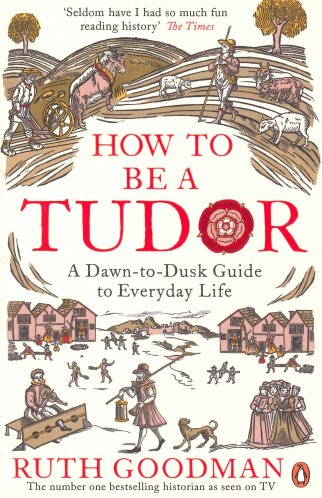 The Tudor era has enchanted generations of history lovers with its interesting monarchs and scandals. The beautiful outfits, the political drama of the age, the legendary marriages of King Henry VIII, the children of Henry VIII, and how England grew into a dominant force in European politics. These are the things that people tend to focus on when studying the Tudors, yet this is a very narrow view of the time period. We tend to focus on the inner workings of the court system, but we don’t focus on the common people who lived in England during this time. What was it like to live in Tudor England for the common people? This is the question that Ruth Goodman explores in her book, “How To Be a Tudor: A Dawn-to-Dusk Guide to Everyday Life”.
  In recent years, the study of the English conflict known as the “Wars of the Roses” has become rather popular. The Lancasters and the Yorks fighting for the English throne. Only one can be the winner. When we do look at this time period, we tend to focus on the people involved in the battles and the political aspect of the conflict. The battles, how they were fought, and why the conflict started in the first place tend to be pushed to the sideline. That is not the case with this particular book. In Hugh Bicheno’s book, “Battle Royal- The Wars of the Roses: 1440-1462”, the political and military aspects combine with family histories for a comprehensive look into what made this time period so fascinating.
 When we study history and look at certain people, we often have a tendency to treat them almost like fictional characters. They are either the hero, all good with no flaws, or villains, all bad where we only focus on their flaws. We don’t see the person as “human”, neither good nor bad, just someone who tried their lives to the best of their abilities. One such person who tends to get either the hero or the villain treatment is King Richard III of England. To some, he is “white knight”, a man who was wrongly accused and who was faultless. To others, he was a “black legend”, a dastardly villain who wanted power and did not care who he stepped on in order to achieve his goals. With these two different portrayals of Richard III, we often forget that he was just an ordinary man who became king. Matthew Lewis has decided to strip away both the white and black portrayals of Richard III and explore who Richard III the man was in his latest book, “Richard III: Loyalty Binds Me.”
 Adventures of a Tudor Nerd