
 The 16th century was dominated by powerful women who left their indelible mark on European history. Take, for example, the aunt of Charles V, the Holy Roman Emperor. No, not Catherine of Aragon, the first wife of Henry VIII. I am talking about a woman who was the daughter of Emperor Maximilian I, was married three times, had no children, and helped raise her nephew Charles V, was an essential part of the Ladies’ Peace, taught Anne Boleyn how to live at court, and was a patroness of the arts and literature. Of course, I am talking about Margaret of Austria, the Governor of the Netherlands. A formidable woman who saw much change and chose to be part of politics, even though she was a woman. Her remarkable story is told in Rozsa Gaston’s novel, “Margaret of Austria: Governor of the Netherlands and Early 16th-Century Europe’s Greatest Diplomat.”
I would like to thank Rozsa Gaston for sending me a copy of this novel. I am someone who is always looking for a new aspect of the 16th century. I have heard about Margaret of Austria from other books about Anne Boleyn and the 16th century, but I did not know much about this woman. When Gaston asked if I would like to read and review her novel, I jumped at the chance to read it and learn more about her.
Gaston begins her novel with a chart of important figures that would be featured in this story, which was helpful for me as a reader. Then, we get some basic background information about Margaret of Austria, the daughter of Maximilian I of Austria and Mary of Burgundy (known as Mary the Rich). Margaret’s brother was Philip the Handsome, who was expected to inherit their father’s throne. Margaret was destined to be a bride for King Charles VIII of France, so she left her native Netherlands for France at a young age. Our story begins with Charles VIII rejecting poor Margaret because he was already married to Anne of Brittany. Rejected, Margaret goes home, where another marriage is arranged. Her brother Philip would marry Juana of Castile, and Margaret would travel to Spain to marry Juan, Prince of Asturias. This marriage would not last long as Juan would die young.
Her final marriage would be to Philibert of Savoy, which turned into a love match, but Philibert would die a few years into their marriage. Heartbroken, Margaret goes to live with Philip and Juana, which is a mistake because they are constantly at odds. When Philip dies unexpectantly, Juana, no matter how her mental state may be, rules Castile while her eldest son Charles lives with Margaret. Margaret becomes the Governor of the Netherlands for Charles until he is old enough to rule. For the remainder of her life, politics would play a major part in Margaret’s life as she saw issues like the Great Matter, the Sack of Rome, the League of Cambrai, the rise of Martin Luther, and the Ladies’ Peace.
Margaret of Austria was such a powerful woman who would do anything for her family and her beloved Netherlands. To stand toe to toe with some of these major political figures as a woman during the 16th century took guts, but Margaret showed how formidable she was. Gaston does an excellent job telling Margaret’s story, so much so that I want to read more books about her life. Suppose you want to learn more about the life of Margaret of Austria. In that case, I highly recommend you read “Margaret of Austria: Governor of the Netherlands and Early 16th-Century Europe’s Greatest Diplomat” by Rozsa Gaston.
 The life of a 16th-century princess is not all that it is cracked up to be. You can have jewels, and glamorous dresses, attend the glittering yet treacherous court, and have numerous homes. You must marry the person the king says you should marry to create strong alliances for the kingdom, so the concept of marrying for love is not in your vocabulary. You had to ensure your opinions were kept in line with the monarch’s views so you didn’t meet a disastrous end. In other words, the closer you are to the throne, the more scrutiny is forced upon you. No one understood this advice better than Mary Tudor, the daughter of King Henry VII and the younger sister of Henry VIII. She was a daughter, a sister, a wife, a queen, a duchess, and a mother. Her remarkable story is told in Amy McElroy’s book, “Mary Tudor: Queen of France.”
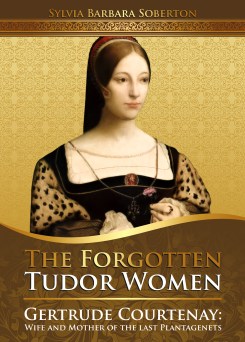
 Today, I am pleased to welcome Sylvia Barbara Soberton back to discuss another forgotten Tudor woman, Gertrude Courtenay, who is the subject of her latest book, “The Forgotten Tudor Women: Gertrude Courtenay. Wife and Mother of the last Plantagenets”.
 About the Book
 Adventures of a Tudor Nerd