
 I am pleased to welcome Wendy Johnson to my blog today to share information about her research for her novel, “The Traitor’s Son.” I would like to thank Wendy Johnson and The Coffee Pot Book Club for allowing me to participate in this blog tour.
I’ve been fascinated by the period known retrospectively as the Wars of the Roses since childhood, so when I came to write ‘The Traitor’s Son’ I already had a grounding in the history. Over the years, I’ve amassed a number of secondary sources: biographies of the principal figures, battlefield histories, political commentaries, and so on, and these have proved invaluable in forming the backbone of the novel. These days, a great deal of primary sources are digitally transcribed, and can be a valuable means of verifying details which would be more difficult to access.
My intention was always to underpin my fiction with fact. I didn’t want to invent things for the sake of the story—for me, the events of the fifteenth century are in themselves dramatic and exciting enough without the need for fabrication. But of course, the duty of a historical novelist is to add flesh to the bones, to bring the past to life, and this is essential as the reader has to be able to empathise with the characters and understand their motivation. So, how did I go about researching the lives of Edward IV, Richard Neville, earl of Warwick— and of course, my protagonist, young Richard Plantagenet, the future Richard III?
I do feel as though I’ve grown up with these figures—the first castle I ever visited as a child was Raby Castle, in County Durham, home to the dynamic Neville family, and a fascination for this remarkable dynasty was formed. My lifelong interest in Richard III himself was kindled during a visit to Middleham Castle, Yorkshire, at the age of eight and has remained with me ever since. I’ve always had a sense of what I feel my characters were really like, but of course, that wasn’t enough: to write a believable novel, I needed to fully research their lives and the events which formed them, before I could consider recreating them on paper. Biographies proved extremely helpful, most providing a clear background to the lives of each individual and helping to form a realistic picture of that particular person, what their personalities may have been, and, in particular, who and what may have influenced them. This was significantly important when it came to Richard himself.
The frustrating thing about the study of the fifteenth century is that, although some primary sources do survive, they are fewer in number than those of the following century, and those that do survive are mostly official documents. It would be wonderful if we could consult, for example, a greater number of personal letters from those concerned. We do have some, but once again, these tend to be letters composed in an official capacity. Those which remain, however, can help cast small rays of light on the people as individuals, for example, the letter sent by a youthful Edward IV, and his brother Edmund, to the Duke of York, thanking him for the gowns he has sent them and requesting him to deal with ‘the odious rule’ of Richard Croft and his brother, fellow trainee knights, who appear to have been bullying them. Although my novel does not cover this earlier period, the letter is illustrative of the comfortable relationship the sons of York had with their father. Likewise, Richard’s letter to his mother, written as king and signed ‘your most humble son’, requesting her ‘daly blessing to my synguler comfort’ offers a small insight into the affection and respect he bore for her. Although such correspondence is rare, many documents having been destroyed in the following century, letters like these do provide a glimpse of both Edward and Richard’s closeness to their parents.
The relationships of the York family, one to another, are the focus of ‘The Traitor’s Son’. Rather than a sweeping saga, I very much wanted to keep the action close, concentrating on Richard and his brothers, Edward IV and George, duke of Clarence, their sister, Margaret, mother, Cecily—and the man, whom I believe played a huge part in young Richard’s upbringing, his cousin and mentor, Richard Neville, earl of Warwick. Research into the life of Richard III indicates a deep reverence for the memory of his father, the Duke of York. York’s death in battle, when Richard was only eight years old, and the danger in which the family was placed thereafter, must have had a devastating effect on the boy. According to the Centre for Male Psychology…research shows the father-child relationship is an important one. In fact, it can be more influential than the mother-child relationship. This is especially true for the 8-12 year old child as they try to make sense of the outside world…’ i This observation helped confirm my theory that following the death of the Duke of York, it would have been natural for Richard to have searched for a father figure in his life, and that this figure could well have been his cousin, Warwick.
Regarding locations, I found I could call on personal experience for some, but had to research others. Having grown up close to Middleham, I know the castle inside and out, so it was very easy to imagine the scenes set within its walls. The city of York, which was very familiar to Richard, remains in part unchanged, and again, it was an easy matter to reimagine his time there. Warwick Castle is another fortress I’ve visited in person, although naturally there have been additions since the days of Richard Neville. London needed to be researched carefully, as very little remains from the medieval period. I found an amazing resource on the Internet entitled the Agas Map of Early Modern London, which uses the Civitas Londinium, a detailed woodcut created in 1561. This incredible, interactive tool allows the user to search for particular streets, churches, parishes, gates, and so on. Highlighting these on the map, it becomes possible to visualise the city at a time not too distant from the period in which my novel is set. For Richard’s exile in the Low Countries, both at the age of eight and again at eighteen, I had to rely on published histories and on images and information I found online. A visual recreation of the Bishop’s Palace at Utrecht (where Richard and his brother, George, resided following their father’s defeat) was extremely useful, as was a delightful video I found of the adjacent tower, the Dom Toren, which actually featured the sound of its bells—so different in their melody from the chimes which would have been a constant accompaniment to life in London.
My favourite element of the writing process will always be the creative part—seeing the characters in my mind’s eye, imagining their emotions and bringing them to life—but my greatest desire with the novel was to create an authentic narrative, and that meant remaining true to the facts and to the people who populate its pages. These were, after all, real people, and I felt I had a duty to portray them with respect and in the most accurate way I could. Therefore, research and facts remain twin components of ‘The Traitor’s Son’.
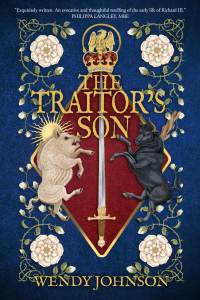 Blurb:
Caught between a king and a kingmaker, young Richard Plantagenet knows he’ll have to choose…
1461: Richard, Duke of York, King by Right, has been branded a traitor and slain by his Lancastrian foes. For his eight-year-old son—Richard Plantagenet—England has become a dangerous place.
As the boy grapples with grief and uncertainty, his elder brother, Edward, defeats the enemy and claims the throne. Dazzled by his glorious sibling, young Richard soon discovers that imperfections lurk beneath his brother’s majestic façade. Enter Richard Neville, Earl of Warwick—cousin, tutor, luminary—whose life has given him everything but that which he truly craves: a son. A filial bond forms between man and boy as they fill the void in each other’s lives. Yet, when treachery tears their world asunder, Richard faces an agonizing dilemma: pledge allegiance to Edward—his blood brother and anointed king—or to Warwick, the father figure who has shaped his life and affections.
Painfully trapped between duty and devotion, Richard faces a grim reality: whatever he decides will mean a fight to the death.
In “The Traitor’s Son”, Wendy Johnson weaves a tapestry of loyalty, love, and sacrifice against the backdrop of England’s turbulent history. Through the eyes of a young Richard III, readers are transported into a world where every choice is fraught with peril, and the bonds of kinship are tested to their limits.
Perfect for fans of Hilary Mantel, Annie Garthwaite, and Sharon K. Penman.
Praise for The Traitor’s Son:
“Exquisitely written. An evocative and thoughtful retelling of the early life of Richard III.”
~ Philippa Langley, MBE
“Sometimes the perfect use of the written word takes my breath away. Not very often, but this book is it. A wonderful story written so beautifully that I shall not forget it for a long time. Everything to my mind is perfect. The language, the story, the pacing. Just wonderful.”
~ Kindle Customer, 5* Amazon Review
“Wonderfully woven story of a young Richard III. Woven with a sure knowledge of the history and a realistic telling of a story about a young boy finding his way through tragedy and triumph, uncertainty, and a legacy he cannot escape.
Brilliant debut which promises more and more.”
~ Cris, 5* Amazon Review
“I loved this novel, it was beautifully written, extremely atmospheric, the characters’ personalities came through perfectly, can’t wait for the next instalment.”
~ Linda Hayward, 5* Amazon Review
“Really enjoyed this book. Holds the reader enthralled from the first paragraph to the last. The next volume can’t be released soon enough.”
~ J.M. Henderson, 5* Amazon Review
Buy Link:
Universal Buy Link: https://books2read.com/u/mdJqL5
This title is available to read on #KindleUnlimited.

Author Bio:
Wendy Johnson has a lifelong passion for medieval history, its people, and for bringing their incredible stories to life. Her specific areas of interest are the fifteenth century, the Wars of the Roses, and Richard III in particular. She enjoys narratives that immerse the reader in the past and tries faithfully to recreate the later Middle Ages within her own writing. She has contributed to a number of historical anthologies and was a runner-up in the Woman and Home Short Story Competition 2008.
Wendy is also a founder member of Philippa Langley’s Looking for Richard Project, which located the king’s lost grave in 2012. She co-authored Finding Richard III: the Official Account of Research by the Retrieval and Reburial Project in 2014, and in 2019 received the Richard III Society’s Robert Hamblin Award.
THE TRAITOR’S SON, volume one in a Richard III trilogy, is Wendy’s debut novel, and she is currently working on the sequel.
Author Links:
Author’s Page on Publisher’s Website: https://madeglobal.com/authors/wendy-johnson/
Facebook: https://www.facebook.com/p/Wendy-Johnson-Author-61558759768505/
Book Bub: https://www.bookbub.com/authors/wendy-johnson-cf3f97f7-3a8e-46d9-8394-c5a08caa594d
Amazon Author Page: https://www.amazon.co.uk/stores/author/B0D14SQJP3
Goodreads: https://www.goodreads.com/book/show/208871994-the-traitor-s-son
 The medieval world could be a treacherous place to live in, especially when it comes to life in the medieval court. There was so much backstabbing and men reaching for titles and crowns that were not given to them. Take, for example, the House of York. Now, we will assume that their desire for the throne truly came to fruition during the period known as the Wars of the Roses in the 15th century. However, the sons and the daughter of Edmund of Langley and Isabella of Castile were fiercely loyal to those they served and were ruthless to those who they deemed as their enemies. This is the world that Constance of York, Lady Despenser, is raised in, but when her world is turned upside down, will she choose to stay on the sideline, or will she scheme with her family and fight for what they believe is right? Constance’s story is woven together in Anne O’Brien’s novel, “A Tapestry of Treason.”
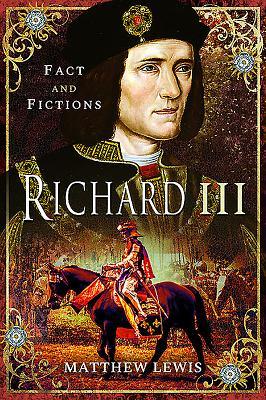 When one looks at the study of history as a whole, the traditional way to look at a person as either good or bad through a combination of facts and fictional tales of their supposed exploits. None so much so as King Richard III, one of the most controversial English monarchs. Fictitious tales, like William Shakespeare’s play
  Adventures of a Tudor Nerd