
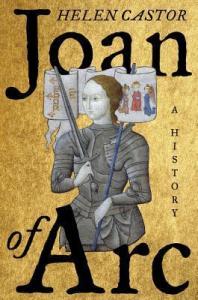
 We all believe we know the story of Joan of Arc, one of the patron Saints of France. A young peasant woman who God called to lead the dauphin to the altar to be crowned King Charles VII of France in a time of civil war between the Armagnacs and the Burgundians, as well as the continuation of the war between England and France. It was a political quagmire, but somehow, as the story goes, Joan of Arc resolved the civil war and gave France a fighting chance against the English. But what did Joan of Arc actually accomplish during her short life? Helen Castor examines the life of this extraordinary young woman in her book “Joan of Arc: A History.”
I have been following Helen Castor for a few years now, and I have heard about this book, but I have not read it until now. Since I have started studying medieval history, I have read a few accounts of Joan of Arc, but I have never read a full biography about the Maid herself, so I was excited to learn more.
To understand the reason why a single young woman who donned armor and led an army to victory, we must go back to the beginning of the conflict between the Armagnacs and the Burgundians, as well as how the English had the advantage over the French at this time in the Hundred Years’ War. France had a relatively weak King Charles VI, who suffered from mental illness. Two potential leaders emerged from the chaos: the king’s son, the dauphin, Charles VII, for the Armagnacs, and John the Fearless, Duke of Burgundy, for the Burgundians. The Burgundians were a commanding force; the Armagnacs needed a miracle, or in this case, a maiden sent by God.
Joan was seen as just a peasant girl from Domremy who heard voices. This may not seem extremely extraordinary in an age where many men and women claimed to have heard voices from God. However, what separated Joan from others before her was the fact that she donned armor and led the Armagnac army during the Orleans campaign. She was victorious and was able to have the dauphin crowned King Charles VII of France. However, her luck shortly ran out when she was captured by the English, placed on trial, and declared guilty of heresy before she was burned at the stake. Finally, Castor examines the trial to redeem Joan’s legacy and how a mere girl became a patron saint of an entire country.
I found this a very engaging and informative biography about Joan of Arc. Castor not only tells her audience the story of a girl who became an icon, but also the story of how France was broken and became whole again. If you are a fan of medieval history, you will enjoy “Joan of Arc: A History” by Helen Castor.
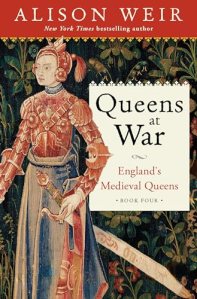 The fifteenth century in England was a time of war. Between a usurper king, fighting with France, and fighting amongst themselves, an English king must be prepared to go into battle at any moment, and his queen must be ready to support him in any way. During this period, there were five kings and queens, and while the kings get a lot of attention, it is the queens who should get their flowers for what they did in times of distress. Alison Weir explores the lives of the final five Plantagenet queens in her final book in the England’s Medieval Queens series, entitled “Queens at War.”
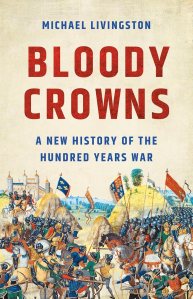 Medieval Europe was a time of conflicts and change. While smaller disputes between countries or civil wars would define borders, the most prominent conflict during this period was the Hundred Years’ War. A conflict that has been traditionally taught to have lasted 116 years between England and France. It is often told from the English perspective, with battles such as Agincourt, Crecy, and Poitiers celebrated. But what if we look at the bigger picture and expand our lens to the whole of Europe while keeping a neutral approach to the France vs England conflict? What if the conflict did not last a mere hundred years, but in fact two hundred years? What type of story would this kind of approach tell when it comes to medieval European history? Michael Livingston takes on the mammoth challenge of telling the tale of how this war changed European history forever in his latest book, “Bloody Crowns: A New History of the Hundred Years War.”
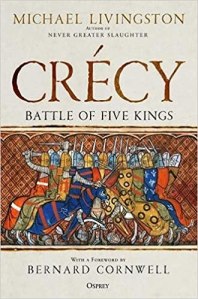 The year is 1346 and war has just begun between France and England. This conflict would be known as the Hundred Years War, which lasted over 116 years and ended in failure for the English. However, some glorious moments like Agincourt gave the English cause to celebrate, but none more so than the Battle of Crecy. It was a colossal battle between five European kings, leaving countless dead on the field without many long-term rewards. So how did the French and English armies meet on the field of Crecy and what truly happened? Michael Livingston dives deep into the archives and archaeological research to tell the truth of this famous battle in his book, “Crecy: Battle of Five Kings.”
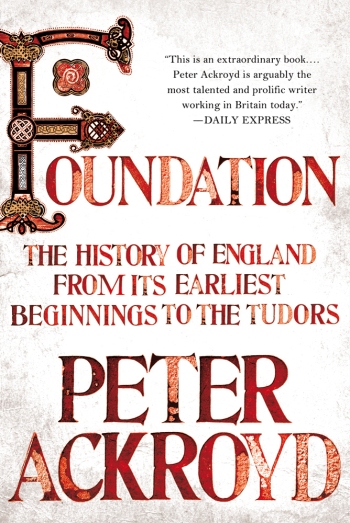 England is a nation that is rich in history and conflicts galore. Through the centuries, England has seen so much change. Many of us know the stories of the medieval and the Tudor kings and queens of England, covered in numerous books, but Peter Ackroyd has taken this concept a step forward. Ackroyd embarked on an epic quest to chronicle the history of England from its prehistoric origins to the modern age. In “Foundation: The History of England From Its Earliest Beginnings to the Tudors,” Peter Ackroyd begins his epic journey into the past to explore the origins of English history.
 Adventures of a Tudor Nerd