
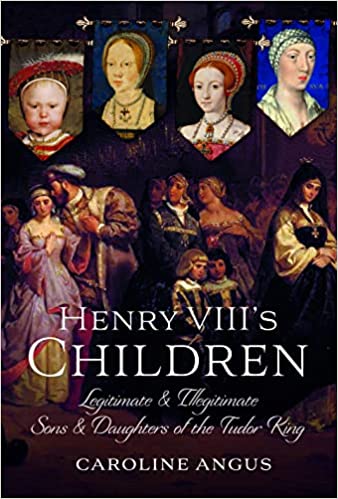
 When we think about the title royal children, images of children who get whatever they want, being spoiled with gems and gowns, and ruling kingdoms, they are married to create alliances. In that sense, it would define a life of luxury. However, for the children of King Henry VIII, luxury was not always in their dictionary. What was life like for the legitimate and illegitimate children of Henry VIII? Caroline Angus explores this question in her latest book, “Henry VIII’s Children: Legitimate and Illegitimate Sons and Daughters of the Tudor King.”
I want to thank Pen and Sword Books and NetGalley for sending me a copy of this book. I have read quite a few books about the children of Henry VIII, so when I saw the title, I was interested to see what new information Angus would provide in her book.
To understand why Henry VIII desired a large family, especially male heirs, Angus explores Henry’s childhood as the second son of Henry VII and Elizabeth of York. We then transition to the marriage of Henry and Katherine of Aragon and her multiple miscarriages until her beloved daughter Mary was born. After Mary, Angus explores the relationships of Henry VIII with Bessie Blount, Anne Boleyn, and Jane Seymour and his other children that were recognized as his own, Henry Fitzroy, Elizabeth, and Edward, respectively.
What I enjoyed in this book is the amount of information that Angus provided about not only Henry’s legitimate children but his illegitimate children, primarily the information about Henry Fitzroy. For so long, Henry Fitzroy was a footnote in the Henry VIII story, but it is so fascinating how much he relied on his eldest son even though he was illegitimate. Then, you have Mary’s upbringing compared to Elizabeth’s, and you see how much of a struggle it was to be a daughter of Henry VIII instead of a treasured son.
Angus also included a section about children who many questioned if they were indeed illegitimate children of the king, including the children of Mary Boleyn. She also included some Tudors I had never heard about, which was interesting to read about how their life experiences differed from their royal counterparts. The king’s legitimate and illegitimate children dealt with so much pain and suffering because of who their dear old dad was, and they all craved a little bit of his love in return.
Angus has done an excellent job telling the tales of the rather sad upbringings of the children of Henry VIII. A crown and a king as a father did not mean your life was a fairy tale. By understanding their childhoods, we can understand why the Tudor children became strong-willed leaders. If you want an excellent book that gives you a glimpse into what it meant to be a child of a monarch during the Tudor period, check out, “Henry VIII’s Children: Legitimate and Illegitimate Sons and Daughters of the Tudor King” by Caroline Angus.
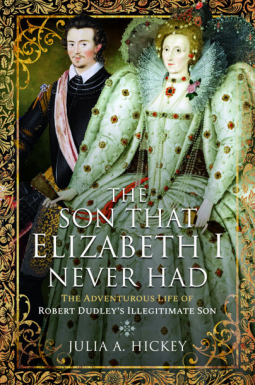 When we study the life of Queen Elizabeth I, the image of a virgin queen who never married tends to come to mind. Of course, she had a man who she favored above all others, Robert Dudley, but he married several times to Amy Robsart and Lettice Knollys. It was with Lettice Knollys that Robert Dudley was able to produce his heir, aptly named Robert Dudley Lord Denbigh, who unfortunately died at a young age. Robert Dudley was left without a legitimate heir, but he did have another son, albeit an illegitimate son, also named Robert Dudley. Julia A Hickey has decided to examine the life of the illegitimate Robert Dudley in her book, “The Son that Elizabeth I Never Had: The Adventurous Life of Robert Dudley’s Illegitimate Son.”
 When we think of those who made an impact in history, we tend to think of those who have been born to a married couple and therefore were considered legitimate children, especially when it comes to royal children. However, we know that illegitimate royal children, like William the Conqueror, greatly impacted history. Illegitimate royal children may have been barred from becoming king or queen of their respective countries of birth, but that does not mean they didn’t impact how their home country was governed. One of these children who affected politics during the Tudor dynasty was Arthur Plantagenet, the illegitimate son of Edward IV. In her latest book, “Arthur Plantagenet: Henry VIII’s Illegitimate Uncle,” she explores the life of this man who gives us extraordinary insight into the running of Calais and how Henry VIII treated other family members.
 Adventures of a Tudor Nerd