
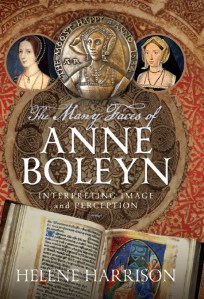
 Anne Boleyn, a queen whose story has lived on for centuries. She was the woman who stood between Catherine of Aragon and King Henry VIII. Her daughter, Queen Elizabeth I, was her greatest legacy and her pride and joy. It was her untimely death due to charges that many believe were unfounded. We all have our image of the infamous queen, but how does that change when we switch the type of media we consume? Helen Harrison explores how our idea of Anne Boleyn changed over time in her latest book, “The Many Faces of Anne Boleyn: Interpreting Image and Perception.”
I would like to thank Pen & Sword Books and NetGalley for providing me with a copy of this book. I have enjoyed Helen Harrison’s previous books on Tudor Executions and Elizabethan Rebellions. When I heard that she was writing a book about Anne Boleyn, I was curious to see what new information she would add to Tudor studies, specifically Anne Boleyn.
So, how do you approach a book like this that is not a biography but tells how Anne Boleyn has been perceived throughout the centuries? Harrison has decided that the best way to show her readers how Anne has been portrayed throughout history is by breaking this book into sections, focusing on one source of media. We get to see Anne through portraiture/images, letters/poems, through foreign dignitaries, her views on religion, on stage and screen, both the movie and television screen, as well as historical fiction.
Harrison also includes a brief biography of Anne’s life so that we can refamiliarize ourselves with her tragic tale before taking the deep dive, which is important when it comes to understanding her legacy. My favorite part of this book is seeing the different takes historians and authors have taken towards it, including everyone’s favorite, the Victorians. It gives an overview of how different historians and authors interpret a single figure and gives us a unique take on the historiography of Anne Boleyn, including G.W. Bernard, who believed that Anne was guilty of some of the charges. The fact that Harrison decided to keep her feelings towards Anne relatively neutral allows the recent research about Anne to shine.
This book is unlike any other book about Anne Boleyn that I have read. It is a comprehensive deep dive into the research around the life of Anne Boleyn that any Tudor nerd will find a fascinating resource. If you are a Tudor nerd or a fan of Anne Boleyn, “The Many Faces of Anne Boleyn: Interpreting Image and Perception” by Helen Harrison is a must-read.
 Adventures of a Tudor Nerd