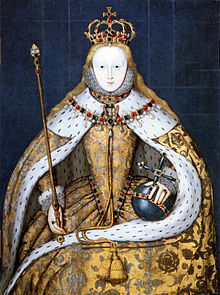
 (Born September 7, 1533- Died March 24, 1603)
Daughter of King Henry VIII and Anne Boleyn.
Sister to King Edward VI and Queen Mary I
Elizabeth was known as the “Virgin Queen” because she never married and she never had a child. Elizabeth was one of the greatest rulers in English history.
Elizabeth I was born on September 7, 1533 to Henry VIII and his second wife Anne Boleyn at Greenwich Palace. At birth, Elizabeth was declared heir presumptive to the throne of England. Her older half-sister, Mary, had lost her position as a legitimate heir when Henry annulled his marriage to Mary’s mother, Catherine of Aragon, to marry Anne, with the intent to sire a male heir and ensure the Tudor succession. However, things didn’t go as planned. Anne never was able to give birth to the desired son that Henry wanted. Anne would later be accused of adultery and treason. On May 19, 1536, Anne Boleyn was executed; Elizabeth was two years old at the time and she was declared illegitimate, just like her step-sister Mary.
Henry VIII married Jane Seymour shortly after Anne Boleyn’s execution. Jane gave birth to Elizabeth’s step-brother Edward, but died shortly afterward. Elizabeth’s father would marry three more times; Anne of Cleves who was divorced; Katherine Howard who was beheaded; and finally Katherine Parr. During this time, Elizabeth met Catherine “Kat” Ashley who was appointed Elizabeth’s governess in 1537 and remained with Elizabeth until her death in 1565. William Grindal became her tutor in 1544 and after his death in 1548, Roger Ascham became Elizabeth’s tutor. Elizabeth received a very good education and she loved to learn. Elizabeth’s life was somewhat normal at this point, but life was about to change drastically.
Henry VIII died on January 28, 1547, when Elizabeth was 13, leaving the throne to his nine year old son Edward VI. Before Henry VIII died, he reinstated his daughters to the line of succession so after Edward VI, Mary would become queen and then Elizabeth. Shortly after Henry VIII’s death, his last wife Katherine Parr married Thomas Seymour, the brother of Jane Seymour and Edward Seymour, Edward VI’s Lord Protector. Elizabeth moved in with Katherine Parr and Thomas Seymour at their home in Chelsea where, it is alleged, Thomas Seymour would act inappropriately towards Elizabeth, including bursting into her bedroom while she was barely dress, slap her on the bottom, and one time, shred Elizabeth’s dress. In May 1548, Elizabeth was dismissed from Katherine’s household; Katherine Parr died from childbirth on September 5, 1548 which allowed Thomas to pursue Elizabeth as his wife, but it failed. Thomas was accused of trying to kidnap Edward VI, charged with treason and executed on March 20, 1549. Elizabeth was interrogated during the investigation into Thomas, but she never admitted anything about the nature of their relationship.
Edward VI would die on July 6, 1553, at the age of 15. Under Henry VIII’s Act of Succession, the crown should have passed onto Mary, however Edward did not like that she was Catholic, so before he died, he issued an act that named his heir as Lady Jane Grey. Lady Jane Grey would only be queen for nine days since Mary brought an army to place her on the throne. On August 3, 1553, Mary rode into London with Elizabeth by her side. On the outside, it looked like Mary and Elizabeth had reconciled, however they were pulling farther apart.
Mary and Elizabeth kept butting heads over religion, Mary being Catholic and Elizabeth being Protestant. Mary’s popularity began to wan with her people when she announced in 1554 that she wanted to marry Philip II of Spain, a devout Catholic. That same year in January and February, a man by the name of Thomas Wyatt staged a rebellion to put Elizabeth on the throne instead of Mary, which failed. Wyatt was beheaded and Elizabeth was interrogated. She was imprisoned in the Tower of London on March 18th; she would later be transferred to Woodstock on May 22nd where she spent a year under house arrest in the custody of Sir Henry Bedingfield.
Elizabeth returned to court on April 17, 1555 to help Mary with the final stages of her pregnancy. However, months passed and it turned out that it was a false pregnancy. As Mary fell ill, Philip II started to consult with Elizabeth on how to run the country, and in October 1558, Elizabeth began to formulate her own court. On November 6, Mary recognized Elizabeth as her heir and on November 17, 1558, Mary I died and Elizabeth I succeeded to the throne.
Elizabeth I became Queen of England at the age of 25. She was crowned in an elaborate ceremony on January 15, 1559, which was cold winter day; Elizabeth would get sick shortly after her coronation, but once she recovered, she made William Cecil, later Baron Burghley, her Chief Minister. Elizabeth had two pressing matters to solve when she first became queen, resolving the matters of religious division in England and who she would marry. With the religious division, she sought to strike a balance, so that even though Protestantism became the national religion, those who wanted to hear the Roman Catholic mass were able to do so in private. Elizabeth became the Supreme Governor of the Church of England.
The other issue that plagued Elizabeth during her reign was who she was going to marry. There were many candidates, foreign and English suitors, but Elizabeth would not commit herself to one man, instead she decided to remain single and considered herself the mother of the English people. The man who probably had the best chance of marrying Elizabeth was Robert Dudley. Dudley was the brother of Guilford Dudley, the husband of Lady Jane Grey. He was married to Amy Robsart, but she died of a fall in 1560 and Dudley was accused of her murder. He was created the Earl of Leicester in 1564. Dudley remarried in 1578 to one of Elizabeth’s Maid of the Privy Chamber, Lettice Knollys. This made Elizabeth angry and she banished Lettice from court. Dudley would die in 1588, shortly after the defeat of the Spanish Armada. Robert Dudley tried for over 20 years to convince Elizabeth to marry him and it resulted in a close friendship, but nothing more.
The other serious contender for the Queen’s hand was Francis, Duke of Anjou, who Elizabeth called her “frog”, heir to the French throne. But again, political considerations made the match ultimately impossible. Other suitors included King Philip II of Spain, King Eric XIV of Sweden, Archduke Charles of Austria, and Henry Duke of Anjou (the duke before Francis). Elizabeth had numerous favorites at her court including Sir Christopher Hatton, Robert Devereux earl of Essex, and Walter Raleigh, just to name a few. The problem was that Elizabeth decided not to marry nor would she declare a successor, even when she contracted smallpox in October 1562 and she thought she might die.
Elizabeth’s refusal to marry or name a successor led to one of the most defining conflicts of Elizabeth’s reign. Catholics viewed Elizabeth as illegitimate and had no right to the throne. To them, Mary Queen of Scots, Elizabeth’s cousin, had a better claim to the throne. Mary was the granddaughter of Henry VIII’s sister Margaret. Elizabeth was persuaded to send a force into Scotland to aid the Protestant rebels, and though the campaign was inept, the resulting Treaty of Edinburgh of July 1560 removed the French threat in the north.When Mary returned to Scotland in 1561 a to take up the reins of power, the country had an established Protestant church and was run by a council of Protestant nobles supported by Elizabeth. Mary refused to ratify the treaty which denied Mary the right to succeed to the English throne.
In 1563 Elizabeth proposed her own suitor, Robert Dudley, as a husband for Mary, without asking either of the two people concerned. Both proved unenthusiastic, and in 1565 Mary married Henry Stuart, Lord Darnley, who carried his own claim to the English throne. The marriage was the first of a series of errors of judgement by Mary that handed the victory to the Scottish Protestants and to Elizabeth. Darnley quickly became unpopular and was murdered in February 1567 by conspirators almost certainly led by James Hepburn, 4th Earl of Bothwell. On May 15, 1567, Mary married Bothwell, arousing suspicions that she had been in on the murder of Lord Darnley. This lead to Mary’s fall from grace and she was held captive starting in July 1567.
Forced to flee her own country, having abdicated her throne in favour of her infant son, James, Mary landed in England in May 1568, seeking Elizabeth’s help in restoring her to her kingdom. Because the matter of Darnley’s death was unresolved, Elizabeth placed Mary in prison for around 20 years. Of course, this angered the Catholics who saw Mary as the figurehead of their cause, so there were plots and plans to get Mary out of prison and place her on the throne instead of Mary. The largest plot was the Babington Plot of the summer of 1586, which laid out plans for Elizabeth’s execution and Spain’s invasion of England. Since Mary knew of the plans, she was tried and found guilty of treason. Elizabeth was very reluctant to sign the death warrant, but eventually she did. Mary Queen of Scots was executed on February 8, 1587 at Fotheringhay Castle; her son James VI was declared Elizabeth’s heir to the throne.
Another huge challenge for Elizabeth was her relationship with Spain and her former brother-in-law, Philip II. With the discovery of the new world and the age of exploration in full force, piracy was becoming more popular. In 1572, Sir Francis Drake decided to plunder Spanish ships in Central and South America. In 1577, Drake was introduced to Elizabeth and she unofficially encouraged his activities against the Spanish. In December 1577, Drake travelled around the world plundering Spanish ships; he returned to England in September 1580 as a national hero and in April 1581, he was knighted.
By 1588, Elizabeth and Philip were considered enemies. Philip had spoken of invading England and dethroning Elizabeth for years, but the execution of the Queen of Scots gave him an added incentive. In July 1587, Philip received a treaty from the pope that gave his approval on the conquest of England. Now he could claim the English throne for himself and dethrone Elizabeth to restore England to Catholicism. In 1587, Drake was able to lead a successful raid against Cadiz, which delayed the Spanish Armada from invading by a year. In the summer of 1588 he sent his mighty Armada fleet against England. But by superior tactics, ship design, and sheer good fortune, the English defeated them. This was one of Elizabeth’s biggest achievements and made Elizabeth extremely popular in England.
In Ireland, there was a revolt against the English, led by Hugh O’Neill, Earl of Tyrone. In spring 1599, Elizabeth sent Robert Devereux, 2nd Earl of Essex, to put the revolt down. To her frustration,he made little progress, even though he begged to go there, and returned to England in defiance of her orders. He was replaced by Charles Blount, Lord Mountjoy, who took three years to defeat the rebels. Essex thought that when he returned to England, he would be treated like a hero, but he was treated with contempt. This made Essex upset and in February 1601, the earl tried to raise a rebellion in London. He intended to seize the queen but few rallied to his support, and he was beheaded on February 25, 1601.
After Essex’s death, Elizabeth’s health began to deteriorate. She would die at the age on 69 on March 24, 1603 at Richmond Palace. Elizabeth was interred in Westminster Abbey, in a tomb shared with her half-sister, Mary I.
Sources:
https://en.wikipedia.org/wiki/Elizabeth_I_of_England#Mary,_Queen_of_Scots
http://www.elizabethi.org/contents/biography/
https://www.biography.com/people/queen-elizabeth-i-9286133
Ashley, Michael. A Brief History of British Kings & Queens. Philadelphia, PA: Running Press, 2008.

 English royal history is filled with fantastic stories of triumphs and tribulations, grand romances, and divorces that shook the foundations of the monarchy. It is also filled with struggles over religion, wars both inside England and with foreign nations, and heartbreaking child losses. We often think about the spouses of the Plantagenets and the Tudors when we think about royal romances, but we shouldn’t forget about the dynasties that came after, like the Stuarts. So how did the Stuart dynasty come to be and how did the unions between monarchs and their significant others affect the dynasty and England? Heather R. Darsie explores this often-overlooked dynasty and the stories of their marriages and romances in her latest book, “Stuart Spouses: A Compendium of Consorts from James I of Scotland to Queen Anne of Great Britain.”
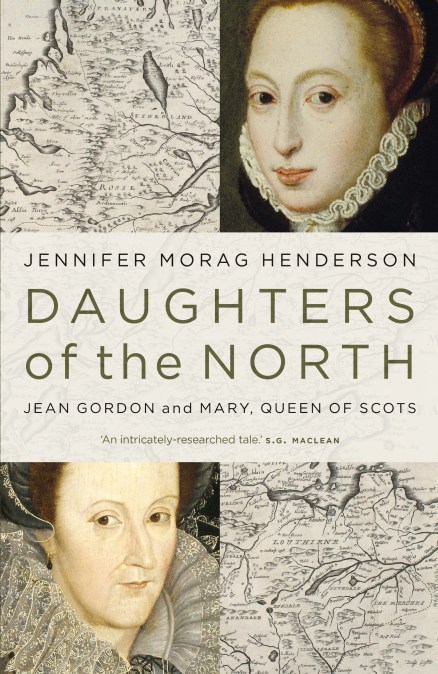 In the late 16th/ early 17th centuries, Scotland was chaotic and full of dynamic characters near or on the throne. People like Mary of Guise, Mary Queen of Scots, Lord Darnley, Earl of Bothwell, the four Maries, and James VI/I show how turbulent the Scottish court was to those around it. However, the stories of those who lived outside the court system and tried their best to maintain control of the country for their monarch tend to fade into obscurity. Take for example the story of Jean Gordon. A noblewoman who was married three times; to James Hepburn, Earl of Bothwell, Alexander Gordon, Earl of Sutherland, and her true love, Alex Ogilive. Jean’s story is full of heartaches, clashing clans, religious squabbles, and loyalty to one’s family, which is told in Jennifer Morag Henderson’s book, “Daughters of the North: Jean Gordon and Mary, Queen of Scots.”
 Adventures of a Tudor Nerd