
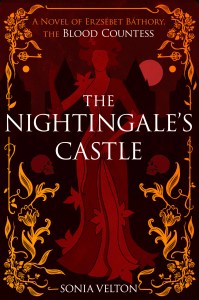
 A castle looms in the distance and the owner, a glamourous countess, has asked for fair maidens from the surrounding areas to work for her. But this is not an ordinary castle and this was not a benevolent countess. The rumors say if you enter the castle, you will never return as the infamous Blood Countess Erzsebet Bathory will kill you and bathe in your blood. A rather gruesome tale that has been told for centuries, but how true is this story? What truly happened in the Countess’s castle and what was the countess like? Sonia Velton hopes to answer these questions in her novel about Erzsebet Bathory’s life, entitled “The Nightingale’s Castle.”
I want to thank Harper Perennial and Net Galley for sending me a copy of this novel. I have heard about Elizabeth Bathory the Blood Countess, but just the dark tales about how she killed virgins and bathed in their blood to keep her youth. Sadly, I don’t know much about the woman herself and the circumstances around her life that made the charges around her so extreme.
We begin with a scene in the future from a court case where we see a mysterious girl listing the names of the accomplices who helped the countess, namely Janos Ficzko Ujvary, Ilona Jo Nagy, Dorottya (Dorka) Szentes, and Katalin Beneczky. The mysterious figure also reveals that there is a ledger that she claims lists the names of every victim of the countess, which totals hundreds of young ladies. Then, we jump to the main story with two servants of the countess, Dorka, and Fickzo, looking for a new woman to work at Cachtice Castle, which they find in Boroka Libalany, the adopted daughter of the town doctor Jozsef. It is at the castle where Boroka meets another girl named Suzanna and the two girls form a sort of friendship as they work in the laundry.
Things seem to be going well for Boroka and Suzanna until they realize that there is something off about this castle. While Boroka meets Countess Erszebet Bathory and gets to interact with her court of young noble ladies, Suzanna sees the darker side of the castle. I do appreciate that each one of the accomplices of the countess gets their unique backstories on how they met Erszebet Bathory. As Boroka gets closer to the countess and earns her trust as a stand-in for her portrait by Valentino, she discovers an intricately craved box and a journal inside that tells the story of Boroka’s birth mother, however the context of the box changes for those who open it. While I do enjoy learning more about Boroka’s familial connection to the countess, the magical box element almost felt unnecessary as she could have easily found the diary in the countess’s library and it would have had the same effect for Boroka.
Finally, we get to see how the case against Erszebet Bathory and her accomplices occurred. Gyorgy Thurzo Count Palatine of Hungary joins with King Matthias of Hungary to create a case against the countess. We get to see the arrest of the countess and her accomplices, the trial, and the aftermath of this case on the entire cast of characters, but especially Boroka.
As this was the first novel that I have read set in late 16th/ early 17th century Hungary and that was about Erszebet Bathory “the Blood Countess,” I found this novel extremely engrossing. It was a haunting yet stunning story filled with so many twists and turns that I did not want it to end. If you want a riveting retake on the life of the infamous Blood Countess, I highly recommend you read, “The Nightingale’s Castle” by Sonia Velton.
 Adventures of a Tudor Nerd