
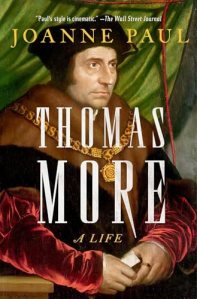
 The year is 1535, and an educated scholar, father, writer, and the former Chancellor of England marches to his demise. His crime was staying silent on an issue that the King deemed extremely important: the idea that the King of England should be the Supreme Head of the Church of England, not the Pope. As a Catholic, Sir Thomas More does not agree with this decree and must die. How did one of the most prominent Tudor scholars of his age fall so quickly? Joanne Paul explores the rise and dramatic fall of this infamous Tudor figure in her latest biography, “Thomas More: A Life.”
Joanne Paul is slowly becoming one of my favorite nonfiction writers. Her debut, “The House of Dudley,” was spectacular, and when I heard that she was writing a biography about Thomas More, I knew I wanted to read it. I know the basic information about Thomas More’s life and his books about the Wars of the Roses and Utopia, but I wanted a book that gives more details about his life.
Thomas More was the son of the lawyer John More and his wife Agnes, born in 1478. A child of the Wars of the Roses, the shifting sands of the political landscape of his youth will prepare him for the tumultuous Tudor court of his adulthood. While he recalls the reign of King Richard III in his book about the period, it should be noted that he was a boy during the king’s reign.
Thomas became a scholar who specialized in Humanism and created a community of like-minded scholars and artists, including men like Desiderius Erasmus. Thomas More would marry twice, to Jane Colt, the mother of his children, Margaret, Elizabeth, Cecily, and John, and Alice Harpur. He would ensure that all his children received a proper Humanist education, and his children, especially Margaret, were praised for their scholarly abilities. He would begin to write like he was running out of time and create one of his most famous works about politics, Utopia, as well as go toe to toe against Martin Luther himself.
More would continue his academic pursuits, even when he captured the attention of King Henry VIII, who would appoint him Chancellor of England. While a great honor, Thomas did not agree with the King on the Great Matter as he believed Queen Katherine of Aragon was the rightful wife of King Henry VIII. He would persecute those whom he deemed as heretics as a devout Catholic man, and it was ultimately his faith that would lead to his earthly doom. When Henry VIII decided that he wanted his people to swear an oath that Henry VIII was the Supreme Head of the Church of England instead of the Pope. As a devout Catholic, Thomas More’s silence was deafening, and he was condemned as a traitor to the crown, destined to be executed.
Even though Thomas More was a controversial figure of the Tudor era for Ricardians and Protestants alike, we in the modern age can learn a lot from his life and apply it to our own time. Paul does it again, as this is a stunning biography of a man who was a scholar and an outspoken Catholic in a time when the King’s power was becoming dangerous. The way she weaves the historical facts, including More’s numerous pieces of writing, with a narrative that is easy to follow is astounding. Truly, this is the definitive biography on Sir Thomas More. If you want a fabulous biography on such an infamous figure of the Tudor age, I highly recommend you read “Thomas More: A Life” by Joanne Paul.
 When we think about the Tudor dynasty, we think about the monarchs who made the dynasty, but we also pay attention to those around the king or queen who sat on the throne. There were families like the Boleyns, the Howards, and the Seymours who stood on the sidelines for a short amount of time, but one family saw the majority of the dynasty through highs and extreme lows. The Dudleys have been seen as a power-hungry family who would do anything to sit on the throne of England, but is there more to their story? In her debut book, “The House of Dudley: A New History of Tudor England,” Joanne Paul explores the lives of this extraordinary family to find the truth about their ambitions and their resilience.
 Adventures of a Tudor Nerd