
 The wives of Henry VIII have been an area of fascination for history nerds and novices alike for centuries. We all know the stories of Catherine of Aragon, Anne Boleyn, Jane Seymour, Anna of Cleves, Katherine Howard, and Kateryn Parr. However, these stories only offer a glimpse at the lives of these women. They follow the more traditional studies of the Tudor queens, but what happens if we take a more revisionist approach to their lives? What can we learn about these women besides their crowns and who they all married? There is more to their stories, like the minute details that Jessica Carey-Bunning explores in her book, “The Wives of Henry VIII: Rethinking the Stories Behind the Symbols.”
I would like to thank Pen and Sword Books and Net Galley for sending me a copy of this book. I am always looking for a new approach to the Tudor queens. So when I saw that it was a book featuring all six wives with a promised fresh perspective, I decided to give it a chance.
Carey-Bunning has taken a different approach to these six remarkable women. Instead of a biography about their lives, she has chosen to highlight aspects of their lives. We, of course, go in chronological order, starting with Catherine of Aragon. With Catherine, we examine why she was named Catherine and its significance in her family, as well as her finances as the widow of Arthur, and extended through her annulment. We then moved to Anne Boleyn and explored her role in the Chateau Vert pagent as well as her looks, either with the English gable hood or the French hood, and she includes the latest research into what Anne might have looked like. After Anne, we transition to Jane Seymour, to her stance on matters of faith and whether or not she was a popular queen.
Anna of Cleves may have had the shortest reign of all the queens, but it is her education and her faith that Carey-Bunning explores in her section. Katherine Howard also had one of the shortest reigns of any of Henry’s wives, but for different reasons than Anna of Cleves. With Katherine, we explore exactly what kind of influence the young queen had and her connection to her infamous cousin Anne Boleyn. Finally, we examine Kateryn Parr, the 17th century’s fascination with the queen, and the tale of her almost arrest over religious matters.
I found this book refreshing with the new approach to the wives of Henry VIII. I learned new aspects of the queens, which was very nice. Carey-Bunning combined an easy-to-follow writing style with innovative research to give her readers a different way to look at the Tudor wives. If you want to learn something new about the Tudor queens, I think you will enjoy “The Wives of Henry VIII: Rethinking the Stories Behind the Symbols,” by Jessica Carey-Bunning.
 When we think about queens of the Tudor dynasties, we often think about films and dramas that show the queen with a gaggle of girls following behind, gossiping, and just being best friends with their queen. However, things on TV and on the screen are not always truthful. The ladies-in-waiting during the Tudor dynasty lived on a tightrope on whether to live their truths or to stay neutral and silent. For centuries, these women tended to be in the shadows of those whom they served, until now. Nicola Clark, in her debut book, “The Waiting Game: The Untold Story of the Women Who Served the Tudor Queens,” tells the stories of these hidden figures of Tudor history.
 A king’s eldest child is usually the next in line to inherit the throne and become the next ruler. At least that is how the line of succession is supposed to work if the heir is male. Mary I knew this better than anyone. As the eldest daughter of King Henry VIII, she knew that once her mother Katherine of Aragon had a son, Mary would become a pawn in the marriage game. She was willing to accept this fate until her father fell in love with Anne Boleyn. Mary is declared a bastard and must fight for her inheritance and the crown of England while maintaining her Catholic faith. Alison Weir tells the tale of this remarkable woman, from her tumultuous childhood to her short reign that marked her legacy, in her latest novel, “The Passionate Tudor: A Novel of Queen Mary I.”
 Rulers cannot govern alone. They require a team of men and women behind them to operate as a cohesive unit. The same can be said for rulers during the Tudor dynasty. We know the stories of men like Cardinal Wolsey and Thomas Cromwell, two men who rose through the ranks to prominent seats of power to ultimately have disastrous falls from grace. However, there was a third Tudor politician who should be in this discussion about rags-to-riches stories. He was the son of a common merchant who went to serve most of the Tudor monarchs as an advisor. Conspiracies and rebellions kept him on his toes, but he ultimately survived the Tudor dynasty, which was a difficult thing to achieve. His name was Lord William Paget and his story is told by his descendant Alex Anglesey in his debut book, “The Great Survivor of the Tudor Age: The Life and Times of Lord William Paget.”
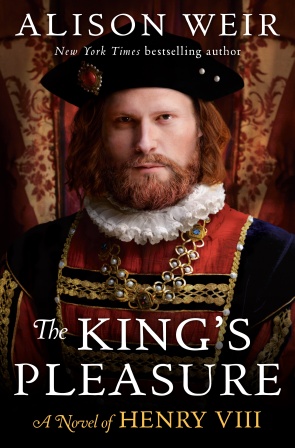 When we think about the Tudor dynasty, we often focus on the women in King Henry VIII’s life and his children, at least when it comes to novels. Writing about this larger-than-life figure, this notorious king and controversial figure in English history, are usually considered ambitious. Few have attempted to write a book about the king’s entire reign, but Alison Weir has embarked on this endeavor in her latest novel, “The King’s Pleasure: A Novel of Henry VIII.”
 When one studies a specific dynasty, we tend to focus on the stories of those who rule their respective countries and explore the men who influenced the king’s decisions. A dynasty’s legacy tends to be viewed from the military and legal victories of the men, but just as important are the women who stood beside the king. Royal women tend to be considered side characters of the dynasty who were only crucial for their inheritance, who they married, and the children they could produce. But if we focused on the story of the royal women in a specific dynasty, what could we learn about the dynasty? Amy Licence took this concept to explore women’s voices and decided to tackle the Tudor dynasty in her latest book, “Tudor Roses: From Margaret Beaufort to Elizabeth I.”
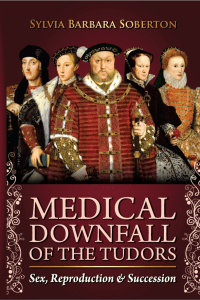 Today, I would like to welcome Sylvia Barbara Soberton to my blog as part of the book tour to promote her latest book, “Medical Downfall of the Tudors”, which is available now.
 The year 1540 during the reign of Henry VIII was a turbulent time. Henry’s new wife, Anne of Cleves, is not exactly the person who he imagined and his eye is starting to wander to a new woman, Katherine Howard. The reformers are starting to lose favor with the king as they and Catholics alike are being executed for treason. This is the London that Matthew Shardlake, our favorite hunchback lawyer turned detective, calls home. He thinks that he has retired from his detective work and serving Thomas Cromwell, but he is sadly mistaken. His next adventure has twice the number of cases and just as much danger that makes his trip to the monastery in “Dissolution” look easy. In the second book of the Shardlake series, “Dark Fire”, C.J. Sansom turns up the heat, the action, and the danger.
 A foreign princess who travels to England to marry the king to establish a strong political alliance. To those who study history, this is a story that has been told numerous times, but what makes this particular story unique is the people involved. The bridegroom was the recently-widowed Henry VIII, the shadow of his former self and notorious throughout Europe for having his second wife Anne Boleyn executed. His new bride to be is the German princess Anna of Kleve. To say that they did not see eye to eye would be an understatement as the marriage did not last long. Her story is often swept under the rug. Anna is often viewed as the “lucky” wife of Henry VIII, but was she? What was Anna’s story and what was her marriage with Henry really like? Alison Weir has taken up the challenge to give her readers a taste of what Anna’s life might have been like in this novel, “Six Tudor Queens: Anna of Kleve, Queen of Secrets”.
 The children of Henry VIII have been the center of historical studies for centuries. Edward VI, Mary I, and Elizabeth I were all considered Henry’s “legitimate” children and were able to obtain the crown of England. Henry Fitzroy was the illegitimate son of the king, but he was still able to gain titles and a good marriage before he died. They all had something in common; they were all recognized by their father, Henry VIII. However, there was another child who many believed to have been the daughter of the king. The name of this intriguing lady was Lady Katherine Knollys and her story comes to life in Sarah-Beth Watkins’ book, “Lady Katherine Knollys- The Unacknowledged Daughter of King Henry VIII”.
 Adventures of a Tudor Nerd