Book Review: “Heroines of the Tudor World” by Sharon Bennett Connolly

Heroines of the Tudor WorldThe world of the 16th century was full of change and equally colorful characters. Most of the dynamic figures of this century were women, who were willing to fight in their ways for what they believed in, whether it was family, faith, or their country. They were heroines in different ways, and each had a story to tell. Each woman had to deal with her obstacles to reach their desired goal, no matter what her station was, from queens and great heiresses to nuns, and even a pirate. Sharon Bennett Connolly has decided to include a handful of these stories in her latest book, “Heroines of the Tudor World.”

I would like to thank Amberley Publishing for sending me a copy of this book. I have been a fan of Sharon Bennett Connolly’s books on medieval women, so when I heard that she was going to tackle the 16th-century and the Tudor world, I knew I wanted to read it. I wanted to see what stories she would select and how far into the Tudor world she would explore.

Connolly begins her book by explaining how the 16th century differed from the medieval times as records about women were becoming more accessible. It was also a time of transition, reformation, and the discovery of the “new world.” Each chapter focuses on a different kind of woman; from the ideal to martyrs for their faiths, scandalous heroines, those who were disinherited, pawns in the bigger game of life, warriors, captives, and survivors. Although it can be difficult to place certain tales of women in just one category, Connolly gave her readers a thrilling look into the 16th century.

It was the stories of these extraordinary women who made this book an exceptional read. There are the typical women who are featured heavily in these kinds of narratives; Elizabeth of York, Margaret Beaufort, the wives of Henry VIII, Mary I, Elizabeth I, Mary Queen of Scots, and Catherine de Medici. However, Connolly decided to include lesser-known women. We have mistresses like Diane de Poitiers and spies like Margaret Dymoke, Lady Coffin. Some great heiresses were disinherited like Claude of France and Elizabeth Fitzgerald, as well as pawns like Marguerite de Valois and captives such as Lady Katherine Gordon and Honor Grenville, Lady Lisle. Of course, some women decided to take matters into their own hands and fight for what they believed in, such as Isabella of Castile, Jeanne d’Albret Queen of Navarre, and Grace O’Malley.

I thoroughly enjoyed learning about the heroines that Connolly included in this book, but my only complaint is that it was not a longer book. There are so many interesting women outside of the European world in the 16th century and I wish she would have highlighted them. Maybe Connolly will write a sequel book to this one to include even more Tudor heroines. If you have enjoyed Sharon Bennett Connolly’s previous books and you are a Tudor nerd, I highly suggest you read, “Heroines of the Tudor World.”
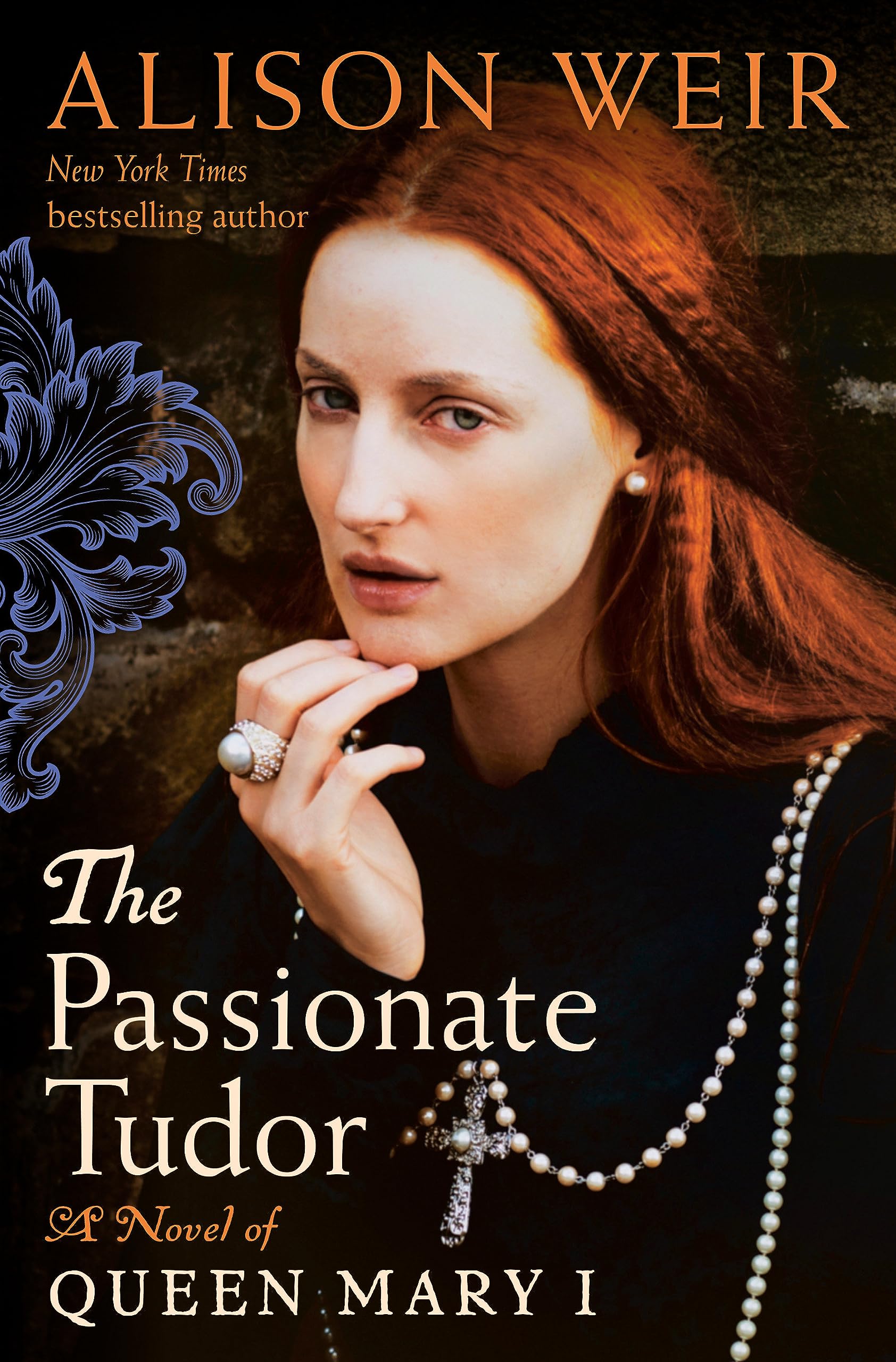
Book Review: “The Passionate Tudor: A Novel of Queen Mary I” by Alison Weir

The Passionate TudorA king’s eldest child is usually the next in line to inherit the throne and become the next ruler. At least that is how the line of succession is supposed to work if the heir is male. Mary I knew this better than anyone. As the eldest daughter of King Henry VIII, she knew that once her mother Katherine of Aragon had a son, Mary would become a pawn in the marriage game. She was willing to accept this fate until her father fell in love with Anne Boleyn. Mary is declared a bastard and must fight for her inheritance and the crown of England while maintaining her Catholic faith. Alison Weir tells the tale of this remarkable woman, from her tumultuous childhood to her short reign that marked her legacy, in her latest novel, “The Passionate Tudor: A Novel of Queen Mary I.”

I would like to thank Ballantine Books and Net Galley for sending me a copy of this book. I have enjoyed the previous novels in The Tudor Rose trilogy by Alison Weir about Elizabeth of York and King Henry VIII, so when I heard she was writing a book about Mary I, I knew I wanted to read it. Mary I is one of those figures who shows how devastating it can be to be close to the throne and the hard decisions one makes when king or queen of a country.

Weir began her novel with Mary at the age of nine in 1525. She is her parent’s pride and joy as she is their only child. Her mother Katherine of Aragon is arranging an advantageous marriage for Mary that would create a strong alliance for England. Not even the birth of her half-brother Henry Fitzroy could dampen Mary Tudor’s spirits. However, that all changed when Anne Boleyn entered the picture and the Great Matter was made public. Katherine of Aragon is no longer queen, Anne Boleyn is Mary’s stepmother, and Mary is now declared a bastard in favor of her half-sister Elizabeth Tudor.

Mary’s life after the birth of Elizabeth Tudor begins to become even more tragic. Her mother Katherine of Aragon dies before she can see her daughter again and Anne Boleyn is executed for treason soon afterwards. Henry VIII marries Jane Seymour, has his desired male heir Edward VI, before Jane tragically dies quickly. As the Supreme Head of the Church of England, Henry wants his daughter Mary, a devout Catholic, to submit to his will, which she ultimately does. We also get to see how Mary interacted with her other stepmothers, Anna of Cleves, Katherine Howard, and Katherine Parr, until the death of her father Henry VIII. Before he died, Henry VIII revised his Act of Succession, making Mary Edward’s heir if he did not have children. However, Edward VI has his idea for who will succeed him after he dies and he names Lady Jane Grey as his heir, although that plan does not last long and Mary is proclaimed the first queen of England to rule on her own.

Weir shows Mary’s life and reign in a very sympathetic way. Even though she does still give her the nickname “Bloody Mary”, we can see a woman who is concerned about the faith of her kingdom and the well-being of her family, especially Edward, Prince Philip her husband, and Elizabeth, who she argues with on matters that matter to her. It is such a tragedy that Mary never had a child that she desperately wanted to have as she suffered through phantom pregnancies. At the end of the day, whether it was matters of faith or family, Mary was someone who was passionate and someone who desired to be loved.

This is a delightful novel about a woman who has often been vilified but maybe we should have sympathy for everything she had to endure starting at a young age. I enjoyed this novel very much and I look forward to the next novel by Weir. If you have enjoyed the previous books in the Tudor Rose trilogy or you just want a different take on Mary I’s story, I highly suggest you read, “The Passionate Tudor: A Novel of Queen Mary I” by Alison Weir.

Book Review: “Wolf Hall” by Hilary Mantel

Wolf HallThe 1520s in England were a raucous time. As the years pass, King Henry VIII’s desire for a legitimate son grows and his resentment towards his wife Katherine of Aragon increases. Henry has decided to divorce his wife of over 20 years to marry a new fling, Anne Boleyn, who would surely give him the son and heir. All of Europe, especially the Pope, is horrified at the direction Henry is taking, but one man stands firmly on the side of the King. Thomas Cromwell rose through the ranks to become Henry VIII’s right-hand man, even though he had rather humble origins. Can Thomas Cromwell help the man who made him and survive the king’s wrath? Hilary Mantel explores the origins of Cromwell’s rise and The Great Matter in the first book in her Thomas Cromwell trilogy, “Wolf Hall.”
“Wolf Hall” is a novel that I have meant to read for a while now. I have heard from the Tudor community how great this novel is plus I saw the advertisements for the television show of the same name. I just never picked it up until I went into a used bookstore, saw it on a shelf, and decided to give it a try.

We are introduced to our main protagonist Thomas Cromwell, getting beaten bloody by his father, a drunkard blacksmith, Walter Cromwell. His childhood is harsh, but his sister Kat and her husband Morgan Williams convince Thomas to run away from his home. Thomas becomes a soldier fighting for the French and spends some time in Italy before he goes back to his native England to become a lawyer, working his way up to work with Cardinal Thomas Wolsey. Thomas Cromwell married Liz Wykys and had three children; Gregory, Anne, and Grace. The first part of the book focuses on Cromwell’s service to Wolsey, Wolsey’s fall from grace, and the tragic deaths in his family.

The majority of this novel focuses on Cromwell’s rise in power to become King Henry VIII’s right-hand man. The main issue that Cromwell must focus on is The Great Matter, the divorce of King Henry VIII from his first wife Katherine of Aragon so that he could marry Anne Boleyn. It is a taboo topic, but Henry realizes that the Pope will not go with his plan. While navigating the tumultuous Tudor court and his home life, Cromwell also has to come up with a plan to make Anne Queen of England and Henry the Supreme Head of the Church of England. A tall task for anyone, but this is Cromwell, a man who will do whatever it takes to succeed.

Reading this particular novel was a struggle for me, not because of the contents, but rather Mantel’s unique writing style. It took me a long time, almost 200 pages, to get into this novel and become invested in the story. There were points in reading this novel where I wanted to give up and wait until I had access to the audiobook to try again, but I chose to keep reading. Once I did get invested in Cromwell’s tale and the ones who surrounded the powerful figure, I was hooked. I think if the beginning was not so convoluted, this would have been an almost perfect novel, except for how she portrayed figures like Mary Boleyn, Jane Rochford, and George Boleyn, which I did not agree with, but that is my own opinion.

This novel is an arduous adventure, but it almost mirrors the same rigorous journey Cromwell took from the son of a drunkard blacksmith to one of the most powerful men in Tudor England. I think I need to take a break from this trilogy to truly digest what I have read before tackling the other two books, but I understand why Mantel and this novel are so beloved in the community. If you want to tackle this book, I would suggest taking your time in the first two hundred pages of this novel before you dive in completely. “Wolf Hall” by Hilary Mantel is a uniquely complex yet unforgettable look at Thomas Cromwell and the Tudor era that will make you question if you know the truth of Cromwell’s story.

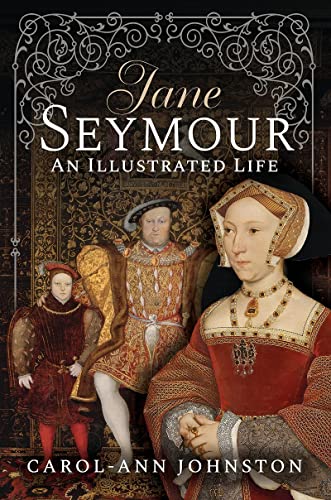
Book Review: “Jane Seymour: An Illustrated Life” by Carol-Ann Johnston

Jane SeymourKing Henry VIII’s six wives each have their unique story that transcends time. Katherine of Aragon was his first wife, the mother of Mary Tudor, and the one Henry left behind after 24 years to marry his mistress Anne Boleyn, the most famous of his wives and the mother of Elizabeth Tudor. Anna of Cleves had the shortest marriage to Henry VIII and ended up with an excellent annulment deal. Catherine Howard was young and a bit naive when it came to the ways of men, which led to her downfall while Catherine Parr survived until the end of Henry VIII’s reign. These five women are stories we know by heart, but the one whose story remains a mystery is Jane Seymour, Henry’s third wife, and the mother of the future King Edward VI. In her debut book, “Jane Seymour: An Illustrated Life” Carol-Ann Johnston tells the story of the wife who gave Henry his desired son.

I want to thank Pen and Sword Books and Net Galley for sending me a copy of this book. Jane Seymour is someone who I have wanted to learn more about ever since I started studying the Tudors. When I heard that the founder of the Jane Seymour- Henry VIII’s Third Wife was turning her research into a book, I knew I wanted to read it.

Johnston begins by tracing the origins of the Seymour family to the town of Touraine, Saint-Maur-sur-Loire, and a man named Richard de St. Maur from the 7th and 8th centuries. She then traces the family to John Seymour, the Sheriff of Hampshire, the one who inherited Wolf Hall, and the grandfather of Jane Seymour. Johnston also explores how Jane Seymour, Anne Boleyn, and Catherine Howard were related, as they were all half-second cousins. Sir John and Margery Seymour had a large family with at least 9 children including Jane, Thomas, and Edward, who would play important roles in the Tudor court.

The bulk of this particular book explores the time Jane Seymour spent at the Tudor court, starting with her time with Katherine of Aragon, exploring her relationship with Anne Boleyn, and finally her time as Queen of England. We get to see how she dealt with big events in the reign of Henry VIII like the Great Matter, the rise and fall of Anne Boleyn, the Pilgrimage of Grace, and the Dissolution of the Monasteries. Johnston also explores what made Jane Seymour famous, the birth of her son Edward VI and her death a matter of days afterward.

For her debut book, I think Johnston does a decent job telling Jane Seymour’s story for a modern audience with lovely photographs of ways she was remembered through art and architecture. There were some really interesting facts about Jane’s life that I did not know about including her family’s origin and her suitor before Henry, but a lot of this felt like information that I already knew from other books. I think it would be nice if Johnston does write another book that she focuses on the origins of the Seymour family because it covers centuries of English history and I am sure there are some intriguing tales in their family tree.
Overall, I enjoyed this book and the information I learned from reading it. If you want to learn more about Jane Seymour’s life and her family, I recommend reading, “Jane Seymour: An Illustrated Life” by Carol-Ann Johnston.

Book Review: “Arthur, Prince of Wales: Henry VIII’s Lost Brother” by Gareth Streeter

Arthur Prince of WalesThe tales of the Tudor kings are unique in how they became kings of England. We all know the story of how Prince Henry became King Henry VIII. His eldest brother, Prince Arthur, died shortly after he married the Spanish Princess Katherine of Aragon. Much has been discussed about Arthur’s wedding night and death, but not much has been written about his time as the Prince of Wales. In his debut book, “Arthur, Prince of Wales: Henry VIII’s Lost Brother” Gareth Streeter explores the life of the first Tudor prince.
I want to thank Pen and Sword Books and Net Galley for sending me a copy of this book. Prince Arthur has been mentioned in numerous accounts of the Tudors, but it is very rare for a book to focus on the young prince. I wanted to see what new information Streeter would bring to the story of the crown prince who would never become king.

Streeter begins his book by exploring the origins of the Tudor line and the significance of King Arthur and ancient Briton kings like Brutus and Cadwaladr. He then dives into the birth and baptism of Prince Arthur, which shows a lot of symbolism that the Tudors wanted to employ to establish their young dynasty. During the part about the baptism of the young prince, Streeter gives his audience a bit of background on those in attendance and the Wars of the Roses.

Most of this book focuses on Arthur’s life as the crown prince and the Prince of Wales, including the duties he was expected to take on. As the heir to the young Tudor dynasty and the son of King Henry VII and Queen Elizabeth of York, he was the hope of the entire country. Unfortunately, the pretenders Perkin Warbeck and Lambert Simnel threatened the fragile peace that Henry VII established. Amid the pretender drama, we see the young prince’s education and the arduous marriage negotiations between Spain and England. Finally, Streeter discusses the relationship between Arthur, Katherine of Aragon, and his family, until his untimely death, which left England with Henry VIII as the only heir to the Tudor dynasty.

For a debut, Streeter has done a great job presenting how he views Prince Arthur’s life and showing new information that Tudor fans alike will find fascinating. As Streeter has said in this book, Prince Arthur was more than just a prince who died. He did live, and his life as the first Tudor prince set the standard for King Henry VIII and Edward VI after him. I thoroughly enjoyed learning about Prince Arthur and look forward to reading the next book Gareth Streeter writes. If you want to learn more about the Tudor prince who never became king, I recommend reading “Arthur, Prince of Wales: Henry VIII’s Lost Brother” by Gareth Streeter.

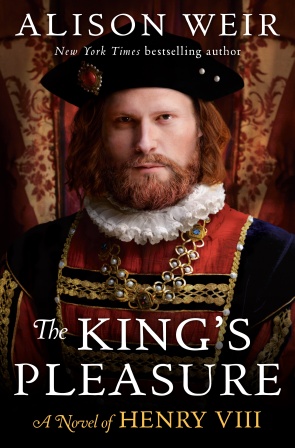
Book Review: “The King’s Pleasure: A Novel of Henry VIII” by Alison Weir

The King's PleasureWhen we think about the Tudor dynasty, we often focus on the women in King Henry VIII’s life and his children, at least when it comes to novels. Writing about this larger-than-life figure, this notorious king and controversial figure in English history, are usually considered ambitious. Few have attempted to write a book about the king’s entire reign, but Alison Weir has embarked on this endeavor in her latest novel, “The King’s Pleasure: A Novel of Henry VIII.”

I want to thank Ballantine Books and Net Galley for sending me a copy of this novel. I have not read many books about the reign of King Henry VIII, except for “The Autobiography of King Henry VIII” by Margaret George, so when I heard that Alison Weir was writing a novel about the titular king, I knew I had to read it.

Weir begins her novel with a moment that must have been difficult for young Prince Henry or Harry as he is referred to in this book. His brother died recently, and his beloved mother, Elizabeth of York, just died, leaving Henry as King Henry VII’s only heir. Henry does not have the best relationship with his father, but he now must fill the void as the heir apparent after Arthur died, leaving his young wife, Katherine of Aragon, a widow. When King Henry VII died, Henry became King Henry VIII and selected a woman he had fallen for to become his queen, Katherine of Aragon.

The bulk of this novel revolves around the relationships between Henry and his first two wives, Katherine of Aragon and Anne Boleyn. Weir is sympathetic toward Katherine of Aragon’s struggles, whereas her portrayal of Anne Boleyn may come across as a bit harsh. Jane Seymour is portrayed as a quiet and obedient queen, and Anna of Cleves’ focus is more on her looks and how Henry treated her more as a sister than a wife. Katherine Howard is someone Henry falls for hard and is devastated by her downfall, and Katherine Parr is the firebrand reformer who wants to heal Henry’s family at the end of his life.

Weir also touches on the complex political web that Henry was involved in, not just in England but European politics of the 16th century. We also see how Henry interacted with his children and how the emotional weight of all of his decisions weighed on him.

I think for how much of a challenge it is to write a novel about King Henry VIII, Alison Weir has done an admirable job in the king’s portrayal. I don’t necessarily agree with how some of the queens were portrayed, but I did enjoy this novel as a whole. I would suggest reading this novel before the Six Tudor Queens series to understand Henry’s perspective before his wives’ stories. If you have enjoyed the latest books about Henry VIII’s wives and his mother, Elizabeth of York, you should read “The King’s Pleasure: A Novel of Henry VIII” by Alison Weir.

Guest Post: “Spotlight for ‘A Matter of Faith’ by Judith Arnopp

Today, I am pleased to welcome Judith Arnopp to my blog to share the blurb from her latest novel, “A Matter of Faith.” I would like to thank Judith Arnopp and The Coffee Pot Book Club for allowing me to be part of this tour. 
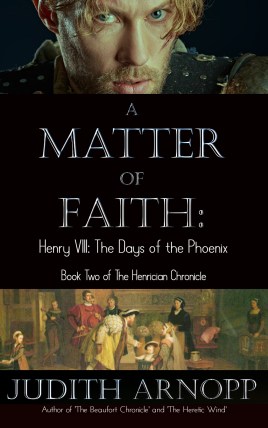
Blurb:

Finally free of Catherine of Aragon, Henry VIII is now married to Anne Boleyn and eagerly awaiting the birth of his son. In a court still reeling from the royal divorce and growing public resentment against church reform, Henry must negotiate widespread resentment toward Anne. He places all his hopes in a son to cement his Tudor bloodline, but his dreams are shattered when Anne is delivered of a daughter.

Burying his disappointment, Henry focuses on getting her with child again, but their marriage is volatile, and as Henry faces personal bereavement and discord at court, Anne’s enemies are gathering. When the queen miscarries a son, and Henry suffers a life-threatening accident, his need for an heir becomes critical. Waiting in the wings is Jane Seymour, a lady-in-waiting who offers the king comfort and respite from Anne’s fiery passions.

But, when Anne falls foul of her former ally, Thomas Cromwell, and the king is persuaded he has been made a cuckold, Henry strikes out, and the queen falls beneath the executioner’s sword, taking key players in Henry’s household with her. 

Jane Seymour, stepping up to replace the fallen queen, quickly becomes pregnant. Delighted with his dull but fertile wife, Henry’s spirits rise even further when the prince is born safely. At last, Henry has all he desires, but even as he celebrates, fate is preparing to deliver one more staggering blow. 

Henry, the once perfect Renaissance prince, is now a damaged middle-aged man, disappointed in those around him but most of all in himself. As the king’s optimism diminishes, his intractability increases and the wounded lion begins to roar.

Buy Links:

This title is available to read on #KindleUnlimited. 

Universal Link: http://mybook.to/amofaith 

Amazon UK: https://www.amazon.co.uk/dp/B0BWF2WL1Q 

Amazon US: https://www.amazon.com/dp/B0BWF2WL1Q 

Amazon CA: https://www.amazon.ca/dp/B0BWF2WL1Q 

Amazon AU: https://www.amazon.com.au/dp/B0BWF2WL1Q 

Author Bio: 

When Judith Arnopp began to write professionally, there was no question about which genre to choose. A lifelong history enthusiast and avid reader, Judith holds an honors degree in English and Creative writing and a Masters in Medieval Studies from the University of Wales, Lampeter. 

Judith writes both fiction and non-fiction, working full-time from her home overlooking Cardigan Bay in Wales, where she crafts novels based on the Medieval and Tudor periods. Her primary focus is on the perspective of historical women from all life roles, from prostitutes to queens, but she has recently turned her attention to Henry VIII himself.

Her novels include: 

A Matter of Conscience: Henry VIII, the Aragon Years. (Book one of The Henrician Chronicle)

A Matter of Faith: Henry VIII, the Years of the Phoenix (Book Two of The Henrician Chronicle)

The Beaufort Bride: (Book one of The Beaufort Chronicle)

The Beaufort Woman: (Book two of The Beaufort Chronicle)

The Kings Mother: (Book three of The Beaufort Chronicle)

The Heretic Wind: the life of Mary Tudor, Queen of England

A Song of Sixpence: The Story of Elizabeth of York

Intractable Heart: The Story of Katheryn Parr

The Kiss of the Concubine: A Story of Anne Boleyn

Sisters of Arden: on the Pilgrimage of Grace

The Winchester Goose: at the court of Henry VIII

The Song of Heledd: 

The Forest Dwellers

Peaceweaver

Her non-fiction articles feature in various historical anthologies and magazines, and an illustrated non-fiction book, How to Dress like a Tudor, will be published by Pen & Sword in 2023.

Social Media Links:

Website: https://www.judithmarnopp.com

Blog: http://juditharnoppnovelist.blogspot.co.uk/

Twitter: https://twitter.com/JudithArnopp

Facebook: https://www.facebook.com/thetudorworldofjuditharnopp

LinkedIn: https://www.linkedin.com/in/judith-arnopp-ba999025/

Instagram: https://www.instagram.com/tudor_juditharnopp/ 

Book Bub: https://www.bookbub.com/authors/judith-arnopp

Amazon Author Page: http://author.to/juditharnoppbooks 

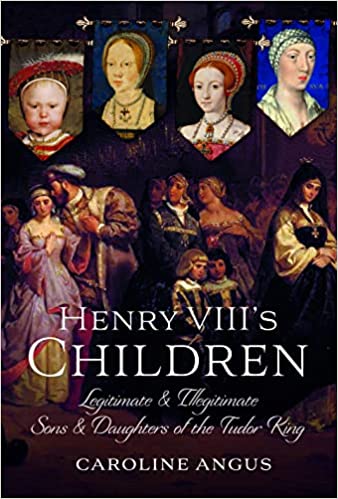
Book Review: “Henry VIII’s Children: Legitimate and Illegitimate Sons and Daughters of the Tudor King” by Caroline Angus

Henry VIII childrenWhen we think about the title royal children, images of children who get whatever they want, being spoiled with gems and gowns, and ruling kingdoms, they are married to create alliances. In that sense, it would define a life of luxury. However, for the children of King Henry VIII, luxury was not always in their dictionary. What was life like for the legitimate and illegitimate children of Henry VIII? Caroline Angus explores this question in her latest book, “Henry VIII’s Children: Legitimate and Illegitimate Sons and Daughters of the Tudor King.”
I want to thank Pen and Sword Books and NetGalley for sending me a copy of this book. I have read quite a few books about the children of Henry VIII, so when I saw the title, I was interested to see what new information Angus would provide in her book.

To understand why Henry VIII desired a large family, especially male heirs, Angus explores Henry’s childhood as the second son of Henry VII and Elizabeth of York. We then transition to the marriage of Henry and Katherine of Aragon and her multiple miscarriages until her beloved daughter Mary was born. After Mary, Angus explores the relationships of Henry VIII with Bessie Blount, Anne Boleyn, and Jane Seymour and his other children that were recognized as his own, Henry Fitzroy, Elizabeth, and Edward, respectively.

What I enjoyed in this book is the amount of information that Angus provided about not only Henry’s legitimate children but his illegitimate children, primarily the information about Henry Fitzroy. For so long, Henry Fitzroy was a footnote in the Henry VIII story, but it is so fascinating how much he relied on his eldest son even though he was illegitimate. Then, you have Mary’s upbringing compared to Elizabeth’s, and you see how much of a struggle it was to be a daughter of Henry VIII instead of a treasured son.

Angus also included a section about children who many questioned if they were indeed illegitimate children of the king, including the children of Mary Boleyn. She also included some Tudors I had never heard about, which was interesting to read about how their life experiences differed from their royal counterparts. The king’s legitimate and illegitimate children dealt with so much pain and suffering because of who their dear old dad was, and they all craved a little bit of his love in return.

Angus has done an excellent job telling the tales of the rather sad upbringings of the children of Henry VIII. A crown and a king as a father did not mean your life was a fairy tale. By understanding their childhoods, we can understand why the Tudor children became strong-willed leaders. If you want an excellent book that gives you a glimpse into what it meant to be a child of a monarch during the Tudor period, check out, “Henry VIII’s Children: Legitimate and Illegitimate Sons and Daughters of the Tudor King” by Caroline Angus.

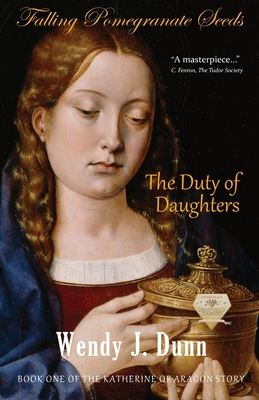
Book Review: “Falling Pomegranate Seeds: The Duty of Daughters” by Wendy J. Dunn

the duty of daughtersA young Spanish princess sits with her close friend, sisters, and brother as their beloved tutor, Dona Beatriz Galindo, tells them a story. As the children of Ferdinand of Aragon and Isabel of Castile, they must marry and create alliances to strengthen their kingdoms, while Beatriz must ensure they are ready for the challenge. Childhood ends rather quickly with a holy war against the Moors, the expulsion of the Jews from the kingdom, and death around every corner. In her novel, “Falling Pomegranate Seeds: The Duty of Daughters,” Wendy Dunn transports readers into a world of hope and sorrow, life and death.
After I read the second book in the Falling Pomegranate Seeds series, “All Manner of Things,” I wanted to read the book that started it all. There have not been many Tudor novels about Katherine of Aragon’s childhood, so I was curious what Dunn would bring to her story as a whole.

Our adventure into the house of Trastamara in Spain begins with Dona Beatriz Galindo being called to Isabel’s chambers. The two women deeply connected as Beatriz taught the queen Latin and tutored her children; Isabel, Prince Juan, Juana, Maria, and Catalina. Now, Isabel has given Beatriz the task of teaching her youngest daughter Catalina how to be Queen of England. Alongside Catalina, Beatriz would teach her companion Maria de Salinas, how best to serve Catalina in their new kingdom.

Beatriz’s relationship with her royal students throughout the novel evolves through trials and tribulations. Through the eyes of Beatriz, we get to see the fall of Granada and the treatment of the Jews during the reign of Ferdinand and Isabel. We also get to see Beatriz’s relationship with the love of her life Francisco Ramirez through letters that she writes to him as he is away at war against the Moors. We are also introduced to Cristobal Colon, also known as Christopher Columbus, as he begs permission to travel to the New World.

At the heart of this novel are the children of Ferdinand and Isabel as they grow up and marry, sometimes moving away. Marriage does not always provide happy endings, as we see with Alfonso, Prince of Portugal, and Margaret of Austria. Death and grief run rampant in the once glorious court as the children grow up quickly. Secrets tear the foundations of this family asunder, but love still overcomes sadness.

Dona Beatriz Galindo may have been just a tutor to the royal family, but Dunn has elevated her tale to one of great significance. Beatriz is a strong, independent woman who fights for those she loves. This sensational novel brilliantly gives Tudor readers a better understanding of what Katherine of Aragon’s childhood might have been like through the eyes of her royal tutor. If you want a novel showing how Katherine of Aragon became the strong queen she was and the women who raised her, I highly recommend you read “Falling Pomegranate Seeds: The Duty of Daughters” by Wendy J. Dunn.

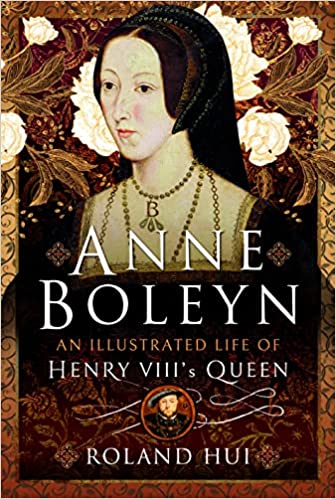
Book Review: “Anne Boleyn, An Illustrated Life of Henry VIII’s Queen” by Roland Hui

Anne Boleyn IllustratedThe wives of King Henry VIII have been discussed for centuries in length through novels and nonfiction books. Katherine of Aragon, Jane Seymour, Anna of Cleves, Catherine Howard, and Catherine Parr are all very popular queens, but there is one that you have all been waiting for, the most famous Tudor queen, Anne Boleyn. Her story has been told so many different ways by historians and historical fiction authors for centuries, and now it is time for another historian to write their spin on her story. In his latest book, “Anne Boleyn, An Illustrated Life of Henry VIII’s Queen,” Roland Hui paints a picture of the tumultuous life, love life, and death of Anne Boleyn.

Thank you, Pen and Sword Books and Net Galley, for sending me a copy of this book. I am always looking for a new approach to the lives of the Tudors in books, and when I heard about this title, it caught my eye.

Like so many books about Anne Boleyn, this biography covers Anne’s childhood, her reign and rocky relationship with Henry VIII, her tragic downfall, and her gruesome execution. Hui begins with the origins of the Boleyn family and Anne Boleyn’s childhood. I am glad Hui decided to focus on Anne’s upbringing in the court of Margaret of Austria because this is the aspect that I was always curious about when it came to Anne. We often talk about how the French court shaped Anne’s upbringing, but Hui shows his readers that the Burgundian court was just as transformative and impacted her life.

This book focuses on the relationship between Anne and Henry VIII and how she helped influence his reign, especially regarding religious matters. With the Great Matter and the creation of the Church of England alongside the rise of the English Reformation, we see Anne Boleyn’s opinions on religious matters. Anne had books written by humanists and reformers like Jacques Lefevre d’Etaples, Johannes Brenz, Simon Fish, and William Tyndale. She also surrounded herself with men like Nicholas Bourbon, Hugh Latimer, Nicholas Shaxton, William Betts, William Latymer, and John Skip. Finally, Hui discusses how Anne Boleyn fell from her husband’s good favor and was executed.

This is an excellent book to introduce people to the story of Anne Boleyn, as you can easily read it in one sitting. I found some of the material in this book repetitive compared to other books about Anne Boleyn, but Hui does lift it with new facts and the images he includes in this book. Overall, I did enjoy the new information Hui had in his nonfiction book. If you are a fan of Anne Boleyn and want to learn new facts about her life, I suggest you check “Anne Boleyn, An Illustrated Life of Henry VIII’s Queen” by Roland Hui.