
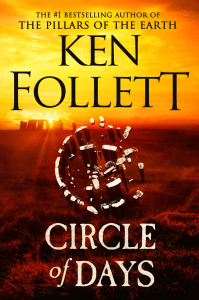
 Stonehenge, a marvel of the ancient world that still stands centuries after it was built. It has been the center of mystery and wonder for all who gaze upon it. A gigantic monolithic structure, whose purpose has been a source of discussion since its origins, but that raises another quandary: who were the people who built such an impressive landmark? This single question presents a grand opportunity for historical fiction writers as we don’t have many written records for this period of time, which means authors have room to play. Ken Follett took on the daunting task of telling the tales of those who built this imposing monument in his latest novel, “Circle of Days.”
I would like to thank Grand Central Publishing and Net Galley for sending me a copy of this novel. I have been a fan of Ken Follett’s historical fiction novels since I read “A Column of Fire” and then the first two books of the Kingsbridge series, “The Pillars of the Earth” and “World Without End.” A bit out of order, but I am loving that series. When I heard that he was writing a brand new historical fiction novel about Stonehenge, it was such an intriguing idea that I knew I wanted to read it.
Like Follett’s previous historical fiction novels, he focuses on several protagonists from different walks of life to create a cohesive story. In the case of this novel, the three main groups; herders, farmers, and woodlanders. Seft, our first main character, is a bit of an outsider. He is the son of a miner who abuses him, but Seft yearns to start a new life and he wants to build things that will help his community. Seft falls in love with a herder girl named Neen, the daughter of a herder elder named Ani. Neen’s sister Joia is a priestess who dreams of a stone monument so that they can keep their traditions alive for generations.
The dreams of Seft and Joia are ambitious in nature, especially because there are those who want to stay in the old ways instead of moving forward. They include Cog, Seft’s abusive father who wants Seft to remain a minder the rest of his life, Troon, the leader of the farmers who refuses to work with the herders and is the enemy of Scagga, an elder of the herders, and finally Baz, once an ally but who turned into an enemy when disaster strikes. From drought and famine to raids and wars, the people of the Great Plains fight for what they believe in while falling in love, starting their own families, and striving to fulfill their ambitions in life.
This is another masterpiece by Ken Follett. Not only are the characters so dynamic, but their world feels so believable. You can tell Follett was meticulous when it came to the research as he made the world of 2500 BC vibrant and so real. I would have liked to have seen a historical note at the end of this particular novel to explain how he was able to create this ancient world. Overall, I loved every moment of this book and I was genuinely sad when it came to an end. I cannot wait to see what Follett will write about next. If you are a fan of Ken Follett or just want a historical fiction novel that explores one of England’s oldest monuments, I highly recommend you read “Circle of Days.”
 April 15, 2019, will be a dark day for Paris and the world. We watched in horror as the magnificent Notre Dame Cathedral burned. For centuries, it stood as the symbol of medieval Paris, and in minutes, it was engulfed in flames. While so many of us felt helpless, Ken Follett decided to do something to help rebuild the great cathedral. He wrote this book, “Notre Dame: A Short History of the Meaning of Cathedrals,” with the proceeds going to the charity La Fondation du Patrimoine.
 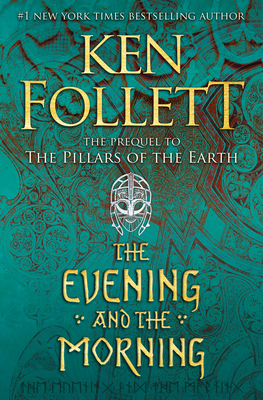 The year is 997 and England is in a dire situation. Fears of invasions from the Welsh and the Vikings leave the Anglo- Saxon residents rattled while those in power take advantage of their citizens. Chaos reigns supreme as those who rule the towns are in constant power struggles between themselves and their king, Ethelred the Unready, with the average villagers caught in the middle, like the villagers of Dreng’s Ferry. It is in this small village where three characters find their lives intertwined with the political and social drama. A young boatbuilder named Edgar endures heartache and sorrow when the Vikings attack his home. A Norman noblewoman named Ragna follows her heart to marry the man she loves and travels to a faraway land but soon finds out how difficult that love can be. Finally, a monk named Aldred works hard for the people while dreaming of transforming his meek abbey into a lively center of learning. Their tales are masterfully woven together in the much-anticipated prequel to the Kingsbridge series by Ken Follett. This is “The Evening and the Morning”.
  known as the Hundred Years’ War, and the massively destructive illness that we know today as either “the Black Death” or “the Black Plague”. This was a time of despair, but it was also a time where we see a shift from old traditions of the church and the state. It is also two centuries after the events of Ken Follett’s massively popular book, “The Pillars of the Earth”. Follett explores how the people of Kingsbridge survived during this tumultuous time in his second book of the Kingsbridge series, “World Without End”.
 When one thinks about epic tales stories of adventures and romance tend to come to mind. One hardly thinks about the construction of a magnificent building as an “epic tale” with monks and builders as the main characters. We see cathedrals as these massive buildings from the past used as churches, but we rarely think about how they were constructed and why. Who were the people who decided to make these spectacular buildings and what might have their lives have been like? These are just some of the questions that Ken Follett wanted to try and answer in his monumental historical fiction masterpiece, “The Pillars of the Earth”.
 After the death of Henry VIII and Edward VI, there was an explosion of religious intolerance, not just in England, but in Europe as a whole. Many believe that it was Mary I “Bloody Mary” who really started this trend, however, the fires of hatred between Protestants and Catholics extended further into the reigns of Elizabeth I and James I of England. We often focus on the monarchs and their inner circles during this time and how the religious persecutions affected the decisions that they made. That tells only part of the story, but how did this religious fighting between Protestants and Catholics affect the normal person? What were their lives like? Ken Follett explores this topic in his third book in his historical fiction series, the Kingsbridge Series, “A Column of Fire”.
  Adventures of a Tudor Nerd