
Book Review: “The Palace: From the Tudors to the Windsors, 500 Years of British History at Hampton Court” by Gareth Russell

The PalaceWhen we think of old homes, we often think of the phrase, “If walls could talk,” because the true treasure of any home is not the floorboards or the walls, but rather the stories of those who lived inside its walls. Take, for example, Hampton Court Palace in England. A home for over 500 years that has seen many architectural and artistic changes in its hallowed halls, but it is the stories of those who stayed for brief periods that truly make this palace spectacular. Stories full of salacious scandals, religious implications, and revelations that would shake England to its core through revolutions. Hampton Court Palace has been the center of English court drama for centuries and finally, these tantalizing tales are being told in a truly remarkable book, “The Palace: From the Tudors to the Windsors, 500 Years of British History at Hampton Court” by Gareth Russell.
I would like to thank Gareth Russell and Atria Books/Simon and Schuster, for sending me a copy of this book. I have enjoyed Russell’s previous biographies about The Queen Mother and Catherine Howard, so when I heard that he was writing a new book about Hampton Court Palace, I knew I wanted to read it.

Russell structures this book similarly to how he structured, “Do Let’s Have Another Drink” in that each chapter is a different tale from this palace’s half a century of history, which is a ton of historical fun to explore. He starts with a story of a ball attended by Elizabeth Windsor, soon to be Queen Elizabeth II, a few days before her coronation in 1953. Full of glitz and glamor, we soon transition to the origins of the land that Hampton Court Palace resides on and how the palace came to be after its humble beginnings as an estate for the Knights Hospitaller. It was not until the Wars of the Roses that the manor gained prominence under a favorite of Henry VII, Giles Daubeney, 1st Baron Daubeney.

By understanding how this phenomenal manor became a palatial palace, we can appreciate the stories that are the bulk of this book. Russell takes his readers through 500 years of English royal history, starting with the tumultuous Tudors, moving to the saucy Stuarts, the haughty Hanovers, the gossiping Georgians, and finishing with the worldly Windsors. Each chapter focuses on one character from each dynasty and one room of the palace.

While I was relatively well aware of the Tudor tales of Cardinal Wolsey, Catherine Howard’s run down the Haunted Gallery, and Mary I’s phantom pregnancies, it was the other dynasties that drew me into an engrossing book. The Stuarts especially shocked me with the colorful cast of characters who ranged from King James I with the King James Bible, Charles II and his many mistresses, and Oliver Cromwell. Russell shows the tragic moments, which included the death of several queens of England, the chaotic period known as the English Civil Wars, the creation of “The Tomb of the Unknown Warrior,” and the story of The Grand Duchess Xenia, the last living sister of Tsar Nicholas II. There are also stories full of art, scientific research, love, humor, and even chocolate and court life.

Russell’s narrative style of writing combined with his meticulous research has created another smash hit. I could not put this book down and I was very sad when I finished reading it, I did not want it to end. I don’t want to spoil much about this book, but it is my new favorite book by Gareth Russell. If you want a book full of fascinating history that you can binge-read, I highly suggest you read, “The Palace: From the Tudors to the Windsors, 500 Years of British History at Hampton Court” by Gareth Russell.

Book Review: “Penelope- Tudor Baroness” by Tony Riches

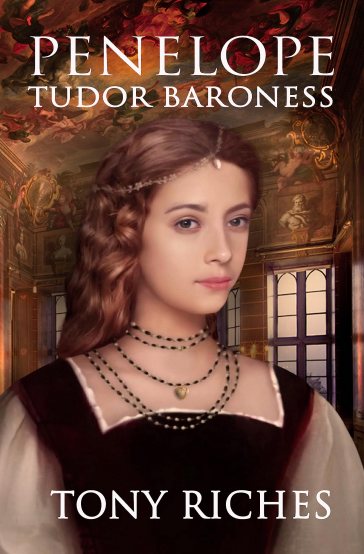
PenelopeIn a time when marrying for love was taboo, one woman took a stand to follow her heart no matter the consequences. Lady Penelope Devereux, the daughter of Lady Lettice Knollys and the step-daughter of Sir Robert Dudley understands how dangerous it is to defy the wishes of Queen Elizabeth I. Her mother and stepfather were banished from court for choosing to marry secretly, but this did not deter Penelope from pursuing love. A story spanning decades, full of love, intrigue, and plots galore, “Penelope- Tudor Baroness” by Tony Riches tells the tale of this remarkable woman and her family.
I would like to thank Tony Riches for sending me a copy of his latest novel. I have been a fan of Riches’ previous novels, which were written about male protagonists, so when I heard that he was writing a book about a Tudor woman, I was curious. I did not know much about Penelope’s life before this novel and I wanted to learn about her life.

Riches begins his novel with Penelope as a young woman going to work at court as a maid of honor for Queen Elizabeth I. It is a great honor as her parents were Lord Walter and Lady Lettice Devereux. To learn what it meant to be a maid of honor, she and her siblings went to the house of Catherine Hastings, Countess of Huntingdon. It seemed as if Penelope was destined for greatness, but it all came crashing down when her mother Lettice married the queen’s favorite, Sir Robert Dudley. A devastating blow for a young woman who wanted a role in the glittering Tudor court, but it did not deter her for long.

Penelope was a woman known for her beauty as she caught the attention of men like Anthony Bagot before she ever set foot in Elizabeth’s court. Her looks captured the attention of Sir Philip Sidney, who wrote the sonnet Astrophel and Stella in her honor. Sidney had her heart, but she would marry a man she did not love, Lord Rich. She is willing to risk everything for love, including her standing at court and the family she has with Lord Rich, but the man she risked it all for is not Sir Philip Sidney. The man who had Penelope’s heart for over 20 years was Charles Blount.

Penelope saw great change during her lifetime. She saw Elizabeth courting the Duke of Anjou and the attack of the Spanish Armada. She was in the middle of her brother’s failed rebellion against Queen Elizabeth, which was known as the Essex Rebellion. Penelope swore loyalty to King James I as Queen Elizabeth was approaching the end of her life and she was there as a lady of the bedchamber for Queen Anne of Denmark. Towards the end of her life, Lady Penelope Rich saw the impact of the Gunpowder Plot against King James I, her divorce from Lord Rich, and fighting for the rights of her children with Charles Blount.

Riches weaves a delightful tale of love, and loyalty to one’s family even amongst plots for power. Penelope was a strongly independent woman who fought for love and her family, even if that meant becoming enemies with the most powerful people in England. A remarkable woman who left her mark on both the Tudor and Stuart dynasties, Lady Penelope Rich took her life and legacy into her own hands. “Penelope- Tudor Baroness” by Tony Riches is a gorgeous novel that fans of Tudor and Stuart history will adore.

Book Review: “The Son that Elizabeth I Never Had: The Adventurous Life of Robert Dudley’s Illegitimate Son” by Julia A. Hickey

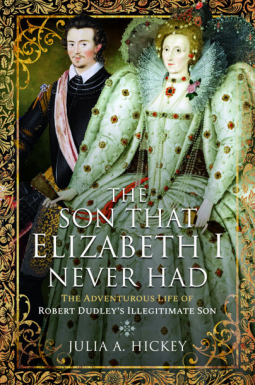
cover260109-mediumWhen we study the life of Queen Elizabeth I, the image of a virgin queen who never married tends to come to mind. Of course, she had a man who she favored above all others, Robert Dudley, but he married several times to Amy Robsart and Lettice Knollys. It was with Lettice Knollys that Robert Dudley was able to produce his heir, aptly named Robert Dudley Lord Denbigh, who unfortunately died at a young age. Robert Dudley was left without a legitimate heir, but he did have another son, albeit an illegitimate son, also named Robert Dudley. Julia A Hickey has decided to examine the life of the illegitimate Robert Dudley in her book, “The Son that Elizabeth I Never Had: The Adventurous Life of Robert Dudley’s Illegitimate Son.”

Thank you, Pen and Sword Books and Net Galley, for sending me a copy of this book. I am always in the mood to learn about someone from the Tudor period I have never heard about before. I did not know that Robert Dudley had an illegitimate son and that he might have been married before he married Lettice Knollys, so I was excited to learn more about this mysterious son.

Hickey begins her biography about this often forgotten Dudley by exploring the origins of the Dudley family and how his father was able to rise from the ashes to become Queen Elizabeth’s favorite. I think she did a decent job explaining Dudley’s history, but Hickey tends to jump around instead of staying in chronological order with specific issues, which is a pet peeve for me. I also felt like this background information went on for a bit too long, but that might have been because I had just recently read a biography about Dudley, so most of the background information was not new to me.

Robert Dudley had fallen in love and allegedly married one of Elizabeth I’s maids of honor, Douglas Sheffield, who was Robert “Robin” Dudley’s mother. Robert Dudley would later marry Lettice Knollys to the ire of Queen Elizabeth I and had a son named Robert Dudley to add to the confusion, known as Lord Denbigh or “the noble imp.” After Robert’s legitimate son, we see the rise of Robin Dudley, as he became an explorer and trader in the silk industry. We also see Robin Dudley dealing with romantic scandals, notably leaving England, his wife Alice Leigh, and their growing family to flee to France with his mistress and future wife, Elizabeth Southwell. Robin and Elizabeth were married even though Robin never divorced Alice, thus committing bigamy and making him an enemy of the Stuarts, especially King James I.

Robin was also allegedly involved in the Essex Rebellion but only stayed in prison for a short time. He tried to gain legitimacy through a court case arguing that his parents were indeed married, but it failed spectacularly. Besides the scandals, Robin was an adventurer and deeply fascinated with navigation; his most notable work, The Secrets of the Sea, was the 1st atlas of the sea ever published. It was interesting to see how Robin’s life transformed as he worked in Italy until the end of his life and how he dealt with living during the reigns of Elizabeth and the early Stuarts in different ways.

I wanted to learn more about the early Stuart kings and the different issues that Hickey included in this book that were unfamiliar to me. Robert “Robin” Dudley lived quite a fascinating life, and I think he would have made his father Robert Dudley proud with his adventures to new lands and the book The Secrets of the Seas. Suppose you are also interested in learning more about Robert Dudley and his illegitimate son. In that case, I recommend reading “The Son that Elizabeth I Never Had: The Adventurous Life of Robert Dudley’s Illegitimate Son” by Julia A. Hickey.

Biography: Sir Walter Raleigh

(Born around 1552- Died October 29, 1618)220px-Sir_Walter_Ralegh_by_'H'_monogrammist
Son of Walter Raleigh and Catherine Champernowne
Married to Elizabeth Throckmorton.
Father of Damerei, Walter (also known as Wat), and Carew Raleigh.
Sir Walter Raleigh was a writer and an adventurer who helped establish a colony near Roanoke Island. He was imprisoned in the Tower of London a few times and was later executed for treason.

Sir Walter Raleigh was born around 1552, although some believe he was born in 1554, to Walter Raleigh and Catherine Champernowne in Devon. He was the youngest of five sons born to the couple. His half-brothers John Gilbert, Humphrey Gilbert, and Adrian Gilbert, and his full brother Carew Raleigh were also prominent during the reigns of Elizabeth I and James I. Catherine Champernowne was a niece of Kat Ashley, Elizabeth’s governess. The Raleigh family were very devout Protestants and they were persecuted during the reign of Mary I, especially Sir Walter Raleigh’s father who had to hide in the Tower of London to avoid execution. From a young age, Raleigh had a deep hatred for Roman Catholicism and was an extremely devout Protestant, even more than Elizabeth I herself.

In 1569, Raleigh went to France to help the Huguenots in the religious wars, at the age of seventeen. In 1572, he attended Oriel College, Oxford, but he left a year later without a degree. He would later attend the Middle Temple law college in 1575, but in his trial in 1603, he would deny that he studied law. It was during this time that Raleigh’s love for poetry is said to have started.

In 1578, Raleigh set out with his half-brother, Sir Humphrey Gilbert on a voyage to North America to find the Northwest Passage. They never reached their destination and the mission degenerated into a privateering foray against Spanish shipping. Raleigh’s actions were not well received by the Privy Council, the monarch’s advisors, and he was briefly imprisoned. Between 1579 and 1583, Raleigh took part in the suppression of the Desmond Rebellions. These rebellions were motivated to maintain the independence of feudal lords from their monarch, but also there was an element of religious antagonism between Catholic Geraldines and the Protestant English state. He was known for his ruthlessness at the siege of Smerwick and establishing English and Scottish Protestants in Munster. One of the people he met while in Munster was the English poet Edmund Spenser.

By 1582 he had become one of Elizabeth’s favourites, and he began to acquire monopolies, properties, and influential positions. In 1583 the queen secured him a lease of part of Durham House in the Strand, London, where he had a monopoly of wine licenses, in 1583, and of the export of broadcloth in 1585. In 1585, Raleigh was knighted and he became warden of the Cornish tin mines, lieutenant of Cornwall, and vice admiral of Devon and Cornwall and frequently sat as a member of Parliament.

In 1584, Queen Elizabeth granted Raleigh a royal charter authorising him to explore, colonise and rule any lands that were not under Christian rule, in return for one-fifth of all the gold and silver that might be mined there. This charter specified that Raleigh had seven years in which to establish a settlement, or else lose his right to do so. Instead, he sent others to found the Roanoke Colony, later known as the “Lost Colony”. In 1588, he did help

In 1591, Raleigh was secretly married to Elizabeth “Bess” Throckmorton. She was one of the Queen’s ladies-in-waiting, 11 years his junior, and was pregnant at the time. She gave birth to a son, believed to be named Damerei, but he died in October 1592 of plague. The following year, the unauthorised marriage was discovered and the Queen ordered Raleigh to be imprisoned and Bess dismissed from court. Both were imprisoned in the Tower of London in June 1592. He was released from prison in August 1592 to manage a recently returned expedition and attack on the Spanish coast. The fleet was recalled by the Queen, but not before it captured an incredibly rich prize off a merchant ship. He was sent back to the Tower, but by early 1593 had been released and become a member of Parliament. It was several years before Raleigh returned to favour, and he travelled extensively in this time. Walter and Elizabeth had two more sons, Walter (known as Wat) and Carew.

Raleigh himself never visited North America, although he led expeditions in 1595 and 1617 to the Orinoco River basin in South America in search of the golden city of El Dorado. In 1596, Raleigh took part in the Capture of Cadiz, where he was wounded. He also served as the rear admiral of the Islands Voyage to the Azores in 1597. On his return from the Azores, Raleigh faced the major threat of the 3rd Spanish Armada during the autumn of 1597.

Raleigh’s aggressive policies toward Spain did not recommend him to the pacific King James I His enemies worked to bring about his ruin, and in 1603 he and others were accused of plotting to dethrone the king and was consigned to the Tower. In 1616 he was released but not pardoned. With the king’s permission, he financed and led a second expedition to Venezuela , promising to open a gold mine without offending Spain. Raleigh’s son Walter died in the action. King James invoked the suspended sentence of 1603, and he remained imprisoned in the Tower until 1616. In 1617, Raleigh was pardoned by the King and granted permission to conduct a second expedition to Venezuela in search of El Dorado. During the expedition, a detachment of Raleigh’s men under the command of his long-time friend Lawrence Keymis attacked the Spanish outpost of Santo Tomé de Guayana on the Orinoco River, in violation of peace treaties with Spain, and against Raleigh’s orders. A condition of Raleigh’s pardon was avoidance of any hostility against Spanish colonies or shipping. On Raleigh’s return to England,Count Gondomar, the Spanish ambassador, demanded that Raleigh’s death sentence be reinstated by King James, who had little choice but to do so. On October 29, 1618, Sir Walter Raleigh was executed.

Sources:
https://en.wikipedia.org/wiki/Walter_Raleigh
http://www.bbc.co.uk/history/historic_figures/raleigh_walter.shtml
https://www.biography.com/people/walter-raleigh-9450901
https://www.britannica.com/biography/Walter-Raleigh-English-explorer